

Role of Entrepreneurship in Economic Development: 10 Key Contributions Explained


Admissions Enquiry
Summary- The role of entrepreneurship in economic development extends beyond starting businesses. Entrepreneurs create jobs, drive innovation, increase GDP and per capita income, attract investment, reduce poverty and promote inclusive regional growth. This guide explains the 10 key contributions of entrepreneurship, how its economic impact is measured and why entrepreneurship education and an MBA can help aspiring founders build sustainable, high-growth ventures.

- Entrepreneurship fuels economic development by creating jobs, driving innovation, increasing GDP and raising per capita income.
- New startups and MSMEs generate employment, attract investment and promote inclusive growth across urban and rural India.
- Entrepreneurs improve productivity, encourage competition and support industrial transformation through innovation.
- Government initiatives like Startup India have accelerated India's startup ecosystem, with 2.23 lakh+ recognised startups and 23.36 lakh direct jobs created by March 2026.
- The economic impact of entrepreneurship is measured through startup registrations, employment, GDP/GVA contribution, investment inflows and innovation indicators.
- Entrepreneurship education equips aspiring founders with business, leadership and strategic skills to build sustainable ventures.
- An MBA in Entrepreneurship provides practical exposure, mentorship and industry connections to help students launch and scale successful businesses.
Why do some graduates go on to build startups, lead innovation or scale family businesses while others remain uncertain about their career direction after college?
The answer increasingly lies in the concept of entrepreneurship. Modern economies are being shaped less by traditional career paths and more by individuals who can identify opportunities, take calculated risks and create value in uncertain environments.
This is where the role of entrepreneurship in economic development becomes more than an academic concept. Entrepreneurs generate employment, introduce innovation and stimulate regional as well as national growth. In India specifically, the numbers make the case on their own. The Department for Promotion of Industry and Internal Trade (DPIIT) recognised more than 55,200 new startups in FY 2025–26 alone, the highest in a single year since the Startup India initiative began, taking the total to over 2.23 lakh recognised startups and 23.36 lakh direct jobs created as of 31 March 2026.
However, there are caveats. Successful entrepreneurship is not about jumping in blindly. To turn ideas into sustainable ventures that actually contribute to economic growth, founders need strong business fundamentals, financial clarity and strategic thinking. This is where structured education in entrepreneurship becomes an advantage rather than an option.
Understanding Entrepreneurship in Economic Context
In simple economic and financial terms, entrepreneurship refers to the process of identifying opportunities, mobilising resources and creating value through new (or improved) products, services or business models.
Entrepreneurs perform a unique economic function by-
- Combining capital, labour and technology efficiently
- Taking calculated risks under uncertainty
- Introducing innovation into markets
- Responding quickly to changing consumer needs
These responsibilities require qualities such as innovation, calculated risk-taking, leadership and adaptability. Explore the key characteristics of entrepreneurship to understand the traits that enable entrepreneurs to identify opportunities and build successful ventures
Quick Glance- How Entrepreneurship Drives Economic Development
| Economic Lever | How Entrepreneurship Contributes |
| Employment | Creates direct and indirect jobs across manufacturing, services and digital sectors |
| Income & GDP | Raises per capita income and contributes to Gross Domestic Product growth |
| Innovation | Introduces new products, technologies and business models |
| Poverty Reduction | Builds sustainable livelihoods and reduces income inequality |
| Capital Formation | Mobilises savings and investment into productive, job-creating ventures |
| Regional Growth | Extends opportunity to tier 2/3 cities, easing metro migration pressure |
| Consumer Welfare | Improves competition, quality, choice and pricing |
| Policy Ecosystem | Benefits from and strengthens government schemes like Startup India |
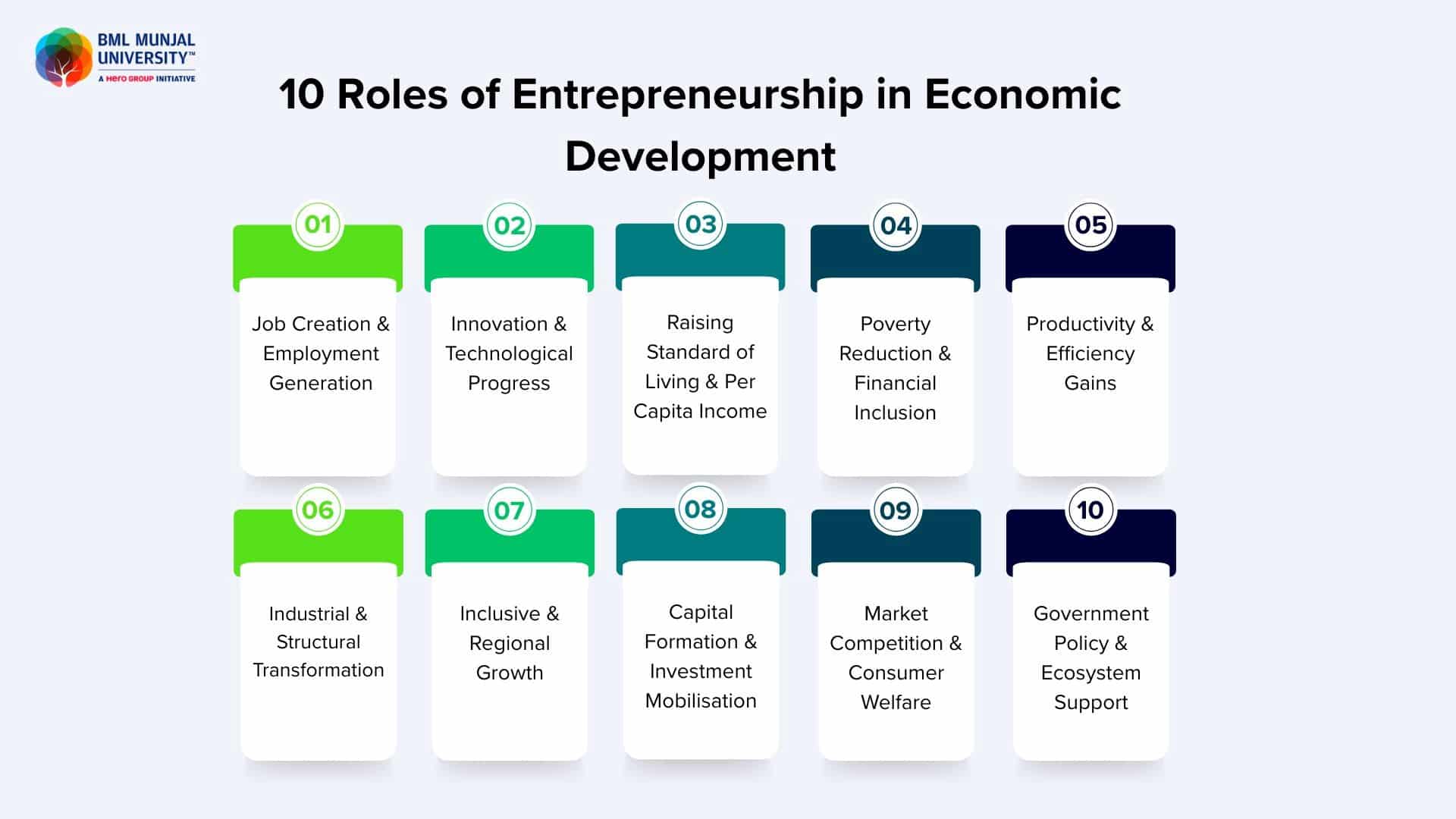
10 Roles of Entrepreneurship in Economic Development
There are several distinct ways entrepreneurship contributes to the economic development of a country. Let's break it down one by one.
1. Job Creation & Employment Generation
Entrepreneurship is one of the largest drivers of employment generation, creating both direct and indirect jobs across manufacturing, services, technology and logistics. Startups absorb skilled and semi-skilled talent while also supporting employment through suppliers, vendors and service networks. In India, 2.23 lakh+ DPIIT-recognised startups have created over 23.36 lakh direct jobs, while the entrepreneur-driven MSME sector employs more than 32.8 crore people, making it the country's second-largest employment generator after agriculture. This reduces unemployment, increases household incomes and stimulates broader economic growth.
2. Innovation & Technological Progress
Entrepreneurs play a central role in introducing innovation into the economy. By developing new products, business models, services and processes, they challenge outdated practices and push industries to evolve. This innovation enhances productivity, improves quality standards and accelerates technology adoption. Economies driven by entrepreneurial innovation remain more competitive, adaptable and resilient to disruption.
3. Raising Standard of Living & Per Capita Income
Entrepreneurship raises living standards by creating jobs, generating wealth and improving access to better products and services. As businesses grow, they increase GDP and per capita income, strengthening household purchasing power. In India, the entrepreneur-driven MSME sector contributes 31.1% of GDP and 48.58% of exports, highlighting its significant role in improving economic well-being.
4. Poverty Reduction & Financial Inclusion
By generating employment and enabling self-employment, entrepreneurship helps lift individuals and communities out of poverty. Small businesses and micro-enterprises give people without access to traditional corporate jobs a path to sustainable income, particularly in semi-urban and rural India, where entrepreneurship-led livelihoods reduce dependency on a single employer or sector.
5. Productivity & Efficiency Gains
Entrepreneurial ventures force existing businesses to improve how they operate. Startups often adopt lean structures, data-driven decision-making and customer-centric approaches, which raise performance benchmarks across industries. As competition rises, firms are compelled to optimise resources, reduce wastage and improve efficiency.
6. Industrial & Structural Transformation
Entrepreneurship supports long-term economic development by enabling structural transformation. As ventures emerge, economies gradually shift from traditional sectors like agriculture toward manufacturing, services and knowledge-based industries. This diversifies income sources, reduces dependence on a single sector and strengthens economic stability, laying the foundation for sustainable growth and global integration.
7. Inclusive & Regional Growth
By enabling local enterprises, self-employment and grassroots innovation, entrepreneurship extends economic opportunities beyond metropolitan centres. Small businesses and startups in tier 2 and tier 3 regions contribute to local employment, improve regional infrastructure utilisation and reduce migration pressures, strengthening economic equity and social stability.
8. Capital Formation & Investment Mobilisation
Entrepreneurs mobilise capital and direct it toward productive activities. Through business creation, they attract private investment, venture capital and institutional funding, converting savings into investment, accelerating capital formation and supporting business expansion and infrastructure development. Increased investment activity strengthens economic momentum and long-term growth capacity.
9. Market Competition & Consumer Welfare
Entrepreneurship increases competition within markets by introducing alternatives to existing products and services. Greater competition encourages better quality, innovation and fair pricing, benefiting consumers directly and, over time, improving living standards, expanding consumer choice and enhancing overall economic efficiency.
10. Government Policy & Ecosystem Support
Entrepreneurship's economic impact is amplified by supportive policy. India's Startup India initiative, like the Fund of Funds for Startups, the Startup India Seed Fund Scheme and tax and compliance simplification, has helped grow the recognised startup base from around 500 in 2016 to over 2.23 lakh by March 2026. Strong policy support reduces regulatory friction, unlocks funding access and accelerates the pace at which entrepreneurship translates into GDP and employment gains.
Together, these factors explain why entrepreneurship and economic growth are deeply interconnected.
How Is Entrepreneurship's Contribution to the Economy Measured?
Economists and policymakers typically track entrepreneurship's economic impact through a combination of indicators-
- New business registrations and DPIIT/MCA startup recognition data
- Direct and indirect employment figures reported by recognised startups
- Contribution to GDP and Gross Value Added (GVA) from the MSME and startup sector
- Venture capital, private equity and FDI inflows into new ventures
- Patent filings and R&D intensity as a proxy for innovation output
- Startup survival and scale-up rates over 3-5 year horizons
These metrics are why national startup data (like DPIIT's) is considered a reliable, citable proxy for entrepreneurship's real economic footprint.
Real-Life Examples of Entrepreneurship Driving Economic Development
| S.No. | Entrepreneur/Company | Economic Contribution |
| 1 | Infosys | Created thousands of high-skilled jobs, boosted India's IT exports and strengthened the global technology sector. |
| 2 | Zerodha | Made stock investing more accessible through low-cost digital trading, increasing financial inclusion. |
| 3 | Amul | Empowered millions of dairy farmers through the cooperative model while strengthening India's rural economy. |
| 4 | Ola | Generated employment for driver-partners and accelerated digital mobility services across India. |
| 5 | boAt | Built a leading consumer electronics brand, promoted local manufacturing and created jobs across the supply chain. |
These examples represent different types of entrepreneurship, from technology startups and cooperatives to digital platforms, each contributing to economic development in unique ways.
Myths and Facts About Entrepreneurship
| Myth | Reality |
| Entrepreneurs are born, not made | Successful founders rely on frameworks, market understanding and execution discipline |
| You can only learn entrepreneurship through failure | Guided learning and application reduce costly trial and error |
| An MBA delays startup plans | It accelerates readiness and improves success probabilities |
| Entrepreneurship only benefits the founder, not the economy | Every new venture contributes to jobs, tax revenue, innovation and regional development |
BML Munjal University: Nurturing the Next Generation of Entrepreneurs
Beyond classroom learning, BML Munjal University has built a structured ecosystem for students who want to translate entrepreneurial ideas into ventures that genuinely contribute to economic development-
- Institute of Innovation and Entrepreneurship (I2E) - drives ideation, mentorship and entrepreneurial skill-building across the university
- ACIC-BMU Incubation Centre - supports students with mentorship, prototyping guidance, legal/technical assistance and investor pitching support
- Industry collaborations and experiential learning built into the MBA curriculum, connecting founders-in-training to real market feedback before they scale
This is what separates studying the theory of entrepreneurship from being equipped to practise it.
How an MBA in Entrepreneurship Supports Economic Development
Formal education in entrepreneurship, delivered through structured management studies, supports economic development by-
- Teaching venture creation, not just business management
- Developing innovation-led and growth-oriented thinking
- Building leadership and decision-making skills under uncertainty
- Encouraging ethical, sustainable and impact-driven ventures
Career Pathways After Studying Entrepreneurship
- Startup founder or co-founder
- Family business expansion and modernisation roles
- Product management, growth and innovation roles
- Incubation, venture analysis and ecosystem roles
- Corporate entrepreneurship and internal venture teams
Build the venture of your dreams by pursuing an MBA in Entrepreneurship at BML Munjal University. Apply now!
To Summarise
For India's youth, the role of entrepreneurship is personal, not theoretical. Entrepreneurs will shape job creation, innovation, GDP growth and regional development over the next few decades. This is already backed by the data, with over 2.23 lakh recognised startups and 23.36 lakh direct jobs created as of March 2026.
However, sustainable impact depends on preparation. Even passionate students with financial stability or access to credit benefit most when they first build skills, frameworks and strategic clarity. An MBA in Entrepreneurship is exactly that multiplier that helps you prepare before you invest, validate before you scale and lead before you risk capital.
FAQs
Entrepreneurship drives economic development by creating jobs, raising per capita income, fostering innovation, improving productivity and enabling structural and inclusive growth.
As entrepreneurial ventures scale, they add to a country’s Gross National Product; this rise in GNP, combined with new employment and income generation, directly increases per capita income across the population.
Yes. Entrepreneurship reduces unemployment by generating new jobs at every stage of business growth and it reduces inequality by extending income opportunities to tier 2/3 regions and communities historically excluded from formal corporate employment.
Government initiatives such as Startup India, the Fund of Funds for Startups, the Startup India Seed Fund Scheme and simplified compliance and tax norms have been central to India’s startup growth, alongside state-level incubation and funding support.
It equips founders with business fundamentals, strategic thinking and practical skills, improving venture sustainability and long-term economic impact.
Yes, with India’s growing startup ecosystem, it helps founders navigate competition, funding, regulation and scaling challenges effectively.
Aspiring startup founders, family business successors, innovation professionals and anyone seeking to build or lead new ventures.
Entrepreneurship drives economic growth by creating new businesses, generating employment, increasing GDP, encouraging innovation and attracting investment. It also improves productivity, strengthens market competition and supports long-term economic development through sustainable business expansion.
Entrepreneurship strengthens local communities by creating jobs, supporting small businesses and increasing local incomes. It promotes regional development, reduces migration to major cities, encourages financial inclusion and improves access to products and services, especially in tier 2, tier 3 and rural areas.
Innovation is important in entrepreneurship because it helps businesses develop new products, improve services and solve real-world problems. It increases productivity, enhances competitiveness, meets changing customer needs and enables entrepreneurs to drive economic growth and long-term business success.
Related Blogs

What Are the Types of Entrepreneurship? 12 Models Explained with Examples
TL;DR There are 12 major types of entrepreneurship- Small Business, Scalable Startup, Social, Digital, Corporate (Intrapreneurship), Franch...
15 Key Characteristics of Entrepreneurship (With Real-life Examples)
Key Takeaways Entrepreneurship is a process and mindset; an entrepreneur is the individual who drives that process. This guide covers 15 key c...

Why an MBA in Entrepreneurship is the Smartest Move for Future Startup Founders
Ever wonder, “Why 9 out of 10 startups fail?” As per the insights, only 1% of startups that become unicorns, such as Uber, Airbnb, Slack, Strip...

No Maths? No Problem. How to Become an Entrepreneur After 12th Commerce
A lot of students are under the impression that commerce without maths scope is extremely limited. However, this is far from true. In India, even if y...

World Entrepreneurs’ Day: Carrying forward a legacy of entrepreneurship
Entrepreneurship is about creating change, not just companies.” – Mark Zuckerberg Millennials and Gen-Z are witnessing a turning point in the w...