
Hierarchy of Courts in India: Understanding How the Judicial System Functions


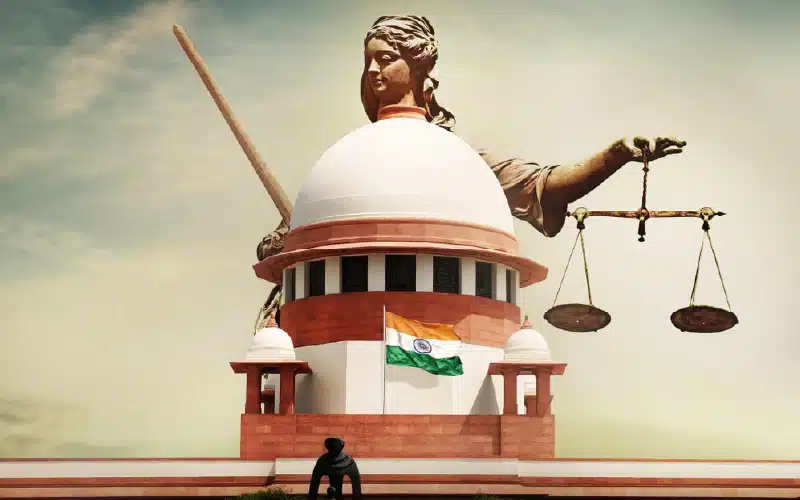
Famously called as antedated and complex, the Indian Judicial System is the backbone of the country’s democratic setup. As one of the biggest judicial systems in the world, it operates on the grounds of justice and equality to ensure that everyone follows the law.
Have you ever wondered about where law and order coexist in one of the biggest democracies on this planet? Well, if you are ready to get yourself involved in the system, then it is important to know the “Structure of the Indian Judicial System”. So, let’s dive in.
Hierarchy of Courts in India
India’s judiciary follows a three-tier hierarchical structure, which ensures justice is administered at various levels.
The Hierarchical Structure
- Supreme Court
- High Courts
- District Courts
1. Supreme Court
As the apex court, the Supreme Court is the highest judicial authority in the nation, handling appeals, constitutional issues and cases of national importance and serving as the final arbiter when it comes to legal disputes.
2. High Courts
Every state or Union Territory has its dedicated High Court, which has jurisdiction over lower courts and tackles appeals from district-level courts. The High Court has both appellate and original jurisdiction, which simply means that the High Court can hear cases directly or as appeals from subordinate courts.
3. District Courts
These courts are at the grassroots level and handle almost all civil and criminal cases. District Courts are further categorised into two- Criminal Court- For handling offences such as thefts, assaults and heinous crimes and Civil Courts- For issues related to property, contracts, etc.
The judiciary also holds the power of judicial review, enabling it to ensure that laws and executive orders comply with the Indian Constitution. This structure assures that citizens have access to justice, regardless of their social or economic status, making the system easily accessible and holistic.
How the Judicial System Functions
India's judicial system works through multiple stages of legal proceedings:
- Filing of Cases
- Trial and Hearing
- Judgment
- Appeals Process
- Enforcement and Judicial Review
Role of Law Courses in the Legal Profession
Considering the intricacy of India’s judicial system and the brimming demand for skilled legal professionals, law course like B.A., LL.B. (Hons.), B.B.A., LL.B. (Hons.) and the 3-Year LLB offers aspiring legal professionals like you all-inclusive pathways to build a successful career in law.
1. B.B.A., LL.B.(Hons.)
This integrated 5-year programme amalgamates business administration in law. B.B.A., LL.B. (Hons.) is curated for you if you are intrigued with corporate law, mergers, acquisitions and business-related legal issues. It entrusts you with in-depth legal expertise along with management skills to have bright careers in
- Corporate Law Firms
- Business Consultancies
- Legal Departments
2. B.A., LL.B. (Hons.)
Another 5-year integrated course, B.A., LL.B. (Hons.), combines arts with law. Here, you will study and master subjects like political science, sociology and history alongside legal studies. This programme is optimal for you if you are keenly interested in constitutional law, human rights or seasonal professionals as legal advocates or judges. It also lays solid foundations for careers in:
- Public Policy
- International Law
- Social Justice
3. 3-Year LLB
This programme is curated for you only if you have already completed an undergraduate degree in any discipline. It emphasises purely legal education and is an ameliorated course to pursue a law career. The 3-year LLB provides flexibility and enables you to specialise in fields like criminal law, corporate law and civil law. It is the best-suited course if you are looking to step into-
- Litigation
- Judicial Services
- Academia
How Law Courses Contribute to the Judicial System?
These Law courses entrust aspirants like you with a profound comprehension of the legal systems and help you contribute to the judicial system in multiple ways:
1. Deep Knowledge of Legal Procedures
By pursuing any of the above-mentioned legal courses, you can gain extensive knowledge of court procedures, judicial precedents as well as legal ethics, which is significant for practising law or working within the judicial system. From comprehending the nuances of case law to mastering litigation strategies, these law courses develop solid legal acumen.
2. Specialisation in Numerous Legal Fields
With a vast array of specialisations, for example, corporate law, criminal law, constitutional law, intellectual property law and more, you can focus on the areas that match your interests and career goals. For instance, if you are interested in constitutional law, you can help shield rights and work towards judicial reforms.
3. Critical Thinking & Problem-Solving
Law courses train to think critically, analyse situations logically and craft legal arguments. These skills are helpful and crucial in helping lawyers represent clients efficaciously, judges in making fair decisions and legal scholars in contributing to policy-making.
4. Preparation for Judicial Exams
On the off, if you choose to pursue any law course, you can also prepare for competitive judicial services exams. Once you succeed, you can become a judge and play a direct role in the administration of justice, making sure judgments are fair, be it a criminal case, a civil dispute or any.
5. Contribution to Social Justice
As a law graduate, you can work as an advocate for social justice, representing vulnerable populations not having access to legal resources. You can get associated with NGOs, (Non-Governmental Organisations), take up public interest litigation or serve in human rights organisations.
To Put It Altogether
Despite challenges, India’s judicial system remains the vital pillar of democracy as well as social order. As the demand for legal experts soars in an increasingly intricate world, renowned universities like BML Munjal University offer courses such as B.B.A., LL.B. (Hons.), B.A., LL.B. (Hons.) and LLB with a mission to equip aspiring legal professionals like you with the skills, knowledge and expertise needed to steer this diverse and vast legal landscape.
By amalgamating academic knowledge with practical experience, these programmes offer pathways to become lawyers, judges, corporate legal advisors and even policymakers, which contribute significantly to the functioning of the judicial system and the broader cause of justice in India. So, if you are all set to make a difference by being different, join BML Munjal University’s law course today!
FAQs
The Indian Judicial System follows a three-tier structure consisting of the Supreme Court, High Courts and District Courts, ensuring justice at national, state and local levels.
Integrated programmes like B.A., LL.B. (Hons.), B.B.A., LL.B. (Hons.) and the 3-Year LL.B. provide in-depth knowledge of legal procedures and the functioning of courts in India.
B.A., LL.B. (Hons.) focuses on humanities and constitutional studies, while B.B.A., LL.B. (Hons.) integrates business and management concepts with law.
Yes. Law graduates can contribute as advocates, judges (after judicial exams), legal advisors, policymakers or through public interest litigation and social justice initiatives.
A law degree develops legal knowledge, analytical thinking, case interpretation skills and an understanding of court procedures, which are essential for clearing judicial services examinations.
Related Blogs
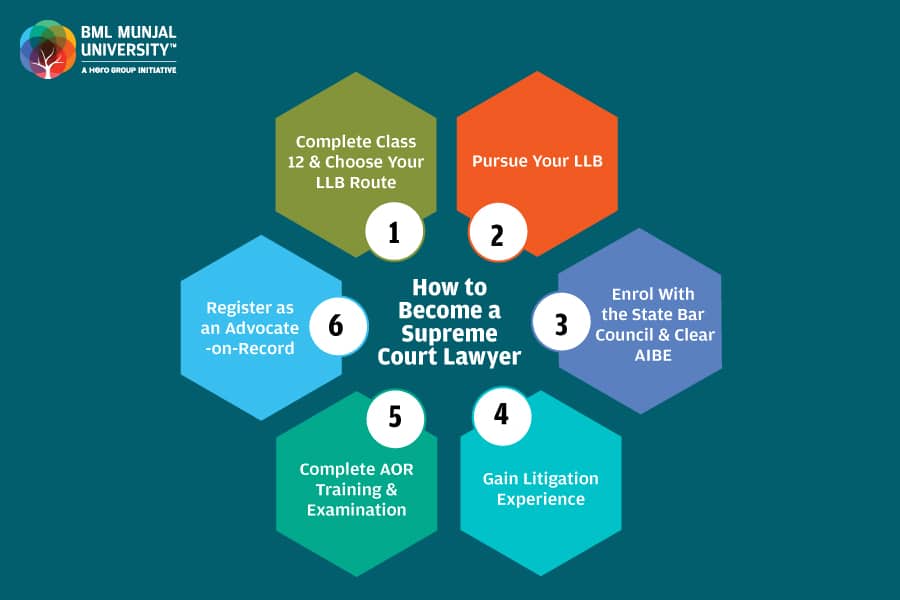
The Road to India’s Highest Court: How to Become a Supreme Court Lawyer
Key Takeaways A recognised LL.B. is the first step toward a career in Supreme Court litigation. After graduation, State Bar Council enrolment ...

How to Become a Judge in India: Eligibility, Salary, & the New 3-Year Practice Rule
A judge's black robe is one of the most respected sights in an Indian courtroom and one of the most misunderstood career paths in law. Every year, lak...

What is Legal Drafting? Types, Skills & Why It’s a Core Skill for Every Law Student in India
A few years ago, a Maine dairy company agreed to pay $5 million to settle a lawsuit that turned on a single missing comma in one sentence of a state l...

Types of Lawyers in India- 20 Law Specialisations, Salaries and Career Scope (2026 Guide)
Today, the law field extends far beyond traditional courtroom practice. Many professionals work with companies, startups, government bodies and intern...

How to Become a Corporate Lawyer in India: Step-by-Step Guide (2026)
Key Takeaways Complete a 5-year integrated BA LLB/BBA LLB after Class 12 or a 3-year LLB after graduation to become a corporate lawyer. Clear ...

LLB vs BA LLB: Which Law Degree Should You Choose?
Why do thousands of students search "LLB vs BA LLB" every admission cycle? The answer lies not just in understanding the difference, but in figuring o...