

Moot Court Competition: Meaning, Types, Top Competitions & How to Prepare


Admissions Enquiry
Summary: A moot court competition is a simulated legal proceeding where law students research legal issues, draft memorials and present arguments before judges. Competitions may be national, international, online or offline and cover areas such as constitutional, corporate and international law. Success depends on strong research, clear arguments, teamwork and oral advocacy. With regular practice and preparation, moot courts help students build legal, analytical, communication and courtroom skills.
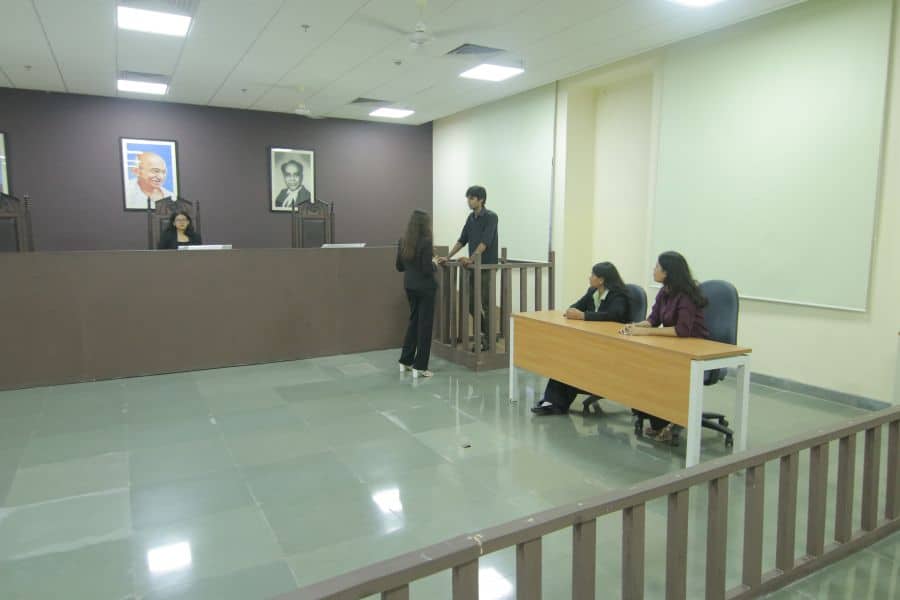
Key Takeaways
- Moot court competitions simulate courtroom proceedings for law students to practise legal research and advocacy.
- Students participate through legal research, memorial drafting and oral arguments.
- Types include national, international, online, offline and intra-college moot courts.
- Popular competitions cover constitutional, corporate, criminal, IP and international law.
- Success depends on legal research, strong arguments, teamwork, time management and oral advocacy.
- Regular practice helps students build confidence and strengthen practical legal skills.
- Moot court experience can improve communication, analytical thinking, employability and career readiness.
What if your classroom turned into a courtroom, your research became your strongest evidence and your arguments could make or break your case? That is the world of a moot court competition- a simulated courtroom experience where law students research legal issues, prepare arguments and present their cases before judges.
But moot courts are not simply about speaking confidently in front of a panel. They are designed to bring the practical side of legal education into the classroom. As per the Hindu, the Bar Council of India (BCI), which regulates legal education and the legal profession in India, has provided for moot court exercises and internships as mandatory components of legal education under the Legal Education Rules, 2008.
For aspiring lawyers, this makes moot court competitions much more than another college activity. They offer a chance to test legal knowledge, sharpen research and argumentation skills, work as a team and experience what it takes to build and defend a legal position under pressure.
So, what exactly is a moot court competition? What are its different types? Which competitions should law students look out for in 2026? And how can you prepare to stand out? Let's break it down.
What is a Moot Court Competition and How Does it Work?
A moot court competition is a simulated legal proceeding in which law students research a hypothetical or unsettled legal issue, prepare written arguments and present oral submissions before a panel of judges. It is designed to replicate key aspects of courtroom advocacy and help students develop practical legal skills.
A typical moot court competition involves three main stages-
- Legal Research- Students analyse the moot proposition, identify legal issues and research relevant case laws, statutes, constitutional provisions and legal journals.
- Memorial Drafting- Teams prepare written submissions, known as memorials, presenting arguments for both sides, usually the petitioner/appellant and respondent.
- Oral Arguments- Students present their arguments before a panel of judges, respond to questions and defend their interpretation of the law under time constraints.
Why Moot Court Competitions Matter More Than Ever
These moot competitions have changed a lot and are now much more dynamic. Let’s look at the reasons why they matter this much now-
- Practical Exposure in a Digital Age
Virtual moots surely have opened global opportunities for students so that they can compete in international competitions and collaborate across borders. - A Test of Adaptability
Modern moots ask for stronger research, tech proficiency and cross-cultural communication skills that are crucial for global legal practice. - Recognition and Visibility
Joining or competing in well-known moot court competitions can help students become more visible in academic and professional settings. - Personal and Professional Maturity
Mooting helps students understand the law; along with that come ethics, empathy, and responsibility after practising it.
In an age where employers look beyond grades, mooting experience stands out as evidence of initiative, discipline and passion for the profession.
Types of Moot Court Competitions in India
Moot court competitions in India are generally categorised along four dimensions-
By Level
- National Moot Court Competitions- Open to law schools across India, typically organised by universities, bar associations or legal trusts.
- International Moot Court Competitions- Open to law schools globally, often simulating proceedings before international courts or tribunals.
By Format
- Offline / In-person Moots- Held on a host campus with live oral rounds before judges.
- Online / Virtual Moots- Conducted over video conferencing, which has significantly widened access to international-level competitions.
By Stage
- Intra-college / Internal Moots- Run within a law school to select students for external competitions.
- Open National or International Moots- External competitions where colleges compete against each other.
By Subject Area
- Constitutional law and criminal law
- Corporate and commercial law
- Intellectual property (IP) law
- International law and arbitration
- Human rights and environmental law
- Taxation and competition (antitrust) law
Which subject area suits a student best often overlaps with where they eventually specialise.
Moot Court Competition Format, Rules and Scoring Explained
The moot court competition format usually includes a moot proposition, legal research, memorial drafting and oral arguments. While specific rules vary by competition, the basic process remains similar.
| Stage | What Happens |
| Moot Proposition | Teams receive a hypothetical legal case and identify the key legal issues. |
| Memorials | Participants research relevant laws and case laws and prepare written arguments for both sides. |
| Oral Rounds | Speakers present their arguments before judges and respond to questions within a fixed time. |
| Advanced Rounds | Top-performing teams progress to rounds such as quarter-finals, semi-finals and finals. |
Moot court competition common rules cover team composition, memorial format and deadlines, oral-round time limits, permitted legal authorities and courtroom etiquette. Rule violations may lead to marks deduction or disqualification, depending on the competition.
On the other hand, moot court scoring generally evaluates the quality of legal research, memorials, legal reasoning, application of law, oral advocacy, responses to judges' questions and time management. However, the exact marking scheme varies by competition.
Upcoming Moot Court Competitions in India 2026
When it comes to the upcoming moot court competitions in India, they include national and international-level events covering constitutional law, corporate law, intellectual property, arbitration, criminal law and other legal disciplines. These competitions allow law students to practise legal research, case analysis, written submissions, oral advocacy and courtroom presentation while competing with teams from other law schools.
Below is a breakdown of the important moot court competitions in India-
Top National Moot Court Competitions in India (2026)
Registration windows and exact 2026 dates vary by competition and are updated annually on each organiser's official page. Below is the list that covers the competitions themselves, which stay consistent year to year.
| Competition | Organised By | Focus Area |
| Bar Council of India Moot Court Competition | Bar Council of India | Constitutional & criminal law |
| Surana & Surana National Corporate Law Moot Court Competition | Surana & Surana International Attorneys | Corporate law |
| NUJS-Herbert Smith Freehills National Corporate Law Moot | National University of Juridical Sciences (NUJS), Kolkata | Corporate & commercial law |
| Nani Palkhivala Memorial National Moot Court Competition | Nani A. Palkhivala Memorial Trust | Constitutional & taxation law |
| KK Luthra Memorial Moot Court Competition | KK Luthra Memorial Trust | Open subject (virtual format) |
| National IP Moot Court Competition | National Law University (NLU), Delhi | Intellectual property law |
| CCI–MNLUCS National Antitrust Moot | Competition Commission of India & MNLU Chhatrapati Sambhajinagar | Competition / antitrust law |
| Manipal Ranka International Moot Court Competition | Manipal University Jaipur | International & constitutional law |
| Lawctopus National Online Moot Court Competition | Lawctopus | Open subject (online format) |
| Mahamana Malaviya National Moot Court Competition | Faculty of Law, Banaras Hindu University (BHU) | Constitutional & civil law |
Top International Moot Court Competitions Law Students Should Know
International moot court competitions give law students an opportunity to compete against teams from different countries while developing expertise in areas such as public international law, commercial arbitration, international criminal law and international trade law. Below are the top international moot court competitions for law students-
| Competition | Organised By | Focus Area |
| Philip C. Jessup International Law Moot Court Competition | International Law Students Association (ILSA) | Public international law - the world's largest moot |
| Willem C. Vis International Commercial Arbitration Moot | Association for the Organisation and Promotion of the Willem C. Vis Moot | International commercial arbitration |
| ICC International Criminal Court Trial Competition | Held at The Hague, Netherlands | International criminal law |
| ELSA Moot Court Competition on WTO Law | European Law Students' Association (ELSA) | International trade law |
Factors That Decide Success in a Moot Court Competition
To perform well in a moot court competition, teams need strong memorials, persuasive oral arguments, sound legal reasoning and effective teamwork. Judges typically assess the following factors-
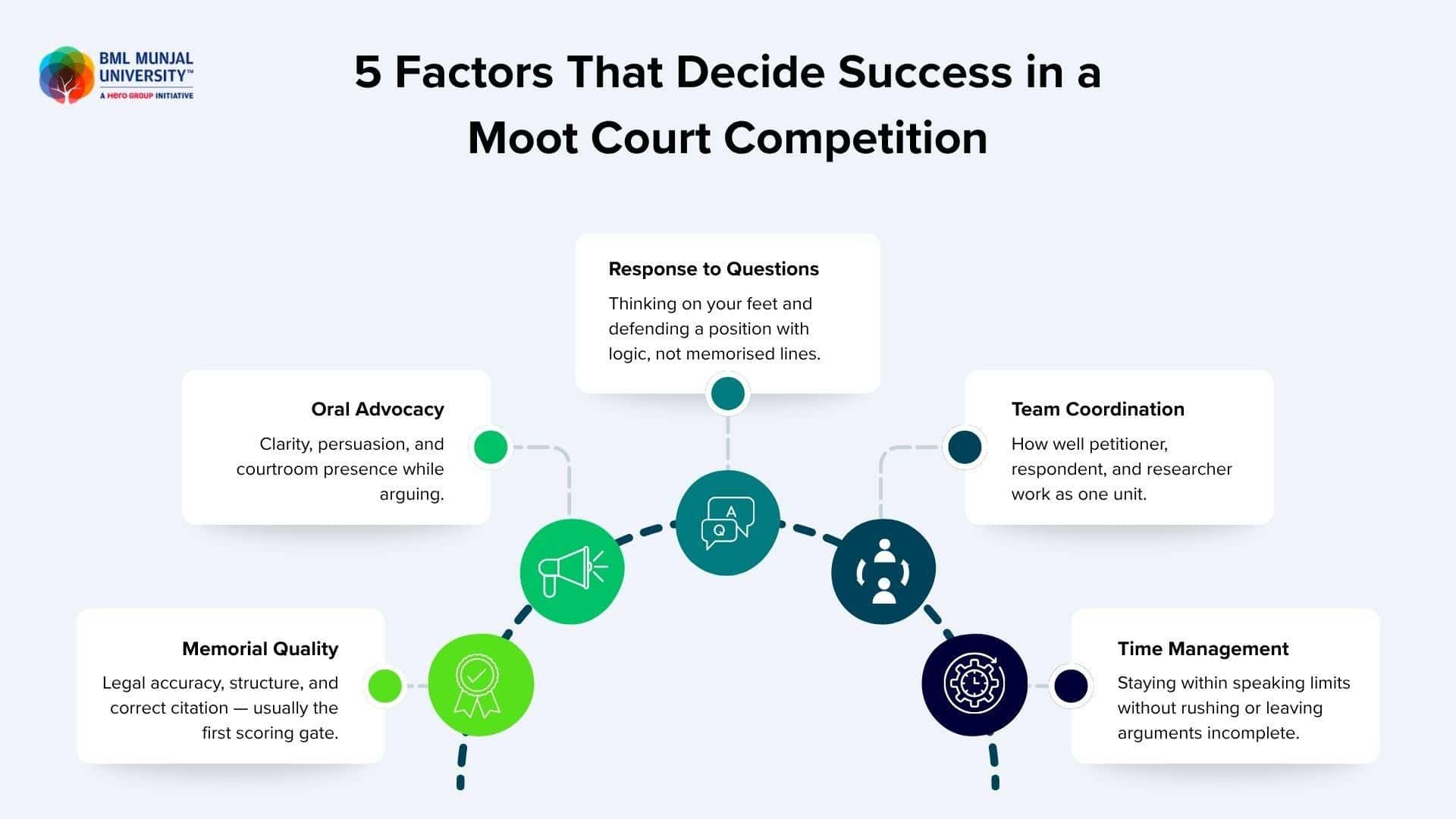
- Memorial Quality- Legal accuracy, structure and correct citation format (usually the first scoring gate before oral rounds even begin).
- Oral Advocacy- Clarity, persuasiveness and courtroom presence during arguments.
- Response to Judges' Questions- The ability to think on your feet and defend a position logically rather than memorised lines.
- Team Coordination- How well the petitioner and respondent speakers, along with the researcher, work as a unit.
- Time Management- Staying within allotted speaking time without rushing or leaving arguments incomplete.
How Do I Prepare for a Moot Court Competition?
To prepare for a moot court competition, start by understanding the moot proposition, conduct focused legal research, draft strong memorials and practise oral arguments. Consistent teamwork and mock rounds can also help you become more confident under questioning.
Here are some practical moot court preparation tips-
- Identify the facts, legal issues and your side- petitioner/appellant or respondent.
- Study relevant case laws, statutes, constitutional provisions and legal journals.
- Build clear arguments, use strong legal authorities and follow the competition's citation rules.
- Rehearse regularly and focus on clarity, pace, confidence and time management.
- Conduct mock rounds and practise giving logical, concise answers to unexpected questions.
- Divide research, drafting and speaking roles early and keep everyone aligned.
From Moot Court Competitions to Real Courtrooms- How This Experience Shapes Careers
The experience gained through a moot court competition often ends up defining a law graduate's professional trajectory.
- Improves Employability- Demonstrates legal research, drafting and advocacy skills to employers.
- Builds Professional Networks- Connects students with lawyers, judges and mentors, creating opportunities for internships.
- Boosts Communication Skills- Builds confidence, clarity and composure while presenting legal arguments.
- Sharpens Analytical Thinking- Teaches students to break down complex legal issues and develop logical arguments.
- Strengthens Your CV- Adds practical legal experience and shows initiative, commitment and courtroom skills.
For students weighing where this experience actually leads, it's worth to know about top career options after law and how to become a corporate lawyer in India.
What Are the Best Moot Court Competition Tips for First-Time Students?
If you are participating in a moot court competition for the first time, focus on understanding the moot problem, researching relevant laws and cases, preparing arguments carefully and practising your oral submissions. These tips can help you approach the competition with greater confidence-
- Read the moot proposition, facts, issues and rules carefully.
- Research relevant laws and cases using reliable legal sources.
- Organise your arguments logically and support them with authorities.
- Practise oral submissions to improve clarity, confidence and timing.
- Anticipate judges’ questions and prepare concise responses.
- Know the facts, authorities, counterarguments and weaknesses of your case.
- Coordinate research, drafting and arguments effectively with your team.
- Follow all formatting, citation, deadline and courtroom requirements.
Step Into the Courtroom of the Future with BML Munjal University
At BML Munjal University, legal education takes you far beyond the regular classroom. Our law programmes are specially designed for students who not just want to study law but also to practise it. Each law programme is backed by moot courts and mock trials to give students the practical experience that links theory with real-world advocacy.
Here’s what makes studying law at BML Munjal University the perfect step toward mastering the courtroom:
- Interdisciplinary Legal Education- BA LLB (Hons), BBA LLB (Hons) and LLB programmes covering corporate law, advocacy and more.
- Expert Faculty & Mentorship- Learn from experienced academics, lawyers and mentors, including former Delhi High Court judge Justice JR Midha.
- Experiential Learning- Gain practical exposure through case studies, simulations and moot court competitions.
- Courtroom & Legal-Aid Training- Build advocacy, legal writing and argumentation skills through structured practice and professional guidance.
At BML Munjal University, mooting is more like an activity that shapes your way of thinking. Students leave with confidence, good courtroom manners and a clear understanding of how to use the law in real situations. Whether you want to be a litigator, corporate lawyer or legal scholar, BMU is the perfect place to start your journey.
Conclusion
A moot court competition is more than an academic exercise; it gives law students an opportunity to experience the practical side of legal education. From researching laws and drafting memorials to presenting arguments and responding to judges, every stage builds valuable skills. Whether you participate in a national moot court competition in India or aim for an international moot court competition, preparation, teamwork and consistent practice can make a difference.
For first-time participants, the experience also builds confidence, improves legal reasoning and strengthens communication. With the right guidance and preparation, moot courts can become an important step towards a successful legal career.
FAQs
No, “moot court” is not an abbreviation, so it doesn’t have a full form. The word “moot” refers to a debatable or arguable legal point and “moot court” simply means a mock court where such points are argued.
The Philip C. Jessup International Law Moot Court Competition is widely regarded as the largest and most prestigious moot court competition in the world, focused on public international law.
The Bar Council of India Moot Court Competition and the Surana & Surana National Corporate Law Moot Court Competition are among the largest and most widely contested national-level competitions in India, drawing participation from law schools across the country.
Moot court competitions are designed for students pursuing a law degree, since they require legal research and courtroom procedure knowledge. But most law schools, including BMU, run beginner-friendly internal moots that don’t require prior mooting experience.
They serve different purposes. Moot court focuses on appellate-style legal argument on questions of law, argued before judges without witnesses. A mock trial simulates a full trial court proceeding, including witness examination and evidence rules. Moot court is more common in Indian legal education; mock trials are more common in trial-advocacy-focused programmes.
Ideally in the early semesters of a law degree. Starting early builds confidence and courtroom experience well before internships or real court exposure.
Moot court sessions combine theory with practice, which helps students develop some courtroom etiquette, along with analytical thinking and persuasive communication skills.
Not really. Some of them focus on constitutional law, others on international or corporate law. This variation allows students to explore specific areas of their interest.
Absolutely. Many universities and law schools organise internal or beginner-level moots to help students learn the basics before competing nationally.
Related Blogs
How to Become a Criminal Lawyer After 12th: A Step-by-Step Guide for 2026
Key Takeaways Choose a 5-year BA LLB or BBA LLB after Class 12. Gain experience through internships, moot courts and legal-aid work. Learn ...
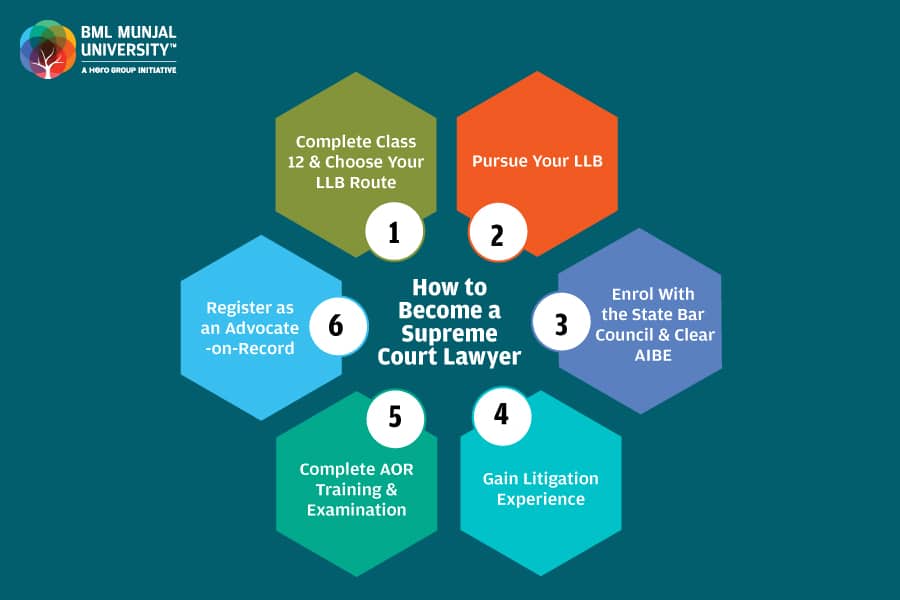
The Road to India’s Highest Court: How to Become a Supreme Court Lawyer
Key Takeaways A recognised LL.B. is the first step toward a career in Supreme Court litigation. After graduation, State Bar Council enrolment ...
How to Become a Judge in India: Eligibility, Salary, & the New 3-Year Practice Rule
A judge's black robe is one of the most respected sights in an Indian courtroom and one of the most misunderstood career paths in law. Every year, lak...

What is Legal Drafting? Types, Skills & Why It’s a Core Skill for Every Law Student in India
A few years ago, a Maine dairy company agreed to pay $5 million to settle a lawsuit that turned on a single missing comma in one sentence of a state l...

Types of Lawyers in India- 20 Law Specialisations, Salaries and Career Scope (2026 Guide)
Today, the law field extends far beyond traditional courtroom practice. Many professionals work with companies, startups, government bodies and intern...

How to Become a Corporate Lawyer in India: Step-by-Step Guide (2026)
Key Takeaways Complete a 5-year integrated BA LLB/BBA LLB after Class 12 or a 3-year LLB after graduation to become a corporate lawyer. Clear ...