

The Road to India’s Highest Court: How to Become a Supreme Court Lawyer


Admissions Enquiry
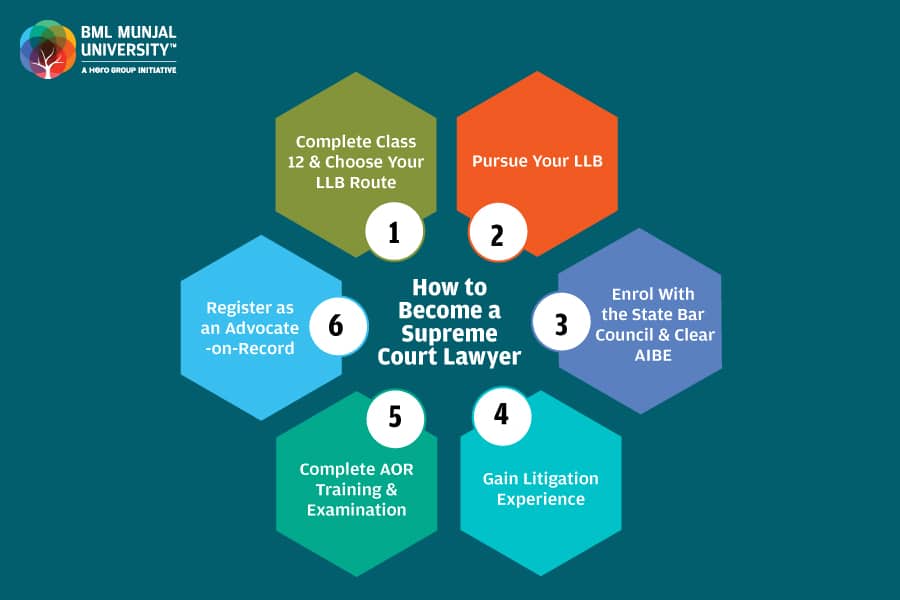
Summary: To become a Supreme Court lawyer in India, you need an LL.B., State Bar Council enrolment, relevant legal practice and strong advocacy skills. Aspiring Advocates-on-Record (AORs) must also meet eligibility requirements, complete one year of prescribed training and clear the AOR Examination.
Key Takeaways
- A recognised LL.B. is the first step toward a career in Supreme Court litigation.
- After graduation, State Bar Council enrolment and AIBE requirements must be completed.
- Build practical experience through litigation, internships, legal research and drafting.
- AOR status requires additional eligibility, prescribed training and the AOR Examination.
- Strong research, drafting, advocacy and case-analysis skills are essential for Supreme Court practice.
- The 2026 AOR Examination has been deferred, with the next cycle expected in 2027.
- A Supreme Court career requires consistent learning, practical exposure and professional growth.
In 2026, becoming an Advocate-on-Record in the Supreme Court of India has become a little more difficult. This is not because the eligibility rules have changed, but because there will be no AOR examination this year.
On April 30, the Supreme Court announced that it would not conduct the Advocate-on-Record (AOR) Examination in 2026, citing the existing strength of AORs. The next examination is likely to be held in 2027. At the time, the Court had 3,791 registered AORs, with another 205 advocates inducted shortly afterwards.
That number is striking when you consider what AOR status represents. An AOR is not simply another title for a Supreme Court advocate; it is a distinct professional status that carries specific rights to act and file matters before the Court.
So, what does it actually take to reach that point?
The journey begins long before the AOR examination with a law degree, professional enrolment, years of legal practice and the gradual development of the skills needed to work at India's highest court.
How Do I Become a Supreme Court Lawyer?
To become a Supreme Court lawyer in India, you need to complete an LL.B., enrol with a State Bar Council, meet the requirements to practise law and gain relevant legal experience. If you want to become an Advocate-on-Record (AOR), you must also complete the prescribed training and clear the AOR examination.
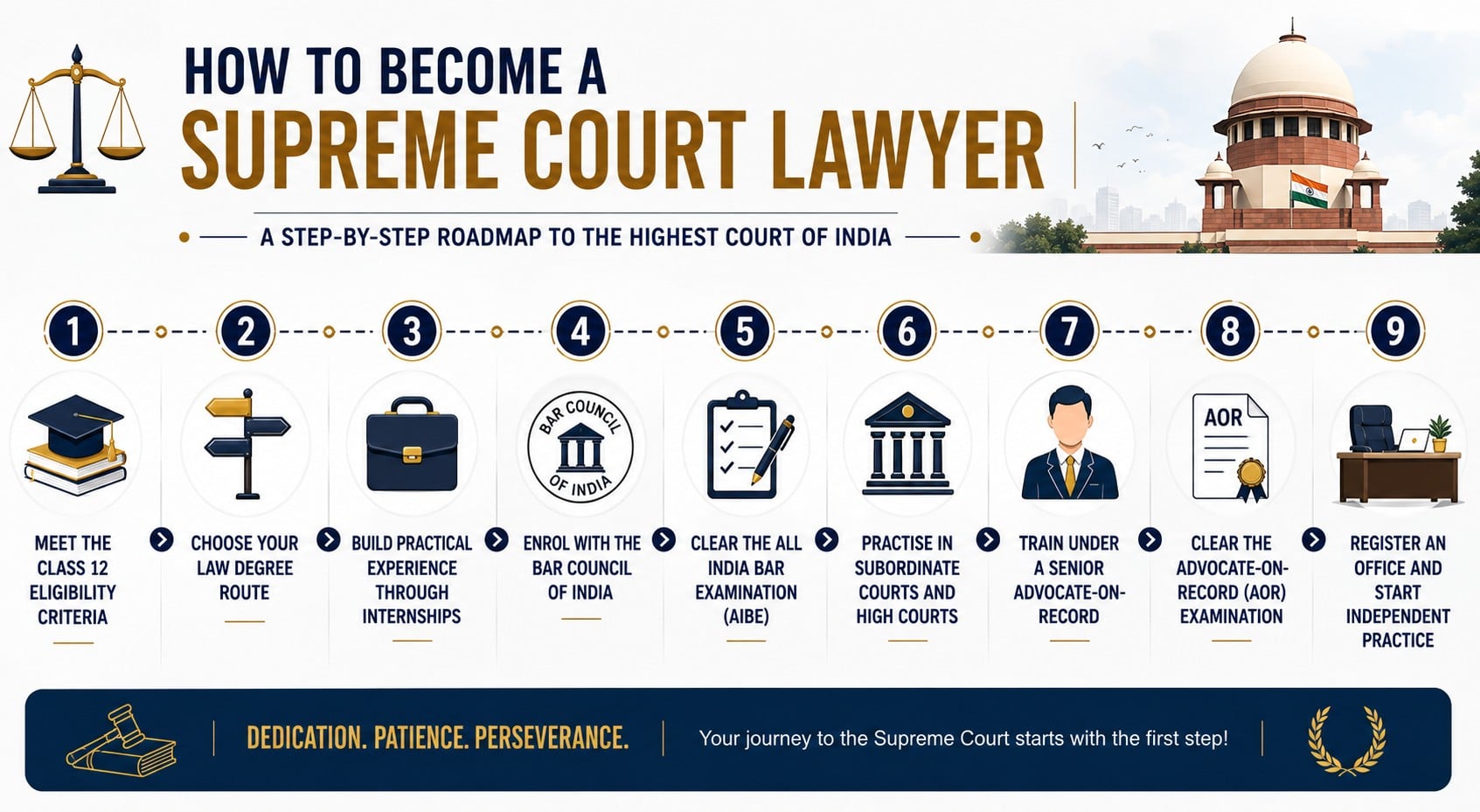
Below are the steps you should follow to become a supreme court lawyer in India-
Step 1: Meet the Class 12 Eligibility Criteria
Students who want to pursue a 5-year integrated LLB after Class 12 must meet the eligibility requirements of their chosen law school and qualify through the admission route that institution prescribes. Depending on the university, admission may be based on a national-level entrance exam such as CLAT or CUET, a university-level test or another approved process; requirements vary by institution and are updated periodically, so always check the current criteria on the law school's own admissions page.
Step 2: Choose Your Law Degree Route
There are two entry points into a legal career in India and the route you choose affects how early you can start building courtroom experience.
| Criteria | 5-Year Integrated LLB | 3-Year LLB |
| Eligibility | After Class 12 | After a bachelor's degree |
| Duration | 5 years | 3 years |
| Admission | Depends on institution (e.g. CLAT, CUET, university-specific tests) | Depends on institution (e.g. DU LLB, other university entrance tests) |
| Best Suited For | Students certain about a law career early on | Graduates transitioning into law with subject-matter background |
| Career Outcome | Legal education leading toward professional enrolment | Legal education leading toward professional enrolment |
Both routes can lead to the same career path. After completing an LL.B. from a BCI-recognised institution, you can enrol as an advocate under the Advocates Act, 1961.
Step 3: Build Practical Experience Through Internships
Internships during law school are where the theoretical foundation starts turning into courtroom-ready skills. Aspiring Supreme Court lawyers typically look for three kinds of exposure during their degree:
- Chambers of senior advocates and litigation-focused law firms - direct exposure to drafting, legal research and case strategy
- Judicial clerkships or research-associate roles - legal research, brief writing and courtroom observation
- Moot court competitions and legal aid cells - argumentation skills and early familiarity with procedural drafting
Step 4: Enrol With the Bar Council of India
Once the law degree is conferred, the next step is registering with a State Bar Council under the Advocates Act, 1961. This enrolment is what turns a law graduate into a provisionally licensed advocate, and it is a mandatory step regardless of which court you eventually plan to practise in.
Step 5: Clear the All India Bar Examination (AIBE)
The Bar Council of India conducts the All India Bar Examination (AIBE) to certify that newly enrolled advocates have the minimum professional knowledge to practise. It is an open-book, objective-type exam covering core and procedural law. Passing it earns the Certificate of Practice (CoP), which entitles an advocate to appear in courts across India. However, appearing before the Supreme Court specifically is also governed by the Court's own procedural rules, including the distinct role of the Advocate-on-Record, covered in the steps below.
Step 6: Practise in Subordinate Courts and High Courts
After enrolment, aspiring Supreme Court lawyers build practical experience through litigation, research and drafting. While district and High Court experience is valuable, it is not mandatory. For AOR eligibility, an advocate must have been on a State Bar Council roll for at least four years before starting the prescribed training.
Step 7: Train Under a Senior Advocate-on-Record
Once an advocate has completed at least four years on a State Bar Council roll, the AOR pathway requires one year of training with an Advocate-on-Record approved by the Supreme Court. The training gives practical exposure to Supreme Court procedure like filing processes, drafting conventions, registry requirements and the professional responsibilities involved in acting before the Court.
Step 8: Clear the Advocate-on-Record (AOR) Examination
The Advocate-on-Record Examination is the final stage of the AOR qualification pathway. Passing it, along with fulfilling the other requirements under the Supreme Court Rules, allows an advocate to register as an Advocate-on-Record and take on the filing and acting responsibilities assigned to an AOR. The official AOR Examination page publishes exam notices, results, previous question papers and study material.
A quick note for 2026: the Supreme Court has paused this year's AOR Examination cycle (see the 2026 update near the top of this guide), so the next sitting is expected in 2027. The syllabus, the four papers below, and the four-year-roll-plus-one-year-training prerequisite are unaffected — only the exam calendar has shifted.
| Paper | Subject | Marks |
| Paper 1 | Practice and Procedure of the Supreme Court | 100 |
| Paper 2 | Drafting | 100 |
| Paper 3 | Professional Ethics and Advocacy | 100 |
| Paper 4 | Leading Cases | 100 |
Exact passing marks, fees and syllabus updates should always be verified on the official AOR examination page and the Supreme Court Rules, 2013, since the Court sets these and can revise them.
Step 9: Register an Office and Start Independent Practice
After completing the AOR examination and fulfilling the remaining requirements under the Supreme Court Rules, an advocate can register as an Advocate-on-Record. The AOR must maintain an office in Delhi within the prescribed distance from the Court and undertake to employ a registered clerk within the specified period.
AOR registration gives the advocate the specific procedural role of filing matters and acting for parties before the Supreme Court under its rules, the point at which the journey that began at Class 12 comes full circle.
Quick Facts on Supreme Court Practice
- A recognised LL.B. and enrolment with a State Bar Council under the Advocates Act, 1961 are the baseline requirements to practise law in India.
- Clearing the All India Bar Examination (AIBE) earns the Certificate of Practice needed to appear in courts, including the Supreme Court.
- Any advocate on a State Bar Council roll can appear and argue before the Supreme Court, subject to the Court's rules.
- Only an Advocate-on-Record (AOR) can file matters and act for a party in the Supreme Court — arguing and filing are separate rights.
- AOR eligibility requires a minimum of four years on a State Bar Council roll before training begins.
- AOR training runs for one year under an Advocate-on-Record approved by the Supreme Court.
- The AOR Examination covers four papers: Practice and Procedure of the Supreme Court, Drafting, Professional Ethics and Advocacy, and Leading Cases.
- The Supreme Court announced on 30 April 2026 that no AOR Examination will be held in 2026; the next cycle is expected in 2027.
- A registered AOR must maintain an office in Delhi and engage a registered clerk, as prescribed under the Supreme Court Rules.
What Is the Difference Between a Regular Lawyer and a Supreme Court Lawyer?
A Supreme Court lawyer is not a separate type of law degree or qualification. The key difference lies in where the advocate practises, the nature of the cases handled and the procedural requirements involved. An advocate enrolled with a State Bar Council can appear and argue before the Supreme Court, subject to its rules. However, an Advocate-on-Record (AOR) has specific rights to file cases and act for parties before the Court.
Here’s a quick comparison of a regular lawyer and a Supreme Court lawyer-
| Aspect | Regular Lawyer | Supreme Court Lawyer |
| Practice | May practise in district courts, tribunals and High Courts, depending on their area of practice. | Regularly handles matters before the Supreme Court, subject to the Court's rules. |
| AOR Status | Does not automatically have AOR status. | May be an Advocate-on-Record (AOR), which provides specific rights to file and act for parties before the Supreme Court. |
| Experience | Experience can vary depending on the lawyer's practice area and court. | Usually has significant experience in litigation, legal research, drafting and advocacy. |
| Types of Cases | May handle matters ranging from civil and criminal disputes to corporate, family or other legal issues. | May handle appeals, constitutional matters and other complex questions of law before the Supreme Court. |
| Procedural Knowledge | Needs to understand the rules and procedures of the courts where they practise. | Requires detailed knowledge of Supreme Court procedures, filing requirements and Court Rules. |
| Professional Standing | Professional reputation depends on expertise, experience and performance. | Standing depends on experience, expertise, advocacy skills and professional reputation—not simply on appearing before the Supreme Court. |
How Much Time Does It Take to Become a Supreme Court Lawyer?
Becoming a Supreme Court lawyer in India is a long-term process that typically takes several years of legal education, professional enrolment and practice. If you also aim to become an Advocate-on-Record (AOR), the journey includes at least four years on the State Bar Council roll, one year of prescribed AOR training and the AOR Examination. The exact timeline can vary by individual.
Here is a general overview of the timeline of becoming a Supreme Court lawyer in India-
| Stage | Typical Duration |
| Law Degree (5-year integrated) or (3-year LLB post-graduation) | 3-5 years |
| Bar Council Enrolment + AIBE | Within 2 years of enrolment |
| Practice as an Enrolled Advocate (litigation, research, drafting) | Minimum 4 years on the State Bar Council roll |
| AOR Training with an Approved Advocate-on-Record | 1 year |
| AOR Examination + Office Registration | Variable - not held every year (paused for 2026; next cycle expected 2027) |
What Skills Are Required to Become a Supreme Court Lawyer?
To become a successful Supreme Court lawyer in India, you need more than a law degree. Strong legal research, drafting, advocacy, case analysis and knowledge of Supreme Court procedure are essential for handling complex cases and presenting clear, well-supported arguments.
- Legal Research: Analyse laws, judgments, precedents and court rules.
- Legal Drafting: Prepare clear petitions, applications and written submissions.
- Oral Advocacy: Present arguments clearly and respond effectively to questions.
- Case Analysis: Identify key legal issues, facts and relevant precedents.
- Supreme Court Procedure: Understand filing processes, limitations and court procedures.
- Legal Knowledge: Build expertise in constitutional and relevant areas of law.
- Professional Ethics: Maintain accuracy, integrity, confidentiality and professionalism.
Start Your Journey Toward the Supreme Court at BML Munjal University
The path to the Supreme Court begins with the law school you choose. The School of Law at BML Munjal University offers 5-year integrated BA LLB (Hons) and BBA LLB (Hons) programmes, accredited by the Bar Council of India, designed to build the foundation this guide describes from day one.
- Admission through CLAT, LSAT-India, CUET or SAT, with BMU-SAT as an additional route
- Curriculum covering constitutional law, corporate law, criminal law and intellectual property law alongside liberal-arts subjects
- Structured moot court participation and internship support to build practical experience
- Mentorship from practising legal scholars to guide students through the early stages of a litigation career
Conclusion
Becoming a Supreme Court lawyer in India is a long-term journey that requires the right legal education, professional enrolment, practical experience and strong advocacy skills. After completing an LL.B. and enrolling with a State Bar Council, aspiring lawyers can build experience through litigation, research and drafting.
Those aiming to become an Advocate-on-Record (AOR) must also fulfil the prescribed eligibility requirements, complete the required training and clear the AOR Examination. While there is no shortcut to Supreme Court practice, consistent learning, practical exposure and strong legal skills can help aspiring lawyers build a rewarding career at India's highest court.
FAQs
Not necessarily. The Supreme Court states that advocates on a State Bar Council roll can appear and argue matters before it, subject to the Court’s rules. However, only Advocates-on-Record can file matters or documents and act for a party in the Supreme Court.
Yes. A 3-year LL.B. is a route into the legal profession for graduates. After the degree, you must complete the applicable enrolment and practice requirements and then build the experience and skills needed for Supreme Court litigation.
Yes. Students can pursue a 5-year integrated LL.B. after Class 12. After graduation, they must complete the applicable professional enrolment and practice requirements and then build experience in litigation.
Supreme Court lawyers do not have a fixed salary. Their earnings depend on factors such as experience, specialisation, reputation, clients, case complexity and whether they work independently or with a law firm.
No, you cannot directly become a Supreme Court lawyer after completing an LL.B. You must enrol with a State Bar Council, meet practice requirements and build relevant legal experience before pursuing Supreme Court practice.
A Supreme Court lawyer generally needs a recognised LL.B. degree and State Bar Council enrolment, along with the applicable requirements to practise. Those pursuing AOR status must also meet additional eligibility, training and examination requirements.
A Supreme Court lawyer can represent clients before India’s highest court and handle significant legal matters. However, professional influence depends on legal expertise, experience, reputation, advocacy skills and the nature of cases handled.
No. An advocate does not necessarily need to be an Advocate-on-Record to argue before the Supreme Court. However, AORs have specific rights to file matters and act for parties under the Court’s rules.
After Class 12, you can pursue a 5-year integrated LL.B., such as BA LL.B. or BBA LL.B. After graduation, enrol with a State Bar Council, meet the practice requirements and gain experience in litigation before moving towards Supreme Court practice.
Related Blogs

How to Become a Criminal Lawyer After 12th: A Step-by-Step Guide for 2026
Key Takeaways Choose a 5-year BA LLB or BBA LLB after Class 12. Gain experience through internships, moot courts and legal-aid work. Learn ...
How to Become a Judge in India: Eligibility, Salary, & the New 3-Year Practice Rule
A judge's black robe is one of the most respected sights in an Indian courtroom and one of the most misunderstood career paths in law. Every year, lak...

What is Legal Drafting? Types, Skills & Why It’s a Core Skill for Every Law Student in India
A few years ago, a Maine dairy company agreed to pay $5 million to settle a lawsuit that turned on a single missing comma in one sentence of a state l...

Types of Lawyers in India- 20 Law Specialisations, Salaries and Career Scope (2026 Guide)
Today, the law field extends far beyond traditional courtroom practice. Many professionals work with companies, startups, government bodies and intern...

How to Become a Corporate Lawyer in India: Step-by-Step Guide (2026)
Key Takeaways Complete a 5-year integrated BA LLB/BBA LLB after Class 12 or a 3-year LLB after graduation to become a corporate lawyer. Clear ...

LLB vs BA LLB: Which Law Degree Should You Choose?
Why do thousands of students search "LLB vs BA LLB" every admission cycle? The answer lies not just in understanding the difference, but in figuring o...