

What is Legal Drafting? Types, Skills & Why It’s a Core Skill for Every Law Student in India


Admissions Enquiry
Summary: Legal drafting is the process of preparing precise, legally binding documents (contracts, wills, deeds, petitions and notices) in language that clearly states the rights, obligations and intentions of the parties involved. Unlike general writing, it follows strict conventions of structure, clarity and enforceability, so the document holds up in court or in a commercial dispute.
A few years ago, a Maine dairy company agreed to pay $5 million to settle a lawsuit that turned on a single missing comma in one sentence of a state law. That is the kind of weight a single word or punctuation mark can carry once it's written into a legally binding document.
This is exactly what legal drafting exists to prevent.
Legal drafting is the process of preparing precise, legally binding documents, contracts, wills, deeds, petitions and notices, in language that clearly states the rights, obligations and intentions of every party involved. Unlike general writing, it follows strict conventions of structure, clarity and enforceability, so the document actually holds up in court or in a commercial dispute.
Whether you are a law student about to draft your first moot memorial or you are still deciding on a law programme and want to understand what this skill actually involves, here's a complete, detailed breakdown.
What is Legal Drafting?
Legal drafting is the technical skill of converting legal rights, intentions and obligations into a written instrument that is unambiguous and enforceable under law. It transforms complex legal concepts, facts and statutory requirements into structured documents that define the rights and obligations of parties in a transaction, dispute or legal proceeding.
In simple terms, every time a lawyer prepares a contract, files a petition or writes a notice, that is legal drafting. The quality of that document can determine whether a client wins or loses, whether a business deal holds or collapses.
Documents commonly produced via legal drafting include-
- Contracts and Agreements
- Wills and Trusts
- Sale Deeds and Lease Deeds
- Memoranda of Understanding (MoUs)
- Court Pleadings and Petitions
- Notices and Affidavits
Career Scope of Legal Drafting in India
Legal drafting is a booming career in India, branching into Litigation, Corporate/Transactional, Legislative and Policy drafting. Driven by complex regulations, cross-border transactions and rapid business expansion, specialised drafting commands strong premiums in law firms, corporations and Legal Process Outsourcing (LPO) firms.
Key career paths and opportunities in India include:
- Corporate & Commercial Contracts Drafting: It involves creating complex agreements such as Mergers & Acquisitions (M&A) contracts, Shareholder Agreements, NDAs and Intellectual Property (IP) licensing. Professionals can work with major law firms or as in-house counsel.
- Policy Drafting: It involves assisting government bodies, ministries and policy think-tanks (like NITI Aayog) in framing Bills, Acts, Rules and organisational regulations.
- Legal Process Outsourcing (LPO): Global firms, such as PWC or specialised global LPOs, hire Indian legal professionals for high-volume contract abstraction, vetting and compliance.
- Freelancing & Legal Tech: The rise of legal tech and freelance platforms allows experienced drafters to consult globally and work on flexible, project-based contracts.
Legal Drafting vs Legal Writing vs Legal Documentation- Key Differences
Learners often use these three terms interchangeably, but they describe distinct things in legal practice.
| Term | What It Covers | Example |
| Legal Drafting | Preparing an original, legally binding instrument that creates or defines rights and obligations. | ● Lease deed
● Employment contract ● Non-disclosure agreement (NDA) ● Legal notice |
| Legal Writing | The broader skill of legal communication, including persuasive or analytical writing, that doesn’t necessarily create a binding document. | ● Case brief
● Legal memorandum ● Client opinion ● Research paper |
| Legal Documentation | The administrative process of compiling, verifying and maintaining legal paperwork and records. | ● Due diligence files
● Compliance records ● Case files ● Transaction records |
Why is Legal Drafting Important?
Below are the three major reasons that define why legal drafting is significant-
- Creates Legal Certainty- a clearly drafted clause leaves little room for two parties to read the same sentence differently.
- Protects Rights- properly worded contracts and notices establish exactly what each party is entitled to and what they owe.
- Prevents Disputes- courts generally apply the principle that an ambiguous clause is read against the party who drafted it, which is exactly why precision protects the drafter’s own client.
It also carries real professional weight- according to Thomson Reuters research, lawyers spend between 40% and 60% of their working time drafting documents and reviewing contracts.
How Many Types of Legal Drafting are There?
Legal drafting is not a single activity, as it spans several distinct practice areas. Understanding these types helps you identify your area of interest and where to sharpen your focus.
| Type of Legal Drafting | Purpose | Common Documents | Core Skill Required |
| Transactional Drafting | Formalises business and personal transactions through legally enforceable agreements. | Sale agreements, partnership deeds, franchise agreements, shareholders' agreements, employment contracts, NDAs, licensing agreements, joint venture agreements | Risk identification and clause precision to address breach, liability, termination and dispute resolution. |
| Litigation Drafting | Prepares documents used in civil and criminal court proceedings. | Plaints, written statements, affidavits, legal notices, criminal complaints, bail applications, writ petitions | Accuracy and strategic framing of facts, causes of action and legal arguments. |
| Legislative Drafting | Creates laws and subordinate legislation for governance and public administration. | Bills, Acts, Rules, Regulations, Notifications, Constitutional Amendments | Constitutional validity, policy consistency and precision to avoid ambiguity and future disputes. |
| Conveyancing | Facilitates the transfer, creation or modification of property rights. | Sale deeds, mortgage deeds, gift deeds, lease agreements, power of attorney, partition deeds | Property law expertise, title verification and compliance with registration and stamp duty requirements. |
| Policy and Compliance Drafting | Establishes internal governance standards and regulatory compliance frameworks. | HR policies, POSH policies, anti-bribery policies, whistleblower policies, ESG frameworks | Regulatory alignment and the ability to translate legal requirements into practical policies. |
| Research-Based Drafting | Provides legal analysis, advice and risk assessments for clients and organisations. | Legal opinions, due diligence reports, advisory memos, regulatory impact assessments | Advanced legal research and analytical writing to deliver actionable recommendations. |
Format of a Legal Document
While the exact structure varies by document type, most legal instruments follow a consistent backbone. Here is a general breakdown of legal document format-
- Title- Names the document and its purpose (e.g., “Lease Deed,” “Employment Agreement”).
- Preamble/Recitals- Background context: who the parties are and why the document exists.
- Parties Clause- Full legal names, addresses and capacities of everyone bound by the document.
- Definitions- Fixes the meaning of key terms used repeatedly throughout the document.
- Operative Clauses- The core rights, duties, terms and conditions mean the working body of the document.
- Representations & Warranties- Statements each party confirms are true at the time of signing.
- Term & Termination- How long the agreement remains valid and how it can end.
- Governing Law & Dispute Resolution- Which law applies and how disagreements will be resolved- courts, arbitration or mediation.
- Signatures & Execution- Where parties sign, with date and witnesses if required.
- Annexures & Schedules- Supporting documents, price lists or technical details attached separately.
What are the Steps to Draft a Clear and Enforceable Legal Document?
Effective legal drafting follows a structured process that moves from understanding the legal issue to reviewing the final document. Below are the general steps you can follow-
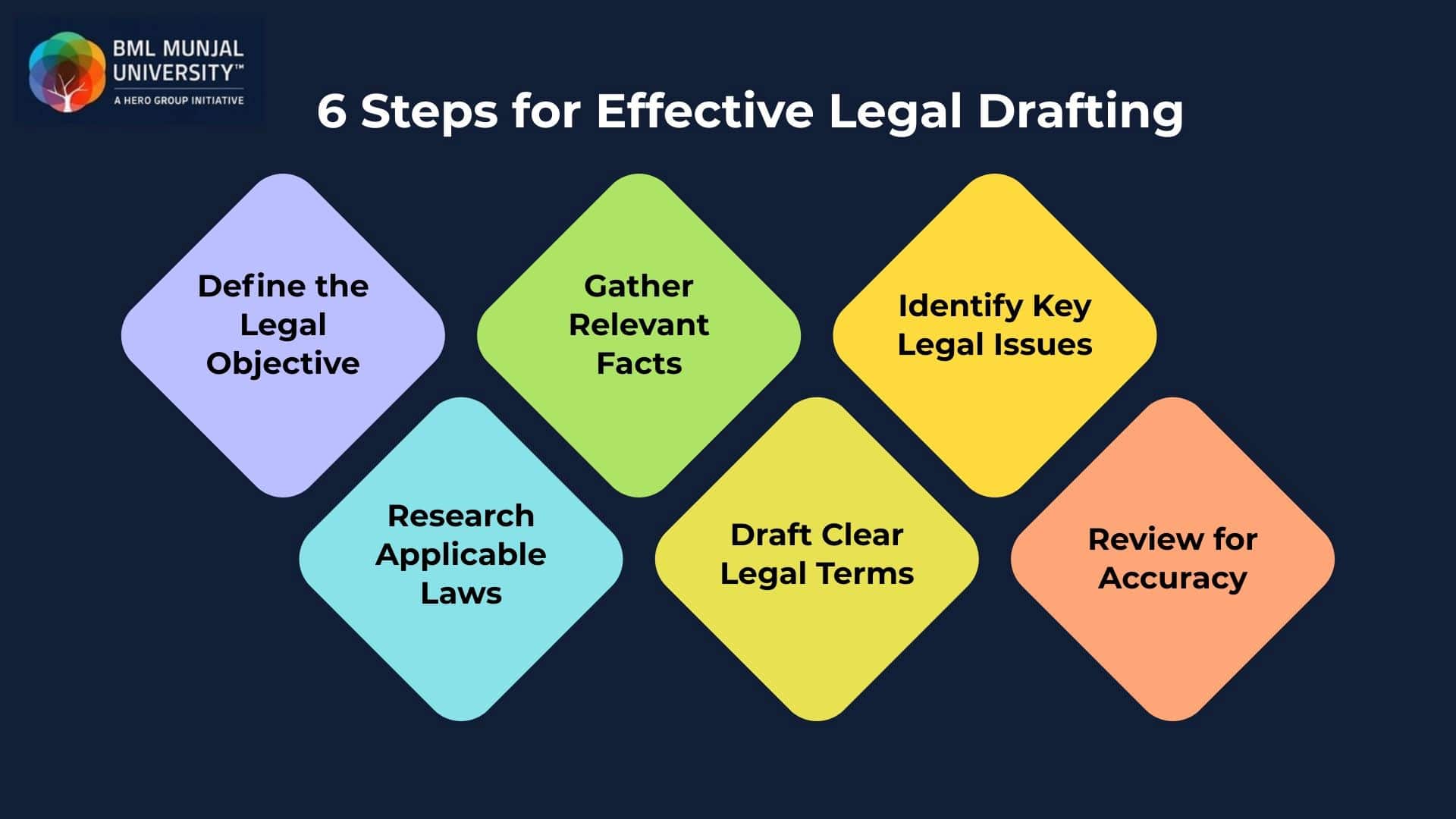
- Understand the purpose- Identify what the document needs to achieve and who will use it.
- Gather relevant facts- Collect accurate information about the parties, events, obligations and timelines involved.
- Research the applicable law- Check relevant statutes, rules, regulations and legal precedents.
- Plan the structure- Organise the document into logical sections, clauses and sub-clauses.
- Draft in clear language- Use precise wording and define important terms consistently.
- Review legal and factual accuracy- Verify names, dates, references, obligations and legal provisions.
- Edit and proofread- Remove ambiguity, repetition, inconsistencies and grammatical errors before finalising the document.
Following these steps can make a legal document clearer, more consistent and easier to interpret.
The Do’s and Don’ts of Legal Drafting
A strong legal draft should be precise without becoming unnecessarily complicated. Here are some basic principles to follow-
Do’s
- Use clear and precise language.
- Keep defined terms consistent.
- Organise clauses logically.
- Check facts, dates and cross-references.
- Review the applicable law.
- Proofread the final draft carefully.
Don’ts
- Do not use unnecessary legal jargon.
- Do not use different terms for the same person or concept.
- Do not create overly long or confusing sentences.
- Do not leave vague or contradictory provisions.
- Do not rely on outdated legal provisions or templates.
- Do not ignore formatting, spelling or punctuation errors.
What a Drafted Clause Actually Looks Like
Most explainers describe the format of a legal document only in the abstract. Here is a short, simplified definitions clause to show what that structure actually looks like on the page (for illustration only, not a ready-to-use template)-
| For the purposes of this Agreement, the following terms shall have the meanings set out below-
Confidential Information’ means any information disclosed by either Party, whether orally or in writing, that is designated as confidential or that a reasonable person would understand to be confidential, including, without limitation, business plans, pricing details and client records. ‘Effective Date’ means the date on which both Parties have executed this Agreement. |
- Defined Terms- Consistent use of defined terms ensures uniform meaning throughout the document.
- Non-Exhaustive Lists- "Including, without limitation" allows for an open-ended definition, preventing narrow interpretations.
- Objective Standard- “A reasonable person would understand to be confidential” provides clarity and eases dispute resolution.
- Modern Language- Avoiding "shall" in favour of the present tense ("means," "must") aligns with contemporary drafting practices and reduces interpretation issues.
What Skills Do You Need For Legal Drafting?
Below is the curated list of core skills that you should develop for legal drafting-
- Clarity and Precision- avoiding vague language so intent is unmistakable.
- Legal Research- staying current on relevant statutes, regulations and precedents.
- Attention to Detail- checking every clause, cross-reference and punctuation mark.
- Analytical and Issue-Spotting Ability- anticipating how a clause could be misread or misused.
- Strong Writing Fundamentals- combining technical accuracy with readability.
- Cross-Referencing and Consistency- catching where a defined term or clause number no longer matches after edits.
- Comfort with Drafting Technology- clause libraries, redlining tools and AI-assisted drafting software are now standard in most law firms and in-house teams.
How to Improve Legal Drafting Skills
Legal drafting improves through regular practice, careful reading and constructive feedback. Here are a few practical ways to strengthen your legal drafting skills-
- Read contracts, petitions, judgments and agreements to understand how well-drafted legal documents are structured.
- Practise drafting different types of legal documents using hypothetical cases and real-world legal situations.
- Write with the intended reader in mind and make the document easy for clients, lawyers, courts or organisations to understand.
- Use clear and straightforward language instead of unnecessary legal jargon or complex expressions.
- Strengthen your legal research skills to ensure every draft is based on relevant laws, regulations and legal principles.
- Seek feedback from professors, mentors or legal professionals to identify mistakes and improve your drafting approach.
- Review every clause carefully to remove ambiguity, inconsistencies, repetition and unnecessary wording.
For law students, activities such as moot courts, internships, legal aid clinics and drafting exercises can provide valuable opportunities to develop these skills in practical contexts.
Common Challenges in Legal Drafting
Legal drafting requires precision, consistency and a strong understanding of the law. Even experienced legal professionals face challenges that can affect the clarity, enforceability and effectiveness of legal documents.
- Time Constraints- Legal professionals often work under tight deadlines while ensuring accuracy and completeness.
- Ambiguity in Language- Unclear wording can lead to disputes and unintended legal interpretations.
- Version Management- Tracking multiple revisions and ensuring the correct final version can be difficult.
- Evolving Legal Requirements- Drafters must continuously update documents to reflect new laws and regulatory changes.
Role of AI in Legal Drafting
Artificial intelligence is reshaping how legal professionals approach drafting. Also, AI-assisted tools are increasingly used to generate first drafts, retrieve precedent clauses and flag inconsistencies across long contracts, which is changing how junior lawyers spend their time.
But what AI cannot replace-
- Judgment on whether a clause is fair and commercially reasonable in the specific context
- Knowledge of state-specific stamp duty and registration requirements
- Client counselling and understanding of the underlying business objective
- Courtroom judgment in litigation drafting
This is now a primary reason why “AI and Law” has started appearing as a dedicated subject in newer law school curricula rather than being treated as a side topic.
How Can I Learn Legal Drafting?
If you are evaluating where to build this skill from the ground up, BML Munjal University’s School of Law offers BA LLB (Hons), BBA LLB (Hons) and a 3-year LLB, all approved by the Bar Council of India. Here, drafting isn’t taught only in the classroom. But students learn it via moot courts and mock trials, student-run legal aid clinics and a dedicated Practice School. This will give students recurring, supervised practice at writing documents that actually hold up to scrutiny.
The exclusive mentor-mentee programme connects students directly with senior legal practitioners, including Justice J. R. Midha, former Judge of the Delhi High Court. Also, industry-ready electives like AI and Law and Mergers & Acquisitions, backed by the Centre on Law, Regulation and Technology (CLRT), keep the curriculum aligned with where legal practice is actually heading.
Conclusion
Legal drafting is far more than writing legal documents. It is the skill of translating rights, obligations and intentions into clear, enforceable language. From contracts and court pleadings to policies and legislation, effective drafting plays a crucial role in every area of legal practice. For aspiring lawyers, developing strong drafting skills early can enhance analytical thinking, improve legal communication and create a solid foundation for a successful legal career. As the legal profession continues to evolve with technology and changing regulations, legal drafting remains one of the most valuable and future-ready skills a law student can possess.
FAQs
Legal drafting involves creating legally binding documents such as contracts, deeds and petitions. Legal writing focuses on explaining, analysing or arguing legal issues through documents like memos, briefs and legal opinions.
Yes. Legal drafting is a highly valued skill in India and is essential for careers in corporate law, litigation, compliance and legal consulting. Professionals with strong drafting skills are often sought after by law firms, corporations and government organisations.
Yes, you can learn the basics of legal drafting through courses and practice. However, drafting legally enforceable documents effectively requires a strong understanding of laws, legal procedures and judicial principles, which is typically gained through formal legal education.
AI is helping legal professionals draft standard documents faster, review contracts and identify potential risks. However, human expertise remains essential for legal interpretation, strategic decision-making and ensuring compliance with applicable laws.
Common examples of legal drafting include contracts, agreements, legal notices, affidavits, petitions, wills, sale deeds, lease deeds, NDAs and powers of attorney.
Law students can improve legal drafting skills by reading legal documents, practising different types of drafts, strengthening legal research skills, participating in moot courts and internships, and seeking regular feedback from faculty members and legal professionals.
A good legal draft is legally accurate, clear, concise and logically structured. It uses consistent terminology, addresses relevant legal issues and minimises the possibility of conflicting interpretations.
Legal drafters should avoid vague language, unnecessary jargon, inconsistent terminology, excessive repetition, long and confusing sentences, incorrect cross-references and outdated legal provisions.
Legal drafting can be challenging initially because it requires knowledge of law, language and document structure. However, regular practice, exposure to different legal documents and feedback can help students gradually develop strong drafting skills.
AI can assist with first drafts, document review, clause comparison and consistency checks. However, legal professionals must still verify the document for accuracy, context, applicable law and the specific needs of the parties involved.
Proofreading helps identify errors in names, dates, clause numbers, cross-references, terminology, grammar and punctuation. Even a small drafting error can affect how a legal provision is understood or applied.
Related Blogs
The Road to India’s Highest Court: How to Become a Supreme Court Lawyer
Key Takeaways A recognised LL.B. is the first step toward a career in Supreme Court litigation. After graduation, State Bar Council enrolment ...

How to Become a Judge in India: Eligibility, Salary, & the New 3-Year Practice Rule
A judge's black robe is one of the most respected sights in an Indian courtroom and one of the most misunderstood career paths in law. Every year, lak...

Types of Lawyers in India- 20 Law Specialisations, Salaries and Career Scope (2026 Guide)
Today, the law field extends far beyond traditional courtroom practice. Many professionals work with companies, startups, government bodies and intern...

How to Become a Corporate Lawyer in India: Step-by-Step Guide (2026)
Key Takeaways Complete a 5-year integrated BA LLB/BBA LLB after Class 12 or a 3-year LLB after graduation to become a corporate lawyer. Clear ...

LLB vs BA LLB: Which Law Degree Should You Choose?
Why do thousands of students search "LLB vs BA LLB" every admission cycle? The answer lies not just in understanding the difference, but in figuring o...

Top Career Options After Law in India: Best Jobs & Career Paths After LLB
[In Summary: Explore career options after law in India, including traditional, corporate, government and future-ready roles, salary insights, top recr...