
MBA Specialisations List 2026: Exploring the Best Traditional and Emerging Options


Admissions Enquiry
Summary: An MBA specialisation is the business discipline, such as finance, marketing or business analytics, that you focus on during your MBA, usually from the second year onward. It shapes the electives you study, the projects you build and the roles recruiters consider you for after graduation. This guide covers the complete MBA specialisations list for 2026, from established tracks to emerging ones, along with fees, salary ranges and a framework for choosing the right fit.

Key Takeaways
- MBA specialisations fall into two broad groups: traditional tracks such as Finance, Marketing, HR and Operations and emerging tracks such as AI & Machine Learning, FinTech and Sustainability.
- A general MBA keeps your options open across industries; a specialised MBA builds deeper expertise in one domain.
- Dual specialisation MBAs let you combine two tracks, such as Finance and Analytics, for a broader skill set.
- Specialised MBA fees in India typically range between Rs. 4 lakh and Rs. 20 lakh, with average salaries between Rs. 6 lakh and Rs. 25 lakh per annum depending on the track.
- GMAC's 2026 Corporate Recruiters Survey found employers increasingly value AI tool proficiency alongside core business skills, a shift reshaping which specialisations are in demand.
- BML Munjal University offers seven MBA specialisations built around portfolio-based, industry-linked learning.
India's MBA education market was valued at USD 9.87 billion in 2024 and is projected to reach USD 19.13 billion by 2033, growing at a CAGR of 7.63%. That growth is being matched by a shift in what employers actually want:
GMAC's 2026 Corporate Recruiters Survey found that while communication and problem-solving remain the most valued skills today, AI tool proficiency is the capability employers expect to matter most within five years.
Amidst all this, choosing the right MBA specialisation is less about picking the highest-paying option and more about aligning your strengths with where hiring is actually headed. This guide walks you through the complete MBA specialisations list for 2026, how each one differs and how to pick the one that fits your goals.
What is an MBA Specialisation?
An MBA specialisation lets you focus on one area of business management in depth. While a general MBA builds a broad foundation across functions, a specialisation takes one of those functions further, through dedicated electives, projects and often a capstone in that domain.
Choosing a specialisation equips you with advanced, industry-relevant skills that help you stand out among MBA graduates. It is, in effect, the path that defines your professional direction after graduation. That said, the split between which specialisations are considered essential and which are considered emerging has shifted meaningfully in the last two years, largely driven by AI adoption and ESG mandates entering mainstream hiring criteria.
Why Should You Choose an MBA Specialisation?
A specialisation changes what an MBA does for your career. Here is why it is worth choosing one over a purely general track:
- It signals role-specific capability, not just a management credential, which is increasingly what recruiters filter for.
- It sharpens your electives, capstone projects and internships around one function, giving recruiters a direct line to a job description.
- It improves your odds in niche, often higher-paying roles, such as business analytics or FinTech, where employers explicitly look for relevant coursework.
- It builds a network within one industry vertical, connecting you to alumni, faculty and recruiters focused on that domain.
- It gives you a clear, consistent career narrative for interviews, instead of a broad story that recruiters have to piece together themselves.
- It can hedge against automation risk: specialisations tied to AI, ESG and data are seeing outsized hiring growth compared with generalist roles.
Top MBA Specialisations List: Traditional and Core Tracks
These are the different types of MBA specialisation most Indian B-schools have offered for years and they remain in consistent demand because nearly every organisation, regardless of sector, needs people in these functions.
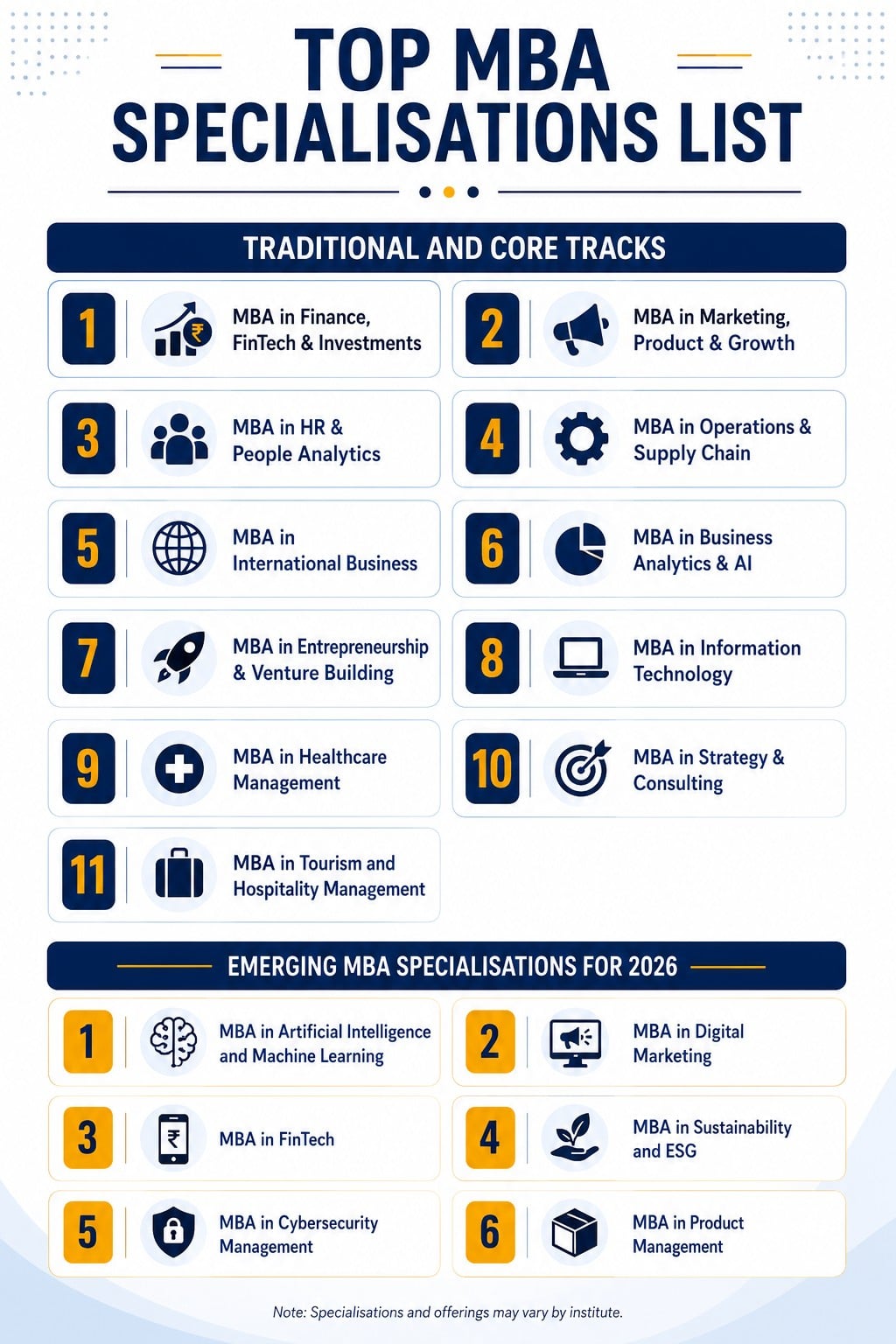
1. MBA in Finance, FinTech & Investments
Covers financial management, investment strategy, financial technology and modern investment practices, combining core finance concepts with the evolving FinTech landscape.
- Course Fees: 6 lakh to Rs. 20 lakh
- Ideal For: Students with strong numerical and analytical aptitude interested in banking, investing or corporate finance.
- Career Options: Financial Analyst, Investment Banker, Portfolio Manager, Corporate Finance Manager
2. MBA in Marketing, Product & Growth
Builds expertise in marketing strategy, product development, customer behaviour and growth, with a focus on creating and scaling products and brands.
- Course Fees: 6 lakh to Rs. 18 lakh
- Ideal For: Those with strong communication, a creative streak and an interest in fast-moving, customer-facing work.
- Job Roles: Brand Manager, Digital Marketing Manager, Product Manager, Market Research Analyst
3. MBA in HR & People Analytics
Focuses on people management, talent strategy, workplace culture and the use of data and analytics to improve employee experience and organisational decisions.
- Course Fees: 5 lakh to Rs. 12 lakh
- Ideal For: Students with strong interpersonal skills who want to shape corporate culture and employee experience.
- Job Options: HR Manager, Talent Acquisition Lead, HR Business Partner, Employee Relations Manager
4. MBA in Operations & Supply Chain
Focuses on improving efficiency across operations, logistics and supply chain systems, covering planning, procurement and process optimisation.
- Course Fees: 5 lakh to Rs. 14 lakh
- Ideal For: Professionals who enjoy process optimisation, planning and logistics.
- Career Options: Operations Manager, Supply Chain Analyst, Procurement Manager, Project Coordinator
5. MBA in International Business
Covers how global markets function, with an emphasis on cross-border trade, export management and global supply chains.
- Course Fees: 6 lakh to Rs. 16 lakh
- Ideal For: Students who want international exposure and aspire to work with multinational corporations or in global trade.
- Job Roles: Export Manager, Global Supply Chain Analyst, International Business Manager
6. MBA in Business Analytics & AI
Combines business analytics, data-driven decision-making and artificial intelligence to help organisations solve complex problems and build smarter business strategies.
- Course Fees: 5 lakh to Rs. 15 lakh
- Ideal For: Those with strong analytical, mathematical or technical skills who want to work at the intersection of data and strategy.
- Career Options: Business Analyst, Data Analyst, BI Analyst, Analytics Manager
7. MBA in Entrepreneurship & Venture Building
Covers entrepreneurship, innovation and venture creation, helping aspiring founders develop, launch and scale new businesses while identifying opportunities in emerging markets.
- Course Fees: 6 lakh to Rs. 15 lakh
- Ideal For: Self-starters who want to build their own business or drive innovation within an existing organisation.
- Job Roles: Startup Founder, Venture Analyst, Innovation Strategist, Business Consultant
8. MBA in Information Technology
Integrates management with technology, focused on digital transformation, IT strategy and systems management.
- Course Fees: 6 lakh to Rs. 16 lakh
- Ideal For: Candidates from an engineering or tech background seeking managerial roles in IT or software.
- Job Options: IT Project Manager, Systems Analyst, Technology Consultant, IT Strategy Manager
9. MBA in Healthcare Management
Prepares you for administrative and managerial roles in hospitals, healthcare startups and pharmaceutical companies.
- Course Fees: 5 lakh to Rs. 12 lakh
- Ideal For: Healthcare professionals or management aspirants interested in the medical and wellness sector.
- Career Options: Hospital Administrator, Healthcare Consultant, Healthcare Operations Manager
10. MBA in Strategy & Consulting
Develops analytical thinking, business modelling and strategic decision-making skills for solving complex business problems and driving organisational growth.
- Course Fees: 7 lakh to Rs. 18 lakh
- Ideal For: Individuals with strong problem-solving ability who aspire to a consulting or corporate strategy role.
- Job Options: Management Consultant, Strategy Analyst, Corporate Planner
11. MBA in Tourism and Hospitality Management
Covers travel, tourism and hospitality operations, with an emphasis on customer experience and business growth.
- Course Fees: 4 lakh to Rs. 10 lakh
- Ideal For: Those passionate about hospitality, tourism and customer service management.
- Career Options: Travel Consultant, Event Manager, Tourism Project Head
List of Emerging MBA Specialisations
These tracks have moved from niche to mainstream over the last two to three years, largely driven by AI adoption, ESG mandates and the rise of digital-first business models. If you are optimising for where hiring demand is growing fastest, this is the list to watch.
1. MBA in Artificial Intelligence and Machine Learning
Combines AI technology with business intelligence to solve modern business problems, one of the fastest-growing specialisations on any current MBA specialisations list.
- Course Fees: 8 lakh to Rs. 20 lakh
- Ideal For: Professionals from tech, computer science or data backgrounds who want to integrate AI with business leadership.
- Emerging Roles: AI Product Manager, Data Strategy Lead, Automation Expert
2. MBA in Digital Marketing
Built around SEO, social media, content strategy and digital branding, the foundations of nearly every modern marketing team.
- Course Fees: 4 lakh to Rs. 10 lakh
- Ideal For: Creative marketers passionate about digital trends, brand engagement and analytics.
- Career Options: SEO Specialist, Social Media Strategist, Growth Marketing Manager
3. MBA in FinTech
Merges finance with technology, covering blockchain, digital payments and financial innovation.
- Course Fees: 6 lakh to Rs. 15 lakh
- Ideal For: Finance professionals or those with tech experience who want to work in digital finance and emerging technologies.
- Emerging Roles: FinTech Product Manager, Blockchain Analyst, Payments Strategist
4. MBA in Sustainability and ESG
Focuses on environmental, social and governance frameworks, sustainable business models and corporate social responsibility strategy.
- Course Fees: 5 lakh to Rs. 14 lakh
- Ideal For: Students interested in responsible business who want to shape how companies measure and report impact.
- Trending Roles: ESG Analyst, Sustainability Lead, CSR Manager
5. MBA in Cybersecurity Management
Combines business management with cybersecurity strategy, risk governance and compliance, an increasingly board-level concern.
- Course Fees: 6 lakh to Rs. 16 lakh
- Ideal For: Candidates with a technology or risk background who want to move into security leadership rather than pure technical roles.
- Emerging Roles: IT Risk Manager, Security Compliance Lead, Cyber Risk Consultant
6. MBA in Product Management
Covers product strategy, user research, roadmap planning and cross-functional delivery, bridging business and technology teams.
- Course Fees: 6 lakh to Rs. 18 lakh
- Ideal For: Those who enjoy working across engineering, design and business functions to ship products.
- Job Roles: Product Manager, Associate Product Manager, Product Strategy Lead
Which MBA Specialisation is Right for You?
Use this as a starting filter based on what you already enjoy or are good at, then cross-check it against the fee and salary details further down.
| What You're Like | Best-Fit Specialisation | Why It Fits |
| Strong with numbers and drawn to markets or investing | Finance, FinTech & Investments | Direct match with the core skill set; leads into banking, PE and corporate finance |
| Creative, people-facing, enjoy storytelling and branding | Marketing, Product & Growth | Builds on communication strength for fast-moving, customer-facing roles |
| Enjoy working with data, patterns and technical problem-solving | Business Analytics & AI | Fastest-growing hiring segment; pairs technical skill with business strategy |
| People-oriented, enjoy mentoring or shaping culture | HR & People Analytics | Matches interpersonal strengths with data-informed HR practice |
| Process-driven, enjoy planning and logistics | Operations & Supply Chain | Rewards structured thinking and an efficiency-first mindset |
| Want to start or scale your own venture | Entrepreneurship & Venture Building | Direct path for self-starters and innovation-minded students |
| Interested in global trade and cross-border business | International Business | Suits those targeting multinational or export-oriented roles |
| Engineering or tech background, want managerial roles | Information Technology or AI & Machine Learning | Leverages an existing technical background into a leadership trajectory |
| Passionate about ethics, environment and long-term impact | Sustainability and ESG | Aligned with fast-growing ESG mandate hiring |
Indicative Salary Benchmarks in India
| Related career direction | Published annual range | Experience covered |
| Business Analyst | ₹9.5-10.5 lakh | 1-9 years |
| Financial Analyst | ₹6.5-7.2 lakh | 1-7 years |
| Marketing Manager | ₹12.6-13.9 lakh | 2-16 years |
| HR Manager | ₹10.7-11.9 lakh | 3-16 years |
| Operations Manager | ₹10.8-11.9 lakh | 3-17 years |
| Data Scientist | ₹15.2-16.8 lakh | 1-8 years |
Source: The figures below are published role-level annual salary ranges on AmbitionBox, not MBA placement data. They provide market context for six common career directions and should not be read as a guaranteed salary after an MBA.
General MBA vs Specialised MBA: Key Differences
An MBA is broadly split into General and Specialised tracks. Both build leadership and managerial skills, but they differ in focus. A General MBA gives you a broad understanding of how businesses operate, suited to those who want flexibility to work across industries. A Specialised MBA lets you go deeper into one domain, helping you become an expert in that niche.
| Aspect | General MBA | Specialised MBA |
| Focus | Broad overview across management disciplines | Deep expertise in one specific domain |
| Curriculum | Core business areas: marketing, finance, HR, operations | Core fundamentals plus advanced, domain-specific electives |
| Flexibility | High; allows career shifts between industries | Lower; builds a defined career track |
| Career Options | General Manager, Consultant, Operations Manager | Domain-specific roles, e.g. Financial Analyst, Data Scientist |
| Average Fees | Rs. 8 lakh to Rs. 20 lakh | Rs. 4 lakh to Rs. 20 lakh depending on track |
| Average Salary | Rs. 10 lakh to Rs. 20 lakh per annum | Varies by track; Rs. 6 lakh to Rs. 25 lakh per annum |
MBA Specialisation vs Major vs Concentration: What's the Difference?
These three terms largely describe the same thing: a focused set of electives layered on top of the core MBA curriculum. The word that gets used depends on the business school and, sometimes, the country.
| Term | What It Means | Where It's Commonly Used |
| Specialisation | The advanced elective track chosen within an MBA, layered on core management coursework, often including a capstone in that domain | The standard term across Indian B-schools, including BML Munjal University |
| Concentration | Functionally identical to a specialisation: a set of electives clustered around one domain within the same MBA degree | Common in US business schools; used interchangeably with 'specialisation' in some dual-recognised or international-facing programmes |
| Major | Terminology borrowed from undergraduate degrees; occasionally used by MBA programmes to describe the same elective focus | More typical at the undergraduate level; rarely the primary term used within MBA marketing in India |
What are Dual Specialisation MBAs?
A dual specialisation MBA combines two elective areas. It is most useful when your target role genuinely needs both skill sets and not simply because you want to keep every option open.
Choose a dual specialisation only if the programme formally offers it and the second track strengthens the role you want. Otherwise, one specialisation with flexible electives is often clearer and easier to explain to recruiters.
| Combination | Useful for | What to check |
| Finance + Business Analytics | Data-led finance, risk, pricing and business intelligence | Whether both elective sets fit within the credit structure |
| Marketing + Digital/Analytics | Growth, customer insights and performance marketing | Whether the programme offers enough technical and marketing depth |
| Operations + Strategy | Transformation, supply-chain improvement and consulting | Whether projects and recruiters support cross-functional roles |
Different Types of MBA Programmes
Before picking a specialisation, it helps to know the format the MBA itself will run in, since this affects pace, cost and how much flexibility you retain.
| Type | Best For | Key Features | Trade-offs |
| Full-Time MBA | Graduates or early-career professionals | Immersive, campus-based, placements included | High time commitment, may require leaving a job |
| Part-Time MBA | Working professionals | Evening or weekend classes | Slower pace, longer completion time |
| Executive MBA | Mid-career executives | Leadership and strategy focus, alternate weekends | Higher cost, needs significant work experience |
| Online MBA | Those needing flexibility | Remote, often asynchronous | Less face-to-face networking, needs discipline |
| Global MBA | Students seeking international exposure | Cross-campus modules, global curriculum | High cost, visa and mobility considerations |
Comparing MBA vs PGDM vs MiM vs Certification Courses
Choose an MBA for a broad, degree-based management experience; a PGDM for a diploma-led management programme; a MiM for an earlier-career option; and certifications when you need a narrower skill boost.
| Option | Best suited to | What it gives you | What to check before enrolling |
| MBA | Graduates and early-career professionals seeking broad management training | University degree, core management subjects and electives | Programme quality and outcomes vary by institution |
| PGDM | Candidates considering autonomous management institutes | Industry-oriented diploma curriculum | Check accreditation and the institute's recognition |
| MiM | Fresh graduates with limited work experience | Earlier-career management foundation, often shorter | May not offer the same career-switching depth as an MBA |
| Professional certification | Professionals building one focused skill | Targeted learning in areas such as finance, project management or analytics | Does not replace the breadth, network or placements of a full management programme |
MBA Eligibility Criteria and Entrance Exams
Although the criteria vary from one institution to another, below are the general requirements-
- A recognised bachelor's degree in any discipline
- Minimum 50% aggregate or equivalent, though this varies by institute
- Some programmes, particularly Executive MBAs, require prior work experience
| Exam | Typically Accepted By |
| CAT | Most Indian B-schools |
| GMAT | Global MBA programmes and many Indian B-schools |
| XAT | Xavier-affiliated and several private institutes |
| NMAT | Select private and private-affiliated colleges |
| GRE | Some global or flexible MBA programmes |
| University-specific tests (e.g. BMU-MAT) | Institute-specific admission routes |
How to Choose the Right MBA Specialisation
With this many tracks on the table, the decision usually comes down to a handful of factors rather than the specialisation with the highest headline salary.
- Align with your strengths and interests: a numbers-oriented mindset points toward Finance or Analytics; an interest in people points toward HR.
- Check industry demand: Analytics, Digital Marketing, Sustainability and AI-related specialisations are showing the fastest growth in current hiring data.
- Think long-term, not just starting salary: consider where you want to be in 5 to 10 years, not only the highest-paying entry-level role.
- Look for elective flexibility: programmes that allow electives from other domains preserve some mobility even after you specialise.
- Check institutional strength: some B-schools are known for particular specialisations, so weigh a programme's track record in your chosen domain.
Transform Yourself Into a Global Leader with a World-Class MBA at BML Munjal University
The MBA programme at BML Munjal University is designed for students aspiring to be leaders, innovators and changemakers. It combines solid academic training with real business experience, helping students build careers that adapt to a fast-changing business world.
Reasons to Choose the MBA Programme at BML Munjal University
- Offers seven specialisations- Business Analytics & AI; Finance, FinTech & Investments; Marketing, Product & Growth; HR & People Analytics; Operations & Supply Chain; Strategy & Consulting; Entrepreneurship & Venture Building.
- Strong focus on innovation and entrepreneurship, supported by the Atal Community Innovation Centre at BMU (ACIC-BMU).
- Business Leadership Luncheons offer students networking opportunities and real-world insight from industry leaders.
- Admissions: BMU accepts CAT, NMAT, GMAT, CMAT, XAT, GRE and BMU-MAT scores; shortlisted candidates complete a Personal Interview and Case Discussion.
BMU's current MBA syllabus combines core management learning with applied components, including Practice School, live projects and applied management portfolios. It also includes AI literacy and prompt-engineering learning in the programme structure.
Conclusion
Picking the right MBA specialisation can be the turning point in the career you are working toward. As industries keep evolving with AI, analytics and global integration, the demand for specialised MBAs keeps growing alongside them. Your specialisation should align your passion with your skills and future goals, whether that means working at a multinational, building a startup or managing large-scale projects.
The right MBA does not just get you a job. It prepares you to lead with vision and purpose. If you are looking for an MBA that covers both the breadth of general management and the depth of a focused specialisation, with strong placements and industry relevance, BML Munjal University's MBA programme is worth exploring. Apply today and take the next step in your management career.
FAQs
There is no single answer, but the fastest-growing specialisations for 2026 include Business Analytics, AI & Machine Learning, Digital Marketing and Sustainability & ESG, as these align with current hiring trends and digital transformation across industries.
Strategy and Consulting, AI & Machine Learning and Finance typically report the highest salary ranges among MBA specialisations in India, though actual outcomes depend heavily on the institute, prior experience and the recruiting companies on campus.
Neither is universally better. A General MBA suits students who want flexibility to move across industries, while a Specialised MBA suits those with a clear target role or domain in mind.
Yes. The core management skills an MBA builds (leadership, communication and strategic thinking) transfer across industries even if your specific electives were in one domain.
Some institutes allow this, particularly where the first year covers common foundational subjects and specialisation electives begin in year two, but it depends on each programme’s structure and elective availability. Check with your specific institute.
Yes, to a meaningful extent. Specialisations tied to current high-demand skills, such as Analytics, AI and Strategy, tend to command higher starting salaries than some traditional tracks, though institute reputation and placement record still matter more than specialisation alone.
It is worth it if your target role genuinely sits at the intersection of two functions, such as Finance and Analytics. If you mainly want to keep your options open, a General MBA usually achieves that more efficiently.
This depends entirely on your existing strengths. A specialisation that plays to your background, for instance HR for someone who enjoys people management or Analytics for someone comfortable with numbers, will generally feel more manageable than one that requires building a skill set from scratch.
Strategy & Consulting, Operations & Supply Chain and HR & People Analytics tend to suit working professionals well, since these specialisations build directly on workplace experience they already have.
Entrepreneurship & Venture Building is the direct fit, though many aspiring founders pair it with Finance or Marketing to round out the practical skills a new business needs.
Business Analytics & AI, Marketing, Product & Growth or a General MBA tend to work well for freshers, as they don’t assume prior domain experience and keep recruiting options broad.
HR & People Analytics, Marketing, Product & Growth and Tourism and Hospitality Management are comparatively lighter on quantitative rigour than tracks like Finance or Business Analytics.
Yes, engineers are not restricted to technical tracks and can choose any specialisation, though their background maps particularly well onto Business Analytics & AI, IT, FinTech and Cybersecurity Management.
Most programmes allow one primary specialisation, though some institutes offer dual specialisation MBAs if the elective structure supports it.
MBA specialisation formats broadly fall into two types: single specialisation, where you focus on one domain and dual specialisation, where you combine electives across two tracks, such as Finance and Business Analytics.
Related Blogs

Management Entrance Exams in India: Which One Is Right for You?
Key Takeaways There is no single best management entrance exam for every MBA aspirant. Compare CAT, XAT, CMAT, NMAT, GMAT, SNAP, MAT and ATMA ...

Is Work-Life Balance Really Possible During an Executive MBA in India?
Key Takeaways India has the highest employee burnout rate globally, with 59% of Indian professionals reporting burnout symptoms against a 20% w...

MBA Without CAT in India: Top Colleges, Entrance Exams & Direct Admission 2026
Can you do an MBA without CAT in India? The answer is yes and it is more common than most students realise. CAT was designed as an entry filter for...

The Benefits of an Integrated BBA MBA: Career Growth & How It Compares to Traditional MBA
Integrated BBA MBA programmes are becoming increasingly popular among students who want to start building management careers right after Class 12. Wha...

MBA in Operations Syllabus: Semester-Wise Curriculum, Key Subjects & Practical Components
An MBA in Operations is one of the most sought-after management specialisations for students interested in business processes, supply chain systems, l...

MBA for Working Professionals: Transform Your Functional Expertise into Business Leadership
You have spent years building expertise, managing people and delivering results. But somewhere between your current role and the one you actually want...