

BBA Business Analytics Syllabus: Semester-Wise Breakdown


Admissions Enquiry

The demand for professionals who can understand data and turn it into business decisions is growing rapidly. This is why BBA Business Analytics has emerged as one of the most career-oriented undergraduate programmes in India.
If you are planning to pursue this course, understanding the BBA Business Analytics syllabus will help you know exactly what you’ll study and how your skills will develop year by year.
This blog explains the business analytics syllabus at the undergraduate level, covering BBA Business Analytics subjects from the 1st year to the final year.
Overview of Business Analytics Syllabus (Undergraduate Level)
| Particulars | Details |
| Course Name | BBA Business Analytics |
| Level | Undergraduate |
| Duration | 3 Years |
| Total Semesters | 6 |
| Mode | Regular / Full-Time |
Year 1 - Foundation of Business & Analytics
The first year focuses on building a strong foundation in management, economics and analytical thinking.
| Semester 1 | Semester 2 |
| Principles of Management | Business Statistics |
| Business Economics | Organisational Behavior |
| Financial Accounting | Cost & Management Accounting |
| Business Mathematics | Data Analysis Using MS Excel |
| Introduction to Business Analytics | Business Environment |
| Business Communication | Corporate Social Responsibility |
| Environmental Studies |
What you learn in 1st year:
Students develop basic business understanding while learning how numbers, statistics and Excel support business decisions. This year prepares you for more technical analytics subjects ahead.
Year 2 - Technical & Applied Analytics
The second year introduces technical tools and applied analytics used in real business scenarios.
| Semester 3 | Semester 4 |
| Database Management Systems | Predictive Analytics |
| Programming for Business Analytics (Python / R) | Data Visualisation (Tableau / Power BI) |
| Marketing Management | Financial Analytics |
| Operations Management | Human Resource Analytics |
| Statistical Methods for Analytics | Business Intelligence Systems |
| Business Research Methods | Minor Project |
What you learn in 2nd year:
Students start working with programming languages, dashboards, predictive models and functional analytics in HR, finance and marketing.
Year 3 - Advanced Analytics & Industry Exposure
The final year focuses on advanced analytics, strategy and industry exposure.
| Semester 5 | Semester 6 |
| Machine Learning for Business | Prescriptive Analytics |
| Big Data Analytics | Data Ethics & Governance |
| Digital Marketing Analytics | Entrepreneurship & Innovation |
| Strategic Management | Capstone Project |
| Risk & Decision Analytics | Elective I (Domain Analytics) |
| Industry Internship / Live Project | Elective II (Domain Analytics) |
What you learn in 3rd year:
Advanced analytics, real-world industry exposure, strategic decision-making and hands-on problem-solving through internships and capstone projects.
Popular Elective Subjects (University-Dependent)
- Banking & Financial Analytics
- Healthcare Analytics
- Retail & E-commerce Analytics
- Supply Chain Analytics
- Artificial Intelligence for Business
- Advanced Excel & SQL
How the BBA Business Analytics Syllabus in India is Industry-Relevant
- Builds strong business fundamentals in management, finance, marketing and operations
- Develops practical data analysis skills used in real business decision-making
- Provides hands-on exposure to industry tools like Excel, Python, SQL and Tableau
- Includes live projects, case studies and internships for real-world experience
- Enhances decision-making and problem-solving abilities using data-driven insights
- Prepares students to be job-ready across multiple industries such as IT, finance, marketing and consulting
Shape a Data-Driven Career with BBA Business Analytics at BML Munjal University
When you’re looking for top institutes for BBA Business Analytics, BML Munjal University (BMU) stands out with a curriculum designed to blend business knowledge with practical analytics skills.
Why BMU’s BBA Business Analytics Programme is Worth Considering
- The syllabus combines core business subjects like Marketing, Financial Management, Operations and Organisational Behaviour with analytics-focused learning such as Data Interpretation, Data Visualisation and tools like Excel and R.
- Emphasis on soft skills development, including Business Communication, Critical Reasoning and Effective Presentation.
- Curriculum includes real-world scenario assignments, helping students apply theory to practical business problems.
- Alongside academic learning, students gain hands-on exposure through projects and internships integrated into the syllabus.
- A balanced mix of business sense and data-driven training equips graduates to make meaningful decisions in modern organisations.
BMU’s BBA Business Analytics programme is structured to develop both analytical thinking and professional communication, making it a strong choice for students who want a well-rounded business analytics education
To Sum Up
The BBA Business Analytics syllabus is thoughtfully designed to prepare students for a data-driven business world. From building strong management fundamentals in the first year to mastering advanced analytics, tools and real-world applications in the final year, the programme ensures steady skill development at every stage.
With hands-on exposure, industry-relevant tools and practical projects, students graduate ready to make informed business decisions. For those aiming to build a future-focused career where business strategy meets data insights, pursuing a BBA Business Analytics at BML Munjal University can be a smart and rewarding choice.
FAQs
BBA Business Analytics subjects include management, economics, accounting, statistics, data analysis, Python/R programming, database management, data visualization, machine learning, business intelligence and industry projects.
The Business Analytics syllabus covers business fundamentals, statistics, data handling, analytics tools, predictive and prescriptive analytics, visualization, ethics, internships and real-world projects for practical exposure.
The four types of Business Analytics are descriptive (what happened), diagnostic (why it happened), predictive (what may happen) and prescriptive (what action should be taken).
BBA Business Analytics is moderately challenging but manageable. It combines business concepts with basic statistics and tools like Excel and Python and becomes easier with regular practice and interest in data.
Related Blogs
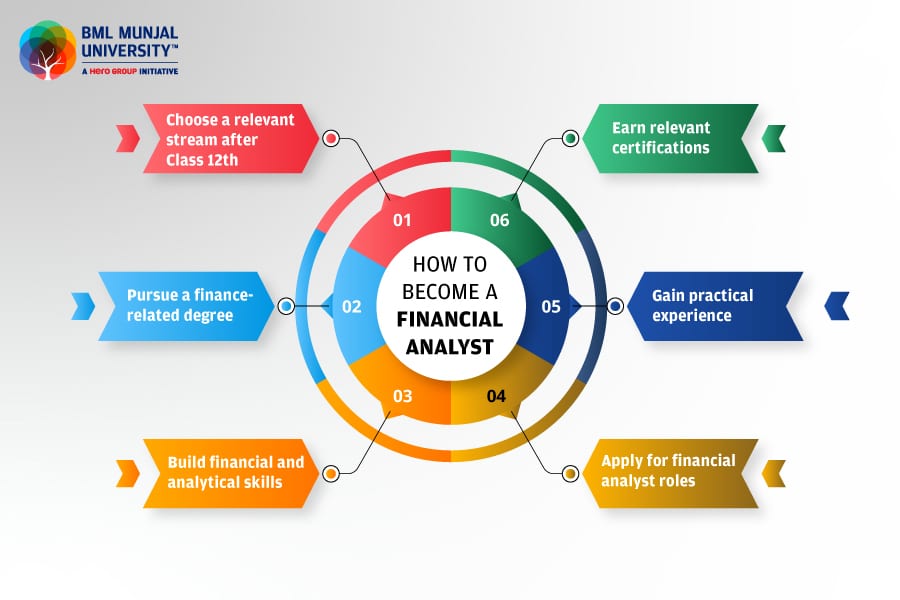
How to Become a Financial Analyst in India: Degree, Skills & Career Roadmap (2026)
A relevant degree in finance, commerce, economics or business can provide a strong foundation for a financial analyst career. Build core skills...
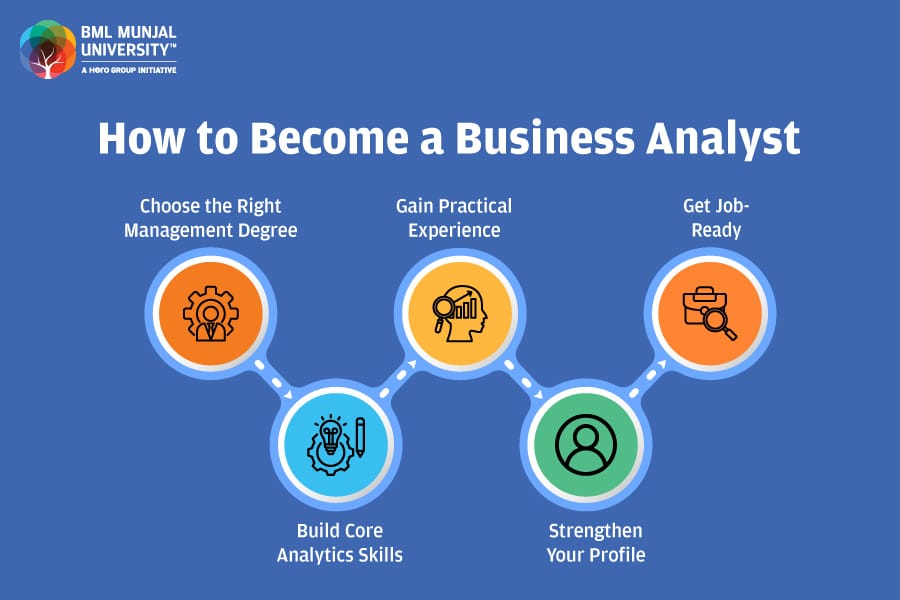
How to Become a Business Analyst: A Complete Career Guide
Key Takeaways A bachelor's degree in business, IT or a related field is the usual starting point; no state licence is required. Students after...

How to Become a Marketing Manager: Complete Step-by-Step Guide
Key Takeaways Becoming a marketing manager is a progression from execution to ownership and leadership. A relevant degree provides the foundat...

How to Become a Policy Analyst: The Career Path No One Explains Properly
Key Takeaways A bachelor's degree in Economics, Political Science, Public Policy, Sociology, International Relations or Law is the minimum qualif...

Business Analyst Salary in India 2026: How Much Can You Really Earn?
Key Takeaways The average business analyst salary in India is ₹7-10 LPA. Freshers in 2026 can earn ₹7-10 LPA, depending on skills and coll...

The Benefits of an Integrated BBA MBA: Career Growth & How It Compares to Traditional MBA
Integrated BBA MBA programmes are becoming increasingly popular among students who want to start building management careers right after Class 12. Wha...