

Blogs


How BMU Integrates AI Into the MBA Without Turning Managers Into Engineers
March 3, 2026 | By BMU
Artificial Intelligence is no longer a futuristic idea reserved for technology firms. It has become part of everyday business decision-making- influencing strategy discussions, marketing planning, financial forecasting as well as operational optimisation.
For management education, this shift presents a fundamental question-
Should MBA students learn artificial intelligence as a technical specialisation?
or
Should they learn how to work effectively in an AI-enabled environment?
Many MBA aspirants hesitate when they encounter AI-focused programmes. They don’t necessarily want to become coders or data scientists. They want to become capable managers who understand how to use AI tools intelligently while retaining strategic judgement.
At BML Munjal University, the approach is clear. AI is not treated as a standalone technical subject. Instead, it is embedded in the daily practice of management learning, so students graduate confident in working with AI rather than intimidated by it.
The Problem with Teaching AI as Just Another Subject
Most MBA programmes approach AI in the same way they approach finance or marketing as a discrete discipline.
- Students are introduced to concepts
- They are shown tools
- They complete assessments
- Then they move on
This model treats AI as a specialised knowledge area.
However, in real organisations, AI does not function as a separate department. It influences strategy discussions, pricing models, operational forecasts, customer segmentation as well as talent analytics at the same time.
When AI is taught in isolation, two gaps often appear-
- Students understand AI conceptually but are unable to apply it in the real world.
- AI seems more focused on technology than management.
Recognising this gap, BML Munjal University redesigned its MBA to treat AI differently.
AI as an Embedded Practice, Not a Parallel Discipline
Instead of positioning AI alongside other subjects, BMU embeds it within management exercises themselves.
Students engage with AI while-
- Investigating industries
- Comparing competitive positions
- Evaluating financial assumptions
- Exploring alternative growth paths
- Strengthening business presentations
This showcases that AI becomes part of the workflow rather than an additional requirement.
Just as spreadsheets once transformed managerial efficiency, intelligent tools now expand analytical capability. The goal is practical fluency, ensuring graduates are comfortable navigating AI-assisted environments.
Mastering AI Without Becoming Technical Specialists
A frequent concern among MBA aspirants is whether AI-focused programmes require programming expertise. This is where BMU’s approach deliberately avoids this expectation. The main focus is on interpretive ability as well as informed usage.
Students are guided to-
- Structure sharper business questions
- Assess AI outputs critically
- Recognise potential limitations
- Combine machine-generated insights with strategic reasoning
This aligns closely with real-world roles. Managers are rarely expected to build algorithms. They are expected to make judgements supported by intelligent systems.
Therefore, the MBA prioritises decision quality over technical depth.
AI Applied Across Management Domains
AI integration at BMU spans core management areas, reinforcing cross-functional understanding.
1. Strategy & Consulting
Students examine industry structures, model scenarios as well as compare strategic alternatives using AI-supported insights that enhance speed and clarity.
2. Marketing & Growth
Data-driven segmentation, campaign testing and predictive response modelling allow students to explore how intelligent systems refine customer engagement strategies.
3. Finance & Decision-Making
Forecasting exercises, valuation comparisons and risk discussions incorporate assisted modelling to deepen financial reasoning.
4. Operations & Supply Chain
Demand projections, optimisation scenarios as well as planning exercises demonstrate how AI supports operational efficiency and responsiveness.
5. Human Resources & People Analytics
Workforce data analysis and performance insights introduce students to how AI informs people-related decisions.
Real AI Ecosystem Supporting Managerial Learning
What strengthens this AI integration is the ecosystem behind it. At BML Munjal University, students work within an environment where they are supported by advanced computing systems, including NVIDIA DGX H200 GPU servers typically found in research-led institutions.
This exposure goes beyond simplified classroom exercises for MBA students. They get an opportunity to engage with AI tools in a setting where real experimentation and applied exploration are possible.
As a result, AI shifts from being an abstract concept to becoming part of everyday managerial problem-solving.
AI Within the Portfolio-Driven MBA Structure
BML Munjal University’s MBA follows a portfolio-based framework, where each term culminates in integrated business outputs.
Students use intelligent systems to-
- Deepen research quality
- Evaluate competing scenarios
- Refine strategic proposals
- Strengthen analytical narratives
Over time, their portfolio demonstrates not only results but reasoning, illustrating how AI informed structured decision-making.
This practical evidence resonates strongly with employers seeking adaptable managers.
Preparing Managers for an AI-Augmented Workplace
As we know, future organisations will depend on a blend of human insight as well as machine intelligence.
Managers must be able to-
- Interpret large volumes of data efficiently
- Question automated recommendations
- Connect insights across functions
- Act decisively amid uncertainty
MBA education must therefore cultivate agility and critical thinking alongside technological awareness. At BML Munjal University, AI is positioned as an enhancer of managerial capability. It strengthens managerial effectiveness without displacing foundational business learning.
Core business foundations such as strategy, finance, marketing and leadership remain central. Intelligent tools simply expand the depth, speed and clarity with which those foundations are applied.
How This Approach Benefits Students
Graduates entering modern workplaces require confidence, not just awareness.
Continuous interaction with AI during the MBA fosters-
- Analytical confidence
- Faster insight generation
- Structured problem-solving
- Clearer communication of recommendations
By the time students enter recruitment processes, AI-assisted thinking is already familiar territory.
A Forward-Looking MBA Perspective
The relevance of future MBA programmes will not depend on whether AI appears in the syllabus.
It will depend on how naturally AI is embedded in learning experiences. Institutions that treat AI as an accessory risk have a superficial understanding. Programmes that integrate it into managerial practice equip students for realities already unfolding in industry.
At BML Munjal University, the objective is clear- cultivate leaders who can think independently while leveraging intelligent systems effectively. Also, the long-term advantage will not belong to those who simply know about AI- it will belong to those who can reason with it.
FAQs
No, you don’t require it because an AI-enabled MBA focuses on AI literacy, not programming. You will learn how to apply AI tools in strategy, marketing, finance as well as operations without deep code knowledge.
An AI-enabled MBA programme integrates artificial intelligence, where students learn how to use AI tools, interpret insights as well as make data-driven business decisions.
Now, employers want to hire managers who can use AI tools and interpret data. An AI-enabled MBA course prepares students to make smarter decisions, improve efficiency and lead teams in technology-driven organisations.
Related Blogs
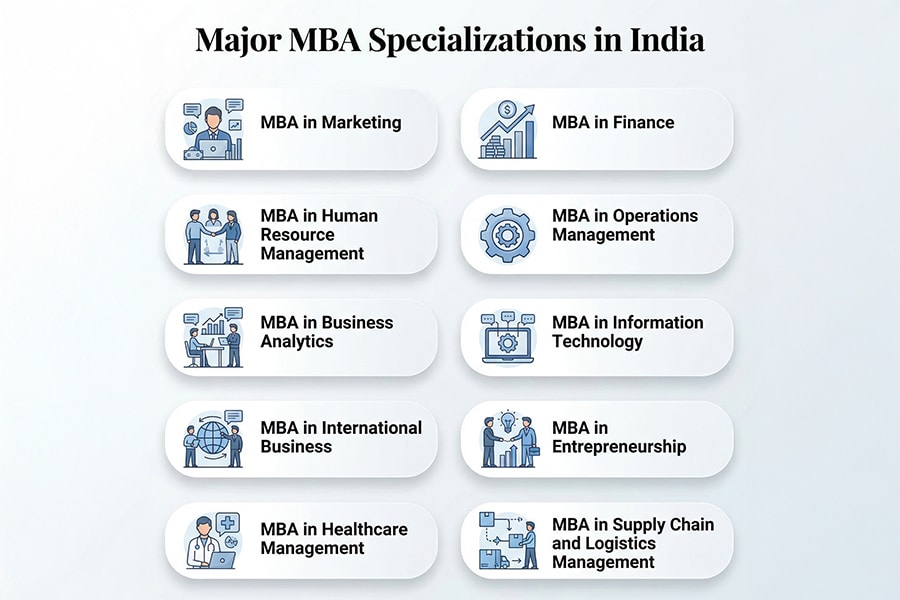
List of Top 10 MBA Courses: A Definitive Guide to Choosing the Right Specialisation
Over the past decade, MBA programmes have gained strong global demand. According to the Graduate Management Admission Council, nearly 90% of employers...
Artificial Intelligence in Education: Transforming the Future of Learning
It is 2026 and the dynamics surrounding AI are now a little different. Now the question is not whether AI will arrive in the classroom anymore, but in...

How a Portfolio-First MBA Changes Placements, Careers and Long-Term Growth
In most MBA programmes, students spend two years learning frameworks, case studies and theories, only to walk into interviews with nothing more than a...

From Subjects to Decisions: How a Portfolio-First MBA Actually Works
The traditional MBA has long been the gold standard for professional advancement. However, a common critique remains: students often graduate with a t...

New-Age MBA Specialisations: Choosing Roles, Not Just Subjects
For years, selecting MBA specialisations has been quite straightforward. Basically, students choose between Marketing, Finance, Human Resources or ...

Why the Future of MBA Education Belongs Inside a University Ecosystem
For decades, MBA education has been closely associated with standalone business schools. The logic was simple- if management is the goal, specialised ...