

How to Become a Corporate Lawyer in India: Step-by-Step Guide (2026)


Admissions Enquiry
Summary: Learn how to become a corporate lawyer in India with this step-by-step career guide. The blog explains the eligibility criteria, law entrance exams, educational pathways after Class 12 or graduation, internship opportunities, essential skills, salary prospects and career growth. It also covers the role of corporate lawyers, Bar Council registration, AIBE requirements and how specialised legal education can help you build a successful career in corporate law.

Key Takeaways
- Complete a 5-year integrated BA LLB/BBA LLB after Class 12 or a 3-year LLB after graduation to become a corporate lawyer.
- Clear CLAT (or other accepted law entrance exams), register with the State Bar Council and qualify the AIBE to practise law in India.
- Build practical experience through internships at corporate law firms, in-house legal teams, financial institutions or regulatory bodies.
- Develop essential skills such as legal research, contract drafting, negotiation, analytical thinking and commercial awareness.
- Corporate lawyers in India typically earn ₹5.2 LPA to ₹21.6+ LPA, with salaries increasing based on experience, specialisation and employer.
India's legal services industry isn't just growing - it's being reshaped in real time. The market is set to expand from USD 2.64 billion in 2026 to USD 3.52 billion by 2031 and the growth isn't coming from courtroom litigation. It's coming from boardrooms.
FDI liberalisation is fuelling a wave of cross-border M&A, the Digital Personal Data Protection Act is forcing companies to rebuild their compliance frameworks from scratch and SEBI's ESG disclosure norms are pulling even mid-sized businesses into a web of regulatory reporting they've never had to navigate before.

In fact, corporate, financial and commercial law already account for the largest single share of India's legal services market and demand for advisory and consultancy work is growing faster than any other legal service segment.
What does this mean in practice?
This simply means that businesses today need lawyers who can understand deal structuring, regulatory risk and commercial strategy well enough to sit at the table before a problem happens, not after. If you are weighing a legal career that blends law, business and strategy, this is arguably the best moment in a decade to ask the question properly- How to Become a Corporate Lawyer in India.
What is a Corporate Lawyer?
A corporate lawyer is a legal professional who advises companies on the laws governing business operations, contracts and commercial transactions, including mergers and acquisitions, regulatory compliance, corporate governance and risk management. Unlike litigation lawyers, corporate lawyers rarely appear in court; their role is advisory and transactional, helping businesses make legally sound decisions before disputes arise.
What Does a Corporate Lawyer Do?
A corporate lawyer's core responsibilities span five key areas-
- Draft and negotiate corporate contracts
- Manage mergers and acquisitions
- Ensure regulatory compliance
- Advise on corporate restructuring
- Mitigate legal and business risks
How to Become a Corporate Lawyer in India: Step-by-Step Process
Becoming a corporate lawyer in India follows a defined academic and professional sequence. The steps below outline the complete journey from school to practice-
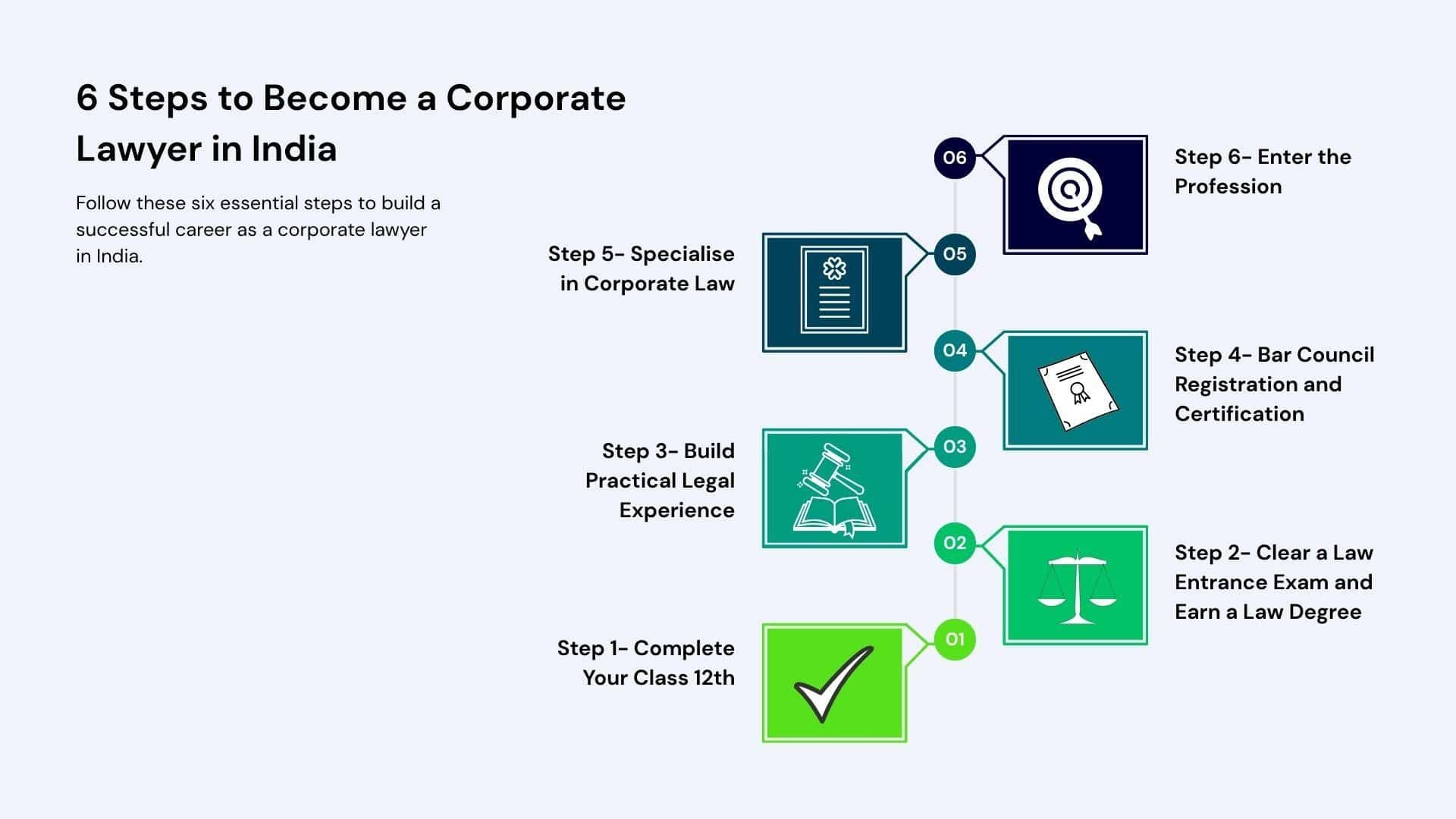
Step 1- Complete Your Class 12th
The first requirement is completing 10+2 from a recognised board. Students from any stream (arts, commerce or science) are eligible, though subjects such as economics, business studies or political science can be advantageous. After Class 12, students can prepare for law entrance exams such as CLAT for admission into integrated law programmes.
Step 2- Clear a Law Entrance Exam and Earn a Law Degree
Formal legal education is mandatory to practise as a corporate lawyer in India. Students may choose between-
| Pathway | Details |
| Five-Year Integrated Law Course | Pursue BA LLB (Hons) or BBA LLB (Hons) after Class 12. Admission is generally through CLAT.
Eligibility- 45% marks in Class 12 for General/OBC/EWS and 40% for SC/ST/PwD candidates. There is no upper age limit. |
| Three-Year LLB Programme | Designed for graduates with a bachelor's degree (e.g., BCom, BBA, BA, BSc). The programme enables students to specialise in areas such as corporate governance, banking and finance law or taxation law. |
Step 3- Build Practical Legal Experience
Academic knowledge alone is not sufficient for corporate law practice. Law students are expected to gain industry exposure through internships with-
- Corporate law firms
- In-house legal teams
- Financial institutions and regulatory bodies
These experiences develop essential skills such as legal drafting, compliance assessment, due diligence and legal research.
Step 4- Bar Council Registration and Certification
After completing a law degree, graduates must enrol with their respective State Bar Council and qualify All India Bar Examination (AIBE). This certification grants the legal right to practise law in India.
Step 5- Specialise and Advance
Many corporate lawyers enhance their expertise through postgraduate studies (LLM) or specialised certifications in areas such as mergers and acquisitions, securities law, competition law or corporate taxation. These qualifications help professionals move into senior advisory and leadership roles.
Step 6- Enter the Profession
Graduates typically enter corporate law practice through one of three routes- joining a law firm's corporate/M&A division as an associate, working as in-house counsel within a company's legal department or joining a consulting or advisory firm's regulatory practice.
What are the Requirements to Become a Corporate Lawyer?
If your goal is to become a successful corporate lawyer in India, you have to fulfil some specific requirements. Below is a breakdown of the criteria-
| Exam | Minimum Qualification | Other Conditions |
| CLAT (UG) | 45% in Class 12 (Gen/OBC/EWS); 40% (SC/ST/PWD) | No upper age limit |
| AIBE | 45% passing marks (Gen/OBC); 40% (SC/ST) | Open-book, no negative marking, unlimited attempts |
How to Become a Corporate Lawyer After 12th
The most direct path to becoming a corporate lawyer is to enrol in a five-year integrated law programme, such as BA LLB (Hons) or BBA LLB (Hons), after Class 12 (any stream). These programmes combine legal education with business or liberal arts, preparing students for corporate legal practice from the outset. Admission is generally based on CLAT or university-specific law entrance exams.
Steps After Class 12
- Complete Class 12 from a recognised board.
- Qualify CLAT or another accepted law entrance exam.
- Pursue a BA LLB (Hons) or BBA LLB (Hons) degree.
- Gain practical experience through internships at law firms or corporate legal departments.
- Enrol with the Bar Council of India (BCI) after completing your law degree and begin your corporate law career.
How to Become a Corporate Lawyer After Graduation
If you already have a bachelor's degree, you can become a corporate lawyer by pursuing a three-year LLB (if you don't already have one) or by specialising after your LLB.
Steps After Graduation
- Complete a three-year LLB (for non-law graduates).
- Pursue an LLM in Corporate or Business Law for specialisation.
- Earn certifications in contract drafting, mergers and acquisitions (M&A), corporate governance, or securities law.
- Gain practical experience through internships or entry-level roles at corporate law firms, in-house legal teams or compliance departments.
Graduates from BCom and BBA programmes often have an advantage in corporate law due to their understanding of business, finance and accounting, which complements legal expertise in commercial transactions and corporate advisory work.
What Internships or Clerkships Will Help Me Break into Corporate Law?
Most corporate law recruiters in India prioritise candidates with at least 2-3 relevant internships during their five years of law school, making early and consistent exposure more valuable than a single high-profile stint in the final year.
Here is the detailed information of internships to gain corporate law experience-
| Internship Type | What You'll Learn | Best For |
| Corporate law firms (M&A/corporate desks) | Contract drafting, due diligence, deal documentation | Building core transactional skills early |
| In-house legal teams | Compliance workflows, contract negotiation, day-to-day business-legal interface | Understanding law from a business lens |
| Judicial clerkships | Legal research, drafting orders/judgments, case analysis | Sharpening research and analytical rigour |
| Financial institutions & banks | Regulatory compliance, loan documentation, securities law | Specialising in banking/finance law |
| Regulatory bodies (SEBI, RBI, CCI) | Policy interpretation, compliance frameworks, enforcement processes | Understanding the regulator's perspective |
You should start interning from your second or third year, moving toward corporate-focused firms in your final two years for specialisation.
What Skills Do You Need to Become a Corporate Lawyer?
A strong corporate lawyer combines legal knowledge with commercial awareness. Key skills include-
- Legal Research and Interpretation- Analysing statutes, case laws and regulations to provide clear, practical advice aligned with business objectives.
- Contract Drafting and Negotiation- Drafting precise contracts and negotiating terms that protect organisational interests while ensuring compliance.
- Analytical and Problem-solving Ability- Assessing complex legal and business situations to identify risks and develop structured solutions.
- Communication and Client-handling Skills- Explaining legal concepts clearly and maintaining effective professional relationships.
- Understanding of Business and Financial Structures- Aligning legal strategy with broader business goals.
Developing these skills during law school, through moot courts, internships and electives, significantly improves employability.
What is the Salary of a Corporate Lawyer in India?
The salary of a corporate lawyer in India typically ranges from ₹5.2 LPA to over ₹21.6 LPA, depending on experience, employer, location and area of specialisation. Freshers usually start with competitive salaries, while experienced corporate lawyers handling mergers and acquisitions (M&A), capital markets or corporate advisory can earn significantly higher packages.
Below is a detailed breakdown of the corporate lawyer salary in India-
| Experience | Annual Salary (Approx.) |
| 1-3 years | ₹5.2 LPA - ₹7.7 LPA |
| 3-6 years | ₹6.2 LPA - ₹9.2 LPA |
| 6-9 years | ₹7.2 LPA - ₹10.3 LPA |
| 9-12 years | ₹16.3 LPA - ₹21.6 LPA |
| 12+ years | ₹19.6 LPA - ₹21.6 LPA |
Source- The above salary data is based on AmbitionBox salary insights.
Transform Tomorrow's Legal Landscape with Future-Ready Law Courses at BML Munjal University
BML Munjal University offers integrated law programmes designed to prepare students for contemporary legal careers, including corporate law. The BA LLB (Hons) and BBA LLB (Hons) programmes at BMU combine legal education with liberal arts and business studies, enabling students to understand law within broader economic and organisational contexts.
Key Highlights-
- Curriculum aligned with the requirements of the Bar Council of India.
- Industry-relevant electives such as AI and Law, Data Privacy Laws, EU Competition Law, Sports Law, Mergers and Acquisitions
- Practical training through moot courts, mock trials, student-run legal aid clinics and mandatory internships
- Strong focus on critical and analytical thinking and professional readiness
This holistic approach equips students with the academic grounding and practical exposure required to succeed in corporate legal practice.
Conclusion
Corporate law offers a dynamic career at the intersection of law, business and strategy. As companies navigate evolving regulations, cross-border transactions and corporate governance requirements, the demand for skilled corporate lawyers continues to grow. Whether you choose the five-year integrated law route after Class 12 or pursue a three-year LLB after graduation, building a strong foundation through quality legal education, internships and specialised skills is essential for long-term success.
By following the right academic path, gaining practical experience and staying updated with legal and business developments, you can build a rewarding career as a corporate lawyer in India.
FAQs
It typically takes 5-7 years, depending on whether a student chooses an integrated five-year law programme or a three-year LLB after graduation, followed by Bar Council registration and the AIBE.
Yes. After completing an LLB, graduates must register with their State Bar Council and clear the All India Bar Examination (AIBE) to receive a Certificate of Practice, which is required to legally practise law in India, including corporate law.
Any stream is eligible for law school, but subjects like economics, business studies, commerce and political science build a useful foundation for corporate law, since the field blends legal analysis with business and financial understanding.
Yes. A formal law degree, either a 5-year integrated BA LLB/BBA LLB or a 3-year LLB after graduation, followed by AIBE clearance and Bar Council registration, is mandatory to practise law, including corporate law, in India.
Corporate lawyers, particularly those specialising in mergers and acquisitions, securities law or international commercial law, are among the highest-paid legal professionals in India.
An integrated BA LLB or BBA LLB provides an early, structured pathway into corporate law, though a three-year LLB after graduation followed by specialisation is equally effective, especially for BCom or BBA graduates.
After completing your LLB, enrol with your State Bar Council and clear the AIBE to practise law. Gain experience through internships or entry-level roles in corporate law firms or in-house legal teams and consider an LLM or specialised certifications in corporate law to enhance your expertise.
After completing your LL.B, pursue an LL.M in Corporate Law or relevant certifications and gain practical experience through internships or entry-level roles at corporate law firms or in-house legal teams. This helps you build the skills needed for a career in corporate law.
Related Blogs

How to Become a Criminal Lawyer After 12th: A Step-by-Step Guide for 2026
Key Takeaways Choose a 5-year BA LLB or BBA LLB after Class 12. Gain experience through internships, moot courts and legal-aid work. Learn ...
The Road to India’s Highest Court: How to Become a Supreme Court Lawyer
Key Takeaways A recognised LL.B. is the first step toward a career in Supreme Court litigation. After graduation, State Bar Council enrolment ...

How to Become a Judge in India: Eligibility, Salary, & the New 3-Year Practice Rule
A judge's black robe is one of the most respected sights in an Indian courtroom and one of the most misunderstood career paths in law. Every year, lak...

What is Legal Drafting? Types, Skills & Why It’s a Core Skill for Every Law Student in India
A few years ago, a Maine dairy company agreed to pay $5 million to settle a lawsuit that turned on a single missing comma in one sentence of a state l...

Types of Lawyers in India- 20 Law Specialisations, Salaries and Career Scope (2026 Guide)
Today, the law field extends far beyond traditional courtroom practice. Many professionals work with companies, startups, government bodies and intern...

LLB vs BA LLB: Which Law Degree Should You Choose?
Why do thousands of students search "LLB vs BA LLB" every admission cycle? The answer lies not just in understanding the difference, but in figuring o...