

What Lies Beneath: Understanding the Hidden Structure of 3D Printed Metals

Admissions Enquiry

Metal 3D printing is transforming manufacturing—but what truly determines the strength and reliability of a printed component lies beneath the surface.
In advanced processes like Wire Arc Additive Manufacturing (WAAM), metals are built layer by layer. While this offers incredible flexibility and cost advantages, it also creates complex internal structures that directly influence performance.
The key question: How does the internal structure of WAAM-built components evolve - and why does it matter?
Looking Inside the Material
Our study dives deep into the microstructural world of WAAM-fabricated components, focusing on:
- Crystallographic texture
- Grain boundary characteristics
- Microstructural evolution across layers
Using advanced characterisation techniques, we uncover how the manufacturing process shapes the internal architecture of the material.
Figure 1: Microstructure Across Deposited Layers
Variation in grain structure across different layers of the WAAM-built component. The layered nature of WAAM leads to distinct microstructural regions. Each layer experiences different thermal cycles, resulting in variations in grain size and morphology.
The Role of Crystallographic Texture
One of the most critical findings is the presence of strong directional texture. This means that grains tend to align in specific orientations during the deposition process.
This alignment can significantly influence mechanical properties like strength, ductility and anisotropy.
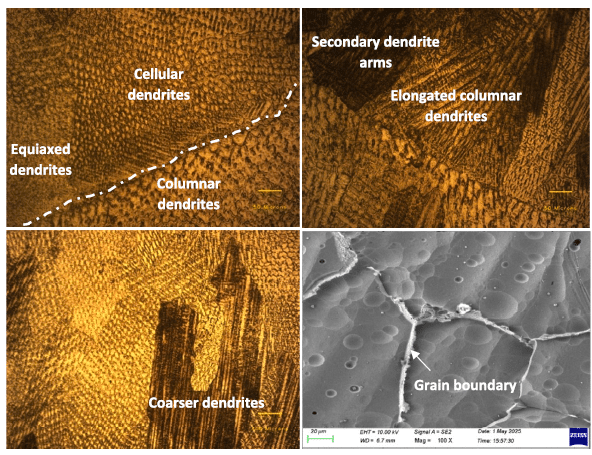
Figure 2: Crystallographic Texture Map
Texture distribution showing preferred grain orientations in the build direction. The results show that the build direction strongly governs grain growth, leading to elongated grains and anisotropic behaviour.
Grain Boundaries: The Strength Controllers
Grain boundaries play a crucial role in determining how materials respond to stress, temperature and fatigue.
Our analysis reveals a mix of:
- High-angle grain boundaries (HAGBs)
- Low-angle grain boundaries (LAGBs)
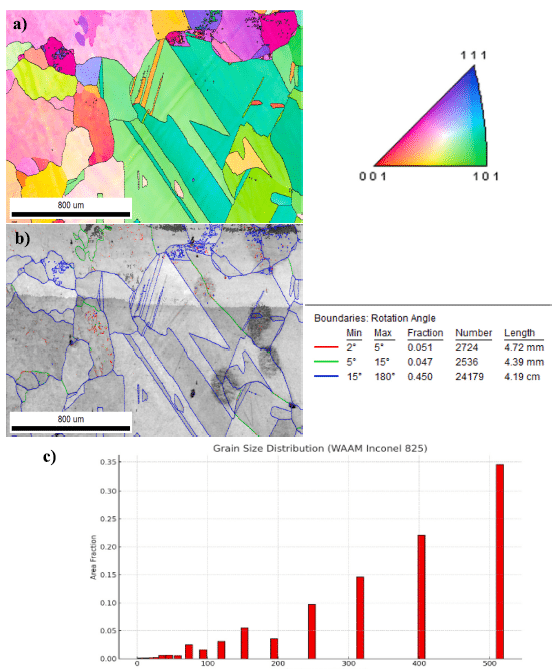
Figure 3: Grain Boundary Distribution
Distribution of high-angle and low-angle grain boundaries within the WAAM structure. A higher fraction of certain boundary types can enhance strength, while others may influence crack propagation and failure mechanisms.
Why This Matters
Understanding these microstructural features is not just academic—it directly impacts real-world applications. The performance of 3D printed metal parts depends not just on shape - but on their invisible internal architecture.
This has implications for:
- Aerospace components
- Automotive structures
- Energy sector applications
Bridging Science and Manufacturing
The study highlights the need for better control over process parameters in WAAM to achieve desired material properties.
By tuning deposition conditions, it is possible to:
- Control grain size and orientation
- Optimise mechanical performance
- Reduce defects and anisotropy
The Bigger Takeaway
Additive manufacturing is not just about building parts—it is about engineering materials from the inside out.
Read the full research article for detailed insights.
https://www.sciencedirect.com/science/article/abs/pii/S0167577X25010663