
B.Tech. vs B.Sc. in 2026: Which is Better for Your Career? (Complete Comparison)


Admissions Enquiry
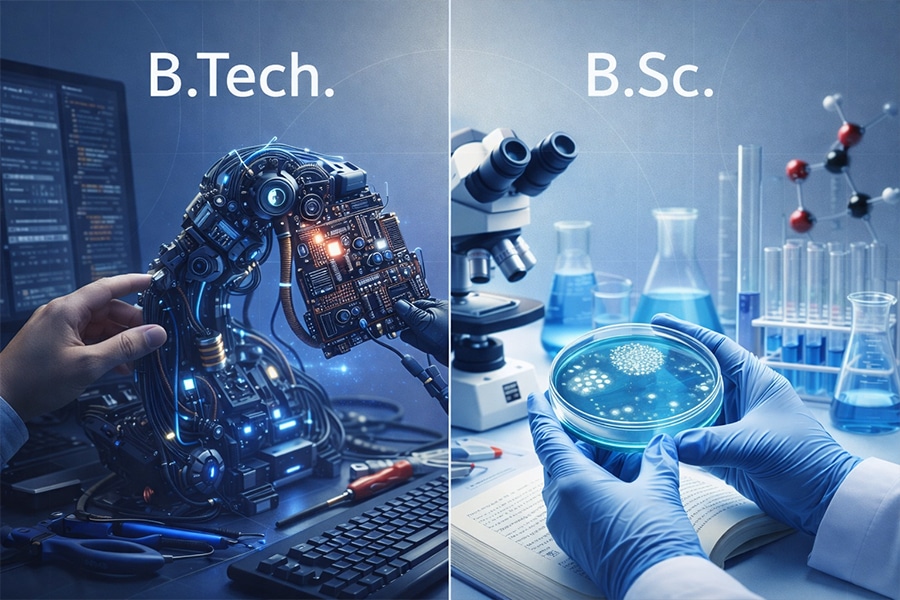
Are you also in a dilemma in choosing between B.Tech. and B.Sc.? If yes, you are at the right place. Deciding between these two courses is becoming more confusing than ever, as both offer strong career opportunities.
All India Survey on Higher Education stated that over 49.66 lakh students are enrolled in B.Sc. programmes, while around 25.15 lakh students pursue B.Tech. courses. This showcases that both degrees are highly popular choices among science stream students.
Simultaneously, industry demand is also evolving rapidly. The 2026 report by India Skills highlights that “Computer Science and IT Engineering Roles Show Employability Rates Close to 80%”. This reflects a strong demand for technical skills in emerging technologies.
As both courses offer academic and professional routes for promising futures, it's become quite difficult for you to decide which one aligns better with your goals. This guide will give a clear overview of B.Tech. vs B.Sc. so that you can make the right decision.
What is B.Tech.?
B.Tech., known as Bachelor of Technology, is a four year undergraduate programme which is focused on engineering and applied sciences. The core idea behind this course is learning how to use science and technology to solve real, complex problems.
These programmes are designed with a focus on practical learning. Students get an opportunity to work on industry projects, mandatory internships, lab participation as well as regular evaluation on technical problem-solving. Many modern universities align their curriculum with what employers are actually looking for in the engineering and technology sectors.
Popular B.Tech. Specialisations
- Computer Science Engineering (CSE)
- Civil Engineering
- Mechanical Engineering
- Information Technology (IT)
- Electronics & Computer Engineering (EComE)
- Electrical Engineering
- AI & Data Science (emerging, high demand in 2026)
What is B.Sc.?
The full form of B.Sc. is Bachelor of Science, which is a three year undergraduate course rooted in foundational as well as theoretical science. This programme is an academic path designed for students who want a deep understanding of how science works.
The course structure places a strong emphasis on conceptual understanding, research methodology and analytical thinking. Students can explore scientific principles across various disciplines and many choose to pursue M.Sc., Ph.D. or specialised roles in research and academia.
Popular B.Sc. Specialisations
- Physics
- Chemistry
- Mathematics
- Biology / Biotechnology
- Computer Science
- Data Science (growing rapidly in 2026)
- Environmental Science
- Forensic Science
B.Tech. vs B.Sc.- Key Differences
Let’s take a look at the major differences between B.Tech. and B.Sc. courses-
| Aspects | B.Tech. | B.Sc. |
| Curriculum Focus | Engineering principles, coding, systems design, labs, internships | Core sciences, mathematical theory, research methodology |
| Skill Development | Problem-solving, system design, coding, project management | Analytical thinking, research, experimental and logical reasoning |
| Industry Recognition | High- preferred by IT, engineering and product companies | Strong in academia, research labs and specialised science fields |
| Career Flexibility | Immediate entry into software, hardware, IT, consulting roles | Higher studies or niche domains like data science, biotech, academia |
| Practical Exposure | Mandatory projects, internships, labs, hackathons | Research projects, lab work, academic internships |
| Higher Study Options | M.Tech., MBA, specialised certifications | M.Sc., PhD, M.Tech. (lateral entry possible) |
| Avg. Starting Salary | ₹4-10 LPA | ₹2.5-6 LPA |
Which Course is Better for You?
The answer to this question completely depends on your interests, learning style as well as career goals. Below is a general overview that helps you make a decision-
Choose B.Tech. if you-
- Want to build a career in engineering, software or technology
- Prefer hands-on, project-based learning over theory-heavy study
- Are looking for strong campus placement support and industry exposure
- Want to enter the job market directly after graduation with competitive salaries
- Are interested in specialisations like AI, robotics, cloud computing or product development
Choose B.Sc. if you-
- Have a strong interest in core sciences- physics, chemistry, maths or biology
- Enjoy conceptual and theoretical learning more than lab-and-build work
- Are planning to pursue M.Sc., PhD or research-oriented careers
- Want flexibility to explore multiple science subjects before specialising
- Are interested in roles in academia, government research labs or healthcare sciences
Career Opportunities After B.Tech. and B.Sc.
Both degrees open a wide range of career opportunities for you. Here is a curated list of job roles you can pursue with salary insights after completion of your programme-
| B.Sc. | Avg Salary | B.Tech. | Avg Salary |
| Software Engineer | 8 LPA | Full-Stack Developer | 7 LPA |
| System Analyst | 9 LPA | Database Administrator | 7 LPA |
| Data Scientist | 12 LPA | Game Developer | 6 LPA |
| Java Developer | 5 LPA | Computer Hardware Engineer | 8 LPA |
| Website Developer | 5 LPA | Network Engineer | 5 LPA |
| Video Game Developer | 6 LPA | System Administrator | 6 LPA |
| Database Administrator | 7 LPA | Cyber Security Expert | 7 LPA |
Future Scope- B.Tech. vs B.Sc. in 2026
B.Tech.
The demand for B.Tech. graduates in 2026 is very high especially in branches like Computer Science, AI and Data Science. You will get a strong placement package from the IT sector, product companies as well as startups. Not only this, many emerging fields such as machine learning engineering, cloud infrastructure and cybersecurity are offering new roles that strongly demand B.Tech. skill sets.
If you are a graduate from a well-structured B.Tech. courses with strong internships, you can often secure offers in the 6-12 LPA range at the fresher level.
B.Sc.
B.Sc. continues to hold strong value for you if your target is research, government science roles or higher studies. In 2026, the demand for B.Sc. in Data Science, Biotechnology and Computer Science is seeing a significant growth from both industry as well as academia.
However, most students who want to move into high-paying private sector roles will need a postgraduate degree (M.Sc) or additional certifications to bridge the gap with B.Tech equivalents.
Important Factors to Consider Before Choosing
When it comes to actually deciding between B.Tech. and B.Sc., it’s important that you evaluate the crucial factors that align best with your interests, learning style and career plans. Below are some key factors to consider-
- Interest Area- Choose B.Tech. for careers in technology and engineering and B.Sc. for science and research.
- Learning Style-Tech. emphasises hands-on learning, while B.Sc. focuses on theories and concepts.
- Career Goals-Tech. is better for jobs in industry, while B.Sc. is ideal for research and teaching roles.
- Higher Studies- Sc. usually needs a master's or Ph.D., while B.Tech. helps you enter the job market faster.
- Industry Exposure- Programmes with internships and projects can improve job prospects.
Why the Right Academic Environment Matters
Your degree choice is important, but where you study also matters as it shapes the outcome.
When you choose a college for B.Tech. that offers strong industry connections, internships and active placement support, it will open very different doors than the same degree.
So when you are evaluating any course, you should look for an industry-aligned curriculum, real-world project exposure, mentorship opportunities, internship partnerships and a genuine record of employment. Courses that blend strong fundamentals with practical learning consistently ensure you are well prepared both for placements and long-term career growth.
After making a decision, the next step is to apply for B.Tech. admission at the selected university.
Conclusion
Now one thing is clear for you- both B.Tech. and B.Sc. are valuable degrees. The choice completely depends on where you want to go. Here is a quick overview for you-
- Tech. is a better choice for you if you want a direct, structured path in the engineering and technology industry with strong salary prospects.
- Choose B.Sc. course if your interest lies in science as a subject, value conceptual depth and are willing to pursue further education to achieve your career goals.
Don’t make a choice on what seems more prestigious or what your peers are choosing. Your choice should align with how you think, what you enjoy learning as well as what you want to build.
FAQs
B.Tech. generally offers higher starting salaries, especially in IT and engineering roles.
No, a 4-year B.Sc is not equivalent to B.Tech. A 4-year B.Sc focuses on theoretical science and research, while B.Tech is an engineering degree with practical, industry-oriented training.
B.Tech. CS is better for students who want to secure software engineering and industry roles, while B.Sc. CS is suitable for those interested in computer science fundamentals, research and higher studies.
B.Sc. is more theory-based, while B.Tech. involves practical and technical learning. Difficulty depends on your interest and strengths.
Yes, but many students pursue higher studies or skill-based courses to improve job opportunities.
Direct switching is not common. However, students can transition into tech roles by learning relevant skills.
Related Blogs
Cybersecurity Scope in India 2026: Jobs, Salaries, Career Scope & Emerging Trends
Key Takeaways Cybersecurity scope in India is expanding due to rising cyber threats and rapid digitalisation. Career opportunities span SOC, e...
Data Science vs Computer Science: Which Course Should You Choose After 12th?
Key Takeaways Computer Science builds software; Data Science turns data into AI-driven insights. Choose Computer Science if you enjoy coding a...
Mechatronics Engineering Scope in India: Is This the Right Career for You?
Key Takeaways Mechatronics engineering combines mechanics, electronics, software and control systems to create intelligent and automated machines...
VLSI Design Course: Scope, Salary Insights & Global Career Prospects
Key Takeaways: VLSI (Very Large Scale Integration) is the discipline behind every chip in your phone, EV and data centre server, packing millions...

Direct Admission in B.Tech. 2026: Process, Eligibility Criteria & Fee Structure
The Indian technical market continues to grow significantly and represents more than 7.4% of the Indian economy. With the landscape expanding into art...

Why a B.Tech. for Working Professionals Could Be Your Smartest Career Move
The professional landscape is changing extremely quickly and it's common for diploma and technician holders working in industry to encounter an invisi...