
VLSI Design Course: Scope, Salary Insights & Global Career Prospects


Summary: A VLSI design course teaches you how semiconductor chips are built, starting with what VLSI actually is, then moving through digital logic fundamentals, hardware description languages (Verilog/VHDL), verification and physical design. In India, where the VLSI design career scope is expanding rapidly on the back of the India Semiconductor Mission (ISM), the right course is less about ticking off topics and more about which pathway (short certification or a full engineering degree) actually gets you industry-ready.
Key Takeaways:
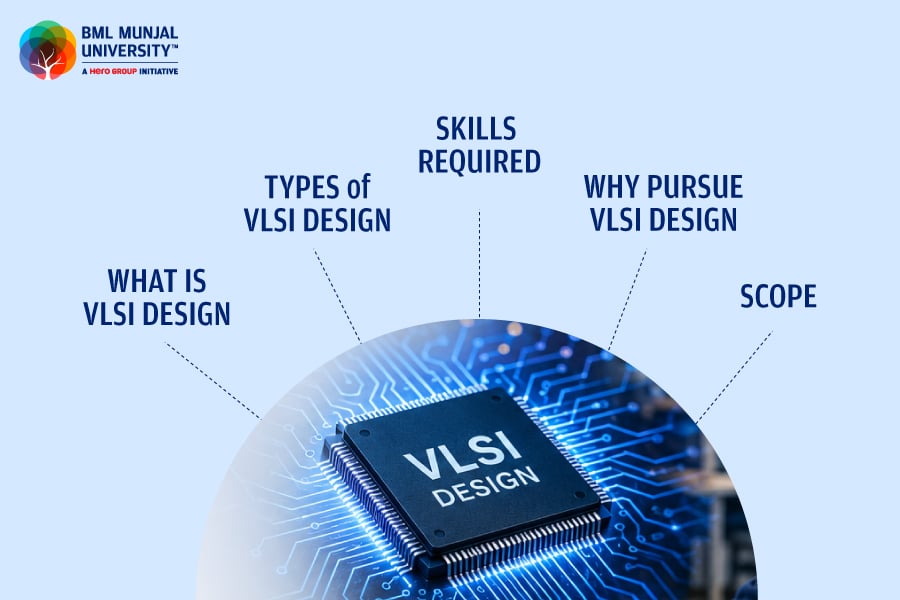
- VLSI (Very Large Scale Integration) is the discipline behind every chip in your phone, EV and data centre server, packing millions of transistors onto a single sliver of silicon.
- A VLSI design course covers digital logic, RTL/Verilog, verification (SystemVerilog/UVM) and physical design (floorplanning, placement, routing).
- India's VLSI career scope is genuinely strong, backed by government investment, global design centres and a talent shortage of roughly 10 lakh skilled professionals.
- Entry-level salaries typically start around ₹4.3 to 7 LPA, rising to ₹22+ LPA for experienced engineers at top firms.
- Success requires both fundamentals (digital logic, HDL) and tool fluency (SystemVerilog, Cadence/Synopsys), not one without the other.
- Beyond private companies like Intel and NVIDIA, VLSI engineers also find opportunities in ISRO, DRDO and PSU defence manufacturing.
- VLSI skills transfer globally, with Taiwan, South Korea, Germany and Silicon Valley all offering strong career mobility.
- A full time B.Tech with a VLSI specialisation gives you both the depth and the portfolio recruiters actually screen for.
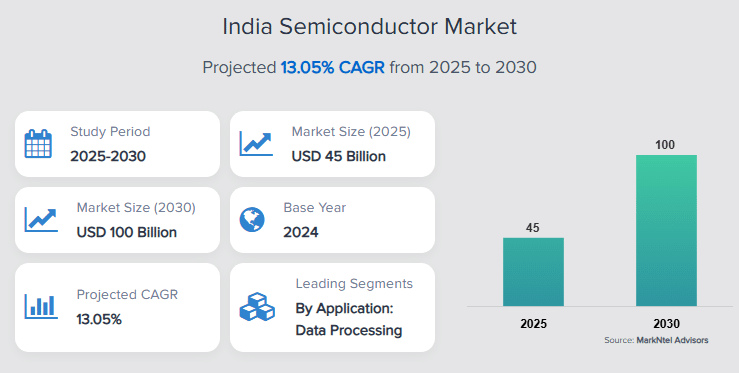
If you've searched "VLSI design course", you've probably noticed the results are a mix of Udemy videos and postgraduate certifications, with no clear answer on which one actually leads to a job. With India's semiconductor market projected to cross $100 Billion by 2030 and the country alone is expected to generate around 10 lakh new semiconductor jobs by 2032, the demand for skilled VLSI engineers is rising rapidly.
However, employers nowadays are looking for candidates with practical, industry-ready skills, not just certificates. That's why choosing a course with hands-on projects, exposure to industry-standard tools and strong placement support can make a significant difference in turning your learning into a lucrative career. For your help, this article breaks down what a VLSI design course covers, why India's VLSI job market is heating up, who should consider this path and how a structured B.Tech. route compares to standalone certifications.
What is VLSI?
VLSI (Very Large Scale Integration) is the engineering discipline that packs millions, sometimes billions, of transistors onto a single sliver of silicon. It's the reason a chip smaller than your fingernail can run an entire smartphone, EV control system or data-centre server. Typically, a VLSI engineer:
- Writes the blueprint (describing circuit behaviour in a hardware description language (Verilog/VHDL))
- Stress-tests it exhaustively (simulating the design against every scenario it might encounter, since testing after fabrication isn't an option)
- Negotiates trade-offs (every design decision trades off power, performance and chip area against each other; you can't maximise all three at once)
- Finalises the physical blueprint (translating verified logic into an exact layout a fabrication plant can manufacture)
What makes this discipline unlike software engineering is the stakes attached to that last step: a shipped chip can't be patched. A bug that slips through becomes a permanent, physical defect baked into every unit manufactured from that design. That single fact is why VLSI demands a level of precision most engineering fields never have to sustain and why engineers who've mastered it are consistently hard to replace.
What Does a VLSI Design Course Actually Teach You?
A VLSI design course builds your understanding of how a chip moves from a written specification to a manufacturable layout. Most structured programmes are organised around three stages: RTL design, verification and physical design. You'll typically start with digital logic and Boolean algebra, move into Verilog or VHDL for describing circuit behaviour and finish with tools that convert your logic into a physical layout ready for fabrication.
Core Topics Include:
- Digital logic design (combinational and sequential circuits, FSMs)
- Hardware description languages like Verilog and VHDL
- Design verification using SystemVerilog and UVM
- Physical design involving floorplanning, placement, clock tree synthesis, routing, etc
- ASIC and FPGA development flow, including DFT (Design-for-Test)
Why Do Structured VLSI Programmes Matter?
A short certification can teach you Verilog syntax in a few weeks; it can't give you the depth to actually debug a failing testbench or close timing on a real design. Structured programmes (like a full-time B.Tech with a VLSI specialisation) build that depth deliberately: you move through digital logic, RTL, verification and physical design in sequence, with each stage reinforcing the last, rather than jumping straight to tool usage.
This matters because recruiters aren't hiring for course completion; they're hiring for design exposure. A structured programme typically includes lab work, tape-out-style projects and access to industry-standard EDA tools (Cadence, Synopsys), which is exactly the "real design exposure" a short certification usually can't replicate in 4-8 weeks.
Different Types of VLSI Design Courses
| Course Type | Best For | Typical Duration | Depth |
| Fundamentals & Basics (e.g., digital design, inverter design) | Absolute beginners | 4-8 weeks | Conceptual |
| Job-Oriented Training (industry-focused institutes) | Freshers seeking placement | 3-6 months | Practical, tool-based |
| Advanced & Certification (e.g., FinFET, UVM verification) | Career switchers, specialists | 20 weeks+ | Deep, project-driven |
| Full-time B.Tech with VLSI specialisation | Students planning a long-term core engineering career | 4 years | Comprehensive + portfolio |
Most short courses cover one slice of this flow well but leave you without exposure to how the pieces connect, which is exactly what a four-year, project-based programme is designed to cover.
Why Is VLSI Design Career Scope in India Growing So Fast?
India's VLSI design career scope is expanding because of a rare combination: government policy, global capacity shifts and rising local design work. The India Semiconductor Mission (ISM) 2.0 has directed sustained investment into chip design and advancing fabrication and multiple global semiconductor companies now run substantial design centres out of India rather than treating it purely as a support hub.
What's Driving the Demand:
- India Semiconductor Mission (ISM) 2.0 incentives accelerating local chip design investment
- Global design centres for companies like Intel, Qualcomm, NVIDIA, AMD and Texas Instruments based in India
- EDA leaders Synopsys and Cadence expanding their India engineering teams
- Rising complexity from AI accelerators, open-source RISC-V architectures and chiplet designs, all needing skilled engineers
- A structural talent shortage as VLSI has a high barrier to entry, which keeps demand ahead of supply
This is a field where India isn't just consuming semiconductor technology anymore, but also designing a growing share of it and that shift is what's reshaping the career scope for engineers entering now.
Emerging Domains for VLSI Engineers
- AI accelerators and custom silicon
- Open-source RISC-V architecture adoption
- Chiplet-based design and advanced packaging
- EV and smart-mobility semiconductor systems
Who Should Take a VLSI Design Course?
Not every ECE or CS student needs to specialise in VLSI, but three groups consistently benefit most from a structured pathway into it.
- Electronics/ECE students: Your core subjects (digital electronics, semiconductor devices) already overlap heavily with VLSI; therefore, specialising in this area deepens what you're already learning.
- Career switchers from embedded systems or software: You'll need to build hardware fundamentals from scratch, but programming and debugging instincts transfer well.
- Working professionals upskilling for physical design or verification: If you're already in VLSI and want to move into a specialised, higher-paying niche.
If your interest is in solving problems close to the hardware, where a bug can't just be patched with a software update, VLSI rewards that mindset more than almost any other engineering discipline.
Skills Required for a Successful VLSI Career
VLSI rewards a specific mix of fundamentals and tooling fluency, not just one or the other. Strong candidates typically combine:
- Digital logic fundamentals- Boolean algebra, combinational/sequential design, FSMs
- HDL proficiency- Verilog and/or VHDL, written well enough to synthesise cleanly
- Verification skills- SystemVerilog, UVM and the ability to write testbenches that actually catch bugs
- Physical design know-how- Floorplanning, placement, clock tree synthesis, timing closure
- EDA tool familiarity- Hands-on comfort with Cadence, Synopsys or similar industry tools
- Problem-solving under constraints- Chip design is a constant trade-off between power, performance and area (PPA)
Recruiters generally screen for the second and third points hardest, since they're the clearest signal of real design exposure versus theoretical knowledge.
Top Reasons to Pursue a Career in VLSI Design
Pursuing a career in VLSI design offers unparalleled opportunities. The top reasons include:
- Genuine talent shortage- India's semiconductor industry is short by roughly 10 lakh skilled workers, which means demand is outpacing supply, not the other way around
- Strong earning potential- Entry-level salaries start around ₹5-12 LPA, with senior architects earning ₹30-50+ LPA
- Government-backed momentum- The India Semiconductor Mission is actively funding fabs and R&D centres, signalling long-term structural investment, not a passing trend
- Global mobility- VLSI skills transfer directly to Taiwan, South Korea, Germany and Silicon Valley
- Recession-resistant demand- Every future technology (AI, 5G, EVs, IoT) ultimately runs on silicon, so VLSI sits upstream of nearly every other tech trend
How to Start a Career in VLSI Design in India?
Getting into VLSI design isn't only about finishing a course, but about following a sequence that builds toward a recognisable, demonstrable skill set.
- Build digital logic fundamentals before touching any HDL.
- Learn Verilog or VHDL through hands-on circuit modelling, not just syntax.
- Choose a specialisation early from RTL design, verification, physical design or DFT.
- Work on at least one end-to-end project that goes from RTL to a synthesised layout.
- Get exposure to industry-standard EDA tools (Cadence, Synopsys or equivalents).
- Validate your learning through an internship or structured industry practicum.
Most standalone courses stop after step 2 or 3. What actually differentiates candidates in interviews is step 4, which is a real, end-to-end project. That’s why BML Munjal University has built its B.Tech programme around a named methodology rather than isolated coursework: the Applied Engineering Portfolio (AEP).
Instead of treating VLSI as a single semester's syllabus, the AEP structures learning so that every VLSI-specialisation student progresses from foundational builds in Year 1 to an industry-grade, deployable chip-design project by Year 4. This means you will graduate with a portfolio, not just a transcript.
Is VLSI Design a Good Career Choice? Top Roles with Salary Insights
Yes! VLSI is considered one of the more future-proof engineering careers in India, largely because it's difficult to enter (steep learning curve, strong fundamentals required) but highly rewarding once you do.
Salary by Experience Level for Popular Roles:
| Role | Avg. Salary in India (0-1yr) | High-End Salary |
| VLSI / RTL Design Engineer | ₹4L-₹11.5L/yr | ₹10.0L - ₹60.0L/yr |
| Physical Design Engineer | ₹4L - ₹6L /yr | ₹50.0L - ₹55.0L/yr |
| Verification Engineer | ₹4L - ₹13.7L /yr | ₹25.0L - ₹35.0L/yr |
| DFT Engineer | ₹3L - ₹12.8L /yr | ₹40.0L - ₹44.0L/yr |
| Embedded Systems Engineer | ₹3L - ₹6L /yr | ₹16L-₹18L/yr |
| Hardware Design Engineer | ₹4L - ₹8L /yr | ₹10.5L - ₹24.3L/yr |
| IoT Engineer | ₹2L - ₹4L /yr | ₹20.0L - ₹24.0L/yr |
| Robotics & Automation Engineer | ₹2L - ₹8L /yr | ₹47.5L - ₹52.3L/yr |
Source: Salary estimates are based on Glassdoor salary insights.
Top Hiring Companies for VLSI Engineers
India's semiconductor boom has brought a wide mix of global chip giants and EDA leaders to actively hire VLSI talent, spanning design, verification and tooling roles.
| Company | VLSI Focus Area |
| Intel | Processor design, advanced packaging |
| Qualcomm | 5G chipsets, smartphone SoCs |
| NVIDIA | GPU architecture, AI accelerators |
| AMD | CPU/GPU design, data-centre silicon |
| Texas Instruments | Analogue and mixed-signal IC design |
| Synopsys | EDA tools, design automation |
| Cadence Design Systems | EDA tools, verification platforms |
Government, PSU, and Defence Sector Opportunities
Beyond private semiconductor companies, India's public sector offers a parallel — and often overlooked — career track for VLSI engineers. Backed by the India Semiconductor Mission's push for self-reliant chip design, government bodies and defence research organisations are increasingly building in-house hardware design capability rather than depending on imported systems.
- ISRO: Communication and satellite hardware systems
- DRDO: Defence electronics and secure chip design
- PSU Electronics & Defence Manufacturing Units: Indigenous chip and hardware development for strategic sectors
Global Career Prospects in VLSI and Chip Design
VLSI is one of the few engineering disciplines where skills transfer almost directly across borders, since chip design flows and tools are standardised globally. This makes international mobility a realistic option for experienced engineers.
| Global Hub | Known For |
| Silicon Valley, USA | Product companies, cutting-edge R&D |
| Taiwan | Foundry and fabrication (TSMC ecosystem) |
| South Korea | Memory and semiconductor manufacturing |
| Germany | Automotive-grade chip design |
| Japan | Precision electronics, embedded systems |
Where Can You Study VLSI Design in India?
Once you've decided VLSI is the direction you want, the next decision is where you build that foundation and this is where the pathway matters as much as the subject matter itself.
BML Munjal University (BMU), an initiative of the Hero Group, offers VLSI Design as a specialisation within its B.Tech programme. Rather than isolating VLSI into a single course, the university embeds it within a four-year system-building journey:
- NVIDIA-powered AI infrastructure, including a DGX H200 setup, giving students access to high-performance computing environments similar to those used in industry chip-design teams.
- 30+ advanced labs, spanning AI & Advanced Data Computing, Cyber-Physical Systems, IoT & Edge and dedicated Electronics & Computing labs (Mechatronics, Instrumentation, Microprocessors).
- Practice School I, II and III provide structured industry exposure that validates classroom learning against real engineering environments before graduation.
- Placement outcomes that reflect this integration: ₹59.35 LPA highest CTC, ₹19.38 LPA top 10% average and ₹14.09 LPA top 25% average.
This means a student choosing VLSI Design at BML Munjal University isn't just completing a course, but also building a portfolio of real systems, validated through practice schools and supported by infrastructure built for actual chip-design and AI workloads.
Conclusion
A VLSI design course can mean anything from a four-week Udemy primer to a fully structured engineering degree and the difference between the two is the difference between knowing the concepts and being able to build with them. Given how fast India's VLSI design career scope is expanding, backed by the India Semiconductor Mission and growing global design centres, the smarter long-term move is a programme that combines strong fundamentals with real, end-to-end project exposure.
If you're evaluating where to start that journey, explore BML Munjal University's B.Tech programme with a VLSI Design specialisation and see how the Applied Engineering Portfolio can take you from foundational builds to an industry-grade capstone. Apply Now!
FAQs
Yes, but to an extent. NPTEL courses from IIT faculty and curated free lists (Digital Circuits, Verilog modelling, VLSI Physical Design) can build strong fundamentals. However, free resources rarely include hands-on EDA tool access or mentorship, which most recruiters expect to see demonstrated.
The best VLSI design course depends on your starting point: beginners benefit from fundamentals-first programmes, while those wanting a placement-ready outcome should prioritise courses (or degrees) with project-based, tool-driven learning over lecture-only formats.
VLSI has a steeper learning curve than many software-focused fields because it requires strong fundamentals in digital electronics and physics. It isn’t inherently “harder,” but it does demand more patience before concepts click into practical skill.
Entry-level VLSI design engineers in India typically earn ₹4-11.5 LPA on average, with high-end packages at top semiconductor firms reaching up to ₹60 LPA at senior levels.
Neither is objectively “better”. VLSI suits those drawn to hardware-level, physics-grounded problem-solving, while CSE offers broader and faster-moving software career paths. The right choice depends on where your interest genuinely lies.
No. AI is increasing demand for VLSI engineers, since AI accelerators, custom silicon and chiplet designs all require more chip-design talent, not less.
Yes. Google actively hires ASIC and VLSI engineers for its custom silicon teams, especially around the Tensor Processing Unit (TPU), its in-house AI chip. Roles span RTL design, verification and physical design, making VLSI skills core to how Google builds its AI infrastructure.
Neither is objectively “better”. AI is a software discipline, while VLSI builds the hardware those models run on. The two are converging, not competing: AI’s growth is driving more demand for custom chips, so choose based on whether you’re drawn to hardware-level problem-solving or software and models.
Not really! It’s core hardware engineering. You’ll use software tools extensively, but the discipline sits closer to electronics and physics than to conventional IT roles.
Related Blogs
Cybersecurity Scope in India 2026: Jobs, Salaries, Career Scope & Emerging Trends
Key Takeaways Cybersecurity scope in India is expanding due to rising cyber threats and rapid digitalisation. Career opportunities span SOC, e...

Data Science vs Computer Science: Which Course Should You Choose After 12th?
Key Takeaways Computer Science builds software; Data Science turns data into AI-driven insights. Choose Computer Science if you enjoy coding a...
Mechatronics Engineering Scope in India: Is This the Right Career for You?
Key Takeaways Mechatronics engineering combines mechanics, electronics, software and control systems to create intelligent and automated machines...

Direct Admission in B.Tech. 2026: Process, Eligibility Criteria & Fee Structure
The Indian technical market continues to grow significantly and represents more than 7.4% of the Indian economy. With the landscape expanding into art...

Why a B.Tech. for Working Professionals Could Be Your Smartest Career Move
The professional landscape is changing extremely quickly and it's common for diploma and technician holders working in industry to encounter an invisi...

B.Tech. for Working Professionals: The Complete Regulatory Compliance & ROI Guide 2026
A Diploma and years of hands-on Mechanical Engineering experience should open bigger career opportunities. But for many working professionals, growth ...