

BA Subjects List: Top Specialisations, Subject Combinations & Year-wise Course Structure


Admissions Enquiry
[In Summary: A BA degree offers subjects such as Psychology, Economics, Sociology, Literature and History, with options to specialise through BA (Hons). This guide covers the complete BA subjects list, course structure, popular subject combinations, career scope and salaries to help you choose the right specialisation.]

Key Takeaways:
- A BA degree typically covers subjects such as Psychology, Economics, Sociology, Literature, History, Political Science and Philosophy.
- BA General provides broader exposure to multiple subjects, while BA (Hons) offers in-depth specialisation in one discipline.
- Popular BA subject combinations can support career paths in civil services, media, finance, analytics, research and public policy.
- Entry-level BA salaries in India generally range from ₹3 LPA to ₹7 LPA, depending on the specialisation, skills and sector.
Hundreds of thousands of students around the country finish Class 12 each year and ask themselves, "What do I want to do now?"
If you are a student interested in the humanities, the arts and the social sciences, a Bachelor of Arts (BA) course is the most flexible, adaptable and valuable path.
Growth in India's media industry, content market, public sector expansion and high demand for social and public policy research mean that BA grads are more employable now than they have been previously. If you are considering your post-Class 12 options, exploring the full BA subjects list is where your research needs to start.
This blog covers the complete BA all subject list, honours specialisations, semester-wise structure, salary expectations and how to select the right pathway for career success after Class 12.
What is a BA Degree?
A Bachelor of Arts (BA) is a three-year undergraduate degree focused on the humanities, social sciences and liberal arts, covering subjects such as Psychology, Economics, Sociology, Literature, History and Political Science. It builds analytical, communication and research skills that apply across careers in media, policy, business, law and education.
Under India's National Education Policy (NEP 2020), the BA structure has become more flexible, letting students combine a major discipline with electives, minors and skill-based courses instead of following one rigid subject track.
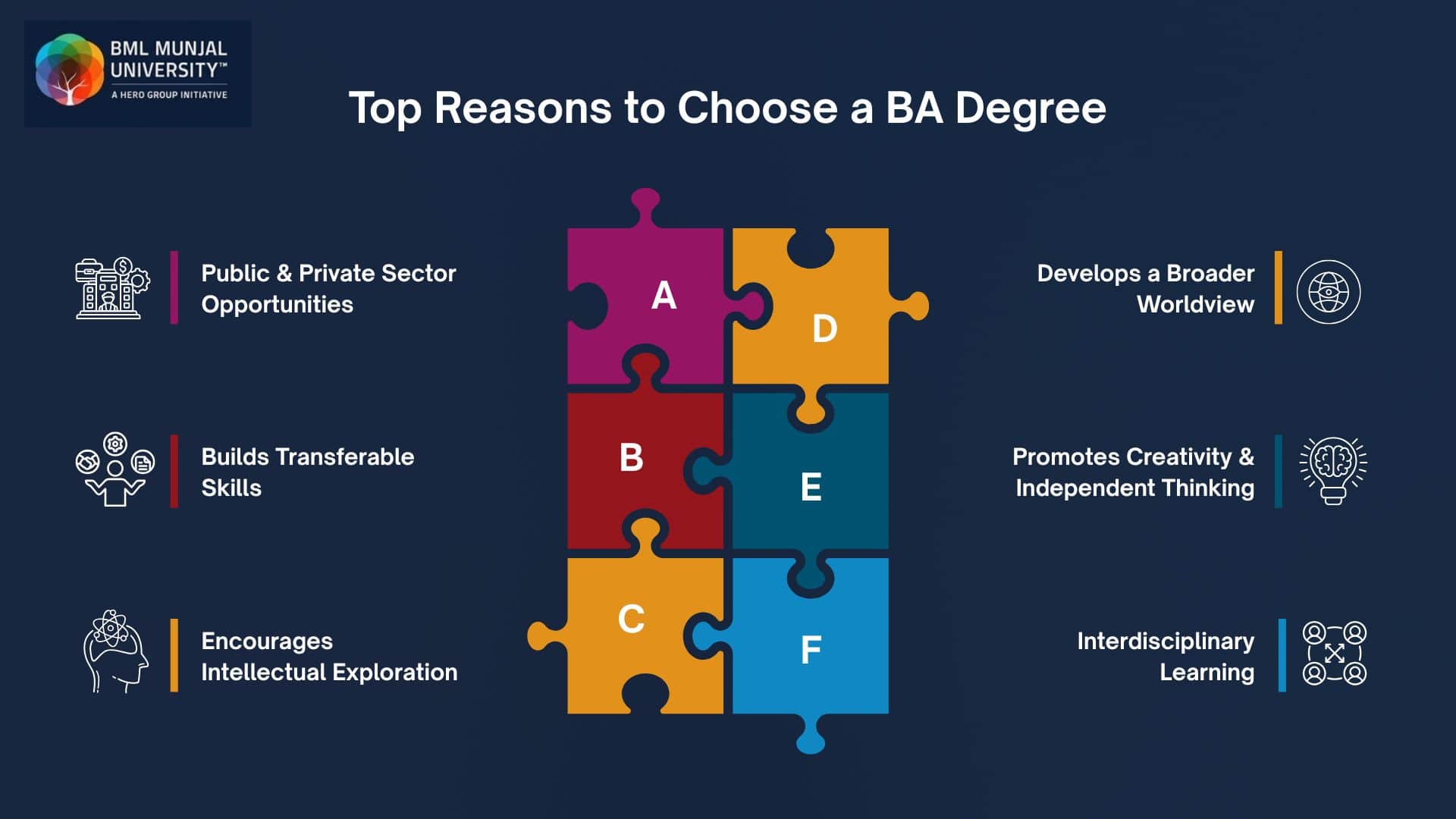
Why Is It Important to Know the BA Subjects List?
Understanding the BA subjects list before choosing a specialisation can help you make informed academic and career decisions. Knowing what each subject covers allows you to select a programme that aligns with your interests, strengths as well as future goals.
- Choose the right specialisation based on your interests and career aspirations.
- Plan your career early by understanding the opportunities linked to different subjects.
- Identify your strengths and interests by exploring different areas of study.
- Make informed academic decisions when selecting core subjects, electives and specialisations.
BA Subjects List- General Overview
The structure of a BA degree has evolved significantly under NEP. Today, students have more flexibility than ever to mix and match BA subjects based on their interests. Generally, the curriculum is divided into three categories-
- Core Subjects- the primary subjects you choose to specialise in
- Electives- additional subjects that complement your major (e.g., an Economics student taking Psychology)
- Ability Enhancement Courses- focused on communication, environmental science or digital literacy
How Is a BA Course Structured Across Three Years?
A three-year BA programme is typically divided into six semesters, with the curriculum progressing from foundational courses to advanced electives and practical or research-based learning. The exact structure may vary depending on the university, specialisation and curriculum framework. Below is a general breakdown of the BA subjects list year-wise-
| Year | Semesters | What You Typically Study |
| First Year | Semesters 1-2 | Foundational papers in the chosen discipline, along with Ability Enhancement Courses such as communication and environmental studies. |
| Second Year | Semesters 3-4 | Discipline-specific core papers and advanced electives, often with an introduction to research methodology. |
| Final Year | Semesters 5-6 | Advanced and career-focused electives, often accompanied by a research project, dissertation or internship component. |
What Are the Different Types of BA Courses?
BA courses are available in different formats based on the level of specialisation, learning mode as well as career goals. The main types of BA courses include-
- General BA- A multidisciplinary undergraduate programme covering subjects from the arts, humanities and social sciences.
- BA (Hons.)- A specialised degree centred on one primary academic discipline.
- Vocational BA- A skill-focused programme that combines academic learning with practical training for specific career fields.
- Integrated BA Programmes- Combine a BA with another degree, such as BA LLB or BA B.Ed., within a structured programme.
- Online BA- A flexible mode of pursuing a BA degree through online classes and digital learning platforms.
BA General vs BA Honours
The most common question students ask is- "What is the difference?"
- BA General- offers a broad overview of multiple arts subjects. You might study History, Political Science and English simultaneously without focusing on just one.
- BA Honours- involves an in-depth, research-oriented study of a single discipline. If you choose BA Honours subjects, you dive deeper into that specific field, such as teaching, research or specialised corporate roles.
What Subjects Are Included in a BA Course?
Below is the most widely offered BA subjects list in India, along with what you study, the skills you develop and the career paths you can pursue.
| Subject | What You Study | Core Skills Developed | Career Paths |
| Psychology | Human Behaviour, Mental Processes and Clinical Health | Empathy, data analysis, observation | Counselling, HR, User Research |
| Economics | Micro/Macroeconomics, Indian Economy and Statistics | Logical reasoning, financial literacy | Banking, Data Analytics, Policy |
| Sociology | Social Institutions, Culture and Group Dynamics | Critical thinking, cultural awareness | Social Work, NGO Management, PR |
| Literature | Classic and Modern Texts, Linguistics and Criticism | Communication, creative writing | Content Strategy, Journalism, Publishing |
| History | Ancient and Modern World History, Archaeology | Research, archival skills, objectivity | Civil Services, Museums, Research |
| Political Science | Political theories, constitution and global relations | Analytical thinking, legal awareness | Law, Public Policy, Politics |
| Philosophy | Ethics, logic and the nature of existence. | Problem-solving, ethical reasoning | Corporate Ethics, Law, Education |
Compulsory vs Elective Subjects in BA
Compulsory subjects are papers every student in a programme must clear, regardless of specialisation- commonly English/Communication, Environmental Science and a foundation course in the major. On the other hand, elective subjects are chosen by the student to complement their core discipline, such as a Sociology major picking a Psychology or Data Science elective to broaden their skill set.
What Are the Most Popular BA Subject Combinations?
Your subject combination shapes not just what you study, but what you are eligible to pursue afterwards. Here is the list of some common BA subject combinations-
A. For Civil Services and Government Exam Aspirants
The combination of Political Science, History and Sociology (or Public Administration) is highly recommended for candidates preparing for UPSC and State PSC exams. This trio effectively encompasses Indian politics, historical perspectives and social issues in a unified approach.
B. For Media, Journalism and Communication Careers
Combining English/Literature, Journalism and Psychology is an effective pathway for media careers. Literature enhances writing skills, Journalism provides industry insight and Psychology offers insight into how audiences interpret information.
C. For Finance, Economics and Data-Focused Careers
A degree in Economics, along with Statistics/Math and Psychology is ideal if you are pursuing careers in banking, data analytics or research. This combination merges financial insight with quantitative and behavioural abilities.
What Are the Top BA Specialisations and Their Career Prospects?
While the full BA subjects list spans a wide range, certain specialisations have grown significantly in popularity due to their career relevance and the skills they develop. Here is a closer look at five high-demand BA Honours specialisations, along with typical entry-level salary ranges in India.
1. BA Psychology
A graduate with a BA Psychology degree applies psychological knowledge to human behaviour, mental illness and cognitive processes.
Students can pursue jobs in clinical settings, human resource management, user experience design and educational counselling.
Starting Salary- ₹2.28 LPA-₹3.96 LPA, rising with certifications in counselling or HR specialisation.
2. BA Economics
A BA Economics degree graduate becomes skilled in data analysis, financial reasoning and policy-making.
They will explore career opportunities that include Banking and Finance, Civil Service, Corporate Research and Public Policy Consulting.
Expected Starting Salary- ₹2.88 LPA-₹3.12 LPA, among the higher-paying BA specialisations due to analytical demand.
3. BA Sociology
In a BA in Sociology, students will build an understanding of how societies operate, the nature of inequality and how institutions influence human behaviour.
Graduates can get a job in NGOs, social enterprises, government welfare agencies, research institutions and journalism or media.
Average Fresher Salary- ₹3 LPA-₹4 LPA, with higher packages in policy research and development-sector roles.
4. BA Literature
With the Indian content industry booming, strong writing and communication skills are in high demand.
A BA in Literature graduate can find opportunities in Content Writing, Editing, Publishing, Media, Academia and Communications for students.
Typical Starting Salary- ₹5.76 LPA-₹6.24 LPA, with content strategy and media roles trending upward.
5. BA History
Graduates with a BA in History degree carry a background in a traditional discipline, but research, writing and analytical skills open opportunities in today's job market.
They can work as Historians, Academic Educators, Museum Curators, Archivists, Documentary Filmmakers and Historical Preservationists.
Average Salary- Usually ₹4-5 LPA, with strong long-term scope in Civil Services and academia.
How to Choose the Right BA Specialisation
When it comes to selecting from the BA subjects list, it shouldn't be a guessing game. You should choose based on your-
1. Career Goals
If you plan on an MBA, Economics or Psychology are strong foundations. If Law is the goal, Political Science or Sociology provides the best context.
2. Interest
You might like watching historical documentaries, but do you enjoy archival research? Align your choice with what genuinely holds your attention day to day, not just what sounds appealing.
3. Subject Comfort
Look for programmes that let you pair a major, like Economics, with a minor, like Data Science, so your comfort level with quantitative or qualitative work is balanced across your workload.
Why Choose BML Munjal University for BA (Hons)?
Once you have selected the BA specialisation that matches your interests and career goals, the next step is choosing a university that allows you to explore the subject beyond the classroom. The School of Liberal Studies at BML Munjal University (BMU) blends interdisciplinary learning with immersive experiences, research and practical exposure to help students build skills relevant to a changing world.
Reasons that make BML Munjal University stand out-
- Choose from Five BA (Hons) Programmes- Pursue a BA (Hons) in Economics, Psychology, Sociology, Literature or History based on your academic interests and career aspirations.
- Learn Through Immersive Experiences- The School follows an immersive approach to learning, which helps you connect academic concepts with real-world issues and experiences.
- Build Future-Ready Skills- The learning environment is designed to strengthen communication, critical thinking and problem-solving skills while encouraging you to engage with diverse perspectives.
- Gain Research and Practical Exposure- You can undertake individual research, internships and vocational training in the final year, adding practical experience to your academic learning.
- Develop an Interdisciplinary Perspective- Learn to examine complex social, economic and cultural issues from multiple perspectives rather than studying your chosen discipline in isolation.
- Explore Global Learning Opportunities- Immersive programmes and exposure to diverse perspectives help you to develop a broader understanding of contemporary global challenges.
Choosing the right BA specialisation gives you direction and finding the right learning environment can shape how you apply that knowledge. BML Munjal University aims to combine academic depth with research, experiential learning and interdisciplinary exposure to prepare you for diverse career and higher education pathways.
Conclusion
A BA degree is no longer limited to a traditional set of arts subjects. With specialisations ranging from Psychology and Economics to Sociology, Literature and History, you can shape your academic journey around your interests, strengths and long-term career goals.
The key is to look beyond the BA subjects list and understand what each specialisation teaches, the skills it develops and where it can lead. You should compare the curriculum, subject combinations, career scope and learning opportunities before making your choice. The right BA specialisation, supported by practical exposure, research and interdisciplinary learning, can help you build a strong foundation for careers across business, policy, media and many other fields.
Choose a subject you are genuinely curious about, but also consider how the programme can help you turn that interest into skills and opportunities for the future.
FAQs
Common BA subjects include Psychology, Economics, Sociology, History, Literature and Political Science, alongside compulsory communication and environmental studies papers.
A BA programme typically has 24-30 subjects in total across three years, combining core papers, electives and skill-enhancement courses.
Most universities require 2-3 compulsory papers in BA 1st year, typically English/Communication, Environmental Science and a foundation course in the chosen major.
The five most popular BA subjects are Psychology, Economics, Sociology, Literature and History, based on demand and career scope.
BA first-year students usually study 5 to 7 subjects per semester, including core papers, electives and skill enhancement courses.
The best BA course depends on your career goal: Economics and Psychology suit MBA-bound students, Political Science and Sociology suit Law and UPSC aspirants and Literature suits media and content careers.
BA Psychology and BA Economics are currently the most in-demand specialisations in India, driven by growth in HR, UX research, banking and data analytics roles.
Yes. A BA, especially with Political Science, History or Sociology, is one of the strongest foundations for UPSC, SSC, Banking (IBPS) and State PSC exams.
Economics is often considered the most challenging BA subject due to its statistical and analytical rigour, though difficulty ultimately depends on individual aptitude and interest.
For journalism, a BA in Literature or Journalism & Mass Communication works best; for psychology-focused careers, BA Psychology; and for finance or analytics, BA Economics is the strongest fit.
Entry-level BA graduate salaries in India typically range from ₹3 LPA to ₹7 LPA, depending on specialisation, skills and sector, with corporate, banking and policy roles at the higher end.
Related Blogs

Top Career Options After BA (Hons) Sociology: Jobs, Salary & Emerging Opportunities
Sociology is the study of society, human behaviour, social relationships and the social systems that influence how people live, work and interact. It ...

How to Become a Clinical Psychologist After 12th – Step-by-Step Guide
India is witnessing a significant rise in mental health awareness. From schools and colleges to workplaces and hospitals, conversations around emotion...

What Can You Do With a BA History Degree? Top Career Paths in 2026
Here is a question you have probably heard or quietly asked yourself: “What exactly do you do with a history degree?” The honest answer to t...

Liberal Arts: The Degree That Prepares You for Jobs That Don’t Exist Yet
Have you ever felt like the degrees that colleges offer are lacking some or the other thing for you? Have you felt like “yes, biotechnology is impor...

When You Can’t Be Replaced by AI, It’s Probably Because You Studied Liberal Studies
As we are seeing AI evolving day by day, some fearful headlines are also getting space in the social media posts, news articles and discussions over c...

How a BA in Liberal Arts Degree Prepares You to Lead in the Age of AI
Every sector — from public policy to media houses, multinational corporations to tech start-ups — now values professionals who can connect ideas a...