

Commerce Without Maths Scope: Top Courses, Eligibility Criteria & Salary Insights


Admissions Enquiry
Summary: Commerce without maths scope covers management, law, media, digital marketing, hospitality and entrepreneurship, fields that hire for business understanding and communication rather than Class 12th mathematics. Beyond BBA and B.Com, options like BA Economics, BMS and BHM widen the field further, alongside certifications like CS, CMA and ACCA that need no maths background. Only a narrow set of quantitative specialisations stay restricted, everything else, including both private and government career paths, remains fully open.
Key Takeaways
- Commerce without maths keeps management, law, media, digital marketing, hospitality and entrepreneurship fully open to you.
- Beyond BBA and B.Com, options like BA Economics, BMS, BJMC and BHM broaden your choices further.
- Company Secretary (CS), CMA Foundation and ACCA are professional certifications that do not require Class 12th maths and can run alongside a degree.
- Both private-sector roles (management trainee, digital marketing, compliance) and government paths (SSC CGL, Bank PO, RBI) stay open regardless of your Class 12th subject choice.
- Corporate law and Company Secretary roles show the sharpest salary growth by year 5-6, often crossing ₹15-25 LPA.
- MBA eligibility later is unaffected by your Class 12th subject choice, it depends on your graduation performance and entrance exam score.
- Only a narrow set of quantitative specialisations (actuarial science, certain Honours programmes) are genuinely restricted without maths.
Dropping maths after Class 10th does not close off a serious commerce career and hiring data backs that up directly. Commerce without maths scope stays wide open across management, law, media, digital marketing, hospitality and entrepreneurship, all of which recruit for business understanding and communication rather than Class 12th mathematics. Recruiters are evaluating skills and experience, not the subject you chose to leave out.
What lies ahead in this blog covers which courses fit which kind of student, what each path realistically pays by year five, how employers weigh your degree against your subject choice at 16 and where commerce without maths falls short of commerce with maths, so you can make the call with the full picture rather than a partial one.
Does Choosing Commerce Without Maths Really Limit Your Career?
No, for the large majority of career goals, dropping maths after Class 10th does not meaningfully limit your options. What it restricts is a small, specific set of quantitative paths: actuarial science, Honours-level B.Com or Economics at some universities and roles built entirely around statistical modelling. Management, law, media, hospitality, digital marketing and entrepreneurship were never behind that door.
The more useful framing: Instead of asking whether you limited yourself, ask whether what you actually want to do needs maths. For most commerce students, the honest answer is no and that's the entire scope question resolved in one line.
Where Can Commerce Without Maths Take You?
Commerce without maths leads into six broad industries, each hiring for skills your Class 11-12th subjects (minus Business Mathematics) already covered: Business Studies, Accountancy at a conceptual level and Economics.
| Industry | Why Maths Isn't a Barrier |
| Management & Corporate | Runs on strategy, coordination and people judgement |
| Law & Compliance | Built on reasoning and regulatory interpretation |
| Media & Communication | Driven by writing, storytelling and audience insight |
| Digital Marketing | Platforms handle analytics; You handle strategy |
| Hospitality & Events | People-first, service-oriented work |
| Entrepreneurship | Built on market understanding and execution |
Progression looks similar across all six: roles get bigger, but not because of maths. However, two of these are worth flagging for scale in 2026. India's digital ad spend reached ₹71,621 crore in 2025, up 19% year on year and is projected to reach ₹98,034 crore by 2027, according to Dentsu–e4m Digital Advertising Report 2026, meaning digital marketing hiring is a structurally expanding field rather than a passing trend.
Moreover, India's startup ecosystem has crossed 132 unicorns by mid-2026, according to Tracxn's Live Unicorn Tracker, sustaining steady demand for commerce-trained talent in operations, growth and finance-support roles even outside traditional corporate structures.
Commerce Without Maths vs Commerce with Maths: Which is Better?
The two paths differ mainly in approach and a narrow set of quantitative options, not in how far either one can take you.
| What You're Comparing | Commerce without Maths | Commerce with Maths |
| Difficulty Level | Moderate, focused on theory and concepts | Higher, includes maths and statistics |
| Core Skills Developed | Communication, business understanding, conceptual clarity | Analytical thinking, numerical ability, problem-solving |
| Career Flexibility | Broad by default, open to nearly every commerce-adjacent path | Slightly narrower early on unless the goal specifically needs maths |
| Higher Education Scope | Open, restricted only in a few quantitative Honours programmes | Slightly wider access to quant-heavy Honours and specialisations |
| Best Suited For | Students who prefer theory, business subjects and people-facing work | Students comfortable working with numbers |
The one honest exception: if your ambition is actuarial science, quantitative finance or economics research, maths matters and no amount of reframing changes that. For nearly every other career discussed in this guide, the two paths converge in outcome.
What Are the Top Courses After 12th Commerce Without Maths?
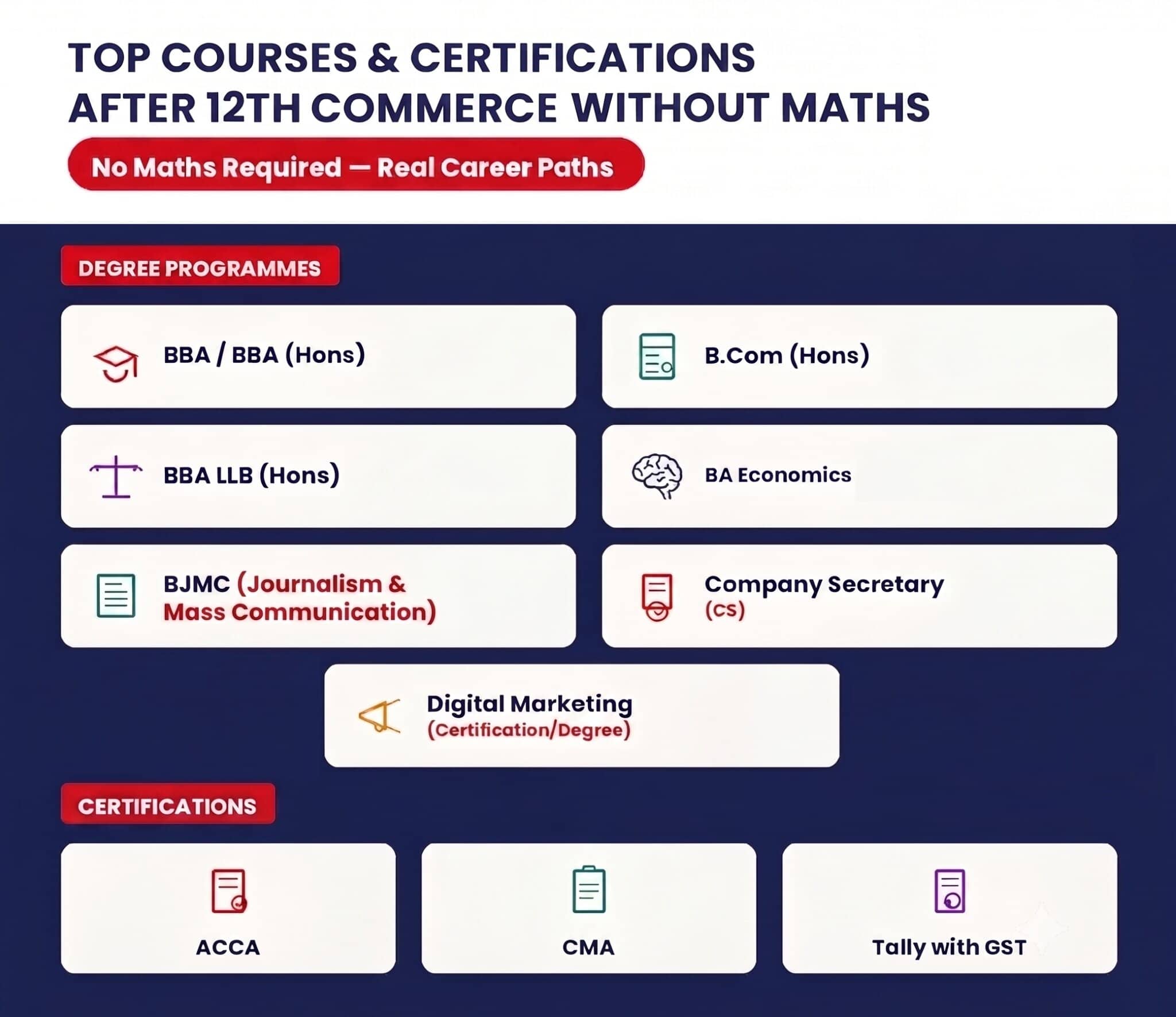
The following options span degree programmes, professional certifications and skill-based courses, all open to commerce students without Class 12th maths. Pick based on the career direction you're already leaning toward.
Core Course Options
These 7 cover the strongest, most in-demand options for commerce students without maths. None require Class 12th mathematics as an eligibility subject.
| Course | Duration | Eligibility | Focus Areas |
| BBA / BBA (Hons) | 3 yrs (4 for Hons) | 10+2, any stream, 60% aggregate | Management, Marketing, HR, Finance, Business Analytics, Entrepreneurship |
| B.Com (Hons) | 3 yrs (4 for Hons) | 10+2, 60% aggregate | Accounting, Taxation, Business Law, Economics |
| BBA LLB (Hons) | 5 yrs | 10+2, 45% aggregate + entrance exam | Corporate Law, Compliance, Business + Legal Studies |
| Digital Marketing | Certification/degree, 6 months-3 yrs | Varies by provider | SEO, Performance Marketing, Content Strategy |
| Company Secretary (CS) | Self-paced, 2-3 yrs | Pass CSEET entrance exam after 10+2 or Direct entry to Executive after graduation | Corporate law, governance, compliance |
Other Course Options
These six broaden the list beyond the core six, useful if your interest sits outside pure management or accounting.
| Course | Duration | Eligibility | Focus Areas |
| BA Economics (General) | 3 yrs | 10+2, any stream | Economic theory, public policy, applied economics |
| BMS (Bachelor of Management Studies) | 3 yrs | 10+2, 50% aggregate | General management, similar scope to BBA |
| BJMC (Journalism & Mass Communication) | 3 yrs | 10+2, any stream | Media, journalism, content, broadcasting |
| BHM (Hotel Management) | 3-4 yrs | 10+2, any stream | Hospitality operations, guest services, events |
| B.Com (General) | 3 yrs | 10+2, 50% aggregate | Broader commerce base, lighter than Honours |
| Event Management (Degree/Diploma) | 1-3 yrs | 10+2, any stream | Planning, vendor coordination, execution |
Professional Certifications
These run alongside a degree and add a credential employers recognise directly, none require Class 12th maths.
| Certification | Duration | Recognised For |
| CMA | Self-paced, alongside degree | Cost accounting, financial management |
| ACCA (Association of Chartered Certified Accountants) | 2-3 yrs | Global accounting and finance qualification |
| Digital Marketing Certification (Google, HubSpot) | 3-6 months | SEO, performance marketing, analytics tools |
| GST Practitioner Certification | A few weeks to months | Taxation compliance, useful for finance-adjacent roles |
| Tally with GST | A few weeks to months | Accounting software, entry-level finance roles |
Eligibility Criteria for Popular Commerce Courses Without Maths
Most eligibility criteria stay the same whether you took maths in Class 12th or not, minimum aggregate matters more than the subject list. Usually 45-60% in Class 12th, which too varies by course. Other factors-
- Stream requirement: Most programmes accept any stream, not just Commerce
- Entrance exam: Only needed for BBA LLB and a few BBA (Hons) programmes
- Basic numeracy (for CMA Foundation, etc.) is different from Class 12th maths
A few Honours-level B.Com/Economics programmes do need maths, check university-specific eligibility
Which Course Should You Choose Based on Your Career Goals?
Match your course to what you're actually drawn to, not to what sounds most reassuring to relatives. The table below gives a direct starting point, with reasoning attached to each recommendation rather than a single blanket pick.
| If You're Drawn To... | Consider | Why |
| General management, Leadership, Keeping options open for an MBA | BBA | Broadest base; sets up management, marketing, HR or an MBA without early specialisation |
| Accounts, Banking, Taxation, you already know the direction | B.Com | Focused grounding in accounting and business law for finance-adjacent roles |
| Reading, Argument, Structured reasoning, High long-term ceiling | BBA LLB | Professional degree; corporate law and compliance salaries scale sharply with experience |
| Corporate governance and Compliance, self-paced study | Company Secretary (CS) | No maths required; respected certification alongside a regular degree |
| Cost and Financial analysis, Comfortable with basic calculation | CMA Foundation | Direct gateway into corporate accounting and finance roles |
| Strategy, Content, Consumer behaviour | Digital Marketing | Fast-growing field; tools handle the analytics, you handle direction |
If you're specifically torn between BBA and a more management-studies-style programme, this detailed BBA vs BMS comparison breaks down the practical differences in curriculum and career outcomes.
How to Choose the Right Course After 12th Commerce with Maths?
Start with what you enjoy doing, not what sounds safest to relatives. Ask yourself questions about what you actually want to do. Below is the help you need for “If this, then what”-
- People-focused or Numbers-focused: Management/Marketing/Law associates people and B.Com/CMA lean towards numbers.
- Structured Rules vs Open-ended Work: Law and Compliance follow set frameworks, Marketing and Entrepreneurship don't.
- Full-time Degree vs Self-paced Alongside One: CS and CMA can run parallel to a degree, BBA/B.Com/BBA LLB are standalone.
- Long-term Goal: Keeping options open for an MBA later favours BBA; a fixed direction like Accounts or Law favours B.Com or BBA LLB.
Career Options After 12th Commerce Without Maths
Career paths split broadly into private-sector and government roles, each rewarding a different mix of skills and offering a different kind of stability.
Private Job Options
Private-sector roles typically pay better early on and offer faster growth, but come with less job security than government positions.
| Role | Typical Entry Point | Fields |
| Management Trainee | BBA/B.Com graduate | Retail, FMCG, banking |
| Sales and Business Development Executive | BBA/B.Com graduate | Any industry with a sales function |
| Digital Marketing Executive | BBA/B.Com + certification | Agencies, e-commerce, startups |
| Compliance Associate | B.Com/BBA LLB graduate | Corporate legal and compliance teams |
| HR Executive | BBA/B.Com graduate | Any mid-to-large company |
Government Job Options
Government roles favour students who prefer stability and a structured exam-based path over open-market competition.
| Exam/Role | Conducting Body | Typical Positions |
| SSC CGL | Staff Selection Commission | Accounts, audit, inspector roles across ministries |
| Bank PO/Clerk (IBPS, SBI) | Institute of Banking Personnel Selection | Probationary Officer, Clerk in public sector banks |
| RBI Assistant/Grade B | Reserve Bank of India | Assistant, Officer roles in RBI |
| State PSC Exams | State Public Service Commissions | Administrative and revenue department roles |
| Railway Recruitment (RRB) | Railway Recruitment Board | Clerk, accounts, commercial apprentice roles |
Commerce Without Maths Scope: Salary Insights for Popular Roles
The figures below are market-rate estimates drawn from third-party salary aggregators (Payscale, Glassdoor-class data) rather than any single institution's placement report and should be read as indicative ranges, not guarantees. What they show consistently is the salary gap between fields widens sharply after year 5-6, driven by specialisation and experience rather than by your Class 12th subject choice.
| Field | Entry-Level | 3-6 Year Mark |
| Management (BBA-track roles) | ₹6.9-7.6 LPA | ₹8.7 - ₹9.6 LPA |
| B.Com-based roles (accounts, banking) | ₹2.5-₹4.0 LPA | ₹5.2-₹6.8 LPA |
| Corporate Law / Compliance | ₹3.5-₹5.5 LPA | ₹9.0-₹12.5 LPA |
| Company Secretary | ₹4.0-₹5.8 LPA | ₹6.9-₹12.2 LPA |
| Digital Marketing | ₹2.5-₹4.5 LPA | ₹6.8-₹11.5 LPA |
| Hospitality & Events | ₹1.8-₹3.5 LPA | ₹4.5-₹8.5 LPA |
Note: Figures are aggregated from AmbitionBox, Payscale and Glassdoor listings and represent typical ranges, not fixed guarantees. Actual pay depends heavily on the specific role, company and city.
Factors Affecting Salary Outcomes
- City tier: Metro cities pay 20-40% more than Tier-2 cities for the same role
- Specialisation and certification: CFA, ACCA, CS and digital marketing certifications push starting pay above the base range
- Employer type: MNCs and consulting firms pay more than smaller domestic firms at entry level
- Negotiation and internship experience: Candidates with strong internships or prior negotiation often land above the stated entry range
What Skills Do I Need to Get a Job in Commerce without Maths?
Employers in this space hire for a specific skill set, sharpen these and the maths question stops mattering.
| Skill | Why It Matters |
| Communication | Most roles involve client interaction, reports or pitches |
| MS Excel and basic data reading | Comfort reading numbers and building simple sheets, not advanced formulas |
| Business fundamentals | Understanding how a company makes money helps across management, marketing and law roles |
| Digital tools | CRM for sales, design tools for marketing, drafting tools for law, whichever track you're on |
| Adaptability and problem-solving | Entry-level roles reward figuring things out, not just following instructions |
How Do Employers Actually Evaluate Commerce Graduates?
Recruiters weigh internships, live projects, communication skills and problem-solving ability well above your Class 12th subject list. Most hiring managers never ask which subjects you dropped at 16, they ask what you have actually done since.
For entry-level commerce roles across management, marketing and law-adjacent functions, what typically moves an application forward-
- A relevant internship or live project, even a short one, over a strong mark sheet alone
- Clear written and verbal communication, tested directly in interviews and case discussions
- Evidence of initiative: a college fest role, a small venture, a portfolio of client work
- Comfort with the tools of the field (CRM software for marketing, basic Excel and reporting for finance-adjacent roles) over formal maths training
This is also why BBA and B.Com programmes with built-in industry exposure change outcomes more than the maths-or-no-maths question ever did. A structured internship pipeline gets you in front of recruiters with something to show, which is the actual filter at entry level.
Myths About the Scope of Commerce Without Maths
A few assumptions keep students second-guessing a perfectly viable choice, worth clearing up directly.
Myth 1. You'll earn less than a maths student.
Salary depends on role, skill and experience, not the subject dropped at 16, corporate law and CS roles often out-earn many maths-based tracks.
Myth 2. Fewer career options are open to you.
Only a narrow set of quant-heavy paths (actuarial science, core finance research) actually require Class 12th maths, everything else stays open.
Myth 3. You can't do an MBA without maths.
MBA entrance exams (CAT, XAT, etc.) test aptitude and reasoning, not Class 12th syllabus, no maths background is needed to sit for them.
Myth 4. CA/CS/CMA are harder without a maths base.
These are entirely separate curriculums that teach their own foundations from scratch, prior maths gives no real head start.
Turn Commerce Without Maths into a Winning Career at BML Munjal University
After clearing your confusion about commerce without maths scope, the next step is selecting the right university. This is where BML Munjal University comes into the picture, which focuses on skills, exposure as well as industry readiness. The university designed its programmes to support commerce students from non-maths backgrounds via practical learning, internships and industry-aligned curriculum.
Courses for Commerce Without Maths Students
- BBA/BBA (Hons) - for management, leadership and business strategy
- Com (Hons.) - for strong foundations in commerce, law and finance concepts
- BBA LLB (Hons) - for careers in corporate law and compliance
With the right guidance, commerce without maths becomes a strength. Take the next step today. Explore BML Munjal University’s programmes and build industry-ready skills.
Conclusion
Commerce without maths scope is real, current and backed by hiring data across management, law, media, digital marketing and entrepreneurship. The decision in front of you isn't whether that scope exists- well, it does- but which corner of it fits how you think and what you want the next five years to look like.
Match your course to that direction rather than to what sounds most reassuring to relatives and the subject you dropped at 16 stops mattering well before your first job offer. If BBA, B.Com or BBA LLB at BML Munjal University fits that direction, start your application once you've made the call.
FAQs
Yes. Management, law, media, hospitality, digital marketing and entrepreneurship are all fully open and none require Class 12th maths as a prerequisite.
You can start CA without Class 12th maths. Success depends on your comfort with numerical work during the course itself, not your subject choice two years earlier.
Yes, for the large majority of commerce programmes. The exceptions are specific Honours-level B.Com or Economics programmes at some universities; always verify that programme’s eligibility directly.
Default to BBA unless you already know you want a numbers-adjacent role like banking or accounts, B.Com is the more focused choice specifically for that path.
BBA, B.Com, BBA LLB, digital marketing certification and company secretary are the best courses without maths, offering strong career growth across corporate, legal and creative industries.
A qualified CA can earn ₹6-10 LPA initially, even without maths in school. Salaries increase rapidly with experience, specialisation and industry exposure.
Yes, many CEOs come from commerce without maths backgrounds. Leadership skills, strategic thinking, experience as well as decision-making ability matter more than studying maths in school.
BBA, B.Com and BBA LLB are the strongest options. They cover management, commerce fundamentals and law without needing a maths background.
Corporate law and Company Secretary roles typically offer the highest long-term salaries, reaching ₹15-30 LPA by the 3-6 year mark.
Yes. BBA LLB and other integrated law programmes accept commerce students regardless of whether they studied maths.
Yes. MBA entrance exams like CAT test aptitude and reasoning, not your Class 12th subjects, so no maths background is required.
BBA is the strongest fit, it builds business fundamentals and often includes incubator support for students wanting to start their own venture.
Related Blogs

10 Best Universities in India for Commerce You Can’t Ignore in 2026
Commerce education in India is rapidly evolving by combining strong academic foundations with industry exposure, global learning as well as career-foc...

Top Career Options after BCom: Find Your Ideal Career Path
[In Summary: After BCom, students can pursue careers in accounting, finance, taxation, banking, marketing, analytics and entrepreneurship. Popular car...

What to Do After 12th Commerce? List of Top 15 Courses with Salary Insights
Commerce is one of the most popular disciplines for learners who aspire to work as businesspeople, bankers, managers, or lawyers. If you decide to con...

Top Career Options After 12th Commerce in 2026: Best Courses & Career Paths
Completing Class 12 is a significant milestone and for Commerce students, it marks the beginning of an exciting journey filled with diverse academic a...

Highest Salary Jobs for Commerce Students
A commerce degree equips you with a strong foundation in business principles, accounting, finance, and economics. This versatile background opens door...
Bachelor of Business Management – Learn to Drive Business Success
Management is, above all, a practice where art, science, and craft meet. - Henry Mintzberg. Management, as a discipline, embraces a "holistic point...