

How to Become a Product Manager: Complete Guide to Skills, Entry Routes & Salary


Admissions Enquiry
Summary: This guide explains how to become a product manager in India: finish a degree in any stream, build skills in data, user research and prioritisation and back them up with a few product teardowns and a one-page PRD. Then enter through an adjacent role such as analyst or engineer or apply for associate product manager roles after an MBA.
Key Takeaways
- You can enter product management from different academic backgrounds; an MBA is one route, not a requirement.
- Common starting points include associate product manager roles and adjacent jobs in analytics, engineering, design, marketing or consulting.
- Build skills in user research, data analysis, prioritisation and communication and practise applying them to real product problems.
- A concise portfolio of product teardowns or case studies can help demonstrate how you think.
Compare degree programmes by the learning, projects and experience they offer; no programme can guarantee a product role.
India’s digital economy employed 14.67 million people in 2022-23 and is projected to contribute one-fifth of the country’s national income by 2029-30. That refers to the broader digital sector, not product manager demand alone. Even so, as digital services grow, organisations are in need of people who can decide which problems to solve & what to build, alongside how to tell whether it works. That is the work of a product manager.
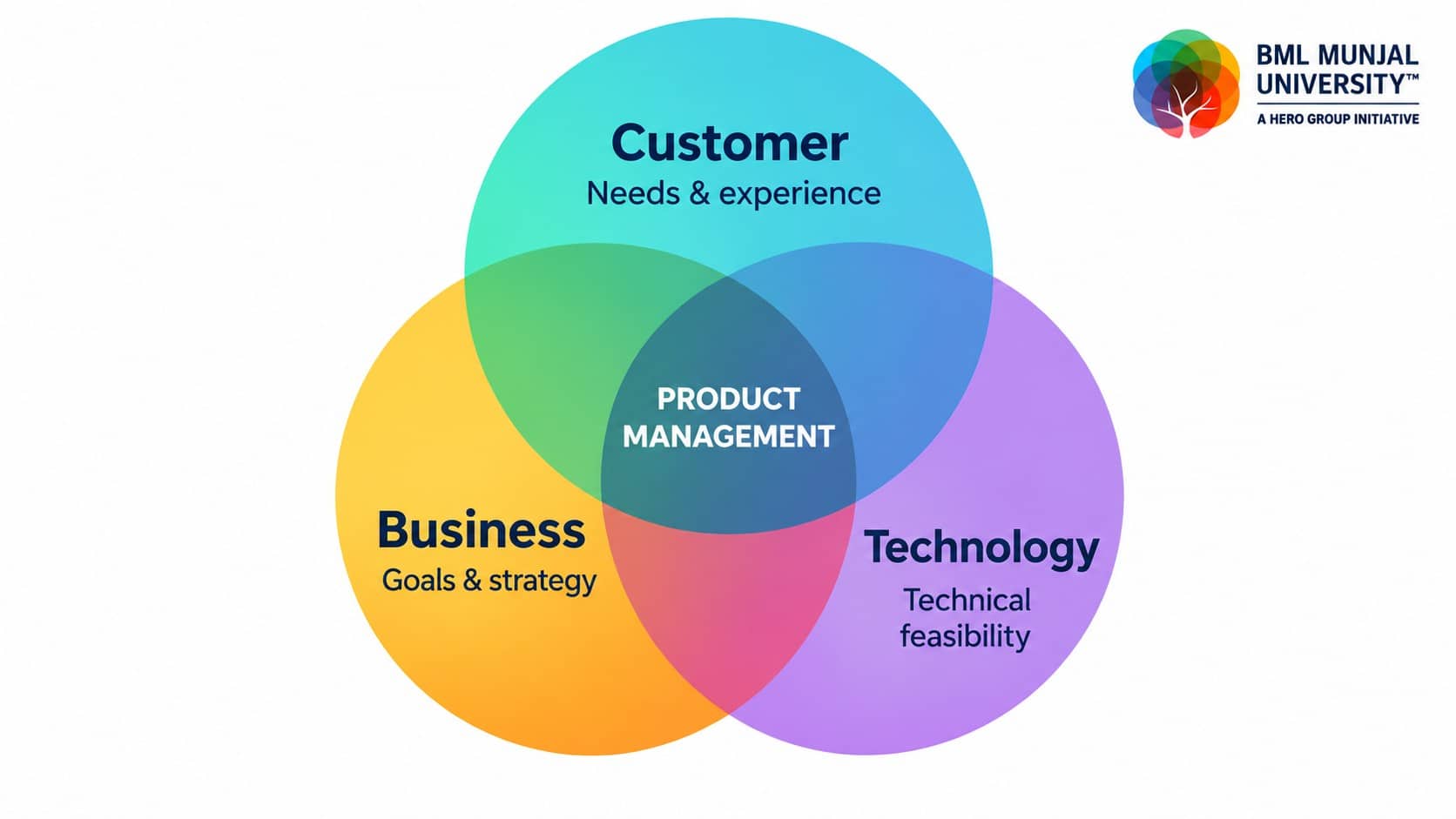
There is no single degree or straight-line route into product management. Some people begin after a bachelor’s degree; others build on a master’s degree or experience in a nearby role. What connects these paths is learning to understand users, make decisions with evidence and work across teams. This guide explores those routes and the skills and practical experience that can help you take your first step.
What a Product Manager Does Day to Day
A product manager usually is the one who decides what gets built and in what order before deciding whether it worked or not. The person in this role is often described as the one who works between engineering, design and the business. That's accurate in a way, but it hides what actually happens behind the scenes.
Most weeks are built from tasks like these -
- Users and usage data come first since this is when you speak to users and analyse data to understand what is lacking.
- You document product requirements, typically a PRD or a collection of user stories, that development can work off of.
- Backlog prioritisation involves the use of tools like RICE or the MoSCoW framework.
- The coordination between teams is also critical since engineering, design, marketing, and support all have to get the same message.
- Once launched, you can look at adoption rates, retention and churn.
One quick clarification, since the titles usually get mixed up. A project manager keeps work on schedule, while a product manager's duty is to decide which work is worth doing.
Skills You Need to Become a Product Manager
You don't need every skill on day one. Basic SQL and one analytics tool will put you ahead of many applicants and you can pick up the rest as you go.
| Skill | What it looks like in practice | Where to start |
| Data literacy | Reading a funnel or a retention curve and forming a view from the numbers. Basic SQL sets you apart. | Practise SQL queries on a free dataset and explore Google Analytics |
| Technical fluency | Knowing what APIs, databases and system design mean, so you can judge what's easy or hard for engineers | Read the API documentation of an app you use |
| User empathy | Asking why users behave the way they do, beyond what they say they want | Talk to five people who use a product you like and note where they get stuck |
| Prioritisation | Choosing what to build first with a framework such as RICE | Rank ten feature ideas for any app and write your reasoning beside each score |
| Communication | Translating between business, engineering and design | Write a one-page summary of a product decision for a reader outside tech |
| Tool familiarity | Working in Jira or Linear, Figma and an analytics tool such as Amplitude, Mixpanel or Google Analytics | Open free accounts and finish one small sample project in each |
| AI fluency | Understanding how AI features are scoped, tested and explained to users | Build a small no-code prototype that uses an AI model |
Coding isn't required for most Associate Product Manager (APM) roles. What you do need is enough technical sense to know what's easy and what's hard for an engineer.
How to Become a Product Manager in India: 3 Entry Paths
Where you start decides the route. Three common starting points are during or right after a bachelor's degree, after a postgraduate degree and from another role you already hold.
| Serial No. | Route | Who it suits | How you get in | Reported timeline |
| 1 | After graduation (UG) | Engineers, business graduates, analysts and anyone with a bachelor's degree | Take an adjacent role, work on product problems, then move internally or apply for entry-level product roles | Internal moves often take 6 to 18 months |
| 2 | After postgraduation (MBA or master's) | MBA and master's graduates | Campus recruitment or direct applications for APM and PM roles | A 2-year programme, plus recruiting |
| 3 | Already working in another role | Analysts, engineers, designers, marketers and consultants | Take on product-style work in your current team, then move internally or apply for PM roles | Often 6 to 18 months of building evidence first |
A. After Graduation
Any bachelor's degree can lead here. Engineers move across often because they're comfortable with the technical side and graduates from business, design and economics get in too. A BBA or BCom graduate, for instance, can start in an analyst or marketing role and work toward a product from there. If you’re wondering how to become a product manager after graduation, start by building product experience in adjacent roles. You can also -
- Join product-minded projects - Take part in hackathons, college clubs or startup projects where you decide what to build and for whom.
- Learn the core skills early - Practise basic SQL, user interviews and a prioritisation framework on small projects.
- Do an internship near product - Analytics, marketing, design and engineering internships at product companies expose you to how product decisions are made.
- Start your portfolio - Write up one product teardown each semester, so you graduate with a few pieces to show.
The most realistic route is an internal move. Here's how it usually goes -
- Start in an adjacent role - Business analyst, software engineer, marketing, consulting and design roles all sit close to product work.
- Take a slice of product work - Offer to own the metrics for one feature or write the requirements for a small change.
- Shadow a PM - Sit in on their planning sessions and ask how they decide what goes first.
- Build three to five case studies - Pick products you use and write them up (the proof-of-work section below shows how).
- Apply inside first, then outside - Referrals from existing PMs raise your odds of an interview at Indian product companies.
Companies like Flipkart, Swiggy, Razorpay, CRED, PhonePe, Meesho, and Zepto have advertised entry-level and associate product roles in the past, but hiring trends can vary based on the needs of each company, so please visit their respective careers pages to see which positions are available at present. In addition, many of these companies refer to the role as Product Manager, not APM.
B. After Postgraduation (MBA or Master's)
An MBA is one structured way in and it isn't a requirement. A master's or MBA can add a structured stretch of learning, case and project work, a peer network and access to campus recruitment, but it doesn't replace the skills and portfolio described above. The programme typically runs two years, followed by campus or lateral recruiting. Some companies that run formal APM programmes recruit from campuses.
Two things to know about APM programmes -
- Many are rotational, with time spent across two or three product teams before converting to a full PM role. Structure and duration vary by company.
- Google's APM programme is one well-known example. Eligibility, locations and application windows change each cycle, so check Google's careers page for current details.
C. If You're Already Working
For professionals asking how to become a product manager from another field, an internal move can be a practical route. There is no requirement for you to start afresh on your career path. Typically, most product managers who transition into the role leverage their existing strengths, for example, technical judgment for engineers, data expertise for analysts, user insights for designers, and business understanding for marketers and consultants. A practical sequence -
- Find the product problem near you. Pick a metric or user complaint your team already tracks and propose a fix.
- Work with your PM. Offer to run user calls, analyse usage data or draft requirements for a small change.
- Write it up. Turn that work into a case study showing the problem, your decision and what you measured.
- Ask for the move. Discuss an internal transfer or a product role with your manager or apply outside with the case study in hand.
Build Proof of Work That Hiring Managers Can See
Interviews test how you think about a product, so give hiring managers something to read before you walk in. An IIT Kanpur course guide suggests three to five product case studies. This set covers the ground -
| Deliverable | What goes in it | What it shows |
| Product teardown | A product you use daily: one user problem, what you'd build next, how you'd prioritise it, how you'd measure success | Product sense and structured thinking |
| One-page PRD | Problem, who it affects, goal, scope and success metric | You can turn a problem into something engineers can build |
| Metric diagnosis | A made-up drop in retention or conversion, your hypotheses and the SQL query you'd run first | Data fluency |
| Prioritised backlog | Ten feature ideas ranked with RICE, with your reasoning next to each score | Trade-off judgment |
For interviews, learn two frameworks well - CIRCLES for product design questions and RICE for prioritisation. The same IIT Kanpur guide suggests twenty or more mock interviews before your final rounds.
Product Manager Salary in India
Pay swings a lot by company type, so treat any single number with care. The figures below come from different platforms and are estimates of reported pay, not typical outcomes for every fresher. Glassdoor India put the average APM salary at about ₹14 LPA, based on 3,209 reported salaries as of May 2026. Check the latest figures on each platform before relying on them.
Career Ladder at Indian Product Companies
| Stage | Typical experience | Approx. annual pay |
| Associate Product Manager | 0 to 2 years | ₹9 to ₹20 LPA |
| Product Manager | 2 to 5 years | ₹10 to ₹23 LPA |
| Senior Product Manager | 5 to 8 years | ₹35 to ₹60 LPA |
| Director or VP of Product | 8 years or more | ₹60 LPA to ₹1.5 crore and above |
How BML Munjal University Can Help You Prepare for a Product Management Career
At BMU, the BBA/BBA (Hons) course builds your foundation through industry-led teaching, mentorship and a professional portfolio from the first year, preparing you for roles across marketing, finance, analytics and product. The MBA course takes it further with hands-on work in AI, analytics and no-code product building, opening up emerging career tracks such as AI Product Manager.
| Programme | Duration | Product-related career track listed | Portfolio element |
| BBA/BBA (Hons) | 3 years, plus 1 year for Honours | Product Manager (Top Career Pathways) | A professional portfolio by graduation |
| MBA | 2 years | AI Product Manager (Emerging Career Tracks) | 8 to 10 projects, 5 portfolios and 1 capstone |
Both programmes share a few features that relate to the routes described above -
- Portfolio-led learning - The programmes are built around producing work you can show, which is the same kind of proof of work this guide recommends.
- AI shows up in the coursework itself - The MBA covers no-code product building, agentic AI products, reading API documentation and prompt engineering and the BBA offers an AI Applications in Business specialisation.
- Industry-linked learning runs through both - CATALYST in the BBA and industry-mentored projects with portfolio reviews in the MBA.
A programme can only give you a structure and time to build the skills and the portfolio. Read each programme page for eligibility, fees and the application process.
Conclusion
If you’re exploring how to become a product manager, focus on practice, user understanding and evidence of your work. Starting with a bachelor’s program, moving on from a master’s or MBA or coming from another field altogether, the process is the same - know the user, make decisions based on facts, and demonstrate this in a portfolio.
Ready to start building yours? Explore the BBA/BBA (Hons) or the Portfolio-First MBA courses at BML Munjal University and see how project-led learning can support your product career.
FAQs
According to the 2026 India Guide by Instahyre, you can become a product manager without an MBA through engineer, analyst, consultant and founder paths. MBA is just one of the possible ways in, which is primarily achieved via college recruitment in companies that have an APM programme.
Not necessarily; most APM positions will not require that, but having technical skills to be able to talk about feasibility with engineers and some basic knowledge of SQL will make you stand out.
Yes, it is possible to start your career as a product manager as a fresher.
It takes 6 to 18 months for an internal transfer, two years for an MBA and additional recruiting for that route. After becoming an APM, it usually takes 18 to 24 months to become a full-time product manager.
A project manager ensures that a given project is delivered within the specified schedule and budget. A product manager determines what needs to be created and verifies its success.
Related Blogs

How to Become a Criminal Lawyer After 12th: A Step-by-Step Guide for 2026
Key Takeaways Choose a 5-year BA LLB or BBA LLB after Class 12. Gain experience through internships, moot courts and legal-aid work. Learn ...

Management Entrance Exams in India: Which One Is Right for You?
Key Takeaways There is no single best management entrance exam for every MBA aspirant. Compare CAT, XAT, CMAT, NMAT, GMAT, SNAP, MAT and ATMA ...
Scope of IoT in India: Careers, Skills and What Comes Next
Key Takeaways The scope of IoT is wide: about 21.1 billion connected devices in 2025, heading to 39 billion by 2030. The IoT future scope in I...

Career in Health Insurance: From Graduation to a Future in the Industry
Key Takeaways India's health insurance premium volume exceeded ₹1.2 lakh crore in FY 2024–25, with the segment growing at around 9%. Healt...
How to Become a Financial Analyst in India: Degree, Skills & Career Roadmap (2026)
A relevant degree in finance, commerce, economics or business can provide a strong foundation for a financial analyst career. Build core skills...
How to Become a Business Analyst: A Complete Career Guide
Key Takeaways A bachelor's degree in business, IT or a related field is the usual starting point; no state licence is required. Students after...