
Scope of IoT in India: Careers, Skills and What Comes Next


Admissions Enquiry
Summary: This guide explains the scope of IoT in India in plain terms. It covers the industries driving demand, the career roles you can aim for, what Glassdoor data says about salaries and the skills to build first. It ends with a simple way to choose between an electronics-led and a computer science-led degree.
Key Takeaways
- The scope of IoT is wide: about 21.1 billion connected devices in 2025, heading to 39 billion by 2030.
- The IoT future scope in India is tied to 5G, smart meters and factory automation.
- Roles range from embedded and edge AI engineers to smart systems engineers.
- Glassdoor India shows an average IoT Engineer salary of ₹6,27,500 a year.
- Build skills in four layers: Sense, Connect, Think and Protect.
- Pick your degree based on whether you lean towards hardware or software.
Today your phone, your smart-watch and even your electricity meter send data online without you lifting a finger. Now multiply that by every home, factory and farm in the world and you get a number that is hard to picture. IoT Analytics estimated about 21.1 billion connected IoT devices worldwide by the end of 2025 and expects 39 billion by 2030. India is part of this shift, with smart meters, 5G towers and factory sensors going up fast. So if you are choosing a degree or planning a career move, the scope of IoT deserves a close look. This guide shows you where the jobs are, what they pay and which skills to build first.
What Is the Scope of IoT Today?
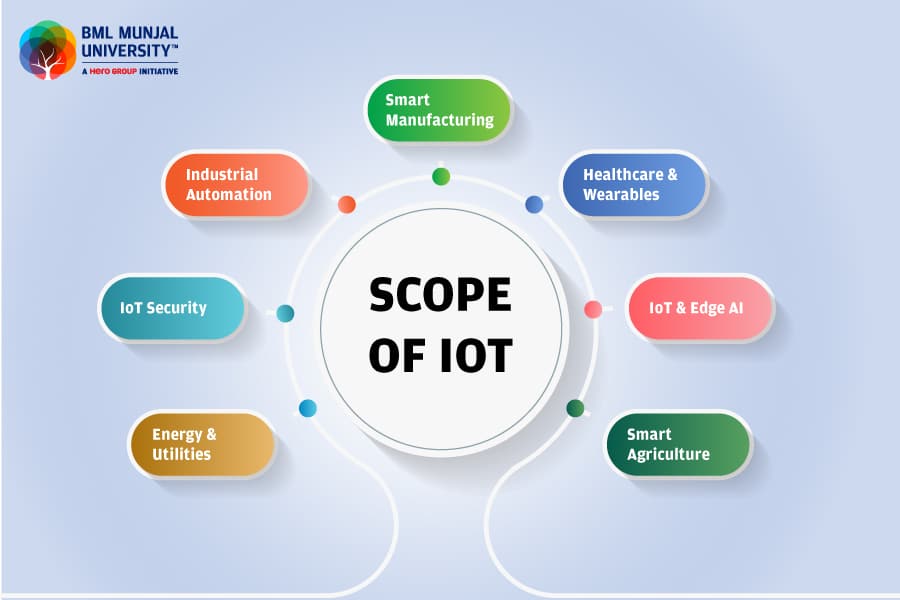
The scope of IoT or Internet of Things, covers any field where physical things collect data and act on it through the internet. Today that means healthcare wearables, smart factories, farm sensors, connected vehicles and city infrastructure. For you, it means jobs that mix hardware, software and data rather than sitting in only one of them.
Think of a smartwatch that alerts a doctor or a sensor that warns a plant manager before a machine fails. Both follow the same idea: sense, send, decide and act.
Which Industries Drive the Future Scope of IoT?
The future scope of IoT is strongest in manufacturing, healthcare, agriculture, energy and urban infrastructure. These sectors gain the most from real-time data, so they need people who can build and manage connected systems. The table shows what IoT does in each and the roles it creates-
| Sector | What IoT does | Roles that grow |
| Manufacturing | Predictive maintenance and smart factory monitoring | Embedded and automation engineers |
| Healthcare | Wearables and remote patient monitoring | IoT and edge AI engineers |
| Agriculture | Soil, weather and irrigation sensing | IoT developers and data analysts |
| Energy and utilities | Smart meters and grid monitoring | Smart systems engineers |
| Urban infrastructure | Traffic, lighting and water monitoring | Cyber-physical systems engineers |
What Is the IoT Future Scope in India?
The IoT future scope in India looks strong because infrastructure spending, 5G rollout and electronics manufacturing are growing together. Demand is moving from small pilots to large deployments. That creates steady hiring for engineers who understand devices, networks and data.
Omdia links India's 2026 technology investment cycle to schemes such as PLI, PM Gati Shakti and India Semiconductor Mission 2.0, with investments above ₹10 lakh crore across sectors. It also lists a 250 million smart-meter mandate and more than 500,000 5G base stations among the demand drivers.
Growth is not automatic, though. IoT Analytics reports that enterprise IoT spending grew 10% in 2024, its lowest rate in over a decade, with hardware struggling while software and cloud kept expanding. Security and device compatibility are also open problems. The practical lesson is to build skills on both the hardware and software sides.
Which IoT Career Roles Are in Demand?
In-demand IoT roles include Embedded Systems Engineer, IoT and Edge AI Engineer, Smart Systems and Infrastructure Engineer, Cyber-Physical Systems Engineer and Hardware Design Engineer. Each sits at a different point between devices, networks and data, so your strengths decide which one suits you. A few examples are-
- Embedded Systems Engineer: Writes the firmware that runs on small microcontrollers.
- IoT and Edge AI Engineer: Runs AI models on devices close to where the data is produced.
- Smart Systems and Infrastructure Engineer: Connects meters, lights and sensors across a building or city.
- Cyber-Physical Systems Engineer: Links software control to machines such as robots.
- Hardware Design Engineer: Designs the boards and chips inside connected devices.
What Salary Can You Expect in an IoT Career?
Glassdoor India lists an average IoT Engineer salary of ₹6,27,500 a year, based on 120 salaries submitted as of July 2026. The typical range runs from ₹3,74,000 to ₹10,00,000 and top earners report up to ₹18,50,000.
| Role | Average | Typical range | Top earners |
| IoT Engineer | ₹5,27,500 | ₹3,74,000 to ₹7,00,000 | ₹18,50,000 |
| IoT Developer | ₹4,15,000 | ₹3,02,000 to ₹5,22,000 | ₹8,70,000 |
Source: Glassdoor India
Treat these numbers as a starting reference. Pay moves with your skill mix, project experience and employer. A working sensor-to-cloud project gives you something concrete to show in interviews.
Which Skills Should You Build for IoT?
Start with the basics of electronics, C or Python programming and networking, then add cloud and security. A simple way to plan this is the Sense, Connect, Think, Protect stack. It splits IoT skills into four layers so you can see where you fit.
- Sense: sensors, microcontrollers such as Arduino or ESP32 and embedded C or C++.
- Connect: Wi-Fi, Bluetooth, MQTT and cellular networks including 5G.
- Think: cloud platforms, data handling and edge AI that runs models on the device.
- Protect: device authentication, encryption and secure updates.
Go deep in one layer and stay comfortable in the other three. Build a room-temperature monitor that sends alerts to your phone and you will touch all four.
How Do You Choose the Right Path Into IoT (Internet of Things)?
Choose what you enjoy doing. If you like circuits, lab benches and hardware debugging, an electronics and computer engineering degree fits well. If you prefer code, cloud and data, computer science with an IoT track fits better.
Both routes meet in the middle. Before you pick a college, check three things: whether Internet of Things is a formal specialisation, whether labs let you build real devices and whether hackathons or projects are part of the course.
BML Munjal University - Where Can You Study IoT-Focused Engineering
IoT sits between hardware, software and data, so you need a place where you can learn all three together. BML Munjal University follows a one-college approach, so you work on problems across subjects instead of staying inside one department. The university offers two B.Tech. routes into this field: B.Tech. Electronics and Computer Engineering and B.Tech. Computer Science and Engineering with an IoT specialisation. Both run for four years across eight semesters.
What Makes Us a Strong Choice for IoT?
- IoT is one of the core areas of study in Electronics and Computer Engineering, alongside AI, VLSI Design and Machine Learning.
- The programme lists IoT and Edge AI Engineer and Embedded Systems Engineer among its career pathways.
- In Computer Science and Engineering, you can choose IoT as a specialisation next to Robotics and Automation, Cyber Security and VLSI Design.
- Centres of Excellence cover IoT, cloud computing, machine learning, AI and VLSI labs.
- Hackathons such as SyncHack 2024, an AI-powered IoT battle, give you a live build challenge.
- Admission is through an entrance exam such as JEE, CUET or BMU-SAT, followed by counselling.
Explore both programme pages to compare the routes and pick the one that matches your strengths. When you are ready, check the eligibility and application steps on the BMU admissions page.
Conclusion
The scope of IoT is wide because it connects devices, networks and data in almost every industry. In India, 5G rollout, smart meters and factory automation are turning that scope into real jobs, from embedded engineering to edge AI.
You do not need to learn everything at once. Start small: pick one layer of the skill stack, build one project and choose a programme that lets you keep building. Whether you lean towards hardware or software, the right path is the one where you get to make real things. Apply now!
FAQs
The scope of IoT in India covers manufacturing, healthcare, agriculture, energy and smart cities. Growth is backed by 5G rollout, smart-meter mandates and large infrastructure spending, so demand is rising for engineers who can work across devices, networks and data.
The future scope of IoT points to billions more connected devices. IoT Analytics forecasts 39 billion by 2030. AI at the edge, 5G and stronger security will shape the next wave of jobs.
It can be, if you build practical skills. Entry roles such as IoT Developer and Embedded Engineer exist across manufacturing, consumer electronics and infrastructure. A small working project, like a sensor that reports to the cloud, helps you stand out.
There is no single best degree. B.Tech. in Electronics and Computer Engineering suits hardware-leaning students, while B.Tech. in Computer Science with an IoT specialisation suits software-leaning students. Choose the one where you can build real devices during the course.
Glassdoor India lists an average of ₹6,27,500 a year for an IoT Engineer, with a typical range of ₹3,74,000 to ₹10,00,000. Actual pay depends on your skills, projects and employer.
Build basics in electronics, embedded C or Python and networking. Then add cloud, data handling and security. The Sense, Connect, Think, Protect stack helps you cover all four layers.
Yes, most roles do. Embedded roles use C or C++, cloud and data roles use Python or similar languages and hardware design roles lean more on circuits and design tools.
AI adds intelligence to connected devices. IoT Analytics names AI, including edge AI, as a key IoT trend, so engineers who can run models on small devices are in a strong position.
Related Blogs

How to Become a Criminal Lawyer After 12th: A Step-by-Step Guide for 2026
Key Takeaways Choose a 5-year BA LLB or BBA LLB after Class 12. Gain experience through internships, moot courts and legal-aid work. Learn ...

Career in Health Insurance: From Graduation to a Future in the Industry
Key Takeaways India's health insurance premium volume exceeded ₹1.2 lakh crore in FY 2024–25, with the segment growing at around 9%. Healt...
How to Become a Business Analyst: A Complete Career Guide
Key Takeaways A bachelor's degree in business, IT or a related field is the usual starting point; no state licence is required. Students after...

How to Become a Marketing Manager: Complete Step-by-Step Guide
Key Takeaways Becoming a marketing manager is a progression from execution to ownership and leadership. A relevant degree provides the foundat...

Difference Between Data Analyst and Business Analyst: Comparing Two In-Demand Career Paths
Key Takeaways Data analysts focus on what the data shows; business analysts focus on what the business should do about it, though both roles shar...

Top B.Tech. Mechanical Engineering Specialisations in India for Working Professionals
If you are working in manufacturing, automotive, energy or any mechanical domain and your career has hit a ceiling, the missing piece is usually your ...