

Difference Between Data Analyst and Business Analyst: Comparing Two In-Demand Career Paths


Admissions Enquiry
Summary: A data analyst collects, cleans and interprets data to uncover patterns, trends and anomalies. A business analyst, on the other hand, uses those insights, along with stakeholder input and process mapping, to recommend business decisions. The two roles overlap more than most people expect, but a data analyst goes deep into the numbers, while a business analyst bridges data and business strategy.
Key Takeaways
- Data analysts focus on what the data shows; business analysts focus on what the business should do about it, though both roles share more overlap than most people expect
- Data analysts need SQL, Python or R and visualisation tools; business analysts need process mapping and stakeholder management skills, and generally don't need to code
- In India, business analysts earn more on average nationally, according to Glassdoor, though the gap narrows at senior levels
- Moving between the two roles is common and usually means upskilling in the other role's core toolkit
- AI is automating repetitive reporting in both roles, shifting the real value toward judgment, validation and communication
- Programmes built around both skill sets, such as BML Munjal University's BBA in Business Analytics, let you keep both career paths open
"Data analyst" and "business analyst" get used almost interchangeably in job postings, but the actual work, skills and pay can differ sharply. Simply put, a data analyst reads the story hidden in the numbers, while a business analyst uses that story to help businesses decide what to do next.
The confusion is understandable, given how fast both fields are growing right now.
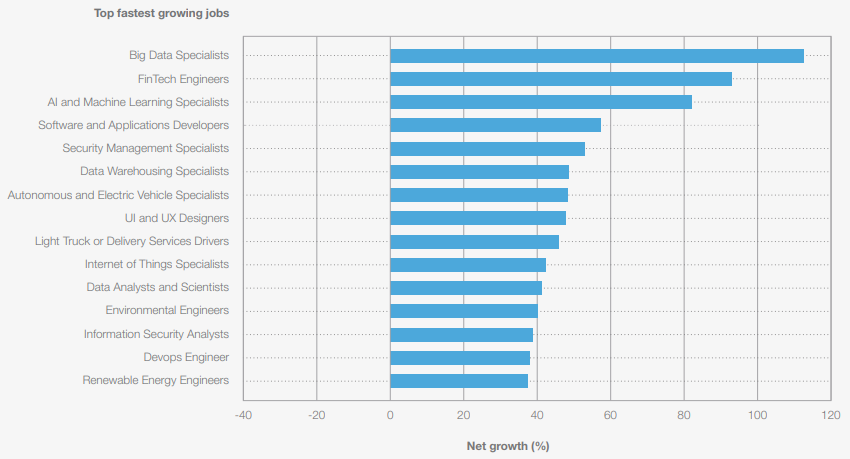
Data analysts and scientists are projected to grow 41% between 2025 and 2030, among the fastest-growing job categories globally, according to the World Economic Forum. Business analyst hiring is climbing alongside it, as companies lean harder on strategy and operations roles to make sense of that data.
Here's how the two roles actually differ, what each pays in India and how to prepare for either.
What’s the Difference Between a Data Analyst and a Business Analyst?
- A Data Analyst collects, cleans and analyses raw data to identify patterns, trends and anomalies, then presents those findings through dashboards and reports.
- A Business Analyst uses data insights, along with stakeholder interviews and process mapping, to recommend business decisions, improve workflows or guide strategy.
At a Glance: Data Analyst vs Business Analyst
| Aspect | Data Analyst | Business Analyst |
| Primary Focus | Analysing data | Solving business problems |
| Main Goal | Identify trends and insights | Improve processes and strategy |
| Core Tools | SQL, Python, Power BI | Excel, SQL, process mapping tools |
| Works Closely With | Data and technical teams | Business stakeholders |
| Best For | People who enjoy coding and analysis | People who enjoy strategy and collaboration |
The confusion between the two roles usually comes from overlap at smaller companies, where one person may do both jobs. At larger organisations, the roles are distinct: a data analyst typically reports on technical, quantitative teams, while a business analyst sits closer to management and operations.
In short:
- Data analyst: works with numbers, finds patterns, reports findings
- Business analyst: works with people, interprets findings, drives decisions
Both roles converge at smaller companies but split clearly at scale
Data Analyst vs Business Analyst: Roles and Responsibilities
A data analyst’s day-to-day work revolves around the data itself: gathering it, cleaning it and turning it into something usable. A business analyst, on the other hand, focuses more on people and process: understanding what a business needs and translating that into a plan.
| Key Responsibility | Data Analyst | Business Analyst |
| Data Collection | Gathers data from primary or secondary sources | Identifies business needs and translates them into requirements |
| Data Preparation | Cleans and organises raw data to remove errors | Acts as the bridge between business teams and IT |
| Analysis | Performs statistical analysis to find trends | Evaluates current business processes for improvements |
| Reporting & Decision Support | Builds dashboards, charts and reports for stakeholders | Creates financial or process models to support decisions |
| Systems & Implementation | Maintains databases and data systems | Oversees implementation of new processes or technology |
What Tools and Technical Skills Does Each Role Require?
A data analyst needs a more technical, quantitative skill set built around programming and statistics. A business analyst needs a blend of business acumen and lighter technical skills, built around process tools and stakeholder communication.
| Category | Data Analyst | Business Analyst |
| Programming | SQL, Python, R | Basic SQL (increasingly common) |
| Data Visualisation | Tableau, Power BI, Looker | Advanced Excel |
| Process & Planning | Not core to the role | Microsoft Visio, Lucidchart |
| Project Management | Not core to the role | Jira, Agile/Scrum |
| Core Strength | Statistical and Quantitative Analysis | Business acumen and Communication |
What Does a Typical Day Look Like for a Data Analyst vs a Business Analyst?
A data analyst's day is largely independent, centred on data. A business analyst's day is largely collaborative and focuses on people. Here's how the two typically break down-
A data analyst's day usually includes-
- Checking overnight data pipelines for errors or gaps
- Writing SQL queries to pull fresh figures
- Building or updating dashboards
- Periodic check-ins to walk stakeholders through findings
A business analyst's day usually includes-
- Interviewing stakeholders to gather requirements
- Running workshops to map processes
- Sitting in meetings with both business and technical teams
- Translating findings into plans others can act on
In short: a data analyst's day is heads-down and technical, a business analyst's day is heads-up and people-facing.
Data Analyst vs Business Analyst Salary in India: Who Earns More
Nationally, business analysts earn more on average than data analysts. At least that’s what the numbers tell us. That gap narrows down at senior levels.
| Level | Data Analyst (India) | Business Analyst (India) |
| Base Pay Range | ₹4L-10L/yr | ₹5L-10L/yr |
| Average Base Pay | ₹6L/yr | ₹7L/yr |
| Senior Average | ₹10L/yr (up to ₹16.1L) | Higher in consulting/BFSI, no single reliable figure |
Source: Glassdoor India Salary Data 2026
What Similarities Do Data Analysts and Business Analysts Share?
Despite their different responsibilities, both roles rely on data to solve business problems and support decisions. Both need strong analytical thinking and the ability to communicate findings clearly.
Here's where the two roles genuinely overlap:
- Both use data to spot trends and improve business outcomes
- Both present findings to stakeholders through reports, dashboards or presentations
- Both need strong problem-solving and attention to detail
- Both work with tools like Excel and SQL, though how deeply varies
- Both collaborate with cross-functional teams to support business goals
At smaller companies and startups, these responsibilities often blur into one role. As a company grows, the two typically split into separate, more specialised positions.
Do You Need Coding Skills for a Data Analyst or Business Analyst Role?
Coding is generally necessary for data analysts but optional for business analysts.
- A data analyst regularly works with SQL and often picks up Python or R to clean, analyse and visualise larger datasets. These skills help automate repetitive work and support deeper analysis.
- A business analyst's day centres more on gathering requirements and communicating with stakeholders. Basic SQL is increasingly useful for validating data, but most business analyst roles don't demand heavy programming.
If you enjoy writing code and working directly with data, data analysis is likely the better fit. If you'd rather solve problems through conversation and planning, business analysis probably suits you more.
What Career Growth Can You Expect in Each Role?
Both paths offer strong long-term growth, just in different directions. Management, specialisation, and data science are the most common directions analysts move into after their first role.
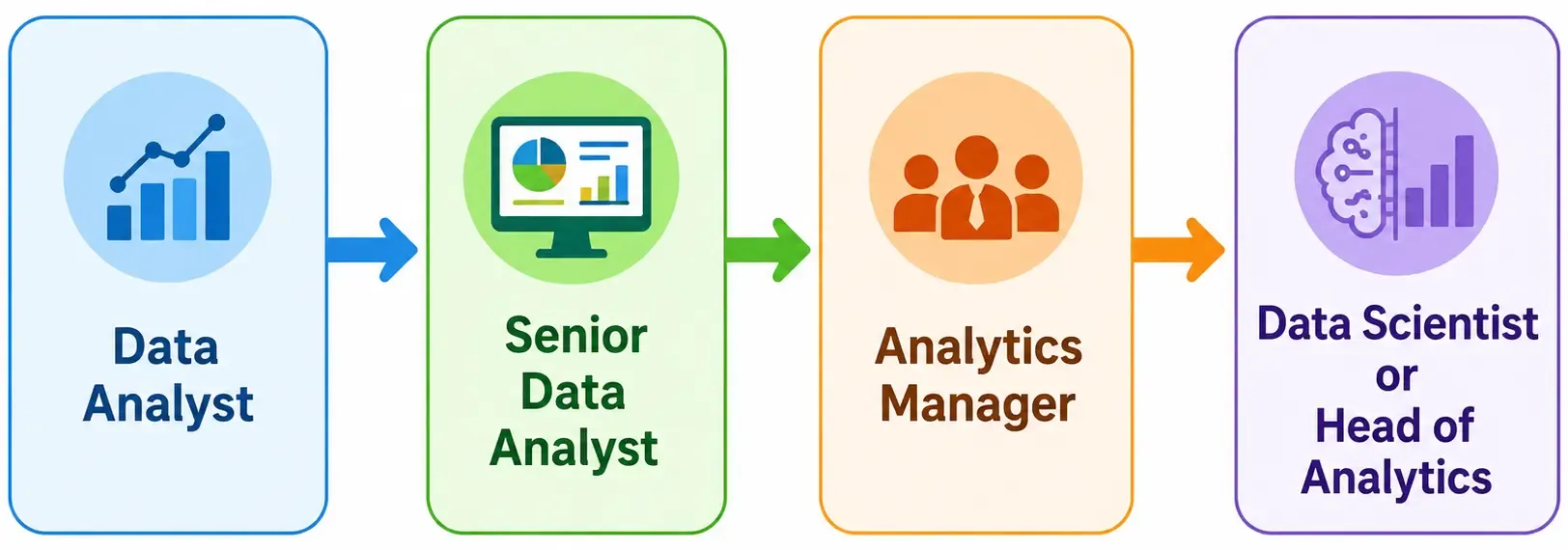
A typical data analyst career often moves through-
A typical business analyst career often moves through-
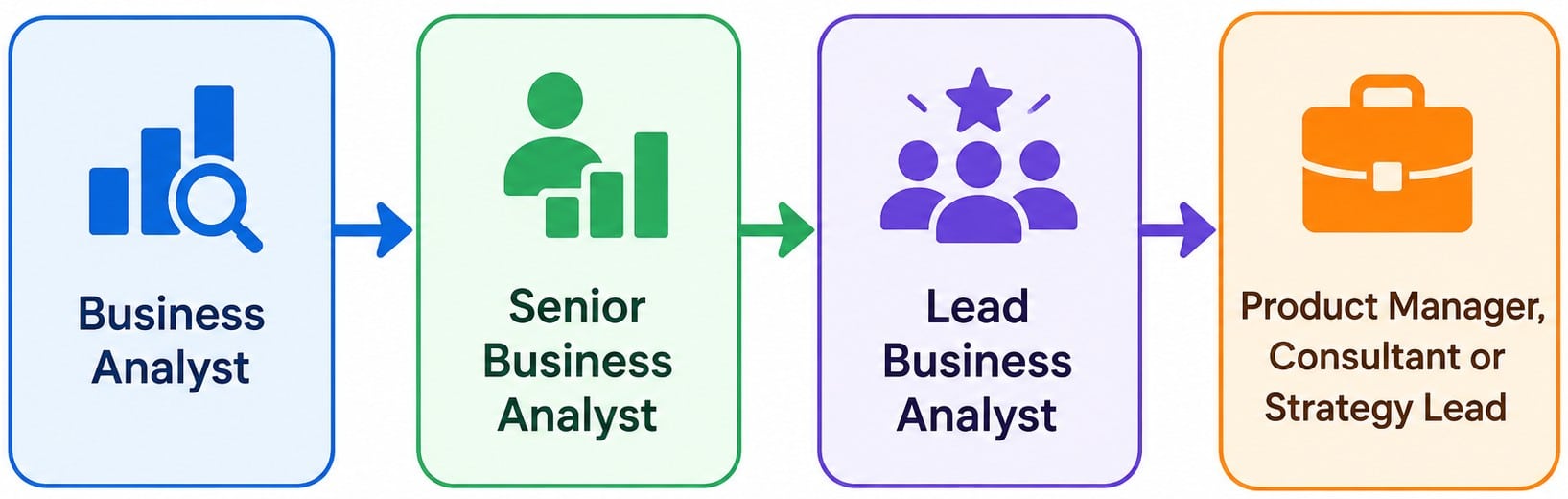
These are common patterns, not fixed rules. Data analysts often move into machine learning or data science. Business analysts commonly move into product management, consulting or leadership.
How Do Data Analysts and Business Analysts Work Together?
On most projects, the two roles work side by side rather than in isolation.
Say an e-commerce company notices sales dropping. A data analyst digs into customer behaviour, sales trends and product performance to find out what's happening. A business analyst takes those findings, talks to stakeholders and recommends a fix, maybe a smoother checkout flow or a revised pricing strategy.
In short: the data analyst explains what's happening, and the business analyst decides what to do about it. Together, they turn raw numbers into action.
How Is AI Changing Data Analyst and Business Analyst Roles?
AI is automating the repetitive parts of both jobs, not replacing either one.
AI tools can now generate reports, summarise data and flag trends in seconds. That shifts a data analyst's time toward validating those insights and building more advanced models. Business analysts are increasingly using AI to speed up requirement analysis and process documentation.
The bigger shift is where the value sits: less time on repetitive output, more time on judgment, business context and communication. Professionals who pair analytical skill with comfort using AI tools are likely to stay ahead here.
Data Analyst vs Business Analyst: Which Path is Better for You
Neither role is objectively better; the right fit depends on how you like to work.
- Choose Data Analyst if:
You enjoy working with numbers, writing code and finding patterns independently in large datasets.
- Choose Business Analyst if:
You enjoy meetings, stakeholder conversations and translating problems into plans that others can act on.
If you’re still unsure, look at the overlap: Both roles reward analytical thinking, attention to detail and clear communication of findings.
How Do You Prepare for a Career in Data or Business Analysis?
If you're unsure which path to pick, the smart move is not picking too early. Build a base in both directions before specialising.
To prepare for data analysis:
- Learn SQL and Python or R
- Build a portfolio using Tableau or Power BI
- Practice on real, messy datasets, not just tutorials
To prepare for business analysis:
- Learn process mapping tools like Visio or Lucidchart
- Practice structuring stakeholder requirements into clear documents
- Get comfortable with Agile/Scrum workflows
In short: The earlier you build both skill sets, the longer you keep both career paths open.
How BML Munjal University's BBA in Business Analytics Supports Both Career Paths
If you're still weighing data analyst versus business analyst, choosing a programme that develops skills for both paths can give you greater flexibility after graduation. BML Munjal University's BBA in Business Analytics blends business knowledge with analytical techniques, allowing students to build the technical and strategic capabilities valued across industries.
The programme prepares and helps you:
- Build analytical skills through descriptive, predictive and prescriptive analytics, data visualisation and machine learning
- Gain practical experience through live projects, workshops, internships and experiential learning opportunities
- Understand how data supports business decisions by combining business intelligence with analytics training
- Explore multiple analyst career paths, including Data Analyst, Business Analyst, Financial Analyst, Marketing Analyst, Operations Analyst and Risk Analyst after graduation
Whether your interest leans toward the technical side of data or the strategic side of business, this programme is built to develop both.
Conclusion
The difference between a data analyst and a business analyst isn't about which career is better. It's about where your strengths and interests lie. If you enjoy working with datasets, coding and uncovering patterns, data analytics may be the right fit. And if you prefer solving business problems, collaborating with stakeholders and shaping decisions, business analysis could be a better match.
Whichever path you choose, both careers increasingly rely on a blend of analytical thinking, business understanding and AI literacy. Building a strong foundation in these skills early can give you the flexibility to explore multiple career opportunities as industries continue to evolve.
If you're looking for a programme that develops both technical and business analytical capabilities, explore the BBA in Business Analytics at BML Munjal University to see how its curriculum, industry projects and experiential learning can prepare you for a career in analytics. Apply now!
FAQs
A data analyst interprets existing data to answer specific business questions, while a data scientist builds predictive models and uses machine learning to forecast future outcomes. Data scientist roles generally require deeper programming and statistics knowledge and often follow a few years of data analyst experience.
A business analyst works across an organisation’s processes and requirements, while a product analyst focuses specifically on one product’s performance, user behaviour and feature decisions. Product analysts typically work closely with product managers rather than broader business stakeholders.
A systems analyst focuses more on technical work, since the role involves designing and improving IT systems and infrastructure. A business analyst focuses more on business processes and requirements, with less depth in system architecture.
A data analyst works across varied datasets and questions, while a BI analyst focuses specifically on building and maintaining dashboards and reporting systems that track business performance over time. The two roles use similar tools but differ in scope.
Both careers offer strong long-term growth in India. Data analyst roles currently have more openings and can lead into data science or analytics leadership. Business analyst roles offer growth into strategy, product management or consulting, often with a higher salary ceiling at senior levels.
For data analysts, certifications in SQL, Python and tools such as Power BI or Tableau are widely recognised. For business analysts, certifications from bodies such as IIBA (CBAP, ECBA) and training in Agile or Scrum are commonly valued by employers.
SQL is essential for querying data; Python or R is used for deeper statistical analysis and Tableau or Power BI is used for building visual reports and dashboards. Advanced Excel remains useful for both data and business analyst roles.
Nationally, business analysts earn more on average than data analysts, according to Glassdoor India data. At senior levels, the gap narrows, and in consulting or BFSI, business analysts with an MBA often pull further ahead. See the salary breakdown above for the full comparison by level.
Yes, transitions happen in both directions and are fairly common. A business analyst moving into data analysis typically needs to build SQL, Python and statistical skills. A data analyst moving into business analysis typically needs to build stakeholder management and process-mapping skills.
Related Blogs

Scope of IoT in India: Careers, Skills and What Comes Next
Key Takeaways The scope of IoT is wide: about 21.1 billion connected devices in 2025, heading to 39 billion by 2030. The IoT future scope in I...

Career in Health Insurance: From Graduation to a Future in the Industry
Key Takeaways India's health insurance premium volume exceeded ₹1.2 lakh crore in FY 2024–25, with the segment growing at around 9%. Healt...
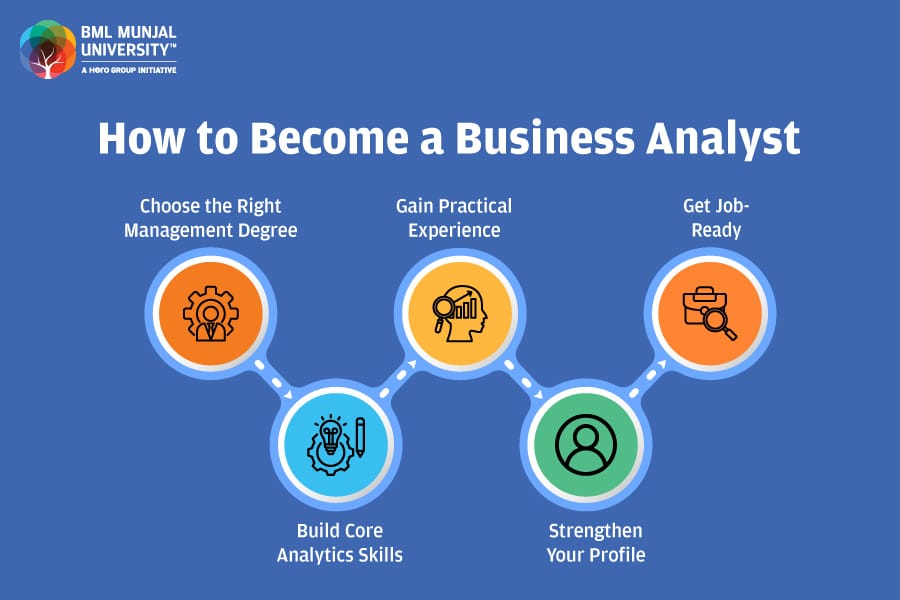
How to Become a Business Analyst: A Complete Career Guide
Key Takeaways A bachelor's degree in business, IT or a related field is the usual starting point; no state licence is required. Students after...

How to Become a Marketing Manager: Complete Step-by-Step Guide
Key Takeaways Becoming a marketing manager is a progression from execution to ownership and leadership. A relevant degree provides the foundat...

How to Become a Software Engineer: Your 2026 Career Roadmap
If you have PCM in your 12th and a vague sense that software engineering pays well, then you are already on the right path. The tricky part is not ...

Logistics & Supply Chain Management Courses: Scope, Salary & Career Opportunities in 2026
According to a recent report, the global logistics market size, which was valued at $5.9 Trillion in 2025, is projected to reach $8.2 Trillion by 2034...