

Social Stratification in Sociology: Understanding How Society Is Structured


Admissions Enquiry
Summary- Social stratification in sociology explains how society is organised into different layers based on factors such as class, caste, wealth, gender, education, occupation and power. This article explores what social stratification means, how it works, major theories, social mobility and its relevance to contemporary India, along with the BA (Hons) Sociology programme at BML Munjal University.
Key Takeaways
- Social stratification describes hierarchies between individuals and social groups.
- Class, caste, gender, wealth, education and power can all influence social position.
- Stratification is closely connected to social inequality and mobility.
- Sociologists study both the structures that create inequality and the possibility of social change.
- BA (Hons) Sociology can provide a foundation for studying these questions through theory, research and field-based learning.
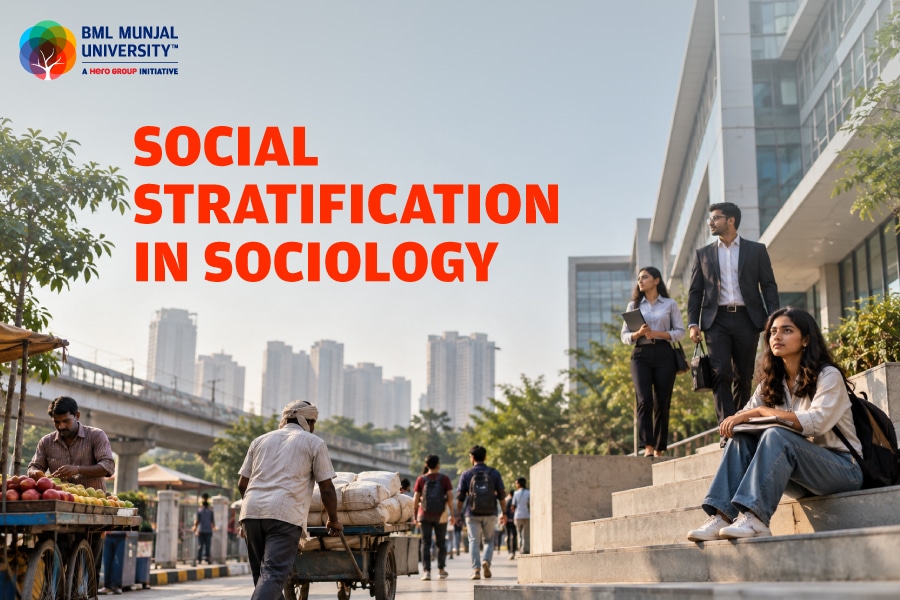
Imagine two students sitting in the same classroom. They may be equally curious, hardworking and ambitious. But outside that classroom, their circumstances could be very different; one may have access to private schooling, professional networks and financial security, while the other may be balancing education with family responsibilities or navigating limited resources.
If we looked only at their individual choices, we would miss part of the story. Social stratification in sociology gives us a way to examine that larger story; it refers to the structured hierarchy through which individuals and groups occupy different social positions and have unequal access to resources, opportunities, power and status.
The concept is therefore not simply about who is rich or poor. Sociology asks a deeper question- Why do particular advantages and disadvantages tend to follow certain social groups across generations?
India provides a particularly important context for studying this question. According to the Ministry of Education's AISHE 2022-23, higher-education enrolment reached 4.46 crore students, up from 3.42 crore in 2014-15. Female enrolment also rose to 2.18 crore, while students from Scheduled Castes accounted for 15.5% and Scheduled Tribes for 6.4% of total higher-education enrolment.
These numbers show expansion, but they also open up a more interesting sociological question- has greater access to education translated into equal opportunities for everyone?
Why Does Social Stratification Matter in Sociology?
Think about a statistic showing that two groups have different educational outcomes; the statistic tells us what is happening, but Sociology asks why. Is the difference related to family income? School quality? Location? Caste? Gender? Parental education? Access to technology? Social expectations?
This is what makes social stratification more than a definition to memorise. It becomes a framework for investigating how social structures shape individual lives.
NITI Aayog's 2024-25 analysis, for example, reports that at the middle stage, mathematics proficiency was 33% for SC and ST students, 39% for OBC students and 48% for the 'Others' category in PARAKH 2024. The numbers do not, by themselves, explain the causes. That is precisely where sociological research begins.
What Are the Main Types of Social Stratification?
Social hierarchies can take different forms and they can overlap.
| Type | What It Relates To | Example of What Sociologists Study |
| Class | Wealth, income and economic position | Differences in access to resources |
| Caste | Social status and historically structured group identities | Caste and opportunity |
| Gender | Social roles and power | Gender differences in work |
| Occupation | Work, income and prestige | Status attached to professions |
| Education | Qualifications and access to knowledge | Education and mobility |
| Power | Influence over decisions and institutions | Who gets to shape policy? |
| Status | Social recognition and prestige | Why some roles receive greater recognition |
These categories should not be viewed as separate boxes; a person's social position can be shaped by several factors simultaneously.
How Does Social Stratification Work?
Stratification becomes easier to understand when you follow a chain. A family's economic circumstances may influence the educational opportunities available to a child; education can influence employment; employment affects income and professional networks and income and networks can then influence the opportunities available to the next generation.
It can look something like- Family background → Education → Employment → Income → Social position → Future opportunities
This is not a fixed formula; people can and do move across social positions. But sociology studies these patterns because they can reveal structural advantages and barriers that are not visible when individual cases are examined in isolation.
Social Stratification vs Social Inequality- What Is the Difference?
The two concepts are closely related, but they describe different things.
| Concept | Meaning |
| Social Stratification | The structured hierarchy of social positions |
| Social Inequality | Unequal access to resources, opportunities, rewards or power |
| Social Mobility | Movement between social positions |
| Social Status | The prestige or recognition associated with a position |
A simple way to remember it is- Stratification describes the structure, inequality describes the unequal distribution within that structure and mobility describes movement through it.
What Are the Major Theories of Social Stratification?
Different sociologists have approached stratification from different angles.
Karl Marx- Economic Class
For Marx, economic relationships were central to understanding social hierarchy. His analysis focused heavily on the relationship between those who own productive resources and those who sell their labour.
The important question was therefore not simply “Who has more?”, but “Who controls economic resources and how does that shape society?”
Max Weber- Class, Status and Power
Weber broadened the discussion by looking beyond economic class. He distinguished between class, status and power, suggesting that a person's social position can be influenced by economic resources as well as social prestige and political influence.
Functionalist Perspective
Functionalist approaches have argued that stratification can serve certain functions in society by encouraging people to undertake roles that require particular skills or responsibilities.
This perspective has also been challenged by other sociologists who question whether unequal rewards are necessary or whether they reproduce existing advantages.
How Is Social Mobility Connected to Stratification?
If stratification describes the layers of society, social mobility asks whether people can move between those layers.
There are several forms-
- Upward mobility- Movement to a higher social position
- Downward mobility- Movement to a lower social position
- Horizontal mobility- Movement between positions with broadly similar status
- Intergenerational mobility- Difference between the social position of parents and children
- Intragenerational mobility- Change in an individual's social position during their lifetime
Education, employment, entrepreneurship, migration and social policy can all influence mobility.
Social Stratification in India- Why It Remains Relevant
India offers a particularly rich setting for studying stratification because multiple systems of social difference intersect. Caste, class, gender, region, education and occupation can interact in ways that shape people's opportunities.
Education provides a useful way to see these differences. ASER 2024, a large-scale rural household survey covering 649,491 children across 605 districts, found that 7.9% of 15-16 year-olds were not enrolled in school nationally. The figure was higher for girls, at 8.1%, compared with 7.7% for boys.
The same survey also examined digital access among 14-16 year-olds for the first time at a national scale. While almost 90% of both boys and girls reported having a smartphone at home, ownership showed a gender gap- 36.2% of boys owned a smartphone compared with 26.9% of girls.
This creates several sociological questions-
- What explains differences in educational participation?
- Why do gaps remain even when access to technology is expanding?
- How does family background affect educational progression?
- How do institutions influence mobility?
- Which policies reduce structural barriers?
This is where sociology turns education data into questions about society.
How Can Social Stratification Be Studied Through Research?
A sociologist does not have to rely on theory alone. The subject can be investigated using-
- Interviews
- Surveys
- Ethnographic observation
- Fieldwork
- Census and government datasets
- Statistical analysis
- Historical research
- Archival research
- Comparative studies
For example, instead of asking “Does caste influence education?”, a researcher could examine enrolment data, interview students and families, study institutional practices and compare educational outcomes across different groups. That combination of theory + evidence + fieldwork is what turns a broad social question into sociological research.
What Can You Study Through Social Stratification?
The topic connects with a surprisingly wide range of contemporary issues.
| Area | Sociological Question |
| Education | Does education create social mobility? |
| Employment | How does social background affect career opportunities? |
| Gender | How are work and social expectations distributed? |
| Caste | How do caste identities influence social relationships? |
| Urbanisation | Does moving to a city change social mobility? |
| Technology | Can digital access reduce or reproduce inequality? |
| Politics | Who has access to political power? |
| Healthcare | How do social conditions influence health outcomes? |
| Globalisation | How are local social structures affected by global change? |
This is why social stratification can become a starting point for studying public policy, development, education, gender, politics, economics and social change.
Explore Society Through BA (Hons) Sociology at BML Munjal University
At BML Munjal University, the BA (Hons) Sociology programme is built around understanding social structures, interactions, inequalities and power within historical and political contexts. The programme specifically includes the study of social stratification, caste, class, gender, sexuality and age, alongside sociological theory and research methodology.
The programme is organised around four broad academic axes-
- Sociological theory
- Methodology
- Sociological themes
- Specialised electives
This structure allows students to move from understanding sociological concepts to using them to investigate real social problems.
What Does the Curriculum Look Like?
The four-year undergraduate structure carries 160 credits, including 80 major credits, 32 interdisciplinary minor credits, 9 multidisciplinary credits, 9 skill-enhancement credits and 12 research/dissertation credits. It also includes a summer internship component.
| Academic Component | 4-Year Requirement |
| Major | 80 credits |
| Interdisciplinary Minor | 32 credits |
| Multidisciplinary | 9 credits |
| Ability Enhancement | 8 credits |
| Value Added Courses | 6–8 credits |
| Skill Enhancement | 9 credits |
| Summer Internship | 2–4 credits |
| Research/Dissertation | 12 credits |
| Total | 160 credits |
The curriculum moves from foundational thinking towards specialised sociological inquiry. Students encounter courses such as Western Classical Thinkers, Archival and Historical Methods, Sociology of the Indian State, Contemporary Social Movements, Modernity, Capitalism and Globalisation, Research Methods, Sociology of Education, Culture, Identity and Society and Science, Technology and Society.
The programme also allows students to work with faculty mentors to choose a major or double major, while students can pursue up to two minors to develop interdisciplinary interests.
This matters for a subject such as sociology because social questions rarely fit neatly into one discipline. Understanding inequality, for example, can require perspectives from economics, politics, history, psychology and public policy.
Conclusion
So, what is social stratification in sociology? It is the study of how societies create and maintain layers of social difference and how those layers influence access to resources, opportunities, power and status. But the most interesting part begins after the definition.
Why does one social group have better access to education? Why do some forms of work receive greater recognition? When does education lead to mobility and when does it reproduce existing inequalities? How do caste, class and gender intersect? These are not questions that can be answered by one statistic or one theory.
They require observation, evidence, historical understanding and critical thinking; the same combination that makes sociology relevant far beyond the classroom.
Ready to explore society, inequality and social change through a research-driven approach? Apply now for the BA (Hons) Sociology programme at BML Munjal University and take the first step towards understanding and shaping the world around you.
FAQs
Social stratification is the structured ranking of people into social layers based on factors such as wealth, caste, class, status, power and education.
Karl Marx mainly viewed stratification through economic class, particularly the conflict between those who own the means of production and those who sell their labour.
Differences in access to quality education based on family income, social background or location are a real-life example of social stratification.
It is hierarchical, socially structured, relatively persistent and linked to unequal access to resources, opportunities and power.
Factors include income, wealth, occupation, education, caste, gender, social status and political power.
Common forms include class, caste, slavery, estate systems and status-based hierarchies.
Economic resources, occupation, education, social recognition, family background and access to political or institutional power can influence them.
They examine indicators such as income, wealth, education, occupation, social mobility, status and access to resources, often using surveys and demographic data.
It helps students understand inequality, social mobility, opportunity and how social structures influence people’s lives.
Yes. Caste is a major form of social stratification in India, historically influencing social status, relationships and access to opportunities.
Related Blogs

Top Career Options After BA (Hons) Sociology: Jobs, Salary & Emerging Opportunities
Sociology is the study of society, human behaviour, social relationships and the social systems that influence how people live, work and interact. It ...

How to Become a Clinical Psychologist After 12th – Step-by-Step Guide
India is witnessing a significant rise in mental health awareness. From schools and colleges to workplaces and hospitals, conversations around emotion...

What Can You Do With a BA History Degree? Top Career Paths in 2026
Here is a question you have probably heard or quietly asked yourself: “What exactly do you do with a history degree?” The honest answer to t...

BA Subjects List: Top Specialisations, Subject Combinations & Year-wise Course Structure
Key Takeaways: A BA degree typically covers subjects such as Psychology, Economics, Sociology, Literature, History, Political Science and Philoso...

Liberal Arts: The Degree That Prepares You for Jobs That Don’t Exist Yet
Have you ever felt like the degrees that colleges offer are lacking some or the other thing for you? Have you felt like “yes, biotechnology is impor...

When You Can’t Be Replaced by AI, It’s Probably Because You Studied Liberal Studies
As we are seeing AI evolving day by day, some fearful headlines are also getting space in the social media posts, news articles and discussions over c...