

15 Key Characteristics of Entrepreneurship (With Real-life Examples)


Admissions Enquiry
Summary: Entrepreneurship is the process of identifying opportunities, creating value and building solutions through innovation, calculated risk-taking and leadership. Successful entrepreneurs typically share 15 core characteristics, including innovation, risk tolerance, vision, adaptability and resilience, that shape how they spot opportunities, build ventures and recover from setbacks. These traits can be developed through education, mentorship and real-world experience.
Key Takeaways
- Entrepreneurship is a process and mindset; an entrepreneur is the individual who drives that process.
- This guide covers 15 key characteristics of entrepreneurship, each explained with a real-world example (Musk, Jobs, Bezos, Nayar, Branson and more).
- India has crossed 2.35 lakh DPIIT-recognised startups as of 2026, creating over 23 lakh direct jobs; entrepreneurship is now a mainstream economic driver, not a niche pursuit.
- The future of entrepreneurship is being shaped by AI-driven ventures, sustainability and remote-first business models.
- Structured education, such as an MBA in Entrepreneurship, can accelerate the development of these characteristics.
Entrepreneurship is not about starting a business or becoming your own boss. But in reality, it runs much deeper than that. It is about
- How you think
- How you respond to challenges
- How you turn ideas into something meaningful
This mindset has become more relevant because India experiences an unprecedented wave of entrepreneurship. As of 2026, the Department for Promotion of Industry and Internal Trade (DPIIT) has recognised more than 2.23 lakh startups, which together have created over 23 lakh direct jobs across the country.
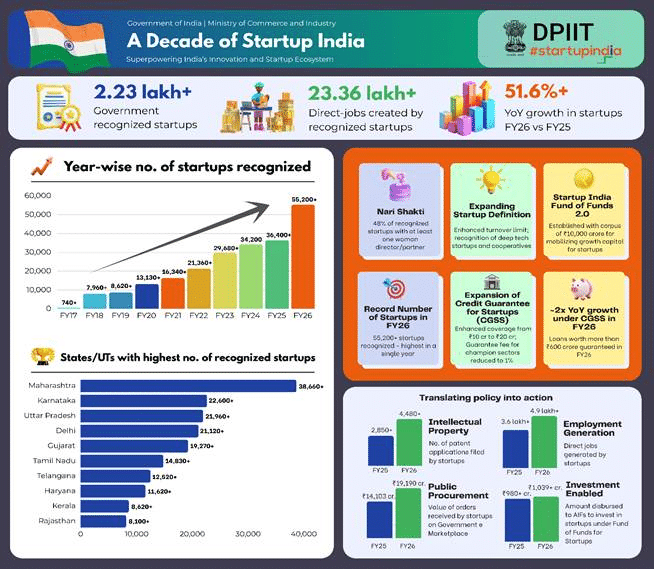
Image Source: DPIIT
Behind every successful venture are the characteristics of entrepreneurship. They shape this entire journey from identifying opportunities to creating solutions that last.
If you are studying business, planning a start-up or exploring career options, understanding these characteristics helps you know what entrepreneurship truly demands and why it matters in today’s fast-evolving economy.
What is Entrepreneurship?
In simple terms, entrepreneurship is the process of turning ideas into action. It involves identifying opportunities, creating value and building solutions, often by starting a new venture or meaningfully improving an existing one. This process is driven by an entrepreneur, the individual who takes on the risk and responsibility of execution.
A simple way to understand the relationship- think of the entrepreneur as a driver and entrepreneurship as the road they travel on. The driver's skill, judgement and decisions matter, but the road itself, with its twists, opportunities and obstacles, is what entrepreneurship as a process represents.
Why Entrepreneurship Matters?
Entrepreneurship is important because it-
- Drives economic development by creating new businesses and expanding industries.
- Generates employment opportunities and contributes to job creation.
- Encourages innovation by introducing new products, services and business models.
- Solves real-world problems through creative and practical solutions.
- Increases market competition, leading to better quality and more affordable products for consumers.
- Supports social development by addressing challenges in areas such as healthcare, education, agriculture and sustainability.
- Boosts a country's competitiveness by attracting investments and strengthening the economy.
Top 15 Characteristics of Entrepreneurship You Should Know
The characteristics of entrepreneurship influence decision-making, risk management as well as long-term success. When students and founders build these traits early, they are better prepared for real-world challenges.
Below are 15 characteristics of entrepreneurship, each illustrated with a real example of how it plays out in practice.
1. Innovation
Innovation is the ability to generate new ideas, products, services or methods of operation, or to meaningfully improve on existing ones. Entrepreneurs rarely invent something from nothing- most build on existing ideas and sharpen them for a market gap.
Real-life Example- Steve Jobs did not invent the smartphone, MP3 player or tablet. He took existing technologies and reimagined them with design and usability at the centre, turning Apple into one of the world's most valuable companies.
2. Risk-Taking Ability
Calculated risk-taking means gathering enough data and market signals before committing resources to a decision, rather than acting on instinct alone.
Real-life Example- Elon Musk staked a large part of his personal fortune, earned from PayPal, into Tesla and SpaceX at a time when both ventures were widely expected to fail. The calculated bets, backed by deep technical conviction, eventually paid off.
3. Vision and Foresight
Vision allows entrepreneurs to see opportunities ahead of the market, while foresight helps them anticipate where trends, technology and customer needs are headed.
Real-life Example- Jeff Bezos started Amazon as an online bookstore in 1994 with a long-term vision of becoming 'the everything store,' anticipating the shift to e-commerce years before it became mainstream.
4. Leadership
No venture grows alone. Founders need to guide teams, make timely decisions and take ownership of outcomes- good and bad.
Real-life Example- Indra Nooyi, as CEO of PepsiCo, was known for her 'Performance with Purpose' leadership style, steering a large global organisation through sustainability-led transformation while keeping teams aligned to a long-term goal.
5. Creativity and Problem-Solving
Entrepreneurs face resource constraints, competition and unexpected setbacks daily. Creativity helps them find solutions where others see dead ends.
Real-life Example- During the 2020 disruptions, many Indian D2C and EdTech founders like Gaurav Kumar (Edumarshal) and Ashish Nichani (Postcard) pivoted entire business models, from offline to online delivery within weeks, turning a crisis into a growth opportunity.
6. Initiative and Proactiveness
Entrepreneurs do not wait for ideal conditions. Acting early and decisively often creates a first-mover advantage that is difficult for later entrants to close.
Real-life Example- Falguni Nayar left a long corporate career at the age of 50 to start Nykaa, entering India's beauty e-commerce space early and building a category leader before larger players caught on.
7. Adaptability and Flexibility
Markets, technologies and customer expectations change constantly. Entrepreneurs who can revise strategy without losing sight of the core mission tend to survive longer.
Real-life Example- Netflix, led by Reed Hastings and Marc Randolph, famously moved from DVD-by-mail rentals to streaming and later to original content production, adapting its entire business model multiple times as technology and consumer behaviour shifted.
8. Self-Confidence
Confidence allows entrepreneurs to trust their preparation and vision, even when investors, peers or the market express doubt without tipping into overconfidence.
Real-life Example- Richard Branson has spoken often about pitching ideas that others dismissed outright, from Virgin Records to Virgin Atlantic, relying on conviction in his own judgement to push through early scepticism.
9. Goal-Oriented Mindset
A clear, measurable goal keeps founders and teams focused. This includes planning milestones, tracking progress and adjusting strategy without losing sight of the target.
Real-life Example- Ritesh Agarwal built OYO around an explicit goal of standardising budget hospitality at scale, expanding city by city with measurable targets rather than vague ambition.
10. Persistence and Resilience
The entrepreneurial path includes rejection, failed products and missed milestones. Persistence keeps founders moving forward; resilience helps them recover from real setbacks.
Real-life Example- Before Airbnb became a global brand, its founders, Brian Chesky and Joe Gebbia, were rejected by multiple investors and nearly ran out of money, reportedly selling novelty cereal boxes to keep the company afloat in its early days.
11. Networking and Relationship-Building
Entrepreneurs rarely succeed alone. The ability to build relationships with mentors, investors, partners and early customers often determines how fast an idea can scale.
Real-life Example- Sara Blakely, founder of Spanx, used strategic networking and cold outreach to get her foot in the door by calling friends of friends and leveraging personal contacts to pitch her idea directly to buyers.
12. Financial Literacy
Understanding cash flow, unit economics and fundraising basics helps entrepreneurs make sound decisions instead of relying on guesswork, especially in the early, cash-constrained stages of a venture.
Real-life Example- Nithin Kamath, founder of Zerodha, used deep financial literacy to understand unit economics and cash-flow management instead of relying on external, high-cost financial or marketing agencies.
13. Passion
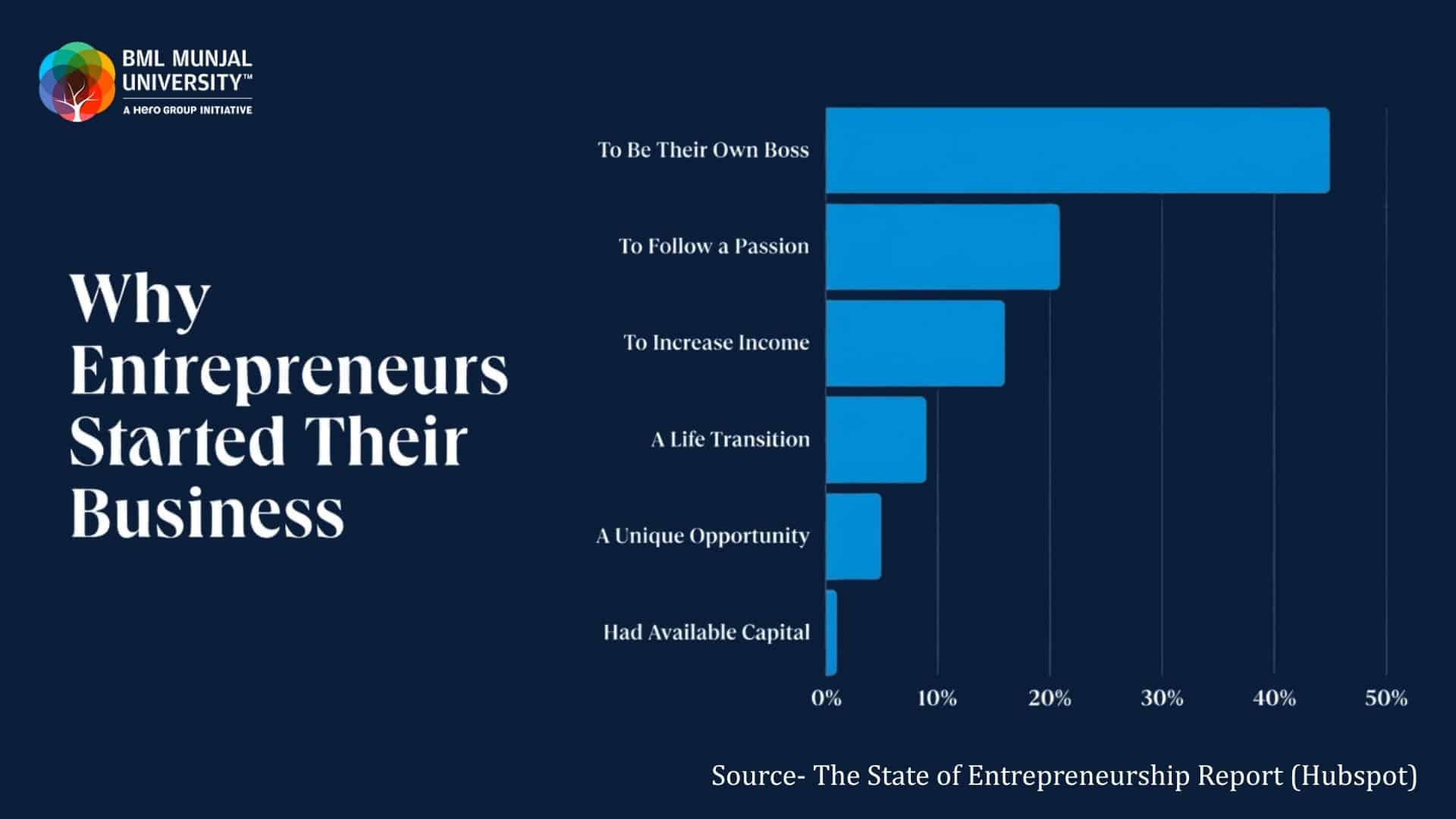
Passion is the genuine drive and emotional commitment an entrepreneur brings to their idea. It is what keeps founders working through long hours, repeated setbacks and slow early traction, long after the initial excitement of starting up has faded. According to HubSpot's State of Entrepreneurship Report, 26% of entrepreneurs launch a venture to follow their passion.
Real-life Example- Deepinder Goyal started Zomato (then FoodieBay) as a side project at Bain & Company, scanning restaurant menus so colleagues wouldn't have to hunt for them at lunch; he stuck with the idea, building the platform city by city, before quitting his consulting job in 2009 to pursue it full-time.
14. Decisiveness
Founders are often required to make high-stakes decisions with incomplete information. Being decisive and willing to course-correct matters more than always being right the first time.
Real-life Example- Sundar Pichai's decision to back Google's pivot toward AI-first products required committing significant resources before outcomes were certain, reflecting the decisiveness expected of leaders steering major strategic shifts.
15. Continuous Learning and Curiosity
Markets and technologies move quickly. Entrepreneurs who stay curious and keep learning are better positioned to spot the next opportunity before competitors do.
Real-life Example- Bill Gates is widely known for his structured 'Think Weeks,' dedicated entirely to reading and learning about emerging technology trends. It is a practice he credits with shaping Microsoft's long-term direction.
How is Entrepreneurship Evolving in 2026 and Beyond?
Entrepreneurship today looks very different from even five years ago, shaped by faster technology cycles, easier access to capital and a growing emphasis on sustainability.
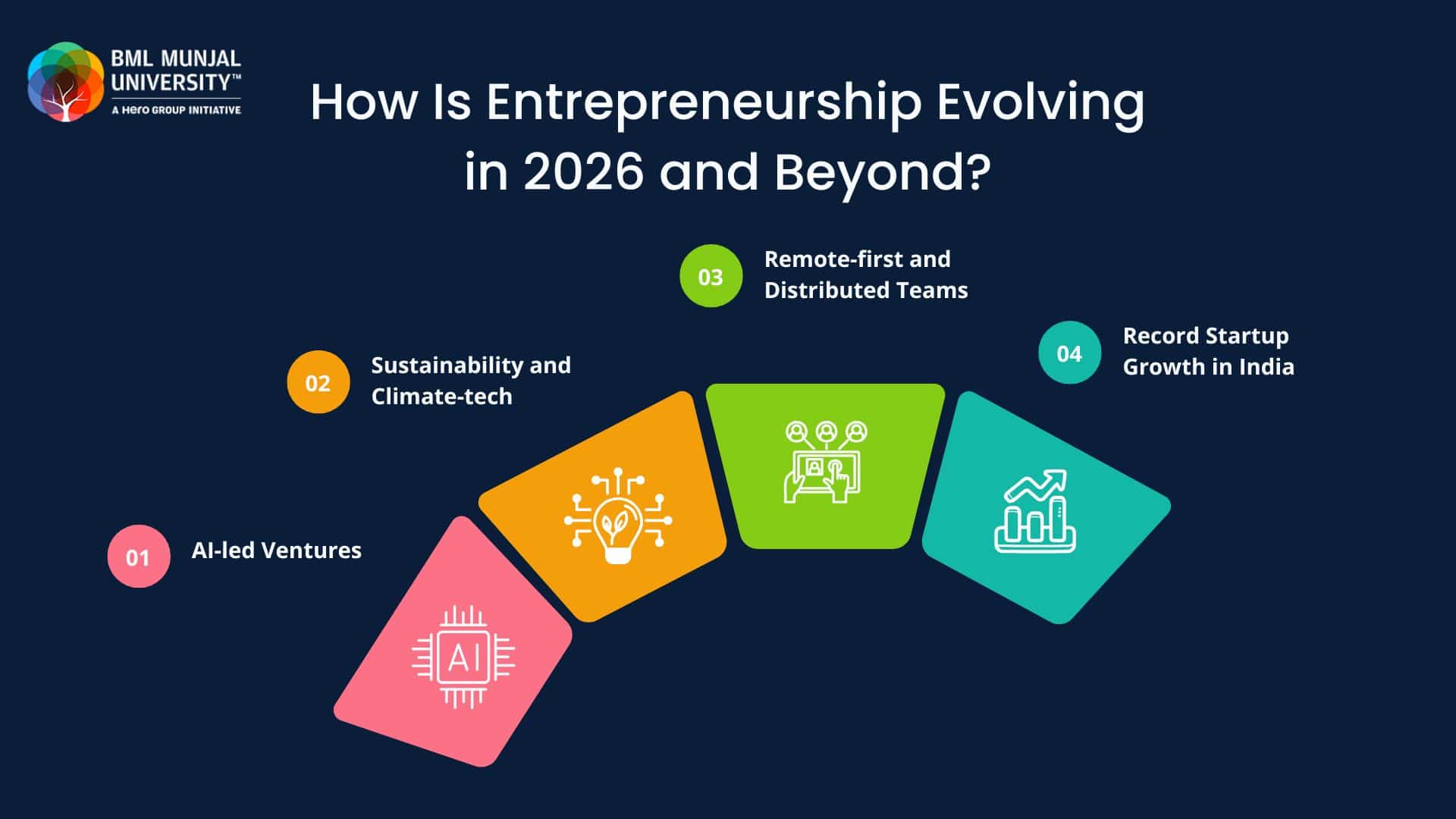
Here are the recent trends and developments in entrepreneurship-
- AI-led ventures- Indian startups are increasingly building AI-first products across sectors such as fintech, healthtech and SaaS, rather than treating AI as an add-on feature. A recent report from Elevation Capital reveals that nearly 86% of Indian startups plan to expand their AI budgets in 2026.
- Sustainability and climate-tech- Green packaging, clean energy and circular-economy startups are attracting growing investor interest as ESG considerations become mainstream.
- Remote-first and distributed teams- More founders are building lean, globally distributed teams from day one rather than centralising operations in a single city.
- Record startup growth in India- Over 55,200 new startups received DPIIT recognition in FY 2025-26 alone, the highest single-year addition since the Startup India programme began in 2016.
What is the Difference Between Entrepreneurship and Entrepreneur?
Entrepreneurship is the broader process of identifying opportunities, taking risks and building a venture that creates value. On the other hand, an entrepreneur is the individual who drives that process, taking the decisions, risks and actions needed to bring an idea to life.
| Items | Entrepreneur | Entrepreneurship |
| Definition | An individual who identifies an opportunity and starts a venture to act on it. | The process of identifying opportunities, taking risks and building a venture from an idea. |
| Focus | On the individual and their personal traits. | On the process, system and mindset of value creation. |
| Primary Goal | To build and lead a successful venture. | To create value, solve problems and drive innovation. |
| Types | There is no fixed "type", entrepreneurs differ by industry and approach. | Includes types such as small-business, scalable start-up, social and corporate entrepreneurship. |
| Skills | Decision-making, leadership, financial literacy and networking. | Opportunity recognition, risk assessment, innovation management and resource mobilisation. |
| Characteristics | Passion, persistence, self-confidence and adaptability. | Innovation, risk-taking, vision and a goal-oriented approach. |
What are the Different Types of Entrepreneurship?
Entrepreneurship is not limited to launching startups or building technology companies. Depending on the entrepreneur's goals, industry and approach, there are several types of entrepreneurship, each with its own purpose, opportunities and challenges.
- Small Business Entrepreneurship
- Scalable Startup Entrepreneurship
- Social Entrepreneurship
- Digital / Online Entrepreneurship
- Corporate Entrepreneurship (Intrapreneurship)
- Franchise Entrepreneurship
- Strategic Solopreneurship
- Hybrid & Multi-Channel Entrepreneurship
For a detailed breakdown of each type with examples, read our complete guide on Types of Entrepreneurship.
Real-life Examples of Successful Entrepreneurs
Beyond the individual examples woven into each characteristic above, it helps to look at how multiple traits combine in a single entrepreneur's journey.
- Elon Musk- Vision, risk-taking and persistence across ventures like PayPal, Tesla and SpaceX.
- Falguni Nayar- Initiative and self-confidence in building Nykaa into a leading public company.
- Richard Branson- Adaptability and confidence in expanding the Virgin brand across diverse industries.
- Ritesh Agarwal- Goal-oriented and creative, transforming budget hospitality through OYO.
- Dario Amodei- Co-founder and CEO of Anthropic, known for his mission-driven, principled leadership and scientific mindset.
Can Entrepreneurial Traits Be Learned?
Yes. While some individuals may show early signs of curiosity or risk tolerance, research and real-world evidence consistently show that most entrepreneurial traits, including financial literacy, leadership, decision-making and risk assessment, can be developed through structured learning, mentorship and direct experience. Entrepreneurship is best understood as a skill set built over time, not a fixed personality type someone either has or doesn't.
Common Challenges and Mistakes Entrepreneurs Face
Even the most promising ventures can stumble when founders overlook fundamentals in pursuit of speed or scale. Recognising these common pitfalls early can help entrepreneurs course-correct before the damage becomes irreversible.
- Scaling too early, before the product or business model has been properly validated with real customers.
- Ignoring cash flow and unit economics in favour of chasing growth or vanity metrics.
- Underestimating competition or assuming a first-mover advantage will last indefinitely.
- Building a team of similar skill sets instead of complementary ones, leaving critical gaps in execution.
- Failing to adapt the original idea based on market feedback, out of attachment to the initial vision.
Taking on funding or partners without aligning on long-term goals, leading to conflict later.
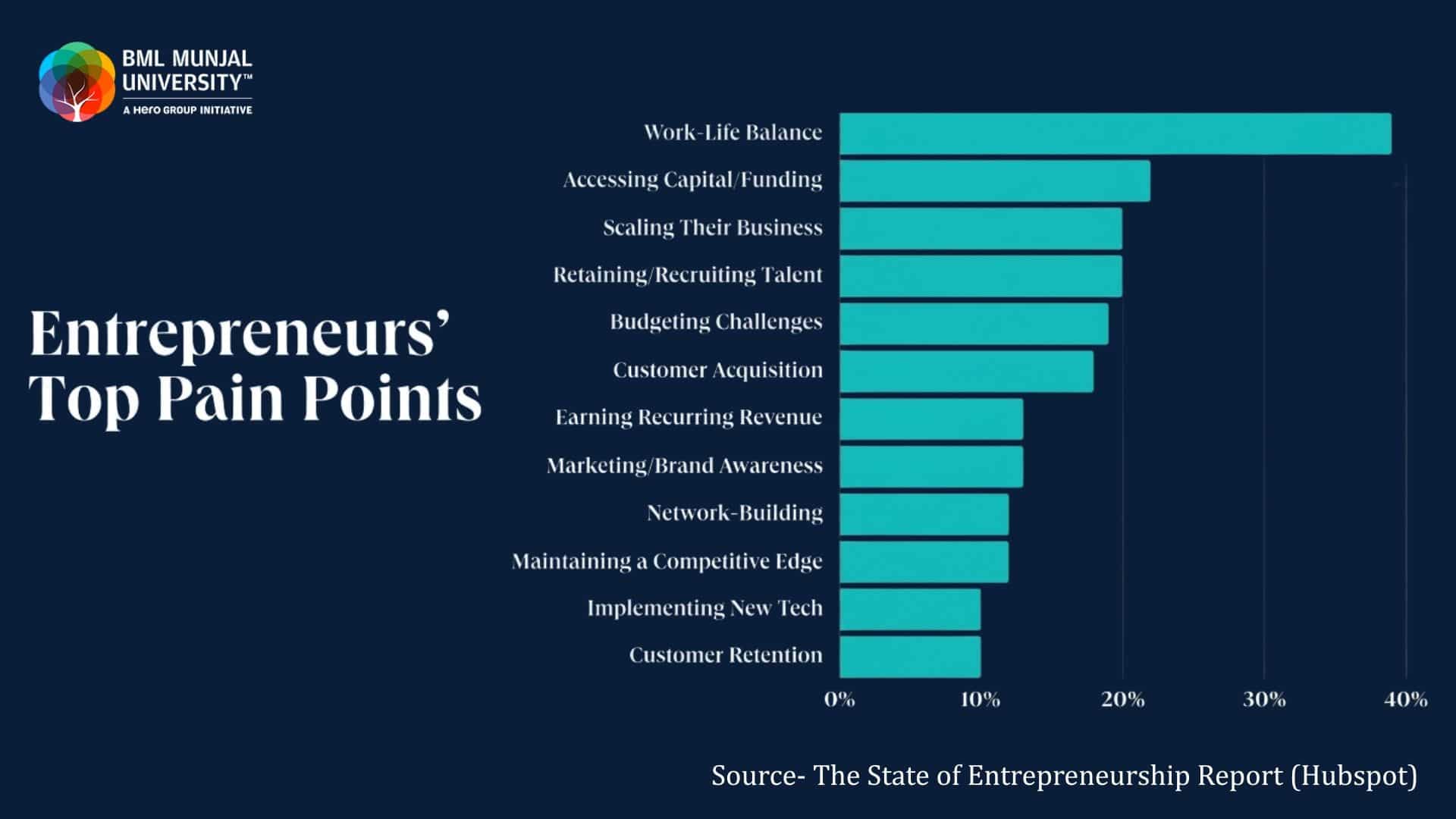
How Do I Develop These Characteristics?
Building entrepreneurial characteristics is less about waiting for inspiration and more about consistent, deliberate practice.
- Work on real projects that involve decision-making and calculated risks.
- Learn from mentors, founders and industry professionals.
- Join incubators, accelerators or business competitions for practical experience.
- Study both business successes and failures to improve decision-making.
- Pursue entrepreneurship-focused education to develop leadership and business skills.
- Reflect on your experiences to continuously improve your judgement and approach.
Build an Entrepreneurial Mindset with the MBA in Entrepreneurship at BML Munjal University
If you want to develop an entrepreneurial mindset, you should learn how to apply it in real business situations. This is where an MBA in Entrepreneurship at BML Munjal University comes into picture. This postgraduate level programme goes beyond theory and emphasises mindset, execution as well as real-world exposure.
The course is designed for students who want to study business and build, scale or lead ventures with confidence. It helps you connect classroom concepts with real entrepreneurial challenges from opportunity identification to long-term growth.
Here are some programme highlights-
- AI-powered, Industry 4.0-ready Curriculum
- Hands-on Training with Tableau, Power BI, etc.
- Exposure to AI-led Marketing
- Guest Lectures from Renowned Speakers
- Industry Workshops by Experts
- Strong Focus on Practical Learning
- Emphasis on Mindset Development
- Career and Venture Readiness
Get an exclusive sneak peek into the programme through our YouTube video:
YouTube video:
Ready to turn your ideas into impact? This is the right time to explore MBA in Entrepreneurship course at BML Munjal University. Take the next step towards building your entrepreneurial future.
Conclusion
Entrepreneurship is more than launching a business- it is a mindset built on innovation, resilience, leadership and continuous learning. The characteristics of entrepreneurship enable individuals to identify opportunities, solve real-world problems and create lasting value, whether they start a company, lead a team or drive change within an organisation.
As technology, AI and sustainability continue to reshape industries, developing these entrepreneurial traits is becoming increasingly important. By understanding and practising these characteristics, you can build the confidence and skills needed to succeed in an evolving business landscape.
FAQs
The five core characteristics of entrepreneurship are innovation, risk-taking, leadership, adaptability and resilience.
You can develop entrepreneurial characteristics by working on real projects, learning from mentors, joining incubators or business competitions, studying case studies and continuously reflecting on your experiences.
Entrepreneurship identifies opportunities, creates innovative products or services, generates employment, drives economic growth, solves real-world problems, encourages competition and creates value for customers, businesses and society.
A successful entrepreneur combines innovation, leadership, resilience, adaptability, calculated risk-taking as well as continuous learning. Also, strong decision-making, financial literacy and persistence help build and grow sustainable businesses.
The main objective of entrepreneurship is to create value by identifying opportunities, solving problems through innovation, building sustainable businesses, generating employment and contributing to economic and social development.
The main types of entrepreneurs include small business, scalable startup, social, digital, franchise, corporate (intrapreneur), solopreneur and hybrid entrepreneurs, each pursuing different business goals and growth strategies.
Yes. While some people naturally display entrepreneurial traits, most characteristics, including leadership, decision-making, risk assessment and financial literacy, can be developed through education, mentorship and practical experience.
Anyone with a business idea, problem-solving mindset and willingness to learn can become an entrepreneur. While certain skills help, most entrepreneurial abilities, such as leadership, decision-making and financial management, can be developed through education, mentorship and practical experience.
An MBA, particularly one with a dedicated entrepreneurship specialisation, can help build practical skills in leadership, finance, marketing and venture execution, along with valuable networks and mentorship.
Related Blogs
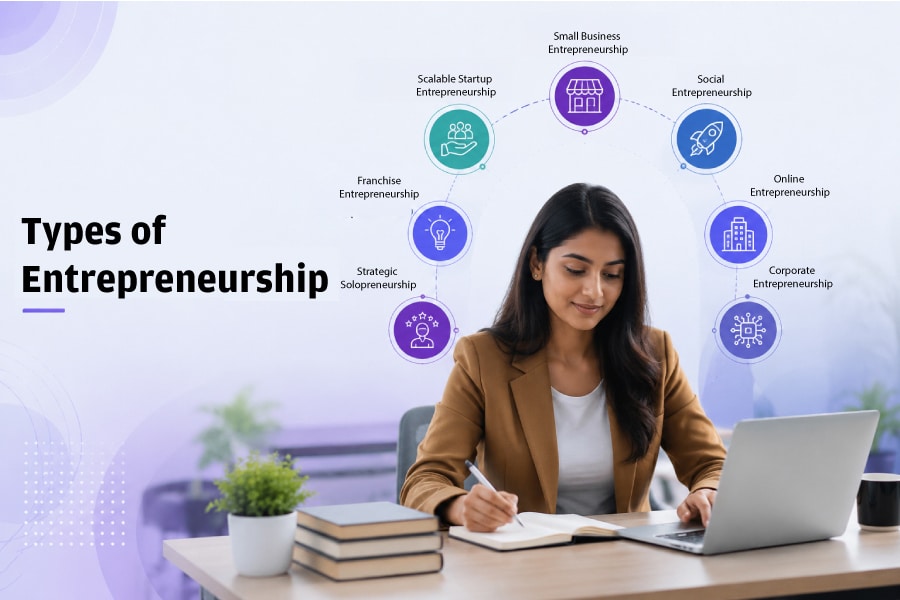
What Are the Types of Entrepreneurship? 12 Models Explained with Examples
TL;DR There are 12 major types of entrepreneurship- Small Business, Scalable Startup, Social, Digital, Corporate (Intrapreneurship), Franch...

Role of Entrepreneurship in Economic Development: 10 Key Contributions Explained
Entrepreneurship fuels economic development by creating jobs, driving innovation, increasing GDP and raising per capita income. New startups an...

Why an MBA in Entrepreneurship is the Smartest Move for Future Startup Founders
Ever wonder, “Why 9 out of 10 startups fail?” As per the insights, only 1% of startups that become unicorns, such as Uber, Airbnb, Slack, Strip...

No Maths? No Problem. How to Become an Entrepreneur After 12th Commerce
A lot of students are under the impression that commerce without maths scope is extremely limited. However, this is far from true. In India, even if y...
World Entrepreneurs’ Day: Carrying forward a legacy of entrepreneurship
Entrepreneurship is about creating change, not just companies.” – Mark Zuckerberg Millennials and Gen-Z are witnessing a turning point in the w...