What Are the Types of Entrepreneurship? 12 Models Explained with Examples


Admissions Enquiry
In Summary- Discover the 12 types of entrepreneurship with examples and understand how they differ in terms of business goals, capital requirements, funding sources, risk levels and growth potential. The guide also explains how to become an entrepreneur, raise funding, develop essential skills and select the entrepreneurial path that aligns with your ambitions.
TL;DR
-
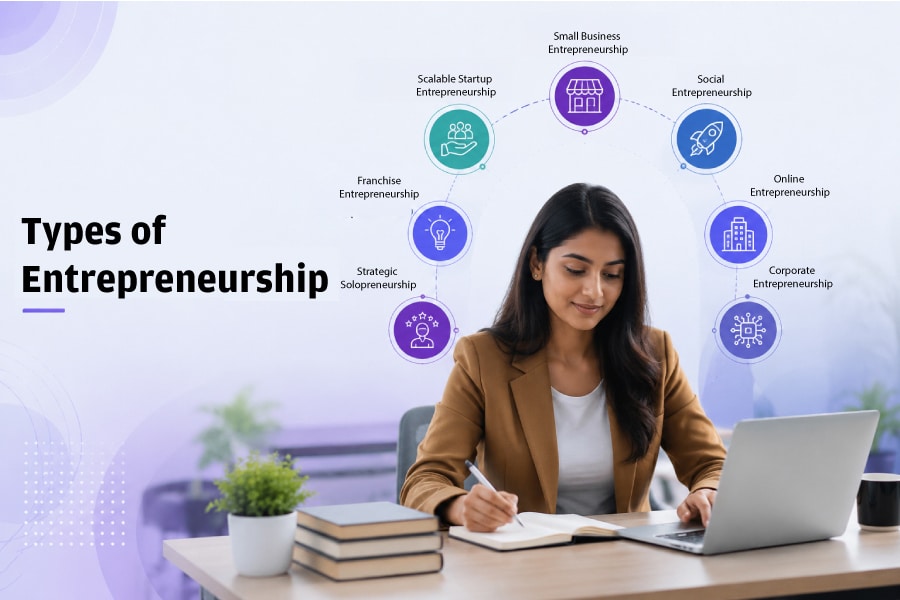
- There are 12 major types of entrepreneurship- Small Business, Scalable Startup, Social, Digital, Corporate (Intrapreneurship), Franchise, Solopreneurship, Hybrid, Research & Deep-Tech, Buyer/Acquisition, Serial and Green Entrepreneurship.
- Each entrepreneurial model differs in terms of investment required, funding sources, risk level, business goals and growth potential.
- The right type of entrepreneurship depends on your skills, available capital, long-term goals and willingness to take risks.
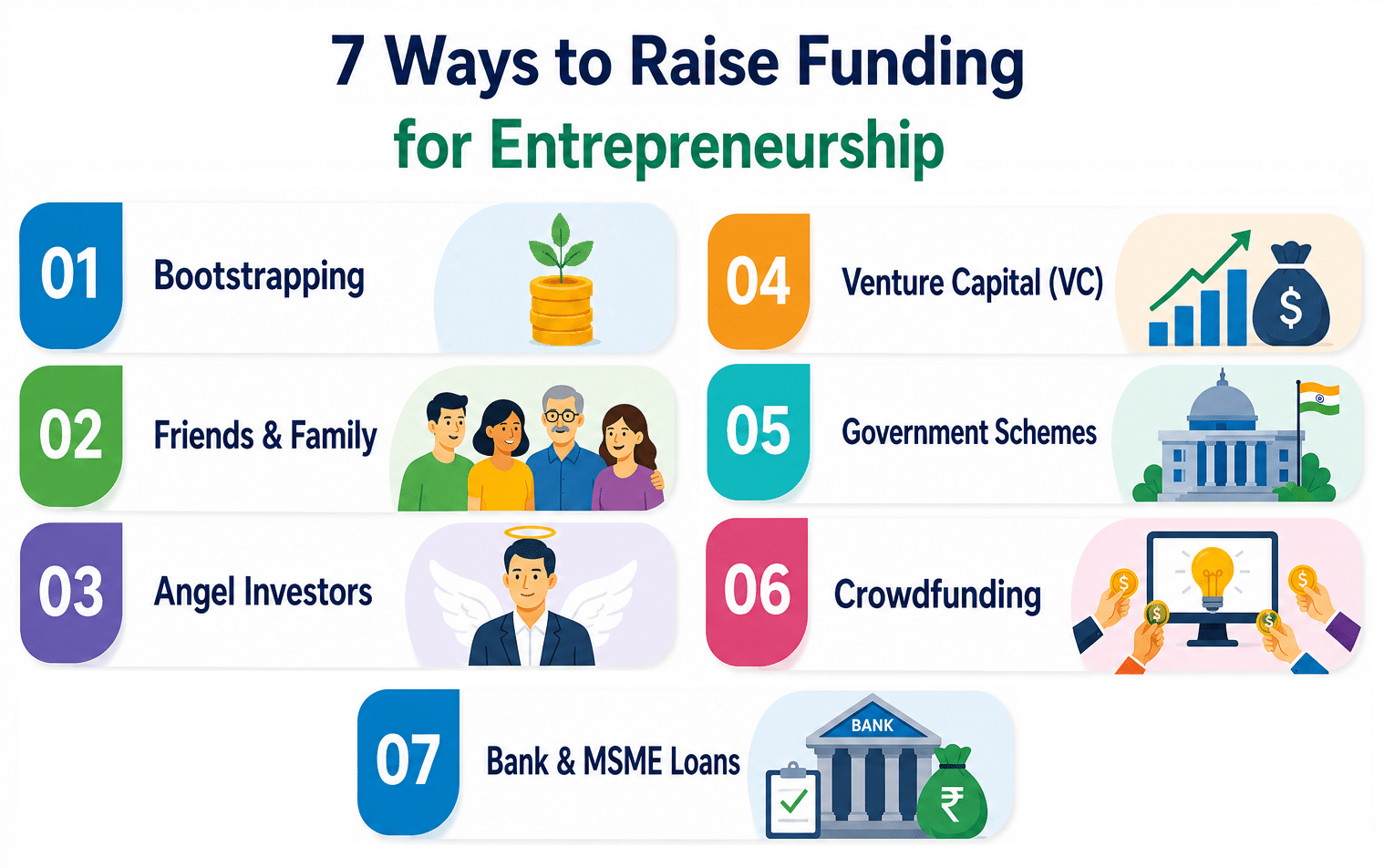
- Funding options in India include bootstrapping, angel investors, venture capital, government schemes, crowdfunding and MSME loans.
- Strong business, financial, communication and digital skills, combined with practical learning and mentorship, improve your chances of building a successful venture.
In India, entrepreneurship just got a major nationwide push.
Adani Group Chairman Gautam Adani launched Vande Bharatam in June 2026. It is a countrywide initiative to identify and support innovators as well as entrepreneurs from every state and union territory. If we see beyond India’s usual startup hubs, more than 80% of founders come from just a handful of cities.
This programme will run a multi-stage search across over 800 districts, shortlist 75 finalists for mentorship and incubation support in Ahmedabad. Also, they will culminate in a grand finale around Independence Day 2026.
The main point is that initiatives like this highlight something important. Entrepreneurship in India is opening up well beyond the familiar tech-startup narrative to include grassroots innovators, small business owners and problem-solvers from every corner of the country. If you also want to build a venture successfully, start with understanding which type of entrepreneurship actually fits your idea, capital as well as goals.
In this blog, you will find a breakdown of the 12 types of entrepreneurship you should know before you choose your path.
At a Glance- Comparing All 12 Types of Entrepreneurship
Here is a quick comparison of all 12 popular types of entrepreneurship that helps you get an idea of which one you should choose-
| Type | Scope | Risk Level | Best For |
| Small Business | Local/regional | Low | Steady, hands-on income |
| Scalable Startup | National/global | High | Founders chasing fast scale |
| Social | Community/national | Medium | Impact-first founders |
| Digital/Online | Location-independent | Low–Medium | Low-capital starters |
| Corporate (Intrapreneurship) | Within organisation | Low | Employees wanting innovation |
| Franchise | Local/national | Low–Medium | First-time owners |
| Solopreneurship | Individual | Low | Consultants, freelancers |
| Hybrid & multi-channel | Multi-channel | Medium | Risk diversifiers |
| Research & Deep-Tech | Specialised/IP-led | High | STEM/research founders |
| Buyer/Acquisition | Varies | Medium | Operational turnaround experts |
| Serial | Multiple ventures | High | Repeat founders |
| Green/Sustainable | Climate/impact-led | Medium–High | Climate-tech founders |
What is Entrepreneurship?
Entrepreneurship is the process of identifying a business opportunity and building a venture around it- organising resources, taking on financial risk and creating value in pursuit of profit, social impact, or both.
It isn't limited to tech startups. Entrepreneurship can take many forms- a single-location small business, a VC-backed scalable startup, a nonprofit-style social venture or even an innovation project built inside an existing company. No matter the path, entrepreneurship is about identifying a problem or opportunity and taking the initiative to solve it.
Why Understanding Different Types of Entrepreneurship Matters
India is home to more than 2.40 lakh DPIIT-recognised startups, generating nearly 24 lakh jobs and almost 48% of these startups have at least one woman director or partner. However, not every entrepreneur follows the same path. A solo content creator, a deep-tech founder building satellite launch vehicles and a franchise owner running a coaching centre are all entrepreneurs, but they differ in terms of investment, growth potential, funding needs and risk.
Understanding which type fits your goals, capital and risk appetite helps you avoid two common mistakes-
- Chasing venture-scale growth when a steady small business would suit you better or
- Underestimating the funding and patience deep-tech or social ventures actually require
12 Types of Entrepreneurship Explained (With Real-life Examples)
Here's a detailed look at each type, including its scope, typical funding sources and a real-life example-
1. Small Business Entrepreneurship
This is the most common and most enduring form of entrepreneurship, as it includes building a business to generate steady, sustainable income while serving a local or niche market.
| Who's It For | People who want a steady income and local community roots, not high-growth ambition |
| Capital Needed | Low to moderate (personal savings, Mudra loans) |
| Risk Level | Low |
| How You Make Money | Direct sales/services to a local customer base, repeat business |
| Biggest Challenge | Growth is capped by the size of the local market |
Real-life example- Haldiram's is a perfect example of a classic small-business-to-large-enterprise journey. They began as a single sweet shop in Bikaner before growing into a national food brand.
Best suited for- First-generation entrepreneurs who want operational control and predictable income.
2. Scalable Startup Entrepreneurship
This is the high-ambition path as it aims at building a venture with exponential growth potential, typically powered by technology and aimed at disrupting an existing industry or creating an entirely new market.
| Who's It For | Ambitious founders comfortable betting big on an unproven idea |
| Capital Needed | High (investor-funded, often multiple rounds) |
| Risk Level | High |
| How You Make Money | Equity value growth and eventual exit (acquisition/IPO), more than early profit |
| Biggest Challenge | Most scalable startups fail before turning profitable, under constant pressure to grow fast |
Real-life example- Ritesh Agarwal scaled OYO from a single budget-hotel listing into one of India's largest hospitality-tech platforms.
Perfect for- Founders chasing large-scale impact who are comfortable with investor-backed risk.
3. Social Entrepreneurship
Social entrepreneurship is defined by its mission: solving a social, cultural or environmental problem through a business model that is financially sustainable. Profit is not the primary driver, the impact is.
| Who's It For | Founders driven by solving a specific social or environmental problem |
| Capital Needed | Moderate (grants, CSR funding, impact investors) |
| Risk Level | Medium |
| How You Make Money | Blended revenue - service fees, grants and hybrid commercial models |
| Biggest Challenge | Balancing mission with financial sustainability without diluting impact |
Real-life example- Harish Hande co-founded SELCO India to bring solar energy to underserved rural households, proving a for-profit model can serve low-income customers sustainably.
Ideal for- People motivated primarily by impact rather than profit maximisation.
4. Digital / Online Entrepreneurship
One of the most accessible types for students, digital entrepreneurship means building income-generating ventures entirely in the online space with low overhead, global reach and the ability to start immediately.
| Who's It For | Anyone with a laptop, a skill and little capital to spare |
| Capital Needed | Very low |
| Risk Level | Low to Medium |
| How You Make Money | Ad revenue, brand collaborations, digital product or service sales |
| Biggest Challenge | Income depends on unpredictable platforms and algorithms outside your control |
Real-life example- Ranveer Allahbadia built BeerBiceps into a multi-platform media business before expanding into content-led commerce ventures.
Best suited for- Students and young professionals wanting a low-capital entry point.
5. Corporate Entrepreneurship (Intrapreneurship)
Not everyone wants to build from scratch. Corporate entrepreneurship or intrapreneurship is about driving innovation within an established organisation- launching new products, leading innovation teams or piloting new business models using existing company resources.
| Who's It For | Employees who want to innovate without leaving the safety of a paycheck |
| Capital Needed | None personally - funded by the company |
| Risk Level | Low personally, though career risk exists |
| How You Make Money | Salary, plus potential bonuses tied to the new initiative's success |
| Biggest Challenge | Navigating internal politics and slow organisational decision-making |
Real-life example- ITC's e-Choupal initiative was built by internal teams to digitally connect rural farmers to markets and remains one of India's most cited intrapreneurship case studies.
Perfect for- People who want entrepreneurial impact along with the stability of a salaried role.
6. Franchise Entrepreneurship
Franchise entrepreneurship involves running a business using an established brand's proven model, systems and support. Rather than building from scratch, the franchisee pays for the right to operate under a recognised name, reducing the uncertainty that comes with starting something new.
| Who's It For | First-time business owners who want a tested playbook, not a blank page |
| Capital Needed | Moderate to high (franchise fee + working capital) |
| Risk Level | Low to Medium |
| How You Make Money | Selling the franchisor's product or service under their established brand and systems |
| Biggest Challenge | Limited flexibility- you must operate exactly within the franchisor's rules |
Real-life example- Rebel Foods scaled cloud-kitchen brands like Faasos and Behrouz Biryani across cities through an asset-light, franchise-style expansion model.
Ideal for- First-time entrepreneurs who want a reduced-risk alternative to building a brand from zero.
7. Strategic Solopreneurship
Unlike traditional freelancing, the modern solopreneur builds a fully developed enterprise that is streamlined, automated and deliberately crafted around personal strengths. They compete not with generalists but with boutique agencies and often win because they are faster, more personalised and more cost-efficient.
| Who's It For | Experts who'd rather do everything themselves than manage a team |
| Capital Needed | Very low |
| Risk Level | Low |
| How You Make Money | Charging directly for your time, skill, or expertise |
| Biggest Challenge | Income is capped by your own hours, with no one to delegate to |
Real-life example- Ankur Warikoo built a solo personal brand spanning content, books and courses without a large founding team.
Best suited for- Consultants, coaches, freelancers and niche subject-matter experts.
8. Hybrid & Multi-Channel Entrepreneurship
Hybrid entrepreneurship blends multiple business models like online and offline, products and services, profit and purpose into a single, resilient venture.
| Who's It For | Founders who don't want all their revenue in one basket |
| Capital Needed | Varies - often a blend of funding sources |
| Risk Level | Medium |
| How You Make Money | Multiple revenue streams across channels (e.g., retail + online + wholesale) |
| Biggest Challenge | Managing complexity across channels without losing focus |
Real-life example- FabIndia combines retail stores, e-commerce and a wholesale artisan-network model under a single brand.
Perfect for- Entrepreneurs wanting resilience against single-channel or single-market risk.
9. Research & Technical (Deep-Tech) Entrepreneurship
Built around patentable science or engineering breakthroughs, this type commercialises original research into a scalable technology business. India's DPIIT formally recognised this as a distinct startup category in its February 2026 framework, with a longer 20-year recognition window and a ₹300 crore turnover ceiling in view of long R&D cycles.
| Who's It For | Scientists and engineers with patentable research they want to commercialise |
| Capital Needed | Very high, with a long R&D runway before revenue |
| Risk Level | High |
| How You Make Money | Licensing IP, government or enterprise contracts, eventual product sales |
| Biggest Challenge | Long, expensive R&D cycles before any revenue appears |
Real-life example- Skyroot Aerospace, founded by former ISRO scientists, is building India's private orbital launch vehicles.
Ideal for- Founders from STEM or research backgrounds building IP-heavy ventures.
10. Buyer / Acquisition Entrepreneurship
Instead of building from scratch, the entrepreneur acquires an existing business and grows value through operational improvement.
| Who's It For | Operators with strong financial and management skills but no original idea of their own |
| Capital Needed | High (acquisition capital or loans) |
| Risk Level | Medium |
| How You Make Money | Improving and growing the value of an already-existing business |
| Biggest Challenge | Overpaying for the acquisition or misjudging the target business's real health |
Real-life example- Radhakishan Damani built DMart in part by acquiring and consolidating retail real estate and formats under disciplined, low-cost operations.
Best suited for- Entrepreneurs with strong operational or financial skills but no original product idea.
11. Serial Entrepreneurship
Serial entrepreneurship involves starting, growing and often exiting multiple businesses over time. Instead of focusing on a single venture, these entrepreneurs continuously identify new opportunities, apply past experiences and build successive businesses across different industries or markets.
| Who's It For | Repeat founders who thrive on starting over, again and again |
| Capital Needed | Varies - often self-funded from past exits |
| Risk Level | High |
| How You Make Money | Building and exiting multiple ventures across a career |
| Biggest Challenge | Avoiding burnout and repeating past mistakes despite experience |
Real-life example- Kunal Shah founded FreeCharge before building CRED, carrying lessons from one venture into the next.
Perfect for- Experienced founders comfortable with repeated risk-taking.
12. Green / Sustainable Entrepreneurship
Green or sustainable entrepreneurship focuses on building businesses that address environmental and social challenges while remaining commercially viable. These ventures prioritise sustainable practices, resource efficiency and long-term positive impact alongside business growth and profitability.
| Who's It For | Founders who want environmental impact built into the business model itself, not as an afterthought |
| Capital Needed | High (climate VC funds, government green schemes) |
| Risk Level | Medium to High |
| How You Make Money | Selling sustainable products, services, or infrastructure at commercial scale |
| Biggest Challenge | Navigating evolving regulation while proving commercial viability alongside impact |
Real-life example- Chetan Maini co-founded Sun Mobility, building battery-swapping infrastructure for electric vehicles in India.
Ideal for- Founders wanting to build climate-tech or circular-economy ventures.
Which Type of Entrepreneurship is Right for You?
Choosing the right path does not always require a perfect answer, but an honest self-reflection. It usually depends on-
- Your risk appetite
- Available resources
- Skills and interests
- Long-term goals
Here’s a simple framework to identify what suits you-
| If you… | Consider… |
| Prefer stability and community impact | Small Business Entrepreneurship |
| Prefer innovation and want to scale fast | Scalable Startup Entrepreneurship |
| Are driven by purpose and social change | Social Entrepreneurship |
| Want to start immediately with low investment | Digital / Online Entrepreneurship |
| Want innovation within a stable career | Corporate Intrapreneurship |
| If you want a proven model with lower risk | Franchise Entrepreneurship |
| Value deep expertise and autonomy | Solopreneurship |
| Have diverse interests and want resilience | Hybrid Entrepreneurship |
How to Raise Funding for Entrepreneurship
The right funding route depends on the type of entrepreneurship you're pursuing. Here are the main options available to Indian founders in 2026-
- Bootstrapping- Using personal savings or early revenue, common for small business, solopreneur and digital ventures.
- Friends & Family- Informal early-stage funding, typically for small business or first-time ventures.
- Angel Investors- Individual investors funding early-stage scalable startups in exchange for equity.
- Venture Capital (VC)- Institutional funding for high-growth scalable startups and deep-tech ventures.
- Government Schemes- The Startup India Seed Fund Scheme, Fund of Funds for Startups and Credit Guarantee Scheme for Startups have collectively deployed thousands of crores to DPIIT-recognised startups, including dedicated support for women-led ventures.
- Crowdfunding- Raising smaller amounts from a large number of backers, often used by social and digital entrepreneurs.
- Bank & MSME Loans- Mudra loans and MSME credit lines for small business and franchise entrepreneurship.
Tip- Deep-tech and research-led ventures can also apply for DPIIT's Deep Tech Startup recognition, introduced in February 2026, which extends the recognition window to 20 years given longer R&D cycles.
The Role of Government and Policy in Entrepreneurship
Government policies play an important role in creating a supportive environment for entrepreneurs. Initiatives such as startup funding, tax incentives, incubation centres, skill development programmes and easier business registration help reduce barriers for new ventures.
In India, schemes like Startup India, Stand-Up India and the Atal Innovation Mission encourage innovation, improve access to funding and support entrepreneurs across sectors, making it easier to start and grow businesses.
Skills Required to Become an Entrepreneur
Regardless of which type you pursue, certain skills separate entrepreneurs who endure from those who stall. In 2026, success depends on balancing technical capability with deeply human qualities like-
Business and Strategic Skills
- Problem-solving- The ability to spot what is broken and figure out a fix, quickly and practically.
- Decision-making- Getting comfortable making calls without having all the answers.
- Financial understanding- Knowing where your money is going and whether your business is actually healthy.
Practical Skills
- Communication- Being clear and real, whether you are talking to a customer, a partner or an investor.
- Marketing basics- Understanding who your audience is and how to reach them without burning through your budget.
- Networking- Building genuine relationships with people who can open doors for you and doing the same for others.
Digital Skills (Increasingly Important)
- Social media understanding- Knowing how to show up where your customers spend their time.
- Basic analytics- Reading the numbers well enough to know what is working and what to drop.
- Online tools- Using the right apps and platforms to work faster and smarter.
Students who start building these skills early have a clear advantage when they eventually take the leap.
How to Become an Entrepreneur?
If you want to be a successful entrepreneur, you have to follow the below mentioned things-
- Identify and validate a real problem or opportunity.
- Choose the type of entrepreneurship that fits your capital and risk appetite.
- Build a business plan and, where applicable, register your business and apply for DPIIT recognition.
- Secure funding appropriate to your chosen type- bootstrapped, government scheme or investor-backed.
- Launch an MVP or pilot, gather feedback and iterate before scaling.
The Role of Education in Entrepreneurship
Entrepreneurship is largely learned by doing, but the right academic environment can significantly accelerate that process.
A structured programme gives you more than a degree. It builds your foundation in business thinking, exposes you to real-world problem-solving and puts you in rooms with mentors, peers and industry professionals who can shape your trajectory early.
Specifically, the right programme can help you-
- Understand business fundamentals before the stakes are high
- Work on live projects that build your portfolio while you study
- Access networks and incubation support that would otherwise take years to build independently
For students serious about entrepreneurship, BML Munjal University offers programmes like BBA in Family Business and Entrepreneurship, Integrated BBA MBA and Portfolio-First MBA in Entrepreneurship & Venture Building that combine business fundamentals, practical exposure and industry interaction. This helps you to build a strong foundation to launch your own venture.
Conclusion
Entrepreneurship offers more than one path to success. Whether you want to build a neighbourhood business, launch a technology startup, create social impact or develop sustainable solutions, understanding the different types of entrepreneurship helps you make informed decisions from the start. By matching your skills, resources and long-term goals with the right entrepreneurial model, you can build a venture that is both sustainable and rewarding.
FAQs
Entrepreneurs are broadly classified by the kind of venture they build- small business owners, scalable startup founders, social entrepreneurs, digital creators, intrapreneurs working within companies, franchisees, solopreneurs and more.
One commonly cited version describes the 6 C’s as Curiosity, Clarity, Commitment, Conviction, Courage and Conquer- the mindset traits often associated with founders who build successful ventures. Different sources present slightly different versions of this framework.
A widely referenced version lists Innovation, Risk-taking, Vision, Organisation and Perseverance as the five core elements that separate a business idea from a lasting enterprise.
Globally recognised names include Elon Musk, Jeff Bezos and Steve Jobs, while in India, founders like Ritesh Agarwal, Kunal Shah and Radhakishan Damani are widely cited across different types of entrepreneurship, from scalable startups to acquisition-led growth.
Start by validating a real problem, choosing the type of entrepreneurship that matches your capital and risk appetite, building a basic business plan, securing appropriate funding and launching a small pilot before scaling.
Digital and small-scale entrepreneurship are often best for students as they require lower investment and can be started alongside studies.
Yes, students can start small ventures, freelancing or online businesses while pursuing their education.
Yes, with growing digital opportunities and startup ecosystems, entrepreneurship offers strong career potential for students.
Related Blogs

Role of Entrepreneurship in Economic Development: 10 Key Contributions Explained
Entrepreneurship fuels economic development by creating jobs, driving innovation, increasing GDP and raising per capita income. New startups an...
15 Key Characteristics of Entrepreneurship (With Real-life Examples)
Key Takeaways Entrepreneurship is a process and mindset; an entrepreneur is the individual who drives that process. This guide covers 15 key c...

Why an MBA in Entrepreneurship is the Smartest Move for Future Startup Founders
Ever wonder, “Why 9 out of 10 startups fail?” As per the insights, only 1% of startups that become unicorns, such as Uber, Airbnb, Slack, Strip...

No Maths? No Problem. How to Become an Entrepreneur After 12th Commerce
A lot of students are under the impression that commerce without maths scope is extremely limited. However, this is far from true. In India, even if y...
World Entrepreneurs’ Day: Carrying forward a legacy of entrepreneurship
Entrepreneurship is about creating change, not just companies.” – Mark Zuckerberg Millennials and Gen-Z are witnessing a turning point in the w...