

MBA Without CAT in India: Top Colleges, Entrance Exams & Direct Admission 2026


Can you do an MBA without CAT in India? The answer is yes and it is more common than most students realise.
CAT was designed as an entry filter for the IIMs — it was never the only route into a quality MBA. Today, dozens of reputed private universities accept NMAT, GMAT, XAT, CMAT and GRE as valid alternatives. Some even conduct their own management aptitude tests, which means you can apply without any national exam score at all.
Skipping CAT is not a workaround. It is a parallel admission route that thousands of students take every year and go on to build strong management careers, provided they choose the right institution.
Online MBA vs Full-Time Campus MBA Without CAT: Know the Difference
When you search “MBA without CAT in India”, a large share of results point to online or distance programmes. These serve a specific purpose — flexibility for working professionals, lower fees and no campus relocation. If that matches your situation, they are worth exploring.
But if you want career transformation (real placements, a peer network, industry mentors, internships and a structured two-year experience that changes how recruiters see you), a full-time campus MBA is a different category entirely. The rest of this guide focuses only on campus-based programmes.
Top MBA Entrance Exams Other Than CAT in 2026
Most top private B-schools in India accept one or more of the following exams. Here is a quick comparison to help you decide which one to target-
| Exam | Conducted By | Attempts/Year | Difficulty |
| XAT | XLRI Jamshedpur | 1 | High |
| NMAT | GMAC | Up to 3 | Moderate |
| GMAT | GMAC | 5 in 12 months | High |
| CMAT | NTA | 1 | Moderate |
| SNAP | Symbiosis | Up to 3 | Moderate |
| GRE | ETS | 5 in 12 months | Moderate-High |
| BMU-MAT | BML Munjal University | As per the schedule | Moderate |
Top Private MBA Colleges in India That Accept Exams Other Than CAT
Below is a quick reference of reputed full-time campus MBA programmes and the exams they accept. This is not a comprehensive list — many more private universities have their own tests or accept multiple scores. Always verify directly with the institution before applying.
| College | Exams Accepted | Programme Fee (Approx.) |
| BML Munjal University (BMU) | NMAT / GMAT / CMAT / XAT / GRE / BMU-MAT | ₹15.1L (2 yrs) |
| XLRI Jamshedpur | XAT / GMAT | ₹30–34L (2 yrs) |
| NMIMS Mumbai | NMAT | ₹21–25L (2 yrs) |
| SIBM Pune | SNAP | ₹17–20L (2 yrs) |
| Great Lakes Chennai | CAT / XAT / GMAT / CMAT | ₹20–22L (2 yrs) |
| IMT Ghaziabad | CAT / XAT / GMAT / CMAT | ₹18–20L (2 yrs) |
What is a Portfolio-first MBA — and How is It Different from a Regular MBA?
A conventional MBA is built around coursework. You attend lectures, clear exams, do a summer internship and graduate with a transcript. The degree tells a recruiter what you studied. It does not show them what you can do.
A Portfolio-first MBA is built around output instead. Projects are not saved for an internship — they are embedded in every term. Each module ends with a real deliverable: a market entry strategy, a financial model, an HR analytics dashboard, an AI-powered campaign. By graduation, you have a portfolio of 8 to 10 industry-reviewed projects that show exactly how you think and execute.
The difference in a job interview is straightforward. Two candidates with similar degrees and similar grades — the one who can walk a recruiter through documented work they have actually built is a different conversation entirely.
How the Portfolio-first MBA at BML Munjal University Stands Apart
Most MBA programmes are built around coursework: attend lectures, clear exams, complete a summer internship and graduate with a transcript. The Portfolio-first MBA at BML Munjal University is built around output instead.
From the first term itself, students work on live business problems — not case discussions or simulations, but actual deliverables reviewed by both faculty and industry mentors. Each module closes with an industry-grade project: a market entry strategy, a financial model, an HR analytics dashboard, a supply chain optimisation plan or an AI-powered marketing campaign.
Across two years, this builds a portfolio of 8 to 10 completed projects. By graduation, students have documented evidence of how they solve real business problems — not just a transcript listing what they studied.
Here is a sample of the kinds of problems students actually work on during the programme-
- Why are margins dropping at a multi-store retail chain — and what should the business do about it?
- How should a D2C brand scale into Tier 2 and Tier 3 cities?
- Should a manufacturing company invest in expansion or focus on cost optimisation?
- How can AI improve demand forecasting at a large FMCG firm?
- How do platform businesses like food delivery or fintech apps actually generate sustainable revenue?
Alongside business strategy, AI is embedded into how the portfolio is built — not as a standalone module but as a working tool. Students use automation platforms, no-code environments and AI agents to research, analyse and execute real decisions across every term.
The programme is backed by the HERO Group legacy and delivered by the School of Management - recognised as the 6th best institution in India for Academia-Industry collaboration by Education World.
Programme Details at a Glance
| Duration | 2 years (4 semesters) |
| Eligibility | Bachelor's degree in any discipline with 50% or above |
| Entrance Exams Accepted | NMAT / GMAT / CMAT / XAT / GRE / BMU-MAT (CAT also accepted) |
| Specialisations | Business Analytics & AI | Finance, FinTech & Investments | Marketing, Product & Growth | HR & People Analytics | Operations & Supply Chain | Strategy & Consulting | Entrepreneurship & Venture Building |
| AI & Tech Modules | Data Visualisation (Tableau & Power BI), Predictive Analytics, AI for Marketing, NLP & Text Analytics, Business Process Automation, Industry 4.0, HR Analytics, Lean Six Sigma |
| Highest CTC | 17 LPA |
| Recruiters | Accenture, Adani Group, Addverb, Alight, Alvarez & Marsal, Axis Bank, Benepik, Bluestar |
| International Immersion | LSE (UK) | University of Leeds | NTU Singapore | University of Warwick | UC San Diego | IBU Canada | University of Salerno |
To explore the programme or apply, visit the official Portfolio-first MBA page.
How to Get Direct Admission into the MBA at BML Munjal University — Step-by-Step Process
The process is more straightforward than most students expect. Here is how it typically works at a private university like BMU-
- Register for BMU-MAT and appear for the exam. It lets you apply directly to BML Munjal University without a national exam score.
- Submit your application along with your score, academic documents and the application fee.
- Attend the Personal Interview and Case Discussion. Shortlisted candidates are evaluated on their reasoning, communication and business thinking skills.
Receive your offer and confirm admission. Final-year students can apply before results are declared and receive provisional offers subject to mark sheet verification.
FAQs
Yes, as long as the university is UGC-approved and the programme is recognised, private universities can offer full-time MBA admissions through exams other than CAT and the degree is legally valid.
No. BMU accepts NMAT, GMAT, CMAT, XAT, GRE and BMU-MAT (its own management aptitude test) for MBA admissions. CAT is also accepted if you have a good score, but it is not mandatory.
It depends on your target colleges. There are options like NMAT, NMIMS, GMAT, CMAT and BMU-MAT (BML Munjal University) that are worth considering if you want to apply directly to a top university without appearing for a national test.
No, it is not mandatory at most private universities, including BMU.
Related Blogs
Is Work-Life Balance Really Possible During an Executive MBA in India?
Key Takeaways India has the highest employee burnout rate globally, with 59% of Indian professionals reporting burnout symptoms against a 20% w...
The Benefits of an Integrated BBA MBA: Career Growth & How It Compares to Traditional MBA
Integrated BBA MBA programmes are becoming increasingly popular among students who want to start building management careers right after Class 12. Wha...

MBA in Operations Syllabus: Semester-Wise Curriculum, Key Subjects & Practical Components
An MBA in Operations is one of the most sought-after management specialisations for students interested in business processes, supply chain systems, l...

MBA for Working Professionals: Transform Your Functional Expertise into Business Leadership
You have spent years building expertise, managing people and delivering results. But somewhere between your current role and the one you actually want...

MBA vs MCA in 2026: Which is Better for Your Career, Salary & Future?
You've recently graduated and you're excited for what’s next. Now comes the question- “Should you do an MBA or an MCA?” Both sound impress...
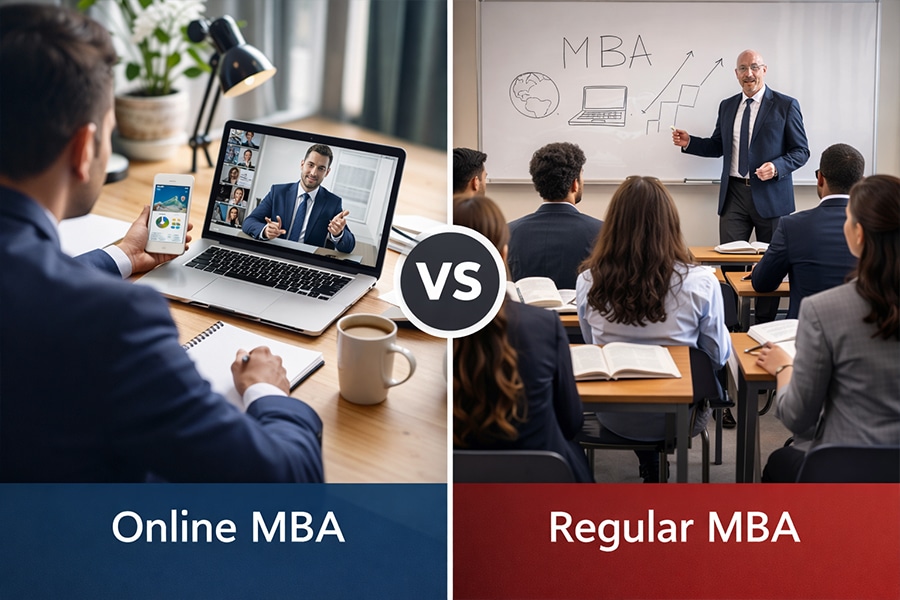
Online MBA vs Regular MBA: Which One Actually Gets You Better Career Growth?
If you are planning to pursue an MBA in 2026, one question naturally comes up- Should you go for an online MBA or a regular MBA? And that’s beca...