
MBA for Working Professionals: Transform Your Functional Expertise into Business Leadership


Admissions Enquiry
Summary: An Executive MBA (EMBA) helps working professionals develop leadership, strategic thinking and business management skills without leaving their jobs. Designed for experienced professionals, it offers career advancement opportunities, higher salary potential, industry networking and entrepreneurial insights. In 2026, with organisations seeking future-ready leaders, an EMBA remains a valuable pathway to senior management and executive roles.

You have spent years building expertise, managing people and delivering results. But somewhere between your current role and the one you actually want, there is a gap that experience alone cannot close. You need structured strategic thinking, cross-functional credibility and the kind of business acumen that earns a seat at the table.
That is exactly where an Executive MBA (EMBA) comes in. Not to teach you business from scratch, but to give you the frameworks, the language and the leadership depth to make your next move and make it count.
This guide brings together everything you need to make an informed decision: what the EMBA is, who it is built for, what it costs you in time and money, what you realistically gain and why 2026 is a particularly strong moment to consider it.
What is an Executive MBA?
An Executive MBA is a postgraduate management degree built for working professionals. Typically, for those with 5 or more years of industry experience or those who want to move into senior leadership without pausing their careers.
Unlike a regular full-time MBA, the EMBA does not ask you to leave your job, give up your income or step back from your professional momentum. Instead, it fits around your existing commitments, with weekend-only or hybrid class formats, a curriculum grounded in real business challenges and a cohort of peers who bring genuine industry experience into the classroom.
The duration typically runs between one and two years. The learning model combines in-person weekend sessions, case-based instruction, live projects and peer-led discussions. The result is a degree that works not despite your work experience, but because of it.
[An Executive MBA is the flexible version of a full-time MBA. You keep your job, your salary and your professional continuity. What you gain is the strategic depth to lead at a higher level.]
EMBA vs Regular MBA vs Online MBA: What is the Difference?
Before you commit, it helps to understand where an EMBA actually sits relative to your other options. Here is a clear comparison-
| Parameter | Executive MBA | Regular Full-Time MBA | Online MBA |
| Target audience | Mid-senior professionals, 5+ years experience | Fresh graduates or early career, 2-5 years | Working professionals seeking max flexibility |
| Work experience required | 3-15 years (typically 5+) | 2-5 years | 2+ years (varies by institution) |
| Format | Weekend or hybrid, part-time | Full-time, campus-based | Fully online, self-paced or live |
| Duration | 1-2 years | 2 years | 1-3 years |
| Curriculum focus | Advanced strategy, leadership and cross-functional management | Business fundamentals and broad management | General management, often introductory |
| Peer cohort | Experienced executives across industries | Mix of freshers and early career professionals | Highly varied, often virtual only |
| Career outcome | Senior role transitions, P&L leadership, CXO pathways | Career foundation, function switch, entry into management | Incremental upskilling, flexible career growth |
Bottom line: if your goal is a senior role transition, a P&L responsibility or a credible step towards a CXO designation, the EMBA is the most direct route. An online MBA covers ground, but cannot replicate the peer learning depth and strategic rigour of a campus-based executive cohort.
Why the Executive MBA Is More Relevant in 2026 Than Ever Before
According to the recent research conducted by the CMI Team, the global MBA Education Market Size is set to witness a colossal rise at a CAGR of 15.6% from the years 2023 to 2032. In valuation, it reached US$ 47.1 billion in 2022. Correspondingly, the market valuation is projected to reach US$ 83.08 billion by the end of 2032.
India's executive education market reached INR 1,480 crore in 2024 and is projected to grow to INR 2,090 crore by 2029, driven by rising demand for leadership development programmes and the rapid expansion of digital platforms that make executive education more accessible than before.
The drivers are clear- organisations across India are expanding faster, operating in more complex environments and facing an acute leadership talent gap at the mid-senior level. As AI and automation reshape operational roles, the demand for professionals who can think strategically, lead cross-functional teams and drive business outcomes is increasing sharply.
According to the Michael Page 2025 Salary Guide, salary increments for promotions typically range from 25-35%, with critical leadership roles and emerging-skill positions seeing hikes of 30-40%. An EMBA is one of the most direct ways to position yourself for exactly those roles.
Who Should Pursue an Executive MBA?
The EMBA is intentionally selective in who it serves well. It is not a general upskilling certificate. It is a leadership accelerator for professionals at a specific crossroads. Here are the profiles that benefit the most-
- Mid-career managers (5-10 years of experience) who are managing teams but feel underprepared when conversations shift to strategy, P&L or organisational design.
- Tech and engineering professionals moving into business leadership, product management or cross-functional roles who need a structured management framework to complement their technical depth.
- Entrepreneurs and business owners scaling a venture who want a sharper understanding of finance, operations, team-building and investor communication.
- Domain specialists (doctors, lawyers, consultants, scientists) who are now leading teams and need to think like a business leader, not just a subject-matter expert.
- Executives at a professional ceiling who have consistently delivered results but are not being considered for the next level because they lack the strategic credentials or cross-functional credibility.
Signs You Are Ready for an EMBA
You do not need a perfectly mapped-out career plan to start. But if any of these feel familiar, it is worth taking seriously-
- You are managing teams but struggle when the conversation moves to financials, strategy or broader business decisions.
- Your role has stopped expanding, even though your performance has not.
- You want to shift industries or functions, but do not have the credentials or network to make that move confidently.
- You are thinking about launching something of your own and want a structured business foundation, not just ambition.
- You have a CXO or VP-level role in your sights within the next three to five years.
Executive MBA Eligibility Criteria: What Most Programmes Expect
Requirements vary by institution, but the common benchmarks across reputed EMBA programmes in India are as follows-
| Criteria | Typical Requirement |
| Work experience | Minimum 5 years (strong profiles with 3 years considered at some institutions) |
| Educational qualification | Bachelor's degree from a recognised university with at least 50-60% |
| Minimum age | 27 years at the time of admission (most programmes) |
| Entrance process | Aptitude test and personal interview or direct admission based on profile |
| Entrance exams accepted | GMAT, CAT (for shorter experience profiles) or institution-specific test |
| Learning format | Weekend only or hybrid (weekday evenings and weekends) |
A note on entrance exams: if you have 10 or more years of experience, GMAT-based admissions routes are typically more appropriate than CAT-based ones, which tend to favour candidates with shorter work histories.
What Skills Does an Executive MBA Build?
An EMBA is not about going back to basics. It is about adding strategic intelligence, financial literacy and leadership depth to what you already know. Most well-structured programmes develop the following-
- Strategic Thinking- How to analyse complex business environments and make decisions that account for long-term organisational impact.
- Financial Literacy- Reading and interpreting P&L statements, balance sheets and business cases; evaluating investments with confidence.
- Leadership & People Management- Managing diverse teams, navigating organisational culture, building high-performance environments.
- Innovation & Design Thinking- Structured frameworks for identifying problems worth solving and building solutions that work in real markets.
- Operations & Cross-functional Management- Understanding how businesses function end-to-end, beyond your own department or function.
- Data-driven Decision-making- Using analytics and structured research to guide strategy rather than relying solely on experience and instinct.
- Executive Communication- Presenting complex ideas clearly to boards, investors and cross-functional stakeholders.
Beyond the curriculum, the peer cohort itself is one of the most valuable parts of the experience. In an EMBA classroom, you are solving case studies alongside professionals from IT, banking, healthcare, manufacturing and consulting. Each brings a different perspective to the same business problem. That cross-industry learning is something no online module can replicate.
Career Outcomes: What Changes After an Executive MBA?
Executive MBA graduates in India typically see salary growth of 25-50% post-completion, with some top-tier programme alumni reporting significantly higher jumps over a three-to-five year period after completion.
As a broader data point, graduates of ISB's PGPpro (one of India's most recognised executive programmes) reported a salary increase of 247% within three years of completing the programme, according to the Financial Times Global MBA Rankings 2025.
Even outside top-tier IIM or ISB programmes, mid-senior professionals completing EMBA programmes from credible institutions consistently move into roles with greater scope, higher compensation and broader organisational influence. The career shifts typically fall into three categories-
- Vertical promotion- Moving from manager to senior manager, from functional head to business unit head or from VP to SVP within the same organisation.
- Lateral switch- Moving from a specialist or technical role into general management, strategy or consulting.
- Entrepreneurship- Using the business frameworks, network and confidence gained through the programme to launch or scale a venture.
Job Roles EMBA Graduates Typically Transition Into
- General Manager / Business Unit Head
- VP / Director (Marketing, Finance, HR, Technology, Operations)
- Chief Operating Officer (COO) or Chief Strategy Officer (CSO)
- Management Consultant
- Business Development Head
- Entrepreneur / Co-Founder
- Product Head / P&L Owner
Salary outcomes in India for these roles range from ₹20-60 LPA and above at mid-senior leadership levels, depending on the sector, organisation size and the individual's background.
Scope of Executive MBA in India in 2026
India's leadership hiring is going through a recalibration, not just expansion. Companies want managers who can think strategically, read data in a business context and deliver impact quickly, not just hold a credential.
The strongest EMBA-relevant demand sits in IT and technology services, BFSI, e-commerce, healthcare and pharma and increasingly within Global Capability Centres (GCCs), which are now handling strategic and decision-making functions rather than back-office work. GCCs are projected to lead salary growth in 2026, with hikes of around 10-11%, well above India Inc's broader average of about 9%. India is also set to add roughly 4.5 lakh GCC jobs this year across its 1,700+ centres.
Company-sponsored EMBA enrolments continue to climb alongside this. If you're on a high-performance track at your current employer, it's worth raising the idea of sponsorship directly before applying independently. Many private-sector firms and MNCs treat it as part of their leadership development spend and it works in your favour on cost, employer alignment and post-programme placement.
Entrepreneurship After an EMBA: A Growing Trend in India
One of the more interesting shifts in recent years is how many EMBA graduates use the programme not as a springboard to a corporate role, but as the foundation for starting or scaling something of their own.
The combination of structured business knowledge, a strong peer network of experienced professionals and the confidence that comes from completing a rigorous programme creates a compelling base for entrepreneurship. In India's growing startup ecosystem, EMBA graduates are increasingly showing up as founders, co-founders and early-stage investors.
If entrepreneurship is part of your longer-term plan, an EMBA gives you the financial literacy, operational frameworks and investor-facing communication skills that meaningfully reduce the risk of early-stage mistakes.
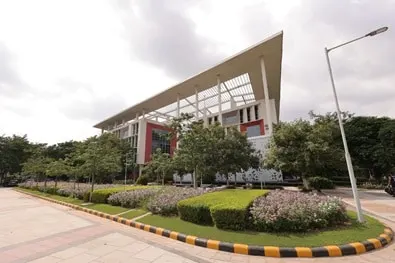
Executive MBA at BML Munjal University: Built for Leaders, Backed by Industry
Most descriptions of executive programmes start to sound the same after a point, which is "industry-aligned," "flexible format", or "experienced faculty." So here’s a more specific example of what makes a programme worth your two years.
The Executive MBA programme at BML Munjal University is designed for professionals with five or more years of experience, executives in mid-level supervisory roles and those who are ready to take their leadership to the next level.
Here is what makes it structurally different-
- Weekend-only Format- Classes are held on weekends, so you keep your income, your seniority and your professional momentum throughout the programme.
- Industry-connected Faculty- BMU's faculty combines academic rigour with real-world industry experience, bringing current business challenges directly into the classroom.
- Cross-industry Cohorts- Your batchmates bring experience from IT, BFSI, manufacturing, healthcare and consulting, making peer learning one of the most valuable parts of the experience.
- Experiential Learning- Case simulations, live projects and direct industry interaction are built into the curriculum, not treated as optional extras.
- Multiple Specialisations- Finance, Marketing, HR, Business Analytics and Systems Management, allowing you to align the programme to your specific career direction.
The EMBA programme at BML Munjal University is for professionals who want a real campus degree, not an online certificate and who want to learn alongside peers who bring genuine business experience into every discussion.
Conclusion
If you are a working professional who has spent years building expertise and now wants to translate that experience into genuine leadership authority, the Executive MBA is one of the most direct paths available to you.
It will not do the work for you. But it will give you the strategic frameworks, the financial literacy, the peer network and the credibility to lead at a level that experience alone cannot unlock. And because you keep working through it, every module you complete can be applied in real time, which means the returns often start before you even graduate.
The question is not whether an EMBA is worth it in general. The question is whether it is worth it for you, at this stage, with your specific goals. If you have a clear direction and the commitment to see it through, the answer is almost certainly yes.
FAQs
Yes, that is exactly what the EMBA is designed for. Classes are scheduled on weekends or in a hybrid format, so you continue working throughout the programme. Most EMBA students maintain the same professional responsibilities they had before enrolling.
Most reputed programmes require a minimum of five years of professional experience. Some accept candidates with three years for particularly strong profiles. If you have ten or more years, GMAT-based admissions routes are typically more appropriate than CAT-based ones.
It depends on your goals. If you want peer learning with experienced professionals, campus credibility and a structured leadership development experience, the EMBA delivers more. If your priority is flexibility or cost efficiency, an online MBA is a reasonable route.
Strong and growing. India’s executive education market is projected to reach INR 2,090 crore by 2029, up from INR 1,480 crore in 2024. Sectors including IT, BFSI, consulting and healthcare are actively building leadership pipelines and hiring for roles that require both domain experience and business acumen.
A regular MBA is typically a full-time, campus-based programme aimed at building foundational business knowledge. An EMBA is part-time, designed for working professionals with five or more years of experience and focused on advanced leadership, strategy and cross-functional management.
EMBA graduates in India typically see salary growth of 25-50% post-completion, according to Hike Education. For top-tier programme alumni, the numbers can be significantly higher over a three to five-year horizon. However, outcomes depend heavily on your field, the institution you graduate from and how strategically you apply your degree.
For most mid-career professionals aiming at senior leadership roles, yes, provided you choose the right programme and enter with a clear career goal in mind. The ROI is strongest when you have a specific transition in mind: a change in function, a senior promotion, a business launch, or a sector switch.
Related Blogs
Is Work-Life Balance Really Possible During an Executive MBA in India?
Key Takeaways India has the highest employee burnout rate globally, with 59% of Indian professionals reporting burnout symptoms against a 20% w...

MBA Without CAT in India: Top Colleges, Entrance Exams & Direct Admission 2026
Can you do an MBA without CAT in India? The answer is yes and it is more common than most students realise. CAT was designed as an entry filter for...

The Benefits of an Integrated BBA MBA: Career Growth & How It Compares to Traditional MBA
Integrated BBA MBA programmes are becoming increasingly popular among students who want to start building management careers right after Class 12. Wha...

MBA in Operations Syllabus: Semester-Wise Curriculum, Key Subjects & Practical Components
An MBA in Operations is one of the most sought-after management specialisations for students interested in business processes, supply chain systems, l...

MBA vs MCA in 2026: Which is Better for Your Career, Salary & Future?
You've recently graduated and you're excited for what’s next. Now comes the question- “Should you do an MBA or an MCA?” Both sound impress...
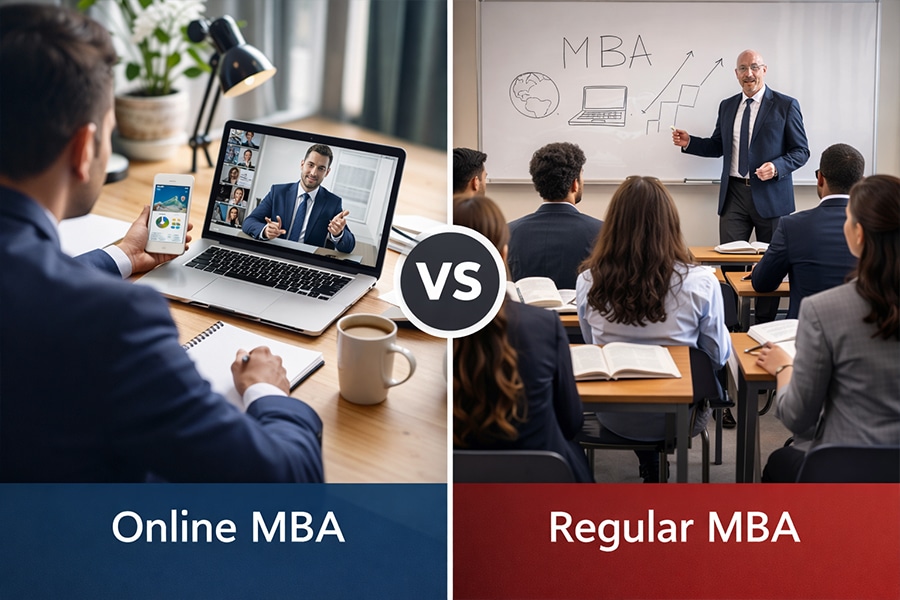
Online MBA vs Regular MBA: Which One Actually Gets You Better Career Growth?
If you are planning to pursue an MBA in 2026, one question naturally comes up- Should you go for an online MBA or a regular MBA? And that’s beca...