

How to Become a Marketing Manager: Complete Step-by-Step Guide


Summary: Curious about how one becomes a marketing manager? This requires not just the process of completing an educational qualification, but gaining relevant experience, developing expertise in digital marketing, analytics, artificial intelligence and strategy and ultimately taking charge of the campaign, team and results. No matter whether this begins straight after Class 12 or at a later point, with education combined with experience and management skills, it is possible to make the move from campaign execution to marketing strategy.
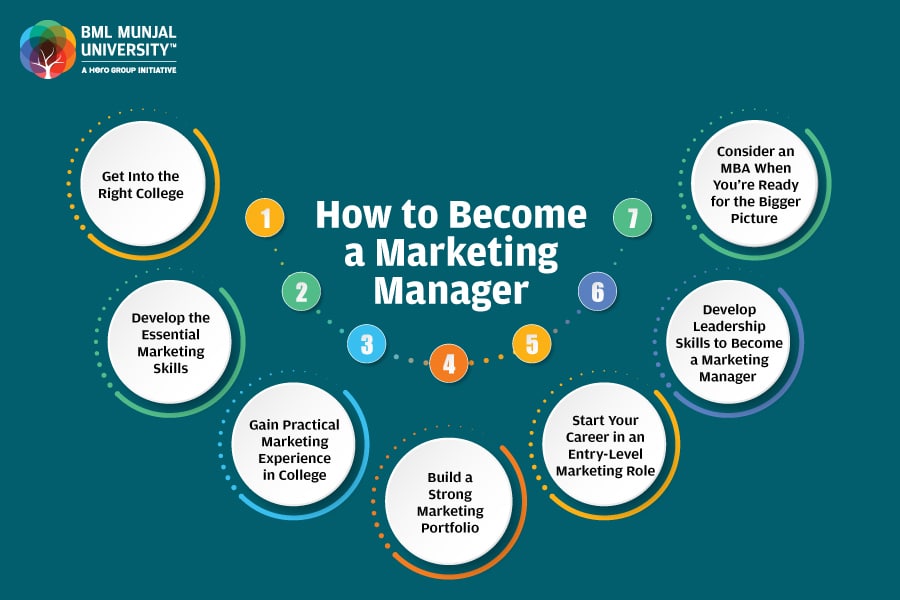
Key Takeaways
- Becoming a marketing manager is a progression from execution to ownership and leadership.
- A relevant degree provides the foundation, while experience, practical skills and measurable results help you progress.
- Build expertise in areas such as digital marketing, performance marketing, brand, product, SEO, analytics or growth.
- An MBA isn't compulsory, but it can help develop the broader business and leadership perspective needed for senior roles.
- The marketing manager salary in India 2026 varies based on experience, industry, location, specialisation and responsibility.
- Internships, live projects and measurable achievements can help turn your knowledge into career evidence.
By early Monday morning, the campaign dashboard is already up, clicks seem to be high, the reach seems great and everyone in the creative department is happy. Then the marketing director asks one simple question: "What has this campaign done for our business?" Suddenly, the discussion shifts from the appearance of a good campaign to issues like consumer behaviour, data, budgets, positioning, revenue and where to go from there.
That is the transition from being involved in marketing to managing marketing. So if you are asking how to become a marketing manager, there is no specific qualification that can automatically land you the position. The usual route is having an educational background, experience, marketing skills and finally management skills.
The opportunity is also becoming more interesting. India's advertising industry reached ₹1.11 lakh crore in FY2025, while digital advertising accounted for 44% of the market. Digital ad spending is projected to reach ₹56,400 crore in FY2026, according to the State of Digital Marketing in India 2025-26.
So, what does it actually take to go from executing campaigns to leading them?
What Does a Marketing Manager Really Do?
The title sounds straightforward, but the job isn't. A marketing manager sits at the intersection of customers, creativity, data and business strategy. Depending on the organisation, they may plan campaigns, understand markets, manage budgets, track performance and coordinate multiple teams.
Typical responsibilities include:
- Developing marketing strategies and campaigns
- Researching customers and market trends
- Setting marketing goals and KPIs
- Managing campaign budgets
- Analysing marketing performance
- Coordinating with sales, product and creative teams
- Managing agencies and external partners
- Building and maintaining brand positioning
- Leading marketing projects and teams
Marketing managers are professionals responsible for developing marketing strategies, conducting market research and managing campaigns around defined goals, timelines and resources.
The key distinction is this: A marketing executive may execute the campaign, while a marketing manager is expected to understand why the campaign exists, how it should perform and what happens next. That difference is where the career journey really begins.
How to Become a Marketing Manager: The Career Roadmap
There isn't one fixed route into marketing management. Someone might begin in digital marketing, while someone else might start in brand, advertising, content, sales or market research. What matters is the progression from doing the work to owning the outcome.
A typical path can look like this:
| Career Stage | What You Build | Your Responsibility |
| Student / Intern | Marketing fundamentals | Learn and assist |
| Marketing Executive | Execution skills | Deliver campaigns |
| Specialist / Senior Executive | Channel expertise | Own campaigns or functions |
| Assistant / Deputy Manager | Leadership skills | Manage projects and people |
| Marketing Manager | Strategy + business thinking | Own marketing outcomes |
There is no universal timeline; some professionals progress faster because they take ownership of larger projects early, while others specialise for longer before moving into management. The real progression is better understood as: Learn → Execute → Specialise → Own → Lead → Strategise
That is what employers increasingly look for; not simply the number of years printed on a CV.
Steps to Become a Marketing Manager: From College to Leadership
Knowing you want to become a marketing manager is one thing and knowing what to do next is another. The good news? You don't have to start as a manager; you build towards it, one qualification, project, campaign and leadership opportunity at a time.
Step 1: Get Into the Right College
Your first step after Class 12 is to choose an undergraduate programme that gives you a foundation in marketing and business.
A BBA, BBA in Marketing or related business programme can introduce you to areas such as marketing, consumer behaviour, finance, management and strategy. But don't choose a programme only because marketing appears in its name; look for opportunities to gain industry exposure, practical experience, internships and live-project experience alongside classroom learning.
Step 2: Develop the Essential Marketing Skills
A marketing manager needs more than textbook knowledge. Start building skills across:
- Digital marketing
- Market research
- Consumer behaviour
- Marketing analytics
- SEO and social media
- Content and communication
- Strategic thinking
- Leadership and teamwork
You don't need to master everything at once. Start broad, then identify the areas where you want to build deeper expertise.
Step 3: Gain Practical Marketing Experience in College
Don't wait until your first job to get practical experience; use college projects, student organisations, competitions and internships to actually practise marketing.
Try planning a campaign, analyse a brand, build a social media strategy, conduct consumer research and work on a live business problem. This is where marketing stops being something you study and starts becoming something you do.
Step 4: Build a Strong Marketing Portfolio
Your resume can tell an employer that you studied marketing and your portfolio can show them how you think.
Include your strongest:
- Campaigns
- Brand projects
- Market research
- Content work
- Digital marketing projects
- Analytics or performance reports
Where possible, add numbers and outcomes, showing that a campaign improved engagement, leads, traffic or conversions is far more powerful than simply listing the task.
A portfolio can be particularly useful when you're competing with candidates who have similar degrees and experience.
Step 5: Start Your Career in an Entry-Level Marketing Role
Your first job probably won't say “Marketing Manager” on the offer letter and that's okay. You might begin as a: Marketing Intern → Marketing Executive / Coordinator → Specialist → Senior Executive / Associate → Assistant Manager → Marketing Manager
These titles vary between companies, but the principle stays the same: your responsibility grows before your designation does. Start by executing campaigns, then learn to own a channel, then a project and then a team.
That's how you begin thinking like a manager.
Step 6: Develop Leadership Skills to Become a Marketing Manager
This is where the role really starts to change, instead of only asking “What do I need to execute?”, start asking:
- What should we do?
- Why will it work?
- Who are we targeting?
- How will we measure success?
- What should we change if it doesn’t work?
Taking ownership of campaigns, budgets, projects and eventually teams is what prepares you for management.
Step 7: Consider an MBA When You’re Ready for the Bigger Picture
An MBA isn't a compulsory checkpoint on the road to marketing management, but it can make sense when you want to strengthen your understanding of business strategy, leadership, finance, operations and organisational behaviour, especially as your responsibilities grow.
For some professionals, it becomes the bridge between being a strong marketer and becoming a broader business leader and that's ultimately the destination- not simply managing marketing activities, but understanding how marketing contributes to the business as a whole.
What Skills Do You Need to Become a Marketing Manager?
Marketing has always required creativity; modern marketing also requires comfort with numbers. A manager may have to understand why one campaign generated leads at a lower cost, why a customer segment is behaving differently or why increasing the advertising budget isn't necessarily producing better results.
That is why the strongest marketing skill set sits across both sides.
| Skill | What It Helps You Do |
| Communication | Present ideas and align teams |
| Consumer Behaviour | Understand why customers act |
| Creativity | Develop distinctive campaigns |
| Data Analytics | Turn performance data into decisions |
| Digital Marketing | Work across modern channels |
| Strategic Thinking | Connect marketing with business goals |
| Budget Management | Allocate resources effectively |
| Leadership | Manage people and projects |
Communication, creativity, analytical ability and interpersonal skills are key capabilities for marketing managers. But another skill is increasingly entering the conversation: AI.
The New Marketing Manager: Where Creativity Meets Data, AI and Growth
Imagine that Monday meeting again; someone proposes a campaign, the modern marketing manager may need to ask: Who are we targeting? What does the data tell us? Which channel is converting? Can AI improve the process? What is the customer acquisition cost? What happened after the click?
Marketing is becoming increasingly digital, measurable and technology-assisted. India's digital advertising market is projected to cross $5 billion in 2026, according to Sensor Tower's State of Digital Advertising in India 2026.
That doesn't mean every aspiring marketing manager needs to become a data scientist; it means they need to understand how technology and data can improve marketing decisions.
Skills worth developing include:
- SEO and search marketing
- Performance marketing
- Social media strategy
- Marketing analytics
- CRM and customer journeys
- Content strategy
- Brand management
- Product marketing
- AI-assisted marketing
- Market research
The goal isn't to memorise every marketing platform; it's to know which tool solves which problem.
From Marketing Executive to Marketing Manager: Building Your Career
This is where the career changes, your first marketing role may ask: “Can you execute this campaign?” Your next role asks: “Can you own this channel?” Then: “Can you improve the result?” And eventually: “Can you lead the people and strategy behind it?”
That is the transition into management; a useful way to think about your progression is: Do the work → Own the result → Lead the process → Lead the people → Lead the strategy.
Relevant work experience is therefore a major part of learning how to become a marketing manager. Employers commonly look for experience across marketing, advertising, sales or related areas before moving professionals into management positions.
That's where your portfolio becomes more valuable. Don't simply document what you did; document what changed because you did it. “Managed social media” tells a recruiter very little, but “Developed a campaign that increased qualified leads by X%” tells a much stronger story.
Do You Need an MBA to Become a Marketing Manager?
Here is where the career path gets interesting. You don't need an MBA to become a marketing manager; many professionals progress through marketing experience, specialised skills and demonstrated results. But as the role becomes more senior, the job stops being only about marketing. You start dealing with budgets, sales, finance, operations, customers, people and business strategy. That is where an MBA can add value.
| Career Goal | What Can Help |
| Enter marketing | Bachelor's degree + internships |
| Build marketing expertise | Practical experience + specialisation |
| Move into management | Experience + leadership responsibility |
| Develop broader business knowledge | MBA / postgraduate management |
| Progress towards senior leadership | Strategy + business + people management |
So, instead of asking “Is an MBA compulsory?”, ask: “Will broader business knowledge help me handle the responsibilities of the role I want next?” For someone aiming to move from executing campaigns to making larger business decisions, that distinction can matter.
Pick a Marketing Specialisation Before You Try to Master Everything
Marketing is no longer one job with one skill set. A professional managing brand perception may work very differently from someone managing paid acquisition; a product marketer may spend more time understanding positioning and customers, while a growth marketer may live inside performance dashboards.
Choosing a direction early can help you build depth instead of collecting disconnected skills.
| Marketing Path | What You Focus On |
| Brand Marketing | Positioning, identity and brand growth |
| Performance Marketing | Paid campaigns, acquisition and conversions |
| Digital Marketing | Online channels and customer journeys |
| Product Marketing | Positioning, launches and product adoption |
| Content & SEO | Search visibility, content and organic growth |
| Growth Marketing | Experiments, funnels and scalable growth |
| CRM & Lifecycle | Retention, engagement and customer journeys |
You don't necessarily have to stay in one specialisation forever. In fact, moving across functions can eventually make you a stronger manager because you begin to understand how different parts of marketing work together.
The goal is to become the person who can look at the entire marketing engine- not just one component and understand what needs to move.
Marketing Manager Salary in India 2026: What Is Your Experience Worth?
Eventually, every career conversation comes down to the same question: “What does it pay?” There isn't one universal answer.
Salary platforms show different figures because they use different datasets and methods. Glassdoor's 2026 India data puts the average senior-level marketing manager salary at around ₹13.5 lakh per year, with a typical total-pay range of approximately ₹8 lakh to ₹19.2 lakh. Indeed reports an average fresher base salary of about ₹26,665 per month in India.
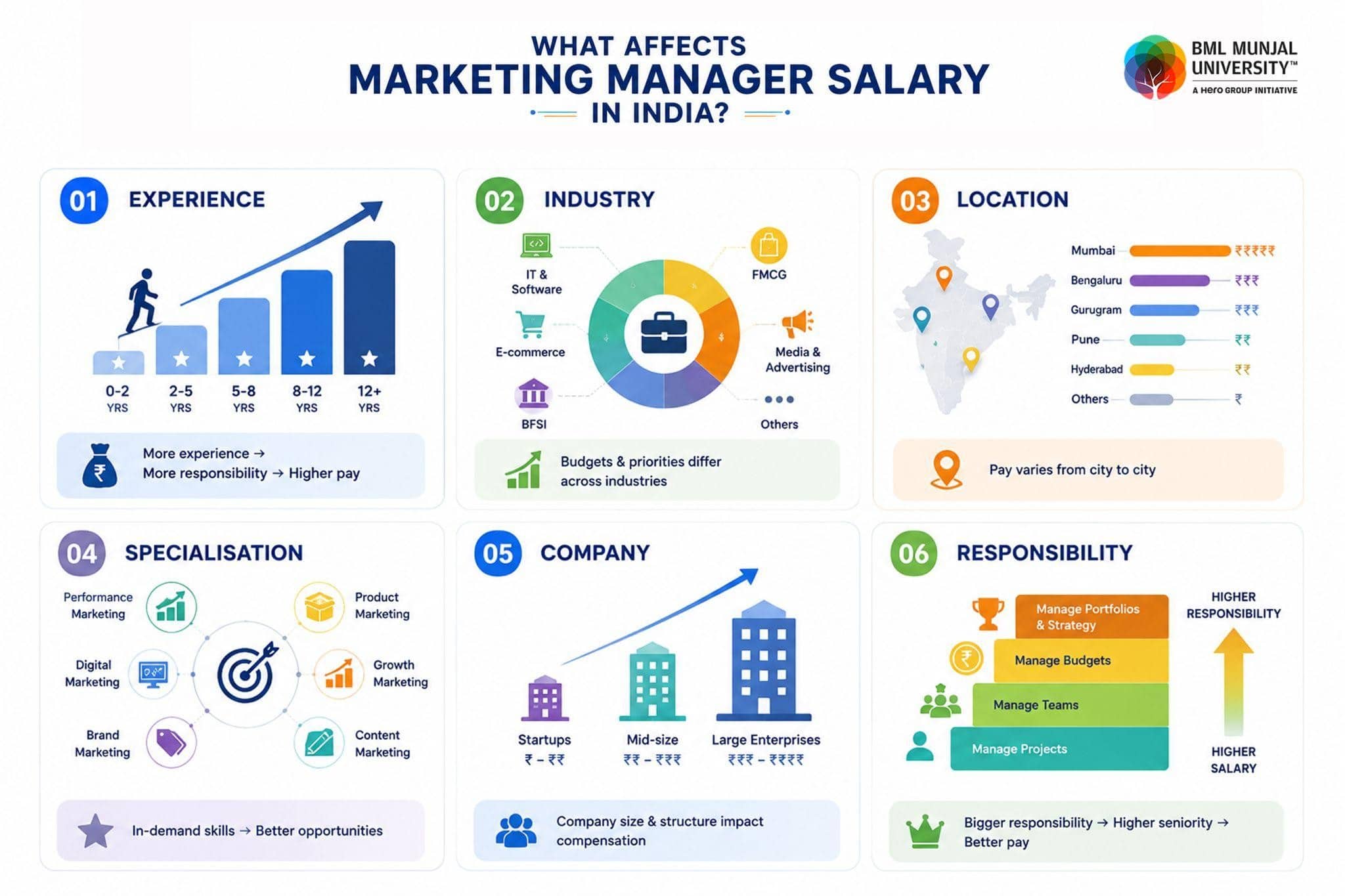
So if you're searching for marketing manager salary in India 2026, don't look for a single magic number, look at the responsibilities behind the salary. A manager handling a small marketing portfolio and one managing a national brand may carry the same designation while having completely different expectations.
How to Stand Out and Build a Strong Marketing Career
The jump from executive to manager is not made by simply adding another line to your resume; it happens when you can demonstrate that you understand outcomes. Instead of saying: “I managed social media.” Think: “I developed and optimised a campaign that improved qualified leads.” The second statement tells a much bigger story.
Start building evidence of:
- Campaign performance
- Customer or market insights
- Budget management
- Cross-functional collaboration
- Team or project leadership
- Data-driven decision-making
- Problem-solving
- Measurable business outcomes
Internships and live projects can help you start building this evidence before your first full-time role. They also offer a chance to see what marketing looks like when deadlines, customers and business objectives replace classroom case studies.
Because eventually, the question in an interview won't be: “Have you studied marketing?” It will be: “What have you done with what you know?”
The Manager Is Not the Finish Line: Where Can Marketing Take You Next?
Marketing management doesn't necessarily have to be the final destination. The skills you build can open routes towards brand leadership, growth, product marketing, digital leadership and broader business roles.
| Experience You Build | Potential Next Direction |
| Brand strategy | Brand Leadership |
| Campaign performance | Growth / Performance Leadership |
| Customer insights | Consumer Strategy |
| Product positioning | Product Marketing |
| Digital channels | Digital Marketing Leadership |
| Team management | Marketing Leadership |
| Commercial thinking | Business / Growth Strategy |
This is why learning how to become a marketing manager is really about learning how to take progressively larger ownership. First, you own a task, then a campaign, then a channel, then a team and eventually, you may find yourself responsible for an entire marketing strategy.
From Campaigns to Boardroom Thinking: Build Your Marketing Edge at BML Munjal University
Becoming a marketing manager is not only about learning how to create campaigns; it is about understanding customers, data, business strategy and leadership well enough to make better decisions.
At BML Munjal University (BMU), the BBA programme is designed around that broader view:
- Marketing specialisation: Build knowledge across branding, consumer insights and market strategy.
- Hands-on learning: Work on live projects, business case studies, internships and industry collaborations rather than relying only on classroom theory.
- Industry from the start: BMU's CATALYST framework brings industry-designed curriculum, practitioner-led learning, corporate mentors and structured internships into the BBA experience.
- AI + analytics: The BBA integrates AI and analytics across specialisations, helping students build a more data-informed approach to business.
- Future-focused marketing: The BBA in Marketing specialisation covers areas such as SEO, SEM, advertising, sales strategy, campaign planning and marketing tools.
- Digital marketing route: Students can also specialise in Digital Marketing, with exposure to SEO, SEM, PPC, social media, content marketing and web analytics, alongside live campaigns and real-world simulations.
If You're Looking Beyond the Bachelor's Level
BMU's MBA in Marketing takes the marketing-management connection further, combining marketing strategy with:
- Portfolio-first Approach
- AI Integration for Marketing
- Predictive Business Analytics
- NLP & Text Analytics
- Business Process Automation
- Data Visualisation using Tableau & Power BI
- Big Data Analytics
The programme combines creativity with data-driven strategy for future marketing leaders. At BMU, the goal isn't simply to prepare you to work in marketing; it is to help you develop the business, analytical and leadership perspective needed to eventually lead it.
Final Verdict
A marketing career often begins with execution: writing the brief, launching the campaign, checking the numbers, but becoming a marketing manager means learning to see the bigger picture, why a campaign matters, what the customer wants, where the numbers are pointing and how a team can turn an idea into measurable growth.
- The journey is built one step at a time:
- Learn the fundamentals of marketing and business.
- Experiment through internships, projects and real-world challenges.
- Specialise in areas shaping modern marketing, from digital and analytics to AI.
- Lead projects, people and decisions.
- Think beyond campaigns and connect marketing with business strategy.
At BML Munjal University, marketing and management programmes bring these dimensions together through industry exposure, experiential learning and a future-focused curriculum.
If you're ready to turn your interest in marketing into the ability to lead it, your next step starts at BMU. Apply now.
FAQs
Earn a relevant bachelor’s degree, gain marketing experience, develop key skills and gradually take on larger projects and leadership responsibilities.
Pursue a BBA, BBA in Marketing, BMS, BBM or B.Com, followed by internships and practical marketing experience.
Complete Classes 11–12, pursue a relevant bachelor’s degree such as BBA or BBA Marketing, and gain practical marketing experience.
Typically, around 3–5 years of relevant experience, although it varies by skills, performance and organisation.
A BBA or BBA in Marketing is a direct route. BMS, BBM and B.Com can also provide a strong foundation.
Start with a relevant degree, internships and practical marketing projects, then gain experience through entry-level roles.
Key skills include communication, creativity, analytics, digital marketing, strategic thinking, leadership and market research.
The average reported salary for a fresher is around ₹26,665 per month, while annual compensation can vary significantly with experience, location, company and role.
It takes relevant education, practical experience and strong marketing and leadership skills, but a clear career path can make the transition easier.
A relevant bachelor’s degree and several years of marketing experience are commonly expected. An MBA can be beneficial for senior management roles.
Packages may include performance bonuses, incentives, additional pay, health benefits and other company-specific benefits.
Technology, finance, FMCG and large consumer businesses can offer strong compensation, although pay depends heavily on the company, role and experience.
Not necessarily. Experience, specialisation, company, location and responsibilities have a greater impact on salary than the job title alone.
Related Blogs
Difference Between Data Analyst and Business Analyst: Comparing Two In-Demand Career Paths
Key Takeaways Data analysts focus on what the data shows; business analysts focus on what the business should do about it, though both roles shar...

How to Become a Policy Analyst: The Career Path No One Explains Properly
Key Takeaways A bachelor's degree in Economics, Political Science, Public Policy, Sociology, International Relations or Law is the minimum qualif...

Business Analyst Salary in India 2026: How Much Can You Really Earn?
Key Takeaways The average business analyst salary in India is ₹7-10 LPA. Freshers in 2026 can earn ₹7-10 LPA, depending on skills and coll...
The Benefits of an Integrated BBA MBA: Career Growth & How It Compares to Traditional MBA
Integrated BBA MBA programmes are becoming increasingly popular among students who want to start building management careers right after Class 12. Wha...
Is BBA Worth It in 2026? Scope, Salary & Career Opportunities Explained
If you've just finished Class 12 and are weighing your options, the question "Is BBA worth it in 2026?" is a fair one to ask. The business landscap...

BBA International Business: Scope, Syllabus & Career Paths Explained
Today, international business goes far beyond import-export operations. It includes managing global supply chains, understanding international markets...