

Career in Health Insurance: From Graduation to a Future in the Industry


Summary: You’ve graduated, built your academic foundation and now comes the harder question: where do you begin? A career in health insurance can take you into sales, claims, underwriting, operations, customer service or analytics, but the right starting point depends on your strengths and the kind of work you want to do. This guide explores the career paths available after graduation, the skills that matter, ways to enter the industry and what to look for in your first role. It also looks at how Niva Bupa Udaan at BML Munjal University can help graduates bridge the gap between earning a degree and being workplace-ready.

Key Takeaways
- India's health insurance premium volume exceeded ₹1.2 lakh crore in FY 2024–25, with the segment growing at around 9%.
- Health insurers' claims-paid ratio by number rose to 87.50% in FY 2024–25, compared with 82.46% in FY 2023–24.
- The sector includes careers in sales, claims, underwriting, customer service, operations, analytics, risk and actuarial functions.
- Technology is changing the nature of insurance work, making data literacy and digital skills increasingly valuable.
- Becoming a health insurance agent is a separate regulated career route involving training, examination and licensing.
- For graduates specifically interested in health insurance sales, BMU's Niva Bupa Udaan Career Accelerator Program provides a structured Hire → Train → Deploy (HTD) pathway.
Imagine graduating and walking into your first career interview; you have a degree; you have completed your projects and perhaps you have even done an internship. Then comes a deceptively simple question- “Why you want a career in Health Insurance?”
You could talk about the growing healthcare market, mention financial protection or say that insurance is an essential service, but a more interesting answer is that health insurance is becoming an industry where healthcare, finance, technology and human decision-making meet.
The scale of that change is visible in the numbers. India's health insurance premium volume crossed ₹1.2 lakh crore in FY 2024–25, with the sector growing at around 9%. During the same year, the claims-paid ratio by number reached 87.50%, up from 82.46% in FY 2023–24. The sector also saw 1,37,361 general and health insurance grievances registered through IRDAI's Bima Bharosa system, of which 93% were disposed of within FY 2024–25.
These aren't merely industry statistics; they represent customers buying protection, people making claims, professionals resolving problems and organisations trying to make the entire system work better. Another number shows how quickly the operating environment is changing: IRDAI has prescribed a timeline of one hour for cashless pre-authorization and three hours for final authorisation in applicable health-insurance claim processes.
So the industry is not simply getting bigger; it is becoming faster, more regulated, more data-driven and more customer-focused and that changes what a health insurance professional needs to bring to the table.
Why Choose a Career in Health Insurance?
Health insurance sits at the intersection of healthcare, finance, technology and customer service, creating career opportunities for graduates with different strengths-
- Growing Industry: Expanding health insurance coverage is creating demand for skilled professionals across multiple functions.
- Multiple Career Paths: Explore opportunities in sales, claims, underwriting, operations, customer service and analytics.
- Meaningful Work: Help individuals and families make informed decisions about their healthcare and financial protection.
- Career Growth: Build experience and progress from entry-level roles to specialist, managerial and leadership positions.
- Digital & Data Exposure: Work with technology, analytics and digital platforms that are increasingly shaping insurance.
- Continuous Learning: Develop valuable skills as products, regulations, technology and customer expectations evolve.
For graduates, this makes health insurance a sector where the first role can become the starting point for a much broader career journey.
Career Opportunities in Health Insurance: Where Can You Work?
A useful way to understand the industry is to ask what question each function is trying to answer.
| Career Area | The Core Question | What the Work Involves |
| Sales & Relationship Management | How do we reach and serve the right customer? | Customer acquisition, product explanation, relationship building |
| Underwriting | What level of risk are we taking? | Evaluating proposals, risk assessment and policy decisions |
| Claims | Does this claim meet the policy conditions? | Documentation, assessment and claims processing |
| Customer Service | How do we resolve the customer's need? | Queries, renewals, servicing and support |
| Operations | How do we make the process work smoothly? | Documentation, coordination and process management |
| Analytics | What is the data telling us? | Identifying trends, patterns, risks and opportunities |
| Risk Management | Where could the business face losses? | Identifying, assessing and mitigating risks |
| Actuarial Functions | How can risk be measured financially? | Statistical modelling, pricing and forecasting |
This is one of the strongest reasons to consider a career in health insurance. You don't necessarily have to decide your entire professional identity on day one, you can enter through one function, develop industry knowledge and later specialise.
What Makes Health Insurance a Good Career Choice?
Health insurance sits in an unusual position, it is a financial product, but it deals with something deeply personal- healthcare. That creates three dimensions to the work.
1. The Business Dimension
Insurers need to acquire customers, price products, manage costs and remain commercially sustainable.
2. The Risk Dimension
Every policy involves uncertainty. Professionals must assess risk, understand patterns and make decisions based on incomplete information.
3. The Human Dimension
At the end of the process is a person. A customer may be buying insurance for their parents, someone may be trying to understand a hospitalisation claim or another customer may simply be confused by the terminology. That means technical knowledge alone isn't enough; a strong professional needs to combine judgment with empathy.
This is especially important as the industry becomes more technology-driven. The National Health Claims Exchange (NHCX), for example, was created to standardise and accelerate health-claim information exchange between insurers, TPAs, healthcare providers and beneficiaries. As of July 2024, 34 insurers and approximately 300 hospitals were live or ramping up on the platform. The direction is clear: Technology is handling more information; professionals still have to understand what that information means.
Career in Health Insurance After Graduation in India: Where Do You Start?
For students searching specifically for a career in health insurance after graduation in India, there isn't one universal entry route. Your starting point depends on the kind of work you want to do.
Start with an Entry-Level Corporate Role
Graduates can explore opportunities in areas such as sales, customer service, operations and other entry-level functions. This is often the most direct route for someone who wants to enter the industry and learn through workplace experience.
Build a Specialised Skill
Some career paths become more technical as you progress. If you are interested in underwriting, analytics, actuarial work or risk management, developing quantitative, statistical or data-related capabilities can strengthen your profile.
Become a Health Insurance Agent
The agent route is different from becoming an employee of an insurer. It is a regulated intermediary pathway in which the professional works directly with customers to explain, sell and service insurance products.
Choose Structured Industry Training
For a graduate with an academic qualification but little industry exposure, a structured training program can help bridge that gap.
The important thing is to look for a program that doesn't stop at theory. Learn the industry → practice the skill → experience the work → build performance.
That transition turns a graduate into a professional.
Skills Required for a Career in Health Insurance
The strongest health insurance professionals usually combine people skills, business understanding and analytical thinking.
| Skill | Where It Helps |
| Communication | Explaining policies, benefits and claims clearly |
| Customer Understanding | Identifying needs and recommending suitable solutions |
| Product Knowledge | Understanding coverage, exclusions and policy terms |
| Analytical Thinking | Risk assessment, claims and insurance data |
| Problem-Solving | Handling customer issues and claim-related queries |
| Attention to Detail | Documentation, policy processing and claims |
| Sales & Relationship Building | Prospecting, pitching, follow-ups and retention |
| Digital & Data Skills | Using insurance platforms, CRM tools and data |
| Compliance Awareness | Following regulatory and ethical requirements |
| Adaptability | Keeping pace with changing products, technology and regulations |
The key takeaway for graduates
You do not need to master every skill before entering the industry. The better approach is to identify the career track that fits your strengths and then build the skills that track demands, like-
- Good with people? → Sales, advisory, customer service, relationship management
- Strong with numbers? → Analytics, underwriting, risk and actuarial functions
- Detail-oriented? → Claims, operations and policy servicing
- Interested in technology and data? → Insurance analytics, automation and digital operations
That makes skill-building much more purposeful than simply trying to become good at insurance as a whole.
How to Become a Health Insurance Agent in India
Becoming a health insurance agent involves more than simply joining an insurer. The process typically moves from eligibility and training to examination and formal appointment.
Step 1: Check Your Eligibility
You must meet the applicable age and educational requirements. IRDAI’s current agent framework requires applicants to be at least 18 years old, with educational requirements depending on the applicable rules and location.
Step 2: Choose a Health Insurer
Decide which health insurer you want to represent and apply for an agency appointment with that insurer.
Step 3: Complete the Required Training
Undergo the prescribed insurance training to understand:
- Health insurance products
- Policy terms and conditions
- Customer needs
- Insurance regulations
- Ethical sales practices
Step 4: Pass the Insurance Agency Examination
You need to pass the prescribed Insurance Agency Examination conducted by a recognised examination body.
Step 5: Submit Your Agency Application
After completing the examination, submit the required documents to the insurer. These may include proof of age, educational qualifications, PAN and examination credentials, along with any other documents the insurer requires.
Step 6: Receive Your Appointment & License
Once the insurer completes the appointment process and the regulatory requirements are met, you can begin working as an insurance agent. An individual agent is authorised to sell insurance and provide after-sales support, including assistance during claims.
Step 7: Build Your Client Base
The job then moves beyond selling policies. A health insurance agent may help customers understand coverage, choose suitable products, complete documentation, renew policies and navigate claims.
In short: Eligibility → Insurer Selection → Training → Agency Examination → Application → Appointment & Licensing → Client Servicing.
How Does Career Growth Work in Health Insurance?
The first job title tells you where you begin; it doesn't tell you where you can end up. A professional might begin in a customer-facing role and eventually manage a team, an underwriting professional may move into more complex risk decisions, a claims professional may progress into claims management or operations leadership and an analyst may move from reporting to strategic risk or business analytics.
The progression generally follows a simple pattern- Entry-level role → Functional expertise → Greater ownership → Management → Leadership.
But something more important happens at every stage. The question you are responsible for answering becomes bigger. At entry level- “Can you handle this customer/case?” Later- “Can you manage this portfolio/team?” Further ahead- “Can you improve the way this function performs?” And eventually- “Can you make decisions that affect the business?”
That is why you should evaluate early career choices beyond salary or designation. A better question is- “What capabilities will this role help me build in the next 12–24 months?”
What Should Graduates Look for in Their First Health Insurance Job?
Imagine two graduates starting on the same Monday; both have similar degrees, one receives a product handbook and is expected to start approaching customers almost immediately, while the other spends time understanding the industry, learning products, practising conversations, receiving feedback and then entering the working environment.
Six months later, the difference may not be in their degrees; it may be in their confidence and ability to handle real situations. That is why practical learning matters.
When evaluating your first opportunity, look for:
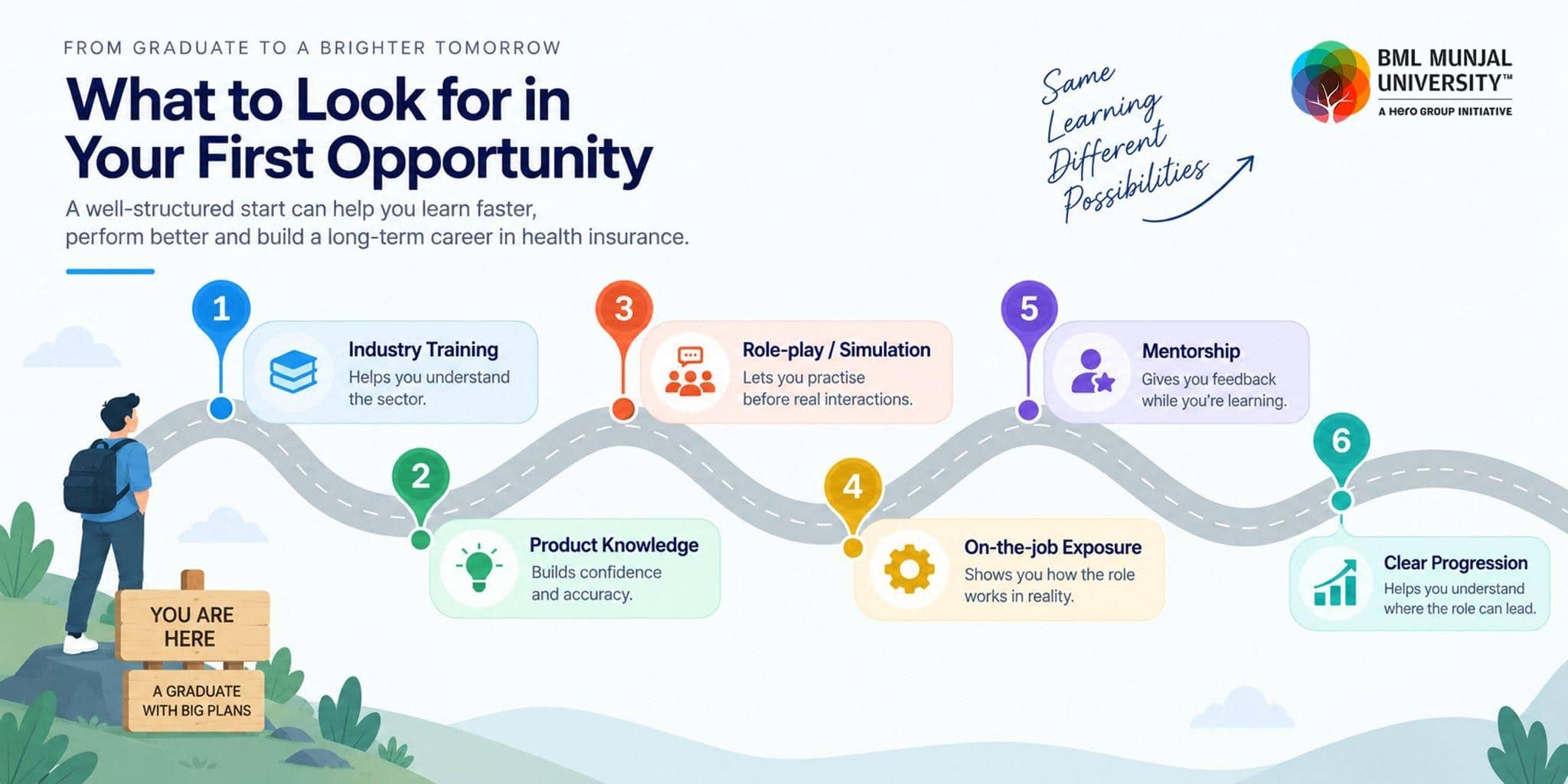
The objective isn't to collect another certificate; it is to reduce the distance between- “I have graduated.” and “I am ready to perform.”
Build Your Career in Health Insurance with Niva Bupa Udaan Career Accelerator Programme at BML Munjal University
For graduates who specifically want to enter health insurance sales, BML Munjal University's Niva Bupa Udaan Career Accelerator programme provides a focused pathway into the sector. This is where the program fits into the larger career picture.
Udaan is offered by BMU in partnership with Niva Bupa and follows a Hire → Train → Deploy (HTD) model. Selected candidates undergo structured training before moving into a paid internship and, subject to performance and applicable organisational conditions, a full-time role.
Program at a Glance-
| Particular | Niva Bupa Udaan |
| Target group | Fresh graduates |
| Academic eligibility | Any discipline, 50%+ marks |
| Age | Up to 28 years |
| Training | 21 days |
| Training stipend | ₹5,000 |
| Internship | 2 months |
| Internship stipend | ₹20,000/month |
| Programme fee | ₹47,000 + applicable taxes |
| Learning format | Instructor-led, role-play-based |
| Work location | Home district |
| Focus | Health insurance sales |
| Certification | Program Completion Certificate |
Udaan prepares graduates for health insurance careers in under three months, combining 21 days of classroom training with a two-month internship.
What Happens During Training?
The curriculum is organised around three pillars:
| Behaviour | Insurance | Sales |
| Build professional communication and manage interactions with clients, supervisors and colleagues confidently. | Understanding the health insurance industry, products, competitive landscape, compliance and Niva Bupa’s work culture. | Learning client identification, pitching, objection handling, follow-ups, closures, pipeline management and target orientation. |
The structure therefore moves beyond- Learn the product → take a test; towards- Understand → Practise → Apply → Perform
What Happens After Training?
Training is only the beginning. The next stage is where classroom learning turns into workplace experience.
- Paid Internship: Move into a 2-month on-the-job internship with a monthly stipend.
- Real-World Experience: Apply what you've learned through real customer interactions and sales activities.
- Performance Evaluation: Your internship performance will help determine your next career step.
- Full-Time Opportunity: Eligible candidates can move into a full-time role based on performance and role availability.
- Career Progression: The pathway can progress from Assistant Unit Manager / Relationship Associate → Executive → Manager → Branch Leadership.
- Continued Learning: Build stronger skills in sales, customer relationships, insurance products and team management as you grow.
The idea is simple- learn first, practice next and then grow into the role.
Final Verdict
A career in health insurance can open opportunities across sales, claims, underwriting, operations and analytics. For graduates, the right first opportunity should go beyond a job title and offer structured training, practical exposure, mentorship and a clear path for growth.
For those exploring a career in health insurance after graduation in India, Niva Bupa Udaan at BMU provides a focused entry into health insurance sales, combining classroom learning, role-play and on-the-job experience. It gives graduates an opportunity to understand the industry while developing skills they can apply in a real work environment.
Ready to take the next step? Apply now and start building your career in health insurance with Niva Bupa Udaan at BML Munjal University.
Related Blogs

Executive Education in India: A Complete Guide for Working Professionals
Key Takeaways Executive education is built for working professionals, not full-time students India's executive education market is growing fas...

How Women Professionals Build Authentic Leadership – Step-by-Step Guide
Key Takeaways Authentic leadership means leading with consistent values and self-awareness, not adopting a borrowed style Women professionals ...
How to Become a Business Analyst: A Complete Career Guide
Key Takeaways A bachelor's degree in business, IT or a related field is the usual starting point; no state licence is required. Students after...
How to Become a Marketing Manager: Complete Step-by-Step Guide
Key Takeaways Becoming a marketing manager is a progression from execution to ownership and leadership. A relevant degree provides the foundat...
How to Become a Management Consultant in India: The Ultimate Career Guide
Key Takeaways A bachelor’s degree is the common starting point for a management consulting career. An MBA is valuable but not mandatory for ...

AI for Managers: Skills to Build, Tools to Master & Potential Risks
Key Takeaways AI supports managerial tasks like research, reporting, and decision-making, but managers retain judgment and accountability for out...