

How to Become a Management Consultant in India: The Ultimate Career Guide


Admissions Enquiry
Summary: Learn how to become a management consultant in India, including the qualifications, skills, experience and interview preparation required. Explore MBA and non-MBA pathways, consulting career timelines, salary expectations, case interviews and key skills needed to build a successful management consulting career.
Key Takeaways
- A bachelor’s degree is the common starting point for a management consulting career.
- An MBA is valuable but not mandatory for every consulting pathway.
- Relevant internships and work experience can strengthen your consulting profile.
- Key skills include problem-solving, analytical thinking, communication and business acumen.
- Consulting interviews often include case studies, aptitude tests and behavioural rounds.
- Management consultant salaries in India generally increase with experience, with figures varying by role and employer.
- You can enter consulting through MBA, non-MBA or certification-based pathways.
- AI literacy and adaptability are increasingly important for aspiring consultants.
What if your ability to solve business problems could become your biggest career advantage?
Management consulting is a career built around solving complex business challenges, from improving performance and entering new markets to navigating digital transformation.
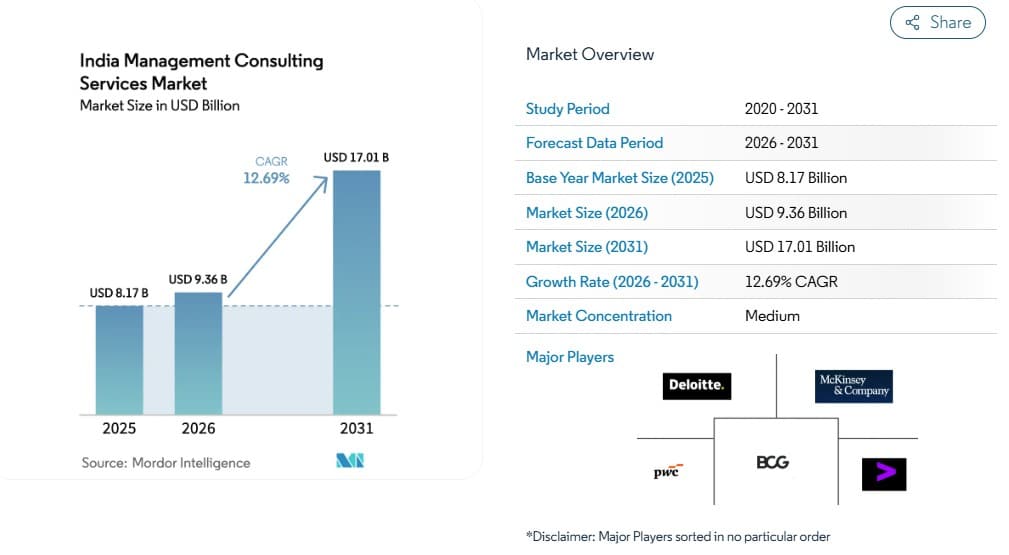
The opportunity is growing in India- the management consulting services market is estimated to reach $9.36 billion in 2026, up from $8.31 billion in 2025. This growth is creating opportunities across strategy, operations, technology and specialised consulting.
But getting into consulting takes more than a degree. Employers look for candidates who can think analytically, structure ambiguous problems, communicate recommendations and turn data into actionable insights. This is where an MBA can be a valuable route, but it is not the only way to enter the profession.
So, how do you become a management consultant in India? This guide covers the qualifications, skills, experience, salary, career pathways and interview preparation you need to build a consulting career.
What Does a Management Consultant Actually Do?
A management consultant helps organisations identify and solve complex business problems, such as declining profit margins, stalled expansion or inefficient supply chains. Their work typically involves analysing business data, interviewing stakeholders, identifying the root cause of a problem and developing practical solutions.
A typical consulting project can move through several stages-
Understand → Analyse → Solve → Recommend → Implement → Measure
Most consulting projects, known as client engagements, last from a few weeks to several months and end with recommendations presented to senior leadership for decision-making.
What Steps Should I Take to Become a Management Consultant?
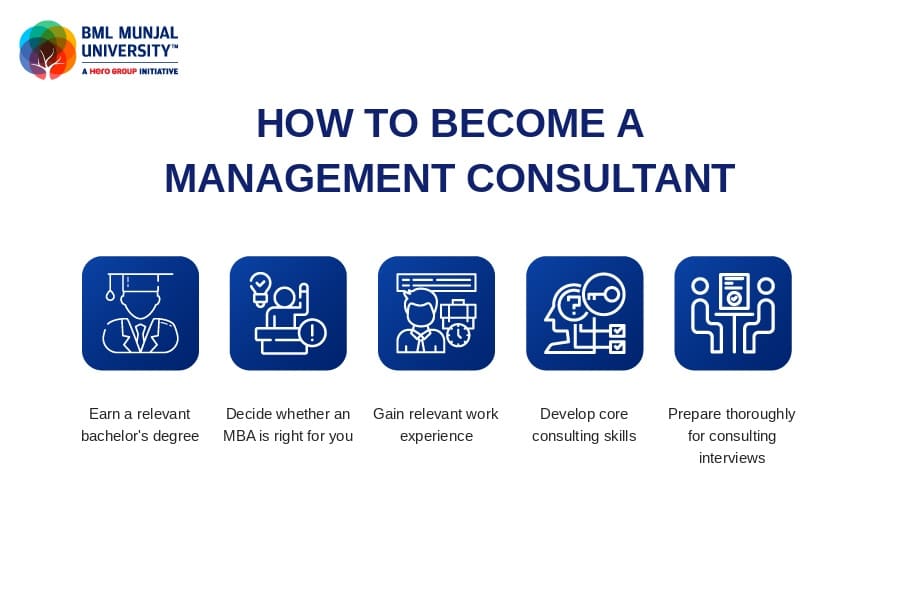
If you are wondering how to become a management consultant, the journey can be divided into seven practical steps. While there is no single path into consulting, building the right education, skills, experience and business knowledge can significantly improve your chances of entering the profession.
Below are some steps that you can follow for becoming a management consultant in India-
Step 1- Complete a Relevant Bachelor's Degree
A bachelor’s degree is the standard educational requirement for management consulting jobs. Consulting firms recruit graduates from diverse academic backgrounds, including-
- BBA or Business Management
- Com or Finance
- Economics
- Engineering
- Mathematics or Statistics
- Computer Science
- Other analytical or professional degrees
Your degree can also shape your consulting specialisation. For example, engineering graduates may enter technology or operations consulting, while finance graduates often pursue strategy, financial advisory or transaction consulting roles.
Step 2- Build a Strong Academic and Professional Profile
Top consulting firms look beyond academic scores. A strong profile demonstrates your ability to solve problems, work in teams and lead initiatives.
Focus on developing-
- Leadership skills
- Analytical thinking
- Communication abilities
- Teamwork
- Business awareness
- Problem-solving skills
- Initiative and adaptability
Participating in case competitions, business clubs, consulting societies, student organisations and real-world projects can strengthen your consulting profile.
Step 3- Gain Relevant Work Experience
Internships provide valuable exposure to business challenges and consulting work. Relevant experience can come from roles in-
- Consulting
- Business analysis
- Strategy
- Finance
- Operations
- Market research
- Corporate strategy
- Business development
- Data analytics
Even if a consulting internship is unavailable, analytical roles in other industries can help you develop transferable skills valued by employers.
Step 4- Decide Whether an MBA Is Right for You
Many professionals ask, "Do you need an MBA to become a management consultant?"
The answer depends on your career goals.
An MBA can be highly valuable for candidates targeting competitive consulting roles through campus placements or career transitions. However, experienced professionals with industry expertise may also enter consulting directly without an MBA.
Ask yourself-
Will an MBA improve access to the consulting opportunities I want?
Step 5- Develop Core Consulting Skills
Successful consultants are expected to analyse complex problems, work with incomplete information and communicate recommendations clearly.
Important consulting skills include-
- Structured problem-solving
- Quantitative and analytical reasoning
- Data interpretation
- Business fundamentals
- Research skills
- Presentation and communication
- Teamwork
- Commercial awareness
- Adaptability
These skills are consistently highlighted by consulting firms and recruiters as essential for long-term success.
Step 6- Prepare for Consulting Interviews
Consulting recruitment processes often include multiple assessment stages, such as-
- Online assessments
- Aptitude and quantitative tests
- Behavioural interviews
- Case interviews
- Guesstimate questions
- Technical or role-specific discussions
Practising case studies, improving business knowledge and strengthening analytical skills can significantly improve interview performance.
Step 7- Apply Strategically
Do not limit your applications to only a few well-known firms. Explore opportunities across different consulting segments, including-
- Strategy consulting firms
- Big Four consulting and advisory firms
- Technology consulting companies
- Specialist consulting firms
- Boutique consulting firms
- Corporate strategy and internal consulting teams
Applying strategically across multiple pathways can increase your chances of starting a successful career in management consulting.
How Long Does It Usually Take to Become a Management Consultant?
How long it takes to become a management consultant depends on your entry route, education and prior work experience. Some graduates can enter consulting directly after completing a bachelor’s degree, while others transition through an MBA or relevant industry experience.
Below is a general breakdown of the duration for becoming a management consultant-
| Career Path | Typical Timeline | Best Suited For |
| Directly After Undergraduate Degree | Start immediately after graduation | Graduates targeting entry-level analyst roles |
| MBA Route | Around 7-11 years from starting undergraduate study | Candidates targeting post-MBA consulting roles |
| Lateral / Non-MBA Transition | Around 2-5 years of relevant experience | Professionals moving into consulting from related roles |
| Consulting Certification | Around 16 months for some programmes | Working professionals and career switchers |
In short, there is no fixed timeline for becoming a management consultant. You can enter directly after graduation or transition later through an MBA, relevant work experience or a specialised consulting programme.
What Skills Do Management Consultants Need to Develop?
Management consultants need a combination of analytical, communication, problem-solving and business skills to identify challenges, evaluate solutions and deliver practical recommendations to clients. As consultants progress from entry-level roles to more senior positions, industry knowledge and stakeholder management become increasingly important.
Here is the list of significant skills for a management consultant-
- Structured Problem-Solving- Break complex business problems into logical frameworks and identify key issues.
- Data & Financial Analysis- Use Excel, financial modelling, data analysis and visualisation to support recommendations.
- Client Communication- Present complex findings clearly and communicate confidently with senior stakeholders.
- Project & Stakeholder Management- Manage workstreams, teams, deadlines and client relationships effectively.
- Industry Expertise- Develop specialised knowledge that adds value as you progress into senior consulting roles.
What Does the Case Interview and Consulting Recruitment Process Involve?
The management consulting recruitment process typically involves multiple rounds designed to assess analytical thinking, problem-solving, communication and cultural fit. While the exact process varies by firm and role, it commonly includes-
- Resume Screening & Assessment- Recruiters review your profile, followed by an aptitude, reasoning or online assessment at some firms.
- Case Interviews- Candidates solve one or more business cases with an interviewer, explaining their approach and reasoning step by step.
- Fit or Behavioural Interview- This round evaluates your communication, motivation, teamwork, leadership and suitability for the role.
- Final or Partner Round- The final stage may combine a challenging case with a detailed discussion about your experience and career goals.
How Should You Prepare for a Consulting Case Interview?
Prepare by practising 30-50+ mock cases, developing structured problem-solving skills, reviewing common case frameworks and improving mental maths for quick calculations and estimates. Focus on understanding frameworks rather than memorising them.
How Much Do Management Consultants in India Earn?
Management consultant salaries in India generally increase with experience, with the average annual salary ranging from about ₹18.6 lakh-₹20.6 lakh for professionals with 1-3 years of experience to ₹29.7 lakh-₹32.8 lakh for those with 12+ years of experience.
Below is the salary breakdown of a management consultant in India, experience-wise
| Experience | Average Annual Salary |
| 1-3 years | ₹18.6-₹20.6 Lakh |
| 3-6 years | ₹22.8-₹25.3 Lakh |
| 6-9 years | ₹26.7-₹29.6 Lakh |
| 9-12 years | ₹29.3-₹32.4 Lakh |
| 12+ years | ₹29.7-₹32.8 Lakh |
Note: Salary data sourced from reported figures on AmbitionBox.
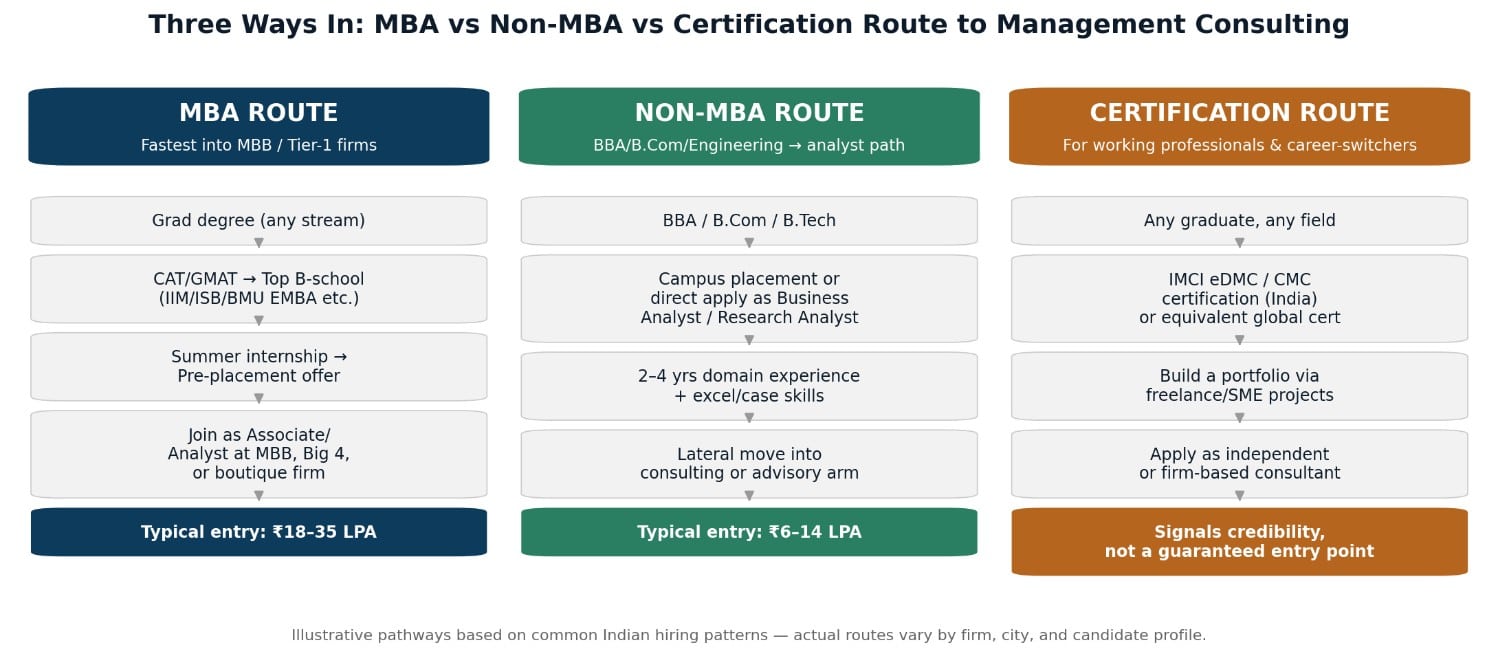
Non-MBA vs MBA vs Certification- Three Ways to Enter Consulting in India
There is no single route to a management consulting career in India. An MBA can provide structured access to top consulting firms, while graduates can also enter through analyst roles and laterally transition. Certifications can help working professionals build consulting knowledge and demonstrate credibility, but they do not guarantee a consulting job.
vs Non-MBA vs
| Route | Best For | Typical Path |
| MBA Route | Fastest access to MBB/Tier-1 firms | Bachelor's → CAT/GMAT → target B-school → summer internship → PPO |
| Non-MBA Route | BBA/B.Com/engineering backgrounds | Bachelor's → analyst/research role → 2–4 yrs experience → lateral move |
| Certification Route | Working professionals & career-switchers | Any graduate degree → IMCI eDMC/CMC → build portfolio → independent/firm-based |
How BML Munjal University Prepares You for a Consulting Career
Are you weighing the MBA route for a management consulting career? If you are a working professional who doesn't want to pause your career, BML Munjal University's Executive MBA is built around exactly this trade-off.
It's a two-year, weekend-only Executive MBA delivered through full on-campus immersion at BMU's campus. The course is designed for professionals with 5+ years of work experience who want to move into leadership roles without pausing their careers.
Key highlights include-
- Case-based and experiential learning
- Strategy, Analytics & AI specialisations
- Industry-focused curriculum
- Weekend format for working professionals
The programme is designed for professionals with 5+ years of work experience, making it particularly relevant for those looking to transition into consulting or move into broader strategic roles. Explore Now!
Conclusion
Becoming a management consultant in India requires more than a specific degree- it requires strong analytical thinking, problem-solving, business knowledge and practical experience. Whether you choose an MBA, enter through an analyst role or transition from another industry, there are multiple paths into consulting.
You should focus on building relevant skills, gaining hands-on experience and preparing thoroughly for case interviews. With the right combination of education, experience and continuous learning, you can build a rewarding consulting career and progress towards increasingly strategic and leadership-oriented roles.
FAQs
According to the AmbitionBox data used in this guide, management consultants with 1–3 years of experience earn approximately ₹18.6-₹20.6 lakh per year in India. Actual salaries vary by consulting firm, location, role, skills and experience.
A bachelor’s degree in fields such as BBA, B.Com, economics or engineering is a common starting point. Relevant internships and experience can strengthen your profile, while an MBA is useful but not mandatory.
Yes, you can become a management consultant without an MBA. You can enter through an analyst or business role after graduation, gain relevant experience and later transition into consulting. An MBA can be valuable for accessing competitive consulting firms, but strong analytical skills, business knowledge, relevant experience and case-interview preparation are also important.
No, 30 is not too old to enter management consulting. Experienced professionals can transition into consulting by leveraging their industry expertise, transferable skills and business experience. An MBA or Executive MBA can also be considered if it supports your target consulting roles and career goals.
Yes, you can enter consulting with no full-time work experience through entry-level analyst or graduate roles. However, internships, case competitions, academic projects and relevant extracurricular activities can strengthen your application. Building analytical, problem-solving and communication skills is particularly important when you have limited professional experience.
AI is unlikely to replace management consultants entirely. Instead, it will automate routine tasks while increasing the value of strategic thinking, problem-solving, client communication and AI literacy.
Related Blogs

Career in Health Insurance: From Graduation to a Future in the Industry
Key Takeaways India's health insurance premium volume exceeded ₹1.2 lakh crore in FY 2024–25, with the segment growing at around 9%. Healt...

Executive Education in India: A Complete Guide for Working Professionals
Key Takeaways Executive education is built for working professionals, not full-time students India's executive education market is growing fas...

How Women Professionals Build Authentic Leadership – Step-by-Step Guide
Key Takeaways Authentic leadership means leading with consistent values and self-awareness, not adopting a borrowed style Women professionals ...
AI for Managers: Skills to Build, Tools to Master & Potential Risks
Key Takeaways AI supports managerial tasks like research, reporting, and decision-making, but managers retain judgment and accountability for out...

Leadership Development Programme for Senior Managers: Building Leaders for a Changing Business World
Key Takeaways Senior managers increasingly need to combine experience with AI, data and strategic thinking. Leadership development is shifting...

Executive MBA for Women: Why Is It the Right Move for Your Career?
Key Takeaways An EMBA is designed for professionals with 5+ years of experience who want to grow into leadership roles while continuing to work. ...