

Leadership Development Programme for Senior Managers: Building Leaders for a Changing Business World


Admissions Enquiry
Summary: Leadership is evolving beyond experience alone. A Leadership Development Programme for Senior Managers helps experienced leaders sharpen strategic thinking, AI fluency and people-management skills. BMU’s Global Partner Programme adds practical learning and global exposure to help them lead with greater impact.
Key Takeaways
- Senior managers increasingly need to combine experience with AI, data and strategic thinking.
- Leadership development is shifting towards practical, future-focused learning.
- 73% of organisations recognise the need to reinvent the manager's role, but only 7% say they are making great progress.
- AI can support analysis and decision-making, but leaders still need judgement, context and accountability.
- Effective development combines practical projects, coaching, feedback and peer learning.
Imagine reaching a point in your career where experience is no longer the only thing that sets you apart. You have been working in senior management positions for years; you have handled various projects, made tough decisions, worked with different people and gained a lot of experience along the way. However, the next position requires additional qualities, such as the ability to work with artificial intelligence, process information, handle uncertainty and align people toward one direction.
This is the moment when a Leadership Development Programme for Senior Managers comes into play. Modern senior leadership involves more than just effective management and target achievement; it is about bringing together strategies, technologies and people to create sustainable outcomes for a company.
The changes can already be seen. The 2026 Global Leadership Study conducted by Harvard Business Impact revealed that 53% of respondents would want leaders to use artificial intelligence more frequently in making strategic decisions and 47% of respondents would want scalability to be an attribute of their preferred leadership development programmes.
For experienced managers, the aim is not to substitute previous experience but to acquire skills that correspond to new leadership needs.
When Experience Isn't Enough: The New Reality of Senior Leadership
Imagine having 15 years of industry experience, managing large teams and consistently delivering results. You know your market, understand your customers and have learnt how to handle pressure. All of this changes when AI starts affecting business decisions, when teams become more distributed, when markets become less predictable, when employees seek more autonomy and when companies must react faster. Experience matters, but adaptability is just as important.
According to the research by Deloitte in 2025 Global Human Capital Trends conducted among almost 13,000 business and HR leaders in 93 countries, 73% of companies understand the need for reinvention of the manager's role, but only 7% say that they've done great at that; according to Deloitte, 36% of managers feel unprepared for the people management responsibilities they have.
The key point here is that the transition to senior management does not mark the end of professional development; in many ways, it is where development becomes more important.
The New Leadership Toolkit: What Senior Managers Need to Master
A future-ready senior manager doesn't need to become a programmer or data scientist. They need to understand how technology, information and people come together to influence business decisions.
| Leadership Capability | Why It Matters |
| AI Fluency | Helps identify where AI can support decisions and workflows |
| Strategic Thinking | Connects immediate actions with long-term goals |
| Data Literacy | Helps interpret information before critical decisions |
| Emotional Intelligence | Builds trust and stronger relationships |
| Change Leadership | Helps teams navigate disruption |
| Communication | Aligns stakeholders across functions |
| Coaching | Develops independent, high-performing teams |
| Systems Thinking | Connects people, processes and technology |
Harvard Business Impact's 2026 research highlights the growing connection between leadership development and AI strategy, transformation and faster organisational learning. Its study surveyed more than 1,100 L&D professionals and functional leaders across 14+ countries.
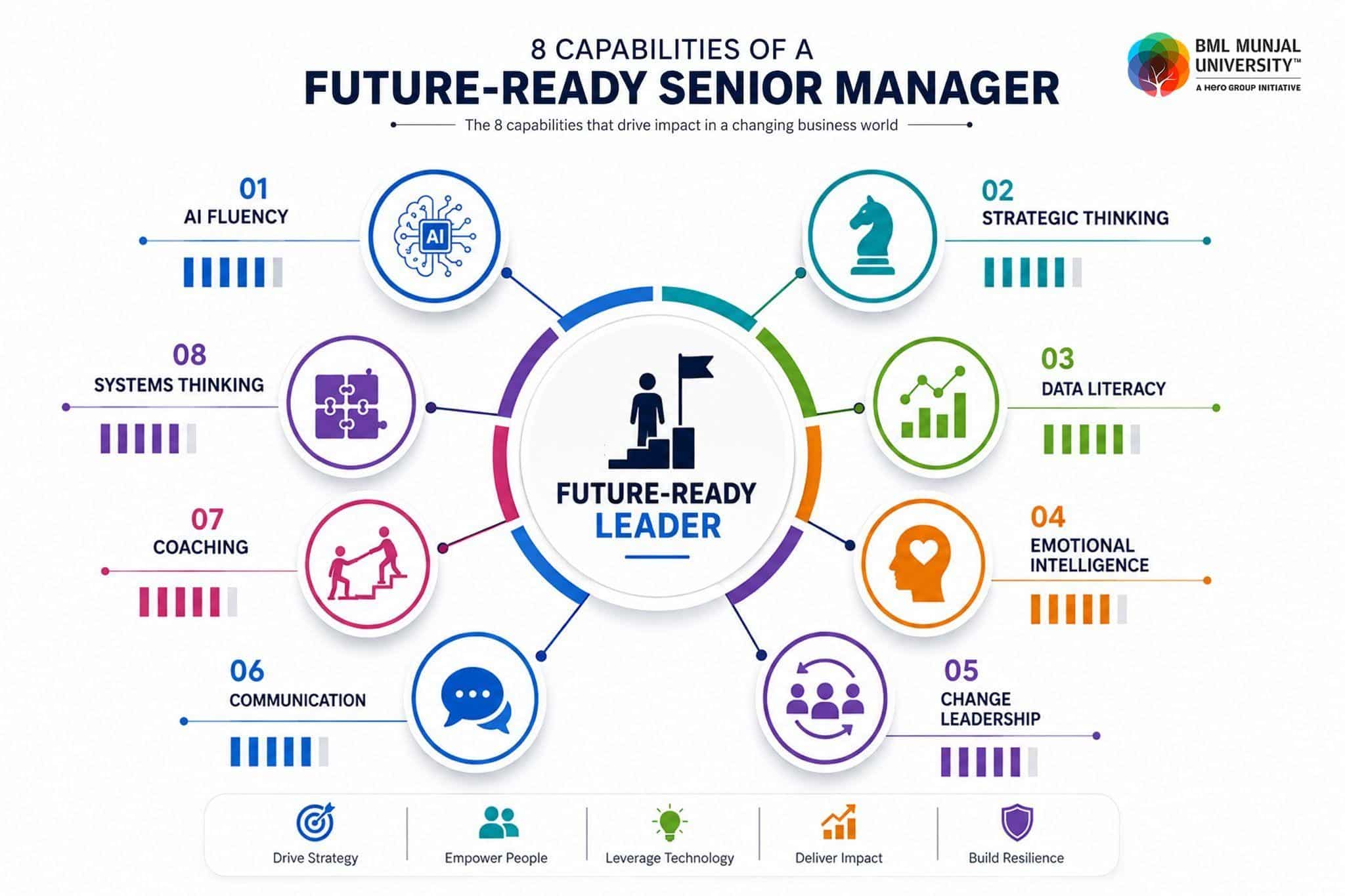
The combination matters. AI can provide information, but leaders still need judgement to understand context, evaluate trade-offs and make responsible decisions.
AI Can Analyse, But Can It Lead? Why Human Judgement Still Matters
AI is increasingly becoming part of daily business. The McKinsey 2025 State of AI survey found that almost nine in ten respondents indicated that AI is regularly used by their companies, but almost two-thirds of them indicated that their companies have not yet started scaling AI within the company.
For senior managers, this creates an important leadership challenge: knowing how to move from experimentation to meaningful business value.
| AI Can Support | Leaders Still Need to Own |
| Analyse information | Make the final judgement |
| Identify patterns | Understand context |
| Generate options | Evaluate trade-offs |
| Automate workflows | Lead people through change |
| Summarise data | Communicate decisions |
| Model scenarios | Take responsibility |
The McKinsey study also emphasised workflow redesigns and senior leadership's engagement in AI governance as key aspects of getting value out of AI. Therefore, AI literacy is not about coding; it is about understanding where the technology adds value, risks and how it influences decisions.
Beyond the Classroom: Turning Leadership Learning into Real-World Impact
Senior leaders do not require yet another learning programme based completely on lectures and theories. Learning becomes valuable when there is an opportunity to use what is learned in situations similar to those they face on the job.
An effective leadership development strategy may include:
- Live business projects related to organisational issues
- Discussions of cases and simulation games for decision making
- Peer learning with experts from various functions
- Coaching and feedback to highlight the leader’s blind spots
- Action learning projects to convert ideas into solutions
- Application in the workplace for developing leadership skills
This strategy should be aligned with the experiential learning framework combining practical application, feedback and structured learning.
From Manager to Leader: How the Role Is Changing
The role of a senior manager is changing from simply supervising performance to creating the conditions for people, technology and strategy to work together.
| Traditional Manager | Future-Ready Senior Manager |
| Supervises tasks | Builds ownership |
| Relies mainly on experience | Combines experience with data and AI |
| Uses top-down communication | Builds collaboration and alignment |
| Responds to change | Leads change |
| Gives periodic feedback | Coaches continuously |
| Follows established processes | Redesigns processes when needed |
The World Economic Forum's Future of Jobs research also identifies analytical thinking, resilience, flexibility and agility among important capabilities alongside rapidly growing technology skills.
How Can Senior Managers Build the Skills to Lead What Comes Next?
Leadership development is much more effective when it follows a process, rather than treating it as a one-time training event.
| Serial No. | Step | Action |
| 1 | Identify | Find the capability gap |
| 2 | Practise | Apply the skill to real work |
| 3 | Get Feedback | Learn from coaching and peers |
| 4 | Formalise | Build the capability through structured learning |
This doesn’t mean going back to the drawing board for professionals who already have experience; it means improving upon the experience they already have through a different way of thinking and leading.
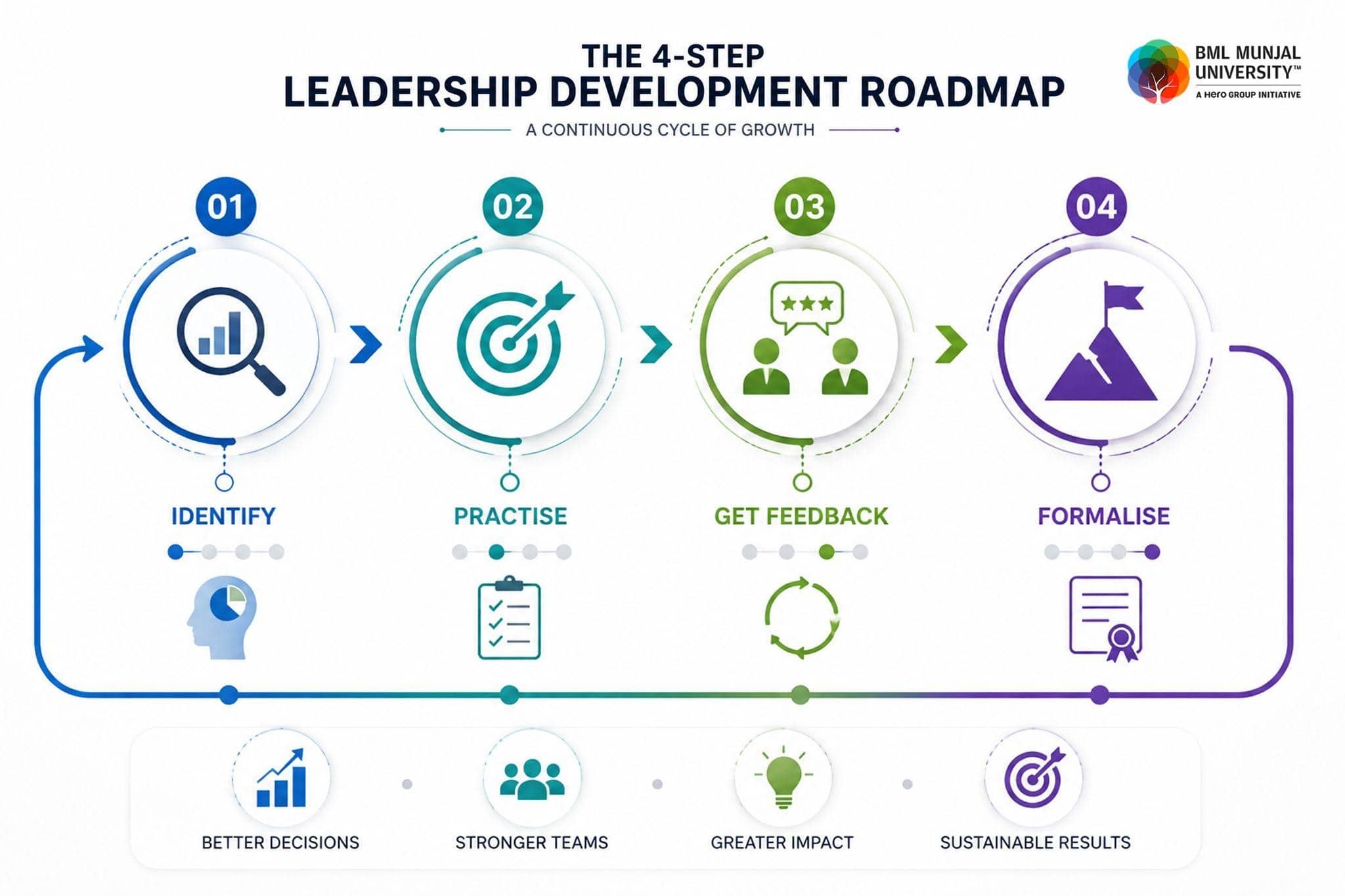
This turns leadership development into a continuous cycle rather than a one-time learning experience.
Turn Your Leadership Potential into Business Impact with Global Partner Programme at BML Munjal University
For those seeking a Leadership Development Programme for Senior Managers, BML Munjal University’s Global Partner Programme provides a well-designed and practical way to develop leadership skills.
Programme at a Glance:
- Targeted towards mid-senior to senior professionals with more than 12 years of experience.
- Involves 100% offline classes for practical learning and networking as an executive.
- Provides learning from both the faculties of BMU and global university partners.
- Offers live business projects framed in collaboration with the organisations involved.
- Involves coaching along with constructive feedback to develop the effectiveness of the participant’s leadership skills.
- Makes use of the concept of action-learning projects which involve the practical application of theories.
- International learning exposure through the collaboration of universities across the globe within the programme.
- Joint certification from BMU and a global university partner once the programme is successfully completed.
- The ongoing programme called Leadership Series, offered in association with Imperial College London, lasts for six months, with five months spent at the BMU campus and international immersion at Imperial College London.
The programme goes beyond classroom learning by combining strategic leadership, practical business challenges, coaching and global exposure. For experienced professionals, it provides an opportunity to sharpen existing capabilities, gain new perspectives and prepare to take on more complex leadership responsibilities.
Final Verdict
Leadership today cannot just be about gaining experience any more. The key to being a leader lies in the ability to constantly learn, innovate and understand the uncertainty while leading through change. A Leadership Development Programme for Senior Managers can create a framework that helps move from running what you have today to defining where you will be in the future.
For professionals with experience who are prepared to develop their strategic and decision-making skills as well as their abilities as a leader, the next phase in their development can begin through deliberate investment in these skills.
FAQs
It is a programme aimed at developing the skills required at the level of senior management, such as strategic thinking, decision-making, people leadership, etc.
Nowadays, fluency in AI, strategic thinking, data literacy, adaptability, communication, emotional intelligence and change leadership have become particularly relevant.
It allows senior managers to understand how to leverage AI in business decisions while maintaining human decision-making and responsibility.
Yes, because structured learning can be used to enhance the existing skills and perspectives of experienced managers in preparation for future roles.
Practical projects, coaching, peer learning, feedback and opportunities to apply learning to real business challenges can make leadership development more effective.
The 70-20-10 rule suggests that 70% of leadership development comes from practical experience, 20% from coaching and relationships and 10% from formal learning.
The 7 C’s are Character, Competence, Commitment, Communication, Courage, Collaboration and Compassion. Together, they represent qualities that can help leaders build trust and lead teams effectively.
Strategic thinking, AI competence, data analysis skills, communication, emotional intelligence, coaching and change management.
Leadership development helps senior managers strengthen their decision-making, strategic thinking and ability to lead people through organisational change.
An effective leadership development programme should include practical projects, coaching, feedback, peer-to-peer learning and structured learning aimed at acquiring new skills in practice
Senior managers become future-ready leaders via continuous development of their technological knowledge, strategic thinking, adaptability and people leadership.
Yes. It can help experienced managers update their capabilities, gain new perspectives and prepare for larger and more complex leadership responsibilities.
Related Blogs
Career in Health Insurance: From Graduation to a Future in the Industry
Key Takeaways India's health insurance premium volume exceeded ₹1.2 lakh crore in FY 2024–25, with the segment growing at around 9%. Healt...
Executive Education in India: A Complete Guide for Working Professionals
Key Takeaways Executive education is built for working professionals, not full-time students India's executive education market is growing fas...

How Women Professionals Build Authentic Leadership – Step-by-Step Guide
Key Takeaways Authentic leadership means leading with consistent values and self-awareness, not adopting a borrowed style Women professionals ...
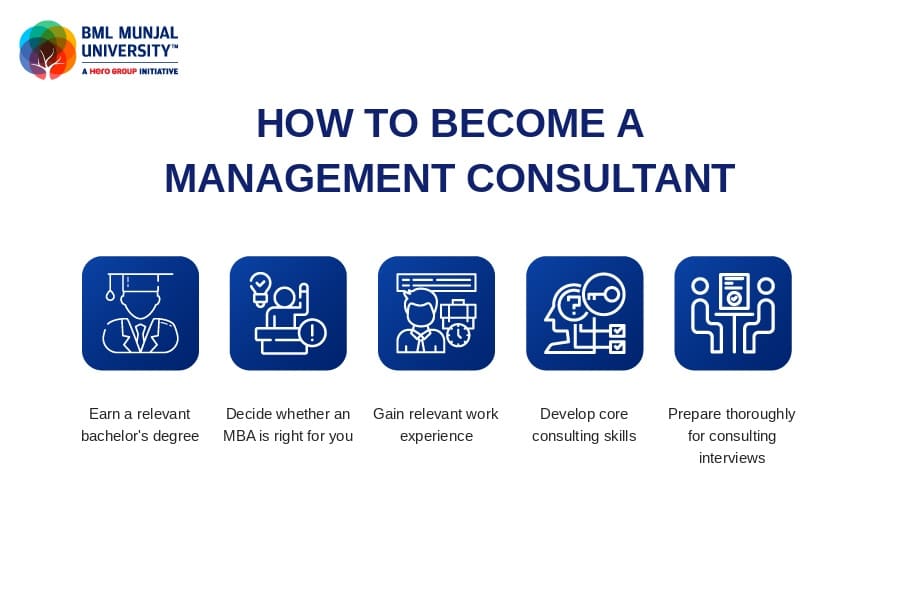
How to Become a Management Consultant in India: The Ultimate Career Guide
Key Takeaways A bachelor’s degree is the common starting point for a management consulting career. An MBA is valuable but not mandatory for ...
AI for Managers: Skills to Build, Tools to Master & Potential Risks
Key Takeaways AI supports managerial tasks like research, reporting, and decision-making, but managers retain judgment and accountability for out...

Executive MBA for Women: Why Is It the Right Move for Your Career?
Key Takeaways An EMBA is designed for professionals with 5+ years of experience who want to grow into leadership roles while continuing to work. ...