

AI for Managers: Skills to Build, Tools to Master & Potential Risks


Admissions Enquiry
Summary: This guide explains how managers can practically use AI in their day-to-day work, covering what AI for managers means, why the skill matters for leadership (not just personal productivity), where AI fits into recurring tasks like research, reporting, and planning, and how to evaluate AI tools and courses responsibly. It closes by pointing to BMU’s AI for Managers programme as a practical next step.
Key Takeaways
- AI supports managerial tasks like research, reporting, and decision-making, but managers retain judgment and accountability for outcomes.
- Indian enterprises report AI adoption nearing 40%, well above the global average, especially in functions managers oversee directly.
- A manager's own AI fluency directly shapes how well their team adopts and uses AI.
- Good starting points include research synthesis, meeting summaries, report drafts and planning support- repeatable, low-risk, easy-to-review tasks.
- Choosing the right AI tool or course should start with the use case, not the features or brand name.
- Key risks to manage: privacy exposure, inaccurate outputs, bias and unclear accountability.
Most working professionals now hear about AI daily, but few have a clear sense of what to actually do with it in their own role. The tools change fast and generic advice rarely fits a manager's real workload.
Deloitte's 2026 State of AI in the Enterprise: India Insights report found that Indian enterprises report significant or full AI usage at nearly 40%, well above the global average of roughly 28% and adoption is strongest in functions managers oversee directly, like strategy, operations and marketing.
AI for managers means using these tools to support tasks like research, reporting, decision-making and communication, while managers keep ownership of judgment and outcomes. This guide covers where AI genuinely helps, the skills worth building, how to evaluate tools and what to look for in an AI course.
What Is AI for Managers?
AI for managers means using AI tools to support day-to-day managerial work, not to replace the manager's judgment. It covers tasks like drafting reports, summarising meetings, researching options and organising information faster, while the manager stays responsible for reviewing outputs, making the final call and managing the team.
For most managers, this isn't about writing code. It's about knowing which tasks are worth handing to AI, how to prompt effectively and how to check what comes back before acting on it.
Why Do Managers Need AI Skills?
Managers need AI skills because AI now touches the core of managerial work: research, reporting, planning and communication. Without basic AI literacy, managers risk falling behind on tasks their peers are already speeding up or approving AI-assisted work they can't properly evaluate.
The gap is also about leadership, not just personal productivity. Gallup's workplace research found that employees whose managers actively support AI use are far more likely to use it well and see it as genuinely useful. In other words, a manager's own AI fluency shapes how effectively their whole team adopts it.
Building AI skills helps managers in four practical ways:
- Productivity: completing research, drafting and analysis faster, so more time goes to judgment calls.
- Decision support: structuring options, comparing scenarios and stress-testing assumptions before deciding.
- Communication: turning raw notes or data into clear updates for teams and leadership.
- Responsible adoption: setting the tone for how a team uses AI safely and appropriately.
How Can Managers Use AI in Their Work?
Managers can use AI across most of their recurring workload, as long as outputs are reviewed before use. Common, low-risk starting points include:
- Research synthesis: pulling together market, competitor or policy information into a working summary.
- Meeting summaries: turning notes or transcripts into clear action points and owners.
- Report drafting: producing a first draft of a status report, review or business case.
- Communications: drafting emails, updates or presentations that need polishing, not writing from scratch.
- Planning support: outlining project timelines, risk lists or resourcing options.
- Idea generation: exploring options for a problem before narrowing down with the team.
- Decision support: laying out pros, cons and trade-offs for a decision the manager will still make.
In short: AI is most useful where the task is repeatable and the manager stays in control of the final judgment.
What Tasks Can Managers Automate With AI?
Managers should prioritise tasks that are repeatable, low-risk and easy to review, not decisions with real consequences.
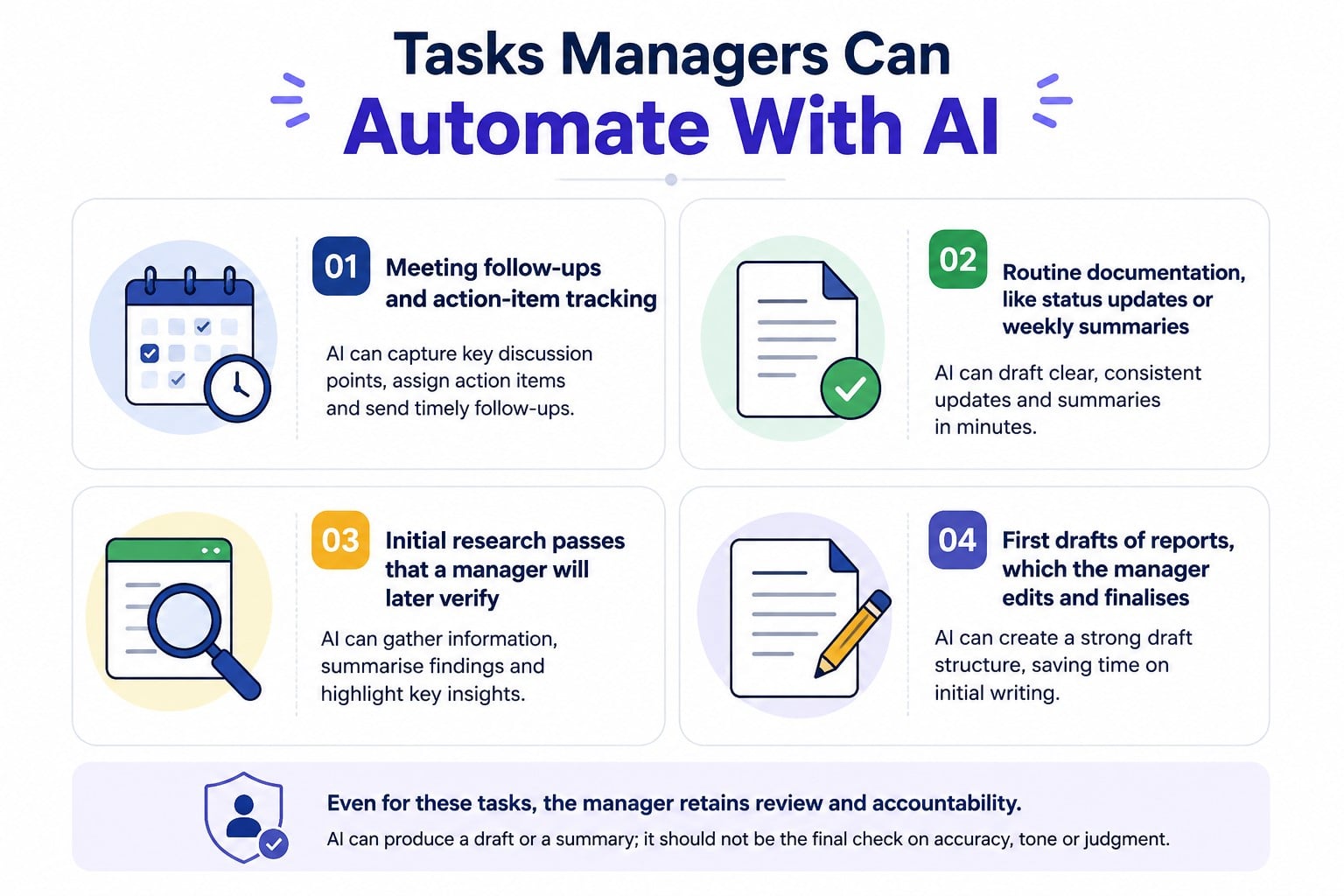
Even for these tasks, the manager retains review and accountability. AI can produce a draft or a summary; it should not be the final check on accuracy, tone or judgment.
What AI Skills Should Managers Learn?
Managers don't need to learn to code. What matters more is a working set of applied skills that make AI genuinely useful and safe in day-to-day work:
- AI literacy: understanding what AI tools can and can't reliably do.
- Prompting: giving AI tools clear, specific instructions to get useful output.
- Verification: checking AI-generated content for accuracy before using it.
- Workflow design: spotting where AI fits into an existing process and where it doesn't.
- Decision-making: using AI-generated options as input, not as the final answer.
- Data and privacy awareness: knowing what information is safe to share with an AI tool.
- Change leadership: helping a team adopt AI without confusion or misuse.
- Governance: applying organisational policy consistently when using AI tools.
How Should Managers Evaluate and Choose AI Tools?
Choosing an AI tool should start with the use case, not the tool's features. A simple evaluation framework helps managers compare options consistently:
| Evaluation Factor | What to Check |
| Use case fit | Does the tool solve a real, recurring task rather than a one-off need? |
| Accuracy and verification | How easy is it to check the tool's output before relying on it? |
| Data handling | Where does input data go and does this meet organisational policy? |
| Integration | Does it fit existing tools and workflows or add extra steps? |
| Ease of adoption | Can the team learn it quickly without heavy technical support? |
| Cost and value | Does the expected time saved justify the cost at team scale? |
| Scalability | Will it still work if usage grows across a team or department? |
| Governance | Is the tool approved for use and are review steps built in? |
What Are the Best AI Tools for Managers?
There's no single 'best' AI tool for managers; the right choice depends on the task, the data involved and organisational policy. Rather than chasing rankings, it helps to think in categories:
- General-purpose assistants (such as ChatGPT, Claude, Gemini or Perplexity) for drafting, research and summarisation.
- Meeting and communication tools for transcription, summaries and follow-up tracking.
- Data and reporting tools that help analyse or visualise information already in use.
- Workflow and automation platforms for repeatable, multi-step processes.
Named tools above are examples, not endorsements of one being safest or most accurate. Managers should verify outputs and use tools their organisation has approved.
What AI Risks and Governance Concerns Should Managers Understand?
The main risks managers should understand are privacy exposure, inaccurate outputs, bias in AI-generated content and unclear accountability when AI is involved in a decision. None of these disappears with better tools; they need active oversight.
- Privacy and confidentiality: avoid entering sensitive or proprietary information into unapproved tools.
- Inaccurate outputs: AI can produce plausible-sounding but wrong information; always verify facts and figures.
- Bias: AI outputs can reflect biased patterns in training data; review for fairness, especially in people-related decisions.
- Accountability: the manager, not the tool, remains responsible for decisions and their consequences.
- Approvals and human oversight: significant outputs should go through the same review a human-drafted version would.
- Responsible-use policies: follow organisational guidelines on approved tools, data handling and disclosure.
Before you deploy AI in your team, check:
- Is the tool approved by your organisation?
- Is there a clear process for verifying AI-generated outputs?
- Does everyone know what information should never be entered into an AI tool?
- Is it clear who signs off before AI-assisted work goes external?
Managers should follow their organisation's policies on data, privacy and compliance and consult internal legal, HR or IT teams where questions arise, rather than treating AI guidance as a substitute for that advice.
What Should an AI Course for Managers Cover?
A useful AI course for managers should build applied capability, not general theory. At minimum, it should cover foundations and prompting, productivity and decision-making use cases, automation and AI agents, business communication, hands-on practice, responsible AI and how these apply to the learner's own industry.
- AI foundations: what AI is and where it fits into managerial work.
- Prompt engineering: how to get useful, specific output from AI tools.
- Productivity and decision-making: applying AI to real workplace tasks.
- Automation and AI agents: understanding how workflows and bots can reduce repetitive work.
- Communication and visual thinking: turning AI output into polished, business-ready material.
- Hands-on practice: working directly with tools, not just watching demonstrations.
- Responsible AI and governance: privacy, bias, oversight and appropriate use.
- Industry context: examples relevant to the learner's own sector or function.
How to Choose an AI Course for Managers
Choosing the right AI course for managers comes down to matching the course to your actual goals and role, not just picking a well-known name. Before enrolling, it helps to ask:
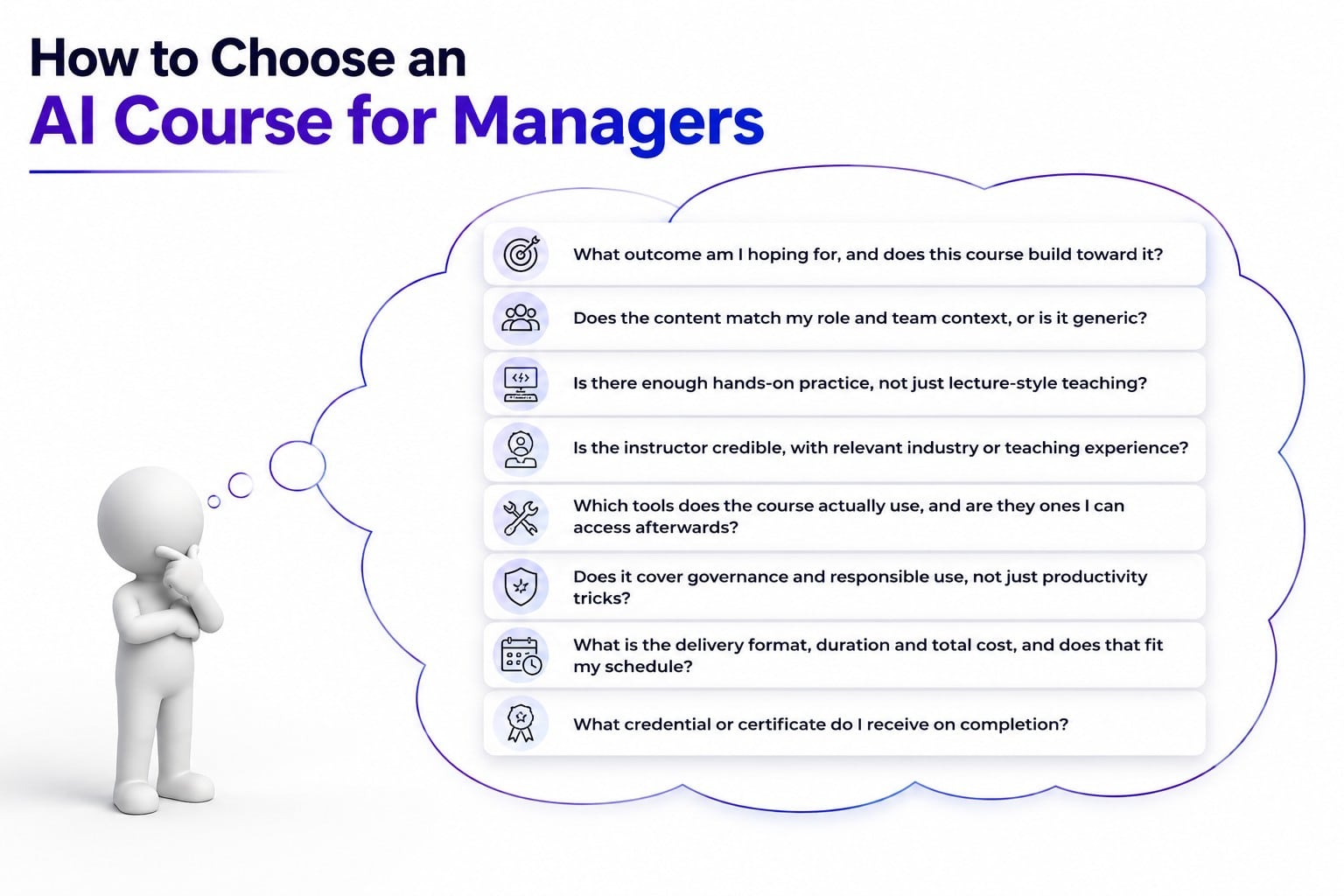
Course formats, duration and fees vary widely across providers, so it's worth comparing a shortlist against these questions before deciding. One option built around exactly this kind of applied, no-code learning is coming up next!
AI for Managers Programme at BML Munjal University: A Practical Next Step
For managers seeking a practical, no-code route into applied AI, BML Munjal University's Centre for Continuing Education runs an AI for Managers programme built around the selection criteria above: hands-on practice, applied tools and a structured approach to automation and governance.
Who It May Suit
The programme is designed for beginner-to-intermediate learners and does not require a technical background, making it a fit for managers who want applied AI skills without learning to code.
What It Covers
The programme is structured around four modules:
- AI Foundations + Prompt Engineering
- Automation, Bots & AI Agents
- AI for Productivity & Decision Making
- AI for Communication & Visual Thinking
What Differentiates the Approach
BMU states that exercises, case studies and scenarios can be customised using an organisation's industry context, operational tools and anonymised internal documents, so the delivery reflects the participating team's actual work rather than generic examples.
The programme is structured around what BMU describes as the 3i Framework: Inquire, Interact and Implement. ChatGPT, Claude, Perplexity and Gemini are among the workshop's prerequisite tools, giving participants hands-on exposure across more than one AI assistant rather than a single platform.
Evidence of Practical Outcomes
Participants can save 30-50% of their time on routine documentation, research and reporting tasks from the following week. This is a stated potential outcome tied to specific task types, not a guaranteed or average result and individual outcomes will vary by role and how the skills are applied.
Conclusion
AI is now a practical part of managerial work, not a future add-on. Managers who build applied AI skills, evaluate tools carefully and stay alert to governance can use AI to support faster research, clearer communication and better-informed decisions, while keeping accountability where it belongs.
If you're ready to build these skills with your team, you can contact amit.ghosh@bmu.edu.in to learn more about enrolling in the programme.
FAQs
AI for managers refers to the practical use of AI tools to support managerial work, such as research, reporting and communication. It does not replace managerial judgment; managers stay responsible for reviewing outputs, applying context and making the final decision.
Managers can use AI for research synthesis, meeting summaries, report drafts, communications, planning and decision support. What’s genuinely useful depends on the manager’s workflow, team structure and organisational policy, so it’s worth starting with a few low-risk, repeatable tasks.
Good candidates are repeatable, low-risk and easy to review, such as meeting follow-ups, routine documentation, status updates and initial research or report drafts. Managers should retain review and accountability for anything AI produces before it’s used or shared.
Not always. Management-focused AI learning can concentrate on applied use, prompting and evaluation rather than software development, so managers without a technical background can still build genuinely useful skills.
Look for hands-on practice, current tools, governance coverage, credible instructors, role-relevant use cases and a delivery format that fits your schedule. A course that only covers theory, without practice or governance, is unlikely to translate into real workplace use.
Cost varies significantly by provider, format and depth of content, from short workshops to longer executive programmes. For BMU’s current fee, check the AI for Managers programme page directly, since pricing details change over time.
Formats vary from short single-day workshops to longer multi-week programmes, depending on depth and delivery style. For BMU’s current programme duration, refer to the AI for Managers programme page for the latest details.
Related Blogs

Career in Health Insurance: From Graduation to a Future in the Industry
Key Takeaways India's health insurance premium volume exceeded ₹1.2 lakh crore in FY 2024–25, with the segment growing at around 9%. Healt...

Executive Education in India: A Complete Guide for Working Professionals
Key Takeaways Executive education is built for working professionals, not full-time students India's executive education market is growing fas...

How Women Professionals Build Authentic Leadership – Step-by-Step Guide
Key Takeaways Authentic leadership means leading with consistent values and self-awareness, not adopting a borrowed style Women professionals ...
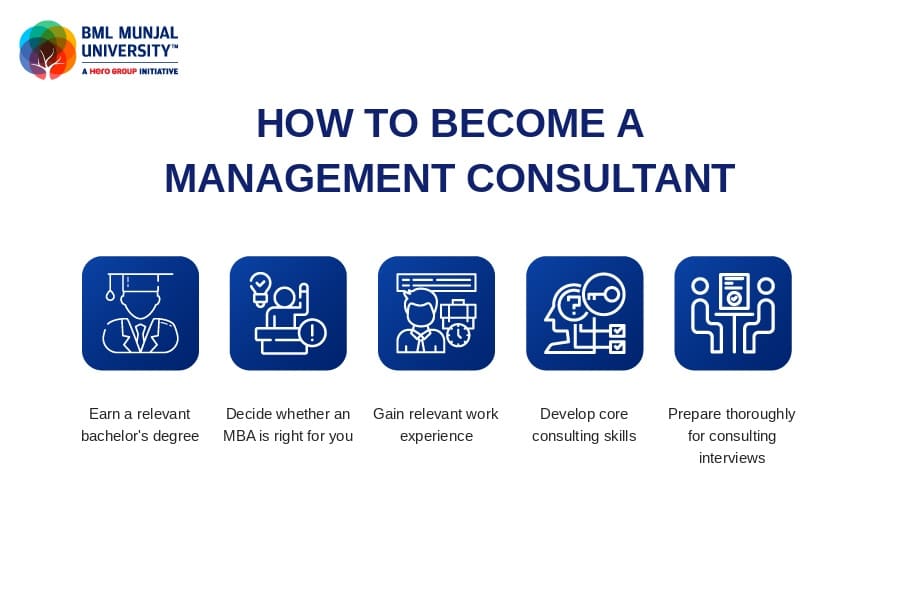
How to Become a Management Consultant in India: The Ultimate Career Guide
Key Takeaways A bachelor’s degree is the common starting point for a management consulting career. An MBA is valuable but not mandatory for ...

Leadership Development Programme for Senior Managers: Building Leaders for a Changing Business World
Key Takeaways Senior managers increasingly need to combine experience with AI, data and strategic thinking. Leadership development is shifting...

Executive MBA for Women: Why Is It the Right Move for Your Career?
Key Takeaways An EMBA is designed for professionals with 5+ years of experience who want to grow into leadership roles while continuing to work. ...