

Management Entrance Exams in India: Which One Is Right for You?


Admissions Enquiry
Summary: Choosing a management entrance exam in India starts with the MBA or PGDM programmes you want, not with the test your friends are taking. This guide compares CAT, XAT, CMAT, NMAT, GMAT, SNAP, MAT and ATMA, then uses the 3T Check (Target, Time and Test style) to help you build a shortlist that fits your plans. It also explains why score validity, admission stages and accepted tests must be checked programme by programme.

Key Takeaways
- There is no single best management entrance exam for every MBA aspirant.
- Compare CAT, XAT, CMAT, NMAT, GMAT, SNAP, MAT and ATMA by their current pattern and the programmes that accept them.
- Use the 3T Check: shortlist by your Target programmes, available time and preferred Test style.
- Attempt rules and score validity vary by exam; admission stages and accepted scores vary by institution.
- Check official exam and programme pages before you register or apply.
Ask three friends which MBA entrance exam to take and you will get three confident, different answers. One says CAT, another says GMAT, a third says “whatever your college accepts”. Each is right for someone and none of them knows your marks or your timeline.
So, how do you know which exam actually makes sense for your MBA plans?
This guide helps you decide which of CAT, XAT, CMAT, NMAT, GMAT, SNAP, MAT and ATMA belong on your shortlist. You’ll compare what each exam tests and how its format fits your plans, so you can focus your preparation on the options that make sense for you. Dates and rules change by cycle; check the relevant exam body’s latest notice before applying.
What Are Management Entrance Exams and Who Are They For?
Management entrance exams are tests that some business schools and universities use when selecting applicants for postgraduate management programmes, including MBA and PGDM courses. A test score is only one part of the process: for example, NTA says CMAT candidates must apply separately to participating institutions and meet each institution’s cut-off and selection criteria.
If you’re considering an MBA or PGDM after graduation or while completing your degree, these exams may be relevant. Check both the exam’s rules and each programme’s eligibility requirements; being eligible to sit a test does not automatically make you eligible for every course.
Which Are the Main Management Entrance Exams in India?
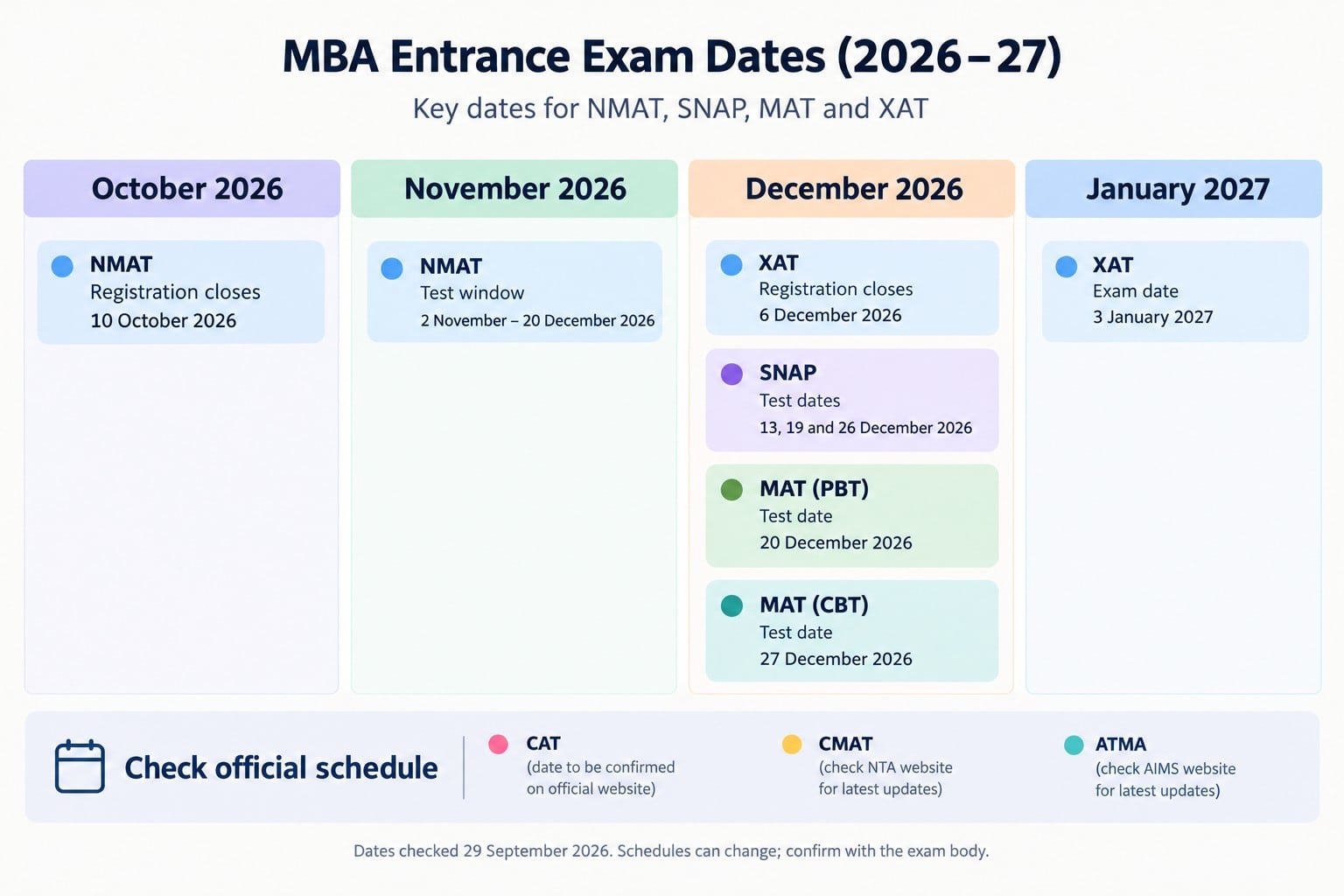
Start with the exams you may actually apply to. Although, a name alone does not tell you whether a particular school accepts its score or how it will use it. The eight exams below are a focused shortlist, not a complete list of every route into management study-
| Exam | It may belong on your shortlist if… |
| CAT | Your target programme’s admission policy accepts CAT, including the IIM programmes you’re considering. |
| XAT | Your target programme lists XAT as an accepted score. |
| CMAT | Your target institution accepts CMAT. NTA says you apply to institutions separately and each sets its own cut-off and selection process. |
| NMAT by GMAC | A target programme accepts NMAT and its testing window and rules suit your plans. Check the school’s application requirements separately. |
| GMAT | Your target business school accepts GMAT, in India or overseas. Acceptance depends on the programme. |
| SNAP | You’re applying to an SIU MBA programme for which SNAP is required. Check the programme’s separate selection process. |
| MAT | Your target institution accepts MAT and the current test session and mode work for you. |
| ATMA | Your target MBA or PGDM programme accepts ATMA. Check the current participating-institute information and the programme’s requirements. |
These eight aren’t the only options. If you’re targeting a particular state, check its entrance tests too; Maharashtra, for example, has a separate MAH-MBA/MMS CET information brochure. Some business schools also accept GRE scores for MBA admission; for instance, BML Munjal University also conducts its own BMU-MAT exam for MBA admissions.
What Does Each Exam Actually Test?
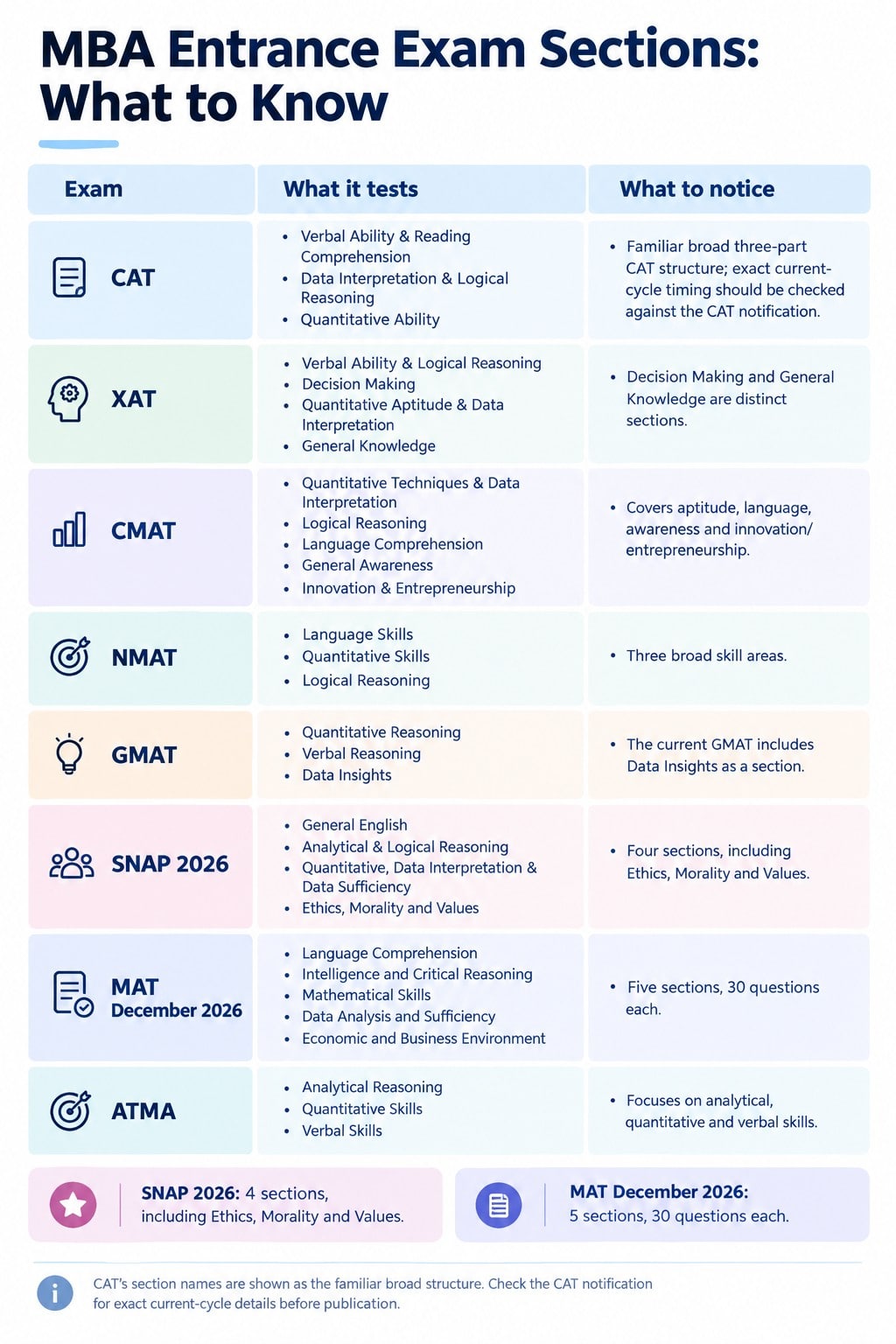
The exam names may sound familiar, but their patterns are not interchangeable. Some focus on three broad aptitude areas; others add decision-making, general awareness or a dedicated data section. Compare the sections below, then check the latest official pattern before you prepare: exam bodies can revise the format between cycles.
| Exam | Sections or skill areas | What stands out |
| CAT | Verbal Ability and Reading Comprehension; Data Interpretation and Logical Reasoning; Quantitative Ability | Three separately timed sections. Check the official CAT website for the current cycle’s notification and timing. |
| XAT | Verbal Ability and Logical Reasoning; Decision Making; Quantitative Aptitude and Data Interpretation; General Knowledge | Decision Making is a distinct section. The official XAT 2027 pattern lists GK separately and says it is considered for XLRI selection, not the overall percentile or cutoff. |
| CMAT | Quantitative Techniques and Data Interpretation; Logical Reasoning; Language Comprehension; General Awareness; Innovation and Entrepreneurship | Five areas, including Innovation and Entrepreneurship. |
| NMAT by GMAC | Language Skills; Quantitative Skills; Logical Reasoning | Three individually timed sections; you choose their order. |
| GMAT | Quantitative Reasoning; Verbal Reasoning; Data Insights | Data Insights is a full section in the current GMAT. |
| SNAP 2026 | General English; Analytical and Logical Reasoning; Quantitative, Data Interpretation and Data Sufficiency; Ethics, Morality and Values | The current official pattern, which applies to 2027 admissions, has four sections and 60 questions in 60 minutes. |
| MAT December 2026 | Language Comprehension; Intelligence and Critical Reasoning; Mathematical Skills; Data Analysis and Sufficiency; Economic and Business Environment | Five sections, with 30 questions in each. |
| ATMA | Analytical Reasoning; Verbal Skills; Quantitative Skills, with each skill area split into two sections | Six sections in total, 30 questions per section and three hours overall. |
A section name is only a starting point: question types, timings and marking rules matter too. Use this comparison to decide what to investigate, then build your preparation plan from the current official pattern and the requirements of the programmes you are targeting.
How Do You Choose the Right Exam for You?
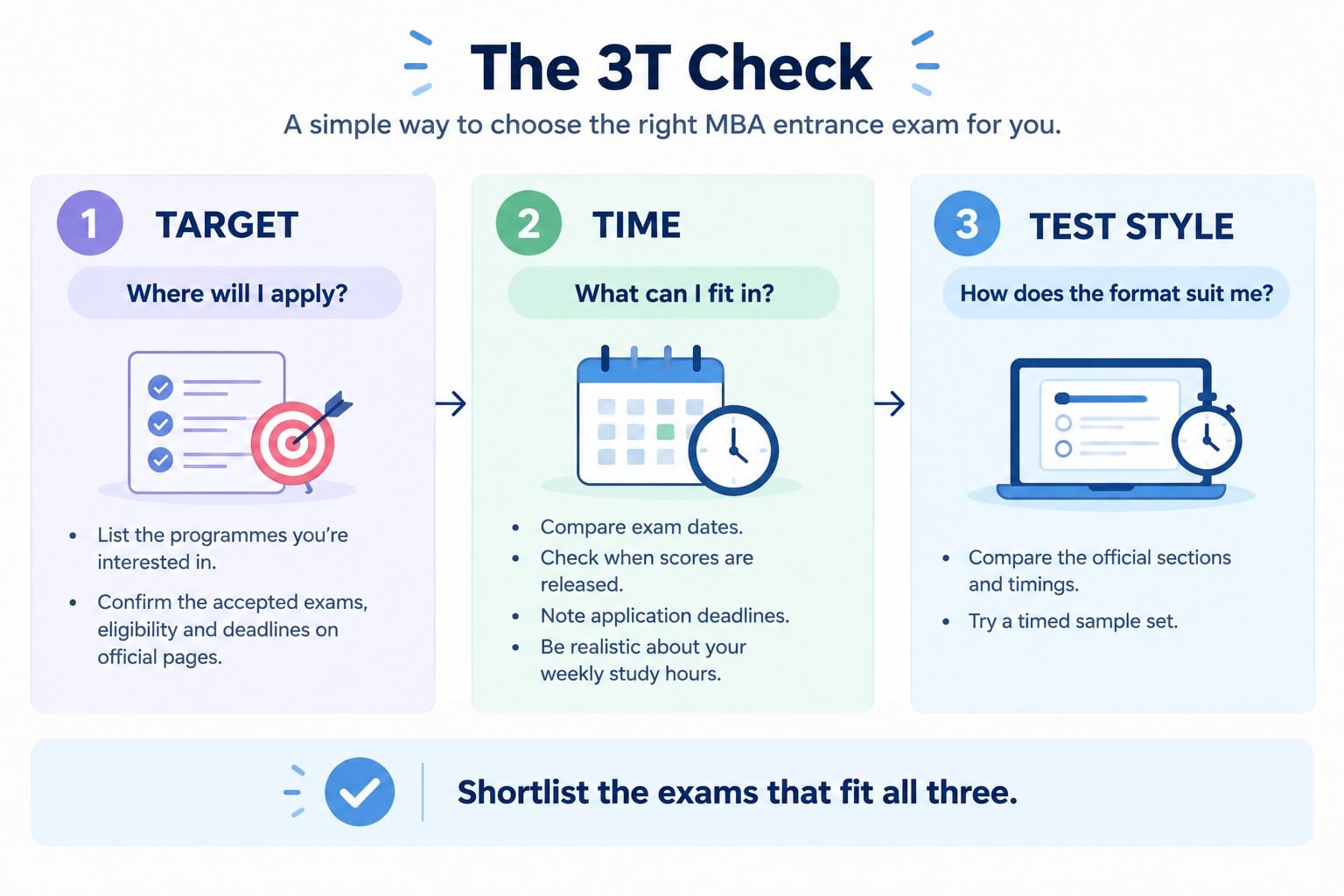
When choosing between management entrance exams, start with three questions: Where do you want to apply? How much preparation time do you have? Which test format suits you best? These three questions form the 3T Check: Target, Time and Test style.
- Target: Write down the MBA or PGDM programmes you would genuinely consider. Check each programme’s current accepted exam list, eligibility criteria and application deadline on its own website. An exam registration is not the same as a programme application: NMAT by GMAC says candidates must apply separately to schools, while AIMA advises MAT candidates to confirm score acceptance directly with the institute.
- Time: Put the exam date, registration deadline, score-release timing and each programme’s application deadline on one calendar. Then be honest about the study hours you can protect each week. A flexible appointment window may help with scheduling, but it only matters if the schools on your list accept that exam and your score will arrive in time.
- Test style: Compare the official sections and timings, then try a timed set of sample questions from the exam body. Notice where you lose time, where you feel confident and whether the format suits how you work under pressure. Your degree subject or a friend’s experience cannot tell you that on its own.
Once you have done the check, shortlist the exam or exams that cover the most programmes you want and fit your actual calendar. If a second exam opens a meaningful additional option, decide whether the extra preparation is worth it. You do not need to sit every test simply because you can.
Short on Time? Take This Quick Route
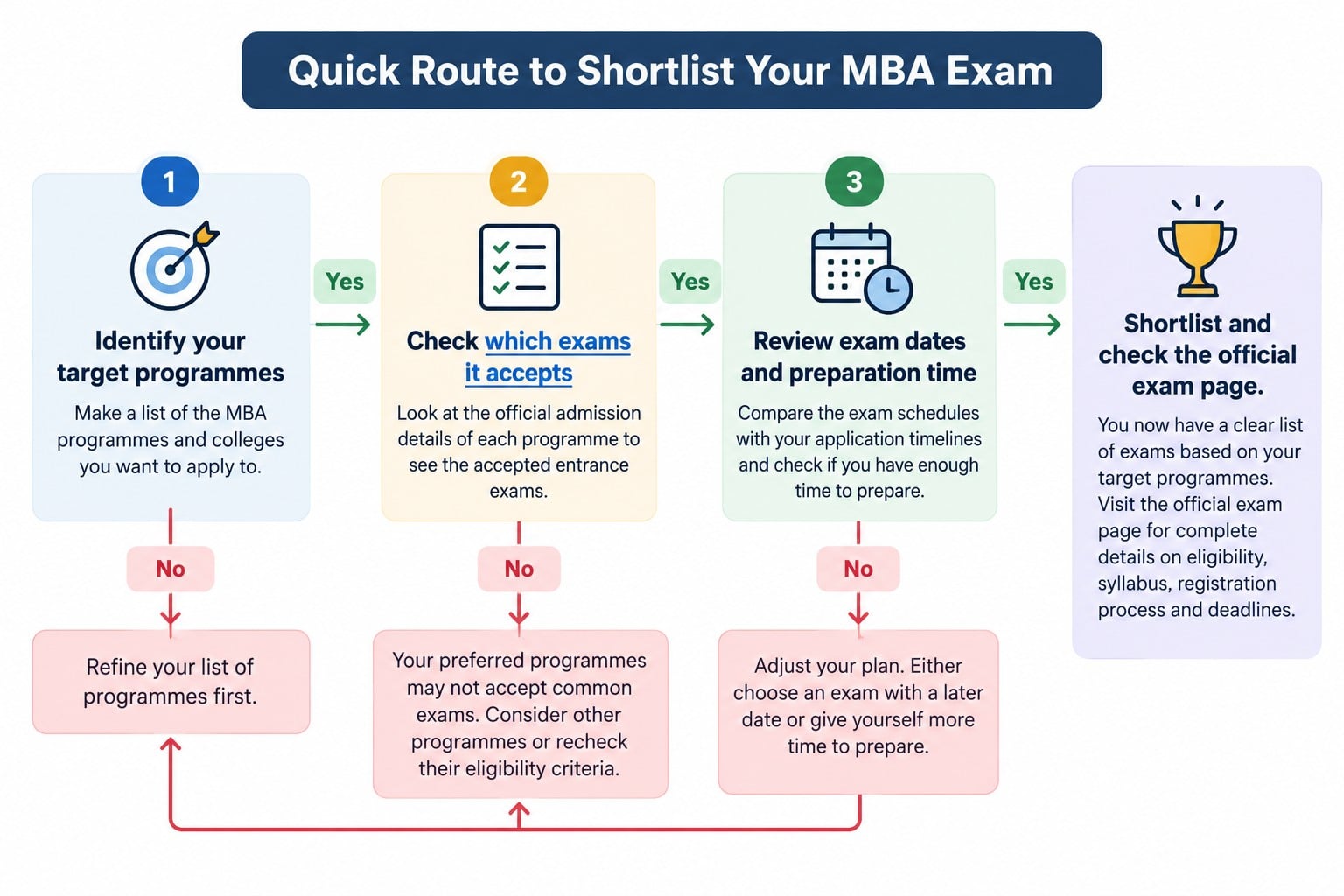
- Have you chosen the exams you want to apply to?
If not, shortlist a few first. The programme’s own admissions page is the place to confirm which exams it accepts.
- Do those programmes accept the same exam?
If yes, check that exam’s current dates and pattern. If not, compare the extra preparation and application steps before adding another test.
- Does the schedule fit your application deadlines and study time?
If yes, try a timed sample set. If not, revisit your programme shortlist or the next available exam cycle.
Your result: shortlist the exam or exams that match your target programmes, calendar and test style. Don’t choose by popularity alone.
How Many Exams Should You Attempt?
There is no ideal number of exams for everyone. I’d choose the smallest set that covers the programmes I genuinely want, then check each exam’s dates, retake rules and application deadlines before registering.
Retake rules differ. For the current testing cycle (2027 admissions), NMAT by GMAC allows up to three attempts, including no-shows, with a 15-day gap between attempts. SNAP offers up to three test dates for 2027 admissions and its official rules say the highest score is used if you sit more than once. GMAT allows up to five attempts in a rolling 12-month period, with at least 16 days between attempts.
MAT has several administrations during the year, but each session has its own schedule and registration deadline. Don’t assume that every school will accept every session or score: check the programme’s current admission page.
Before you add another exam or retake, ask yourself:
- Does it open a programme I want?
- Can I prepare for it properly?
- Will the score arrive before that programme’s deadline?
If the answer is no, another registration may add cost and pressure without helping your shortlist.
What Happens After the Exam?
After the test, check three things: when your score will be available, how long it remains valid and what each programme requires next. These rules differ by exam and school, so don’t assume one score-validity period or selection process applies everywhere.
For example, GMAT scores are valid for five years, while NMAT scores are valid for one year. AIMA also states that MAT scores are valid for one year. For other exams, check the current exam notice and the programme’s own admissions page before deciding when to apply.
A score does not automatically lead to an interview or offer. Each school sets its own shortlisting criteria and later stages. Depending on the programme, these may include a written assessment, group discussion, case discussion or personal interview. NTA’s CMAT guidance, for example, says participating institutions set their own cut-offs and selection procedures.
Once you shortlist programmes, note their application deadlines and keep the documents they request ready. These may include academic records, proof of eligibility and work-experience or category documents if relevant to your application. Follow each programme’s current instructions rather than preparing from a universal checklist.
That process is worth checking for every school on your list. Here is one example: how BML Munjal University describes its MBA admissions process.
Applying to BML Munjal University? Know Your MBA Exam Options
If BML Munjal University is on your shortlist, check its current admissions page before deciding whether to apply. The university lists CAT, NMAT, GMAT, CMAT, XAT, GRE and BMU-MAT as accepted tests. For the intake you’re targeting, make sure BMU’s MBA admissions are open and that your exam score is accepted.
The eligibility criteria at BML Munjal University require a bachelor’s degree in any discipline, with at least 50% or an equivalent grade. Final-year students can apply and work experience is not mandatory. You can submit the application while your test scores or graduation results are pending. Shortlisted candidates then attend a Personal Interview that includes a Case Discussion.
The university offers a Portfolio-First MBA programme. Its curriculum includes portfolio-based project work, AI integration across core and elective courses and a capstone project. Review the current curriculum to see how those elements fit your interests and compare them with the programmes on your own shortlist.
If BMU remains an option for you, then check the next intake’s admissions status, accepted tests, eligibility and curriculum before applying.
Conclusion
You do not need to choose the exam everyone else is taking. Choose the one that fits the programmes you want, the time you can give it and the way you work through a test. The 3T Check can help you turn a long list into a realistic shortlist.
Before you register, confirm that each programme accepts your chosen exam, check its deadline and review the current test pattern. Then give yourself enough time to prepare properly. Your score matters, but each institution sets its own eligibility rules and selection stages.
If BMU’s MBA is on your list, check its official admissions page for the next intake’s status and accepted tests. Apply now!
FAQs
They are tests used by business schools and universities as part of admissions to postgraduate management programmes. The test is one part of an application; each institution sets its own eligibility criteria and selection process.
Start with the programmes you want to apply to. Check which exams they accept, then compare the dates and test patterns. Use the 3T Check (Target, Time and Test style) to decide which option fits your plans.
Yes, if your chosen programme accepts another exam or admissions route. The options vary by institution, so check the current admissions page before registering. For the 2027 intake, BMU’s MBA page lists NMAT, GMAT, CMAT, XAT, GRE and BMU-MAT alongside CAT.
There is no single limit across all exams. Rules differ: NMAT by GMAC allows up to three attempts in its testing year, SNAP allows up to three tests for 2027 admissions and GMAT permits up to five attempts in a rolling 12-month period. Check the current rules for every test you plan to take.
Work experience is not a universal prerequisite for sitting these entrance exams, but check each exam’s eligibility rules. A programme may have separate requirements. BMU, for example, says work experience is not mandatory for its MBA, while its published criteria also allow final-year students to apply.
It depends on the exam and the programme. GMAT scores are valid for five years; NMAT and MAT scores are valid for one year. For other exams, check the current exam notice and the school’s score-acceptance rules.
There is no single rule for every MBA programme. Some schools use interviews, group discussions, written assessments or case discussions; others may use different stages. Check the selection process for each programme. NTA’s CMAT guidance says participating institutions set their own cut-offs and selection procedures.
Some Indian MBA programmes accept GMAT or GRE scores, but acceptance is not universal. Check your target programme’s current admissions criteria. For the 2027 intake, BMU’s MBA page lists both GMAT and GRE among the accepted tests.
For the 2027 intake, BMU’s MBA admissions page lists CAT, NMAT, GMAT, CMAT, XAT, GRE and BMU-MAT.
Related Blogs

Is Work-Life Balance Really Possible During an Executive MBA in India?
Key Takeaways India has the highest employee burnout rate globally, with 59% of Indian professionals reporting burnout symptoms against a 20% w...

MBA Without CAT in India: Top Colleges, Entrance Exams & Direct Admission 2026
Can you do an MBA without CAT in India? The answer is yes and it is more common than most students realise. CAT was designed as an entry filter for...

The Benefits of an Integrated BBA MBA: Career Growth & How It Compares to Traditional MBA
Integrated BBA MBA programmes are becoming increasingly popular among students who want to start building management careers right after Class 12. Wha...

MBA in Operations Syllabus: Semester-Wise Curriculum, Key Subjects & Practical Components
An MBA in Operations is one of the most sought-after management specialisations for students interested in business processes, supply chain systems, l...

MBA for Working Professionals: Transform Your Functional Expertise into Business Leadership
You have spent years building expertise, managing people and delivering results. But somewhere between your current role and the one you actually want...

MBA vs MCA in 2026: Which is Better for Your Career, Salary & Future?
You've recently graduated and you're excited for what’s next. Now comes the question- “Should you do an MBA or an MCA?” Both sound impress...