
Career Options After 12th Humanities: High-Paying Courses and Career Paths


Admissions Enquiry
Summary: Choosing what to study after 12th Humanities can open up several career directions. This blog covers popular courses such as BA Liberal Arts, BA LLB, Psychology, Political Science, English, Journalism, Sociology, Social Work, History, Geography and B.Des. It also discusses high-salary courses after 12th humanities, salary ranges, career opportunities and skills that can support career growth. Along with this, readers can learn about entrance exams, practical skills and key factors to consider when choosing a course and planning their next step.
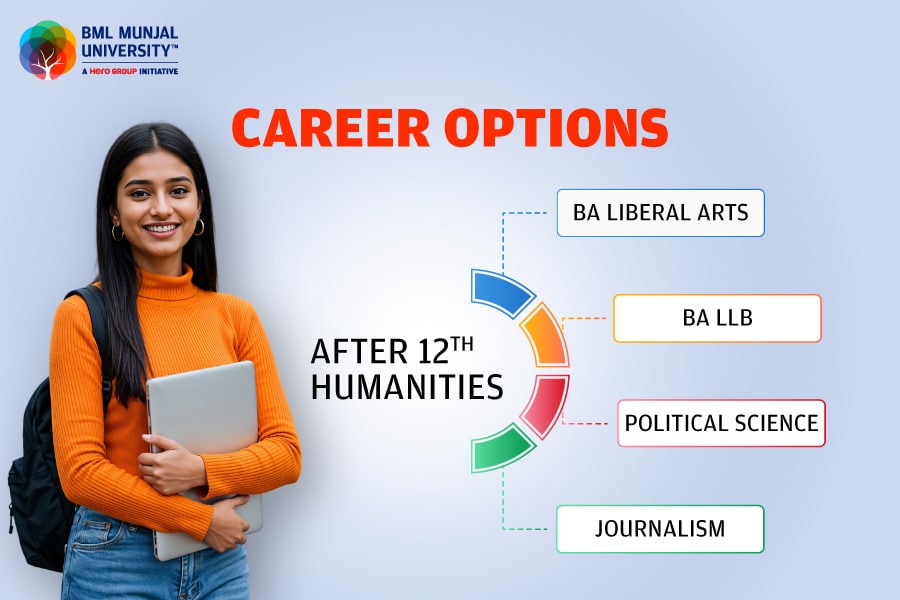
What if the passion you have for stories, people, creativity or understanding of the world could be turned into the basis of a rewarding career? Choosing Humanities as a stream after Class 10 means opening a door not only to academic success but also to a number of interesting career opportunities, which is why Class 12 is the best time to build your career as per your interests.
Whether it is presenting cases in courtrooms or developing policies, creating digital experiences, branding or studying human behaviour, the choice of specialisation is broad. With so many options to choose from, how can you figure out which one is yours? Exploring career options after 12th humanities will allow you to understand which high-salary courses after 12th humanities are suitable for you and give you a clear idea of earnings in each area.
In this article, you will find some career opportunities, undergraduate courses, salaries, entrance exams and useful skills that can give you an advantage. Whether you have already found your career or are still looking for it, you will find here some helpful information for you.
What Careers Suit Graduates of 12th Humanities?
There are a large number of career opportunities that a 12th humanities student can choose from, including legal services, management, media, psychology, design and civil services.
Below are some career choices to pursue depending on your interest and future ambitions-
1. Business, Consulting, and Public Policy
Not sure yet which subject you want to build a career in? BA Liberal Arts is designed for students who want to explore different subjects before choosing a specialisation. You study humanities, social sciences, economics and communication, while internships help you gain experience in consulting, policy research, media or business.
2. Legal
Law is one of the professional fields Humanities students can enter straight after Class 12th. BA LLB (or BBA LLB) is a five-year integrated course, with admission through CLAT, AILET or university-specific entrance exams. Graduates work with law firms, corporate legal teams and compliance departments. Those who want to practise law in court must meet the applicable enrolment requirements of a State Bar Council.
3. Writing, Editing and Publishing
Writers are often hired based on their writing skills and work samples, not just their qualifications. BA (Hons.) English develops reading, writing and analytical skills, while a blog, published articles or a writing internship can help build a portfolio for content writing, publishing and editing roles. Teaching is another career option.
4. Economics, Banking and Analytics
If you are fascinated by numbers as well as interested in policy issues, then you can go for BA (Hons.) Economics. Many banks, consultancy companies and think tanks recruit economists who are good at analysis; moreover, most of the economists pursue an MBA or a master's after graduation. At some institutions, knowledge of Mathematics is required from Class 12 onwards.
5. Civil Services and Public Administration
Many civil services aspirants choose a Humanities subject for graduation and BA (Hons.) Political Science covers topics relevant to the UPSC syllabus. History, Sociology and Geography are also useful options, as they overlap with several areas of the examination. The same academic background can also lead to careers in policy research and public affairs.
6. HR, Counselling and Psychology
A BA (Hons.) Psychology alone does not qualify graduates to work as clinical psychologists or in all professional counselling roles, as these positions may require postgraduate qualifications and additional training. However, the degree provides a foundation in human behaviour that can be useful in HR, learning and development, research and social service organisations.
7. Social Research and Community
Sociology education allows you to gain insight into the functioning of the community, family and other organisations. Students studying BA (Hons.) Sociology will acquire such skills as conducting research, making observations and conducting analyses, which will be beneficial for them in the NGO sector, research institutes or in a public policy team.
8. Journalism and Media
Newsrooms, agencies and brands require personnel who can conduct research on their stories and communicate them effectively. BA in Journalism and Mass Communication (BJMC) is a field involving print, digital and broadcast media and skills applicable to other sectors such as content creation, social media, public relations and copywriting. Campus magazines and student radio stations provide valuable experience to students.
9. Management
Management is open to Humanities students too. A BBA generally takes three years, while an Integrated Programme in Management (IPM) usually takes five years, depending on the institution. Both cover subjects such as marketing, finance, HR and operations. Admission may be through IPMAT, JIPMAT, CUET or university-specific entrance tests and graduates can begin in trainee, executive or analyst roles.
10. Social Work and NGO
Social work involves practical experience as well as classroom learning. During the Bachelor of Social Work (BSW), students gain exposure to communities and social organisations, preparing them for roles in NGOs, CSR teams and development agencies. A master's degree in social work can help graduates qualify for specialised and senior positions.
11. Heritage, Teaching and Research
If you enjoy studying historical sources and understanding why events happened, BA History can lead to careers in teaching, museums, archives and heritage tourism. It can also support UPSC preparation, while a master's degree can help graduates pursue research and, with the required qualifications, college teaching.
Best High-Paying Courses After 12th for Humanities Students
High-salary courses after 12th in humanities can offer strong earning opportunities, with outcomes also depending on the college, skills and experience you build.
| Course | Duration | Common Entry Route | Related Career | Salary Range |
| BA LLB / BBA LLB | 5 years | CLAT, AILET, university entrance | Corporate Lawyer | ₹5–12 LPA |
| Bachelor of Design (B.Des.) | 4 years | NIFT, NID DAT, UCEED | UX Designer | ₹6–17 LPA |
| BA/BSc Economics (Hons.) | 3 years | CUET / Merit | Economist | ₹16.6– 19.1 LPA |
| BBA / Management Programmes | 3 years | IPMAT, CUET, college entrance | Management Trainee | ₹7.7–8.5 LPA |
| BJMC / Digital Media | 3 years | CUET / College entrance | Multimedia Journalist | ₹5–8 LPA |
| BA/BSc Psychology | 3 years + higher study | CUET / Merit | Clinical Psychologist | ₹5.9–6.5 LPA |
Two things to keep in mind - starting salaries vary widely between institutions and the highest earners in every field are usually those who add practical skills (internships, portfolios, certifications) to their degree.
Salary figures are based on salary data reported on Glassdoor and AmbitionBox for related job roles.
Which Entrance Exams are Required for Humanities Postgraduate Programmes?
Different courses have different entrance requirements, so it is important to know which exams you need to take before applying.
Here are some common entrance exams for Humanities students and the programmes they cover.
| Exam | Admission Purpose |
| CUET (UG) | BA programmes and liberal arts at many central and state universities |
| CLAT, AILET, LSAT-India | BA LLB and BBA LLB |
| NIFT, NID DAT, UCEED | Design programmes |
| IPMAT, JIPMAT | Integrated management programmes |
| University or college-level tests | Many private universities, including BA (Hons.) programmes |
Which Government Exams Can I Apply for After 12th Humanities in India?
Humanities students have a natural edge in several government exams because subjects such as polity, history, geography and sociology feature heavily. The following are some government career options for Humanities students.
- Civil Services (UPSC / State PSC) - IAS, IPS, IFS and other services, after graduation in any subject.
- Teaching -Ed. for school teaching; UGC-NET after a master's for college teaching.
- Banking - IBPS and SBI exams for PO and clerk roles, after graduation.
- SSC, Railways and Defence - exams such as SSC CGL, RRB NTPC and CDS for officer and non-officer roles.
- Other - roles through LIC, EPFO and RBI recruitment exams, depending on eligibility.
A BA in Political Science, History or Sociology can double as preparation for the UPSC optional papers. Right after Class 12, a few recruitments are open to 12th-pass candidates, such as SSC CHSL and India Post GDS, but eligibility and age limits change with every notification, so check the official notice.
Overview of Short-Term Courses and Diploma Programmes
Short-term and diploma courses can expand career options after 12th humanities by helping students develop specialised skills and prepare for entry-level roles. Depending on your interests, these programmes can complement a degree or provide practical training for entry-level roles. The table below highlights some popular options, their duration and potential career applications.
| Course | Typical duration | Career Areas |
| Digital Marketing | 6 months–1 year | Marketing, media, startups |
| Content Writing / SEO | 3–6 months | Writing, publishing, marketing |
| Graphic Design / UI-UX Basics | 6 months–1 year | Design and media roles |
| Foreign Languages (French, German, Japanese) | 6 months–2 years | International roles, translation |
| Basic Data Analysis (Excel, SQL) | 3–6 months | Research, business and policy roles |
Take the Next Step with BML Munjal University
Students can explore BMU’s School of Liberal Studies programmes, including BA (Hons.) Economics, Psychology, Sociology, Literature and History. The university also offers BA LLB (Hons.) for those interested in combining humanities with law.
Why Study at BMU?
- Industry exposure - The programmes include internships, fieldwork, research and experiential learning, giving students opportunities to apply classroom learning in real situations.
- Recruitment opportunities - The university provides career support and connects students with industry through recruitment activities, career guidance and professional development.
- Course-specific exposure - Economics students get opportunities around applied research and real-world economic issues, while Psychology students can gain experience through fieldwork, community projects and research.
- Hands-on Law Experience - BA LLB students get practical exposure through moot courts, internships, live projects, legal clinics and courtroom advocacy training, along with opportunities related to litigation, corporate law and public policy.
If you are shortlisting colleges, check BMU’s course structure, admission requirements and available industry opportunities before applying.
Conclusion
Career options through humanities are endless after class 12th, whether it’s a legal career, a psychologist, media, design or a managerial career. It all depends on what courses best suit one’s interests and strengths and what kind of career one wants to pursue.
Before opting for any particular course, one must compare the curriculum, fees, eligibility criteria and career scope of the course chosen by them.
FAQs
B.Tech usually needs Mathematics, as well as other science subjects for Class 12. Hence, for many engineering courses, the Humanities student may not fulfil the eligibility criteria. The list of subjects for the programme that you wish to apply to can always be checked.
Deciding on what to do in life helps in taking the appropriate course after Class 12. B.Ed. could be an apt choice if one wishes to teach in the future. For those wanting to do subjects like English, Psychology, History or Sociology, BA is recommended. Vocational courses can be considered when learning any skill is the primary aim.
There are a few entrance examinations for some courses. CUET is taken up by those who wish to pursue various undergraduate courses and there is CLAT for law. Students can consider IPMAT, NIFT, NID DAT and UCEED according to the course.
Yes, a short course may turn out to be helpful in getting a practical skill. Some examples of practical skills would be digital marketing, content writing, graphic design, video editing, foreign languages and data analysis. Such a skill can be learned along with the degree programme.
The possibilities are quite diverse. A student may consider various courses such as law, psychology, journalism and mass communication, design, social work, management, economics and geography. Various vocational courses are also offered for those students who find it easier to learn by doing.
Courses such as law, design, management, journalism, psychology, economics and liberal arts have the potential to provide various job opportunities in the future.
Related Blogs
Social Stratification in Sociology: Understanding How Society Is Structured
Key Takeaways Social stratification describes hierarchies between individuals and social groups. Class, caste, gender, wealth, education and p...
Top Career Options After BA (Hons) Sociology: Jobs, Salary & Emerging Opportunities
Sociology is the study of society, human behaviour, social relationships and the social systems that influence how people live, work and interact. It ...
How to Become a Clinical Psychologist After 12th – Step-by-Step Guide
India is witnessing a significant rise in mental health awareness. From schools and colleges to workplaces and hospitals, conversations around emotion...
What Can You Do With a BA History Degree? Top Career Paths in 2026
Here is a question you have probably heard or quietly asked yourself: “What exactly do you do with a history degree?” The honest answer to t...

BA Subjects List: Top Specialisations, Subject Combinations & Year-wise Course Structure
Key Takeaways: A BA degree typically covers subjects such as Psychology, Economics, Sociology, Literature, History, Political Science and Philoso...

Liberal Arts: The Degree That Prepares You for Jobs That Don’t Exist Yet
Have you ever felt like the degrees that colleges offer are lacking some or the other thing for you? Have you felt like “yes, biotechnology is impor...