

BBA LLB vs BA LLB 2026: Which Law Degree is Better for Your Career? [Detailed Comparison]


Admissions Enquiry
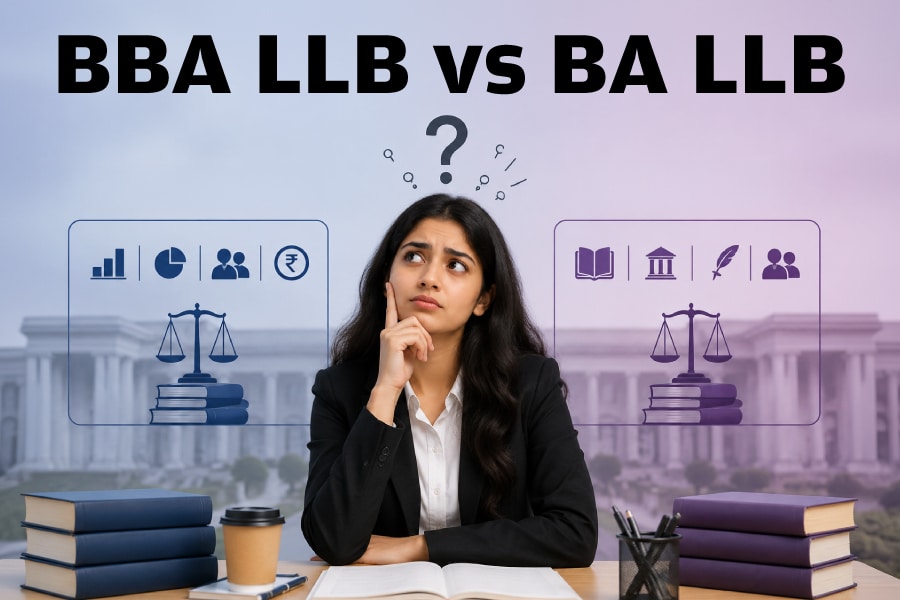
Choosing the right integrated law programme after Class 12 is an important step towards building a successful legal career. Among the most popular options are BA LLB (Hons.) and BBA LLB (Hons.). While both programmes lead to an undergraduate law degree and open doors to careers in litigation, corporate law, judiciary, legal consultancy and higher studies, they differ in curriculum, skill development and career focus.
Many students are confused about BBA LLB vs BA LLB because both courses have the same duration and cover core legal subjects. The key difference lies in the additional discipline that is studied alongside law. BA LLB combines legal education with humanities and social sciences, whereas BBA LLB integrates business administration and management with law.
BBA LLB vs BA LLB: Quick Comparison
| Particulars | BA LLB (Hons.) | BBA LLB (Hons.) |
| Duration | 5 Years | 5 Years |
| Eligibility | Class 12 from a recognised board | Class 12 from a recognised board |
| Admission | CLAT, LSAT- India, CUET (where accepted) or university admission process | CLAT, LSAT- India, CUET (where accepted) or university admission process |
| Annual Tuition Fee | ₹3.90 lakh | ₹4.90 lakh |
| Core Subjects | Political Science, Sociology, Economics, History, Law | Management, Marketing, Finance, Accounting, Law |
| Career Focus | Litigation, Judiciary, Public Policy | Corporate Law, Business Law, Compliance |
| Average Starting Salary | ₹4–8 LPA | ₹5–10 LPA |
| Best For | Students interested in civil, criminal or constitutional law | Students interested in corporate and commercial law |
What is BA LLB (Hons.)?
BA LLB (Bachelor of Arts and Bachelor of Legislative Law) is a five-year integrated law programme that combines legal education with humanities and social science subjects. Instead of pursuing a separate bachelor's degree followed by a three-year LLB, students complete both qualifications in one integrated course.
Along with core legal subjects such as Constitutional Law, Criminal Law, Contract Law, Family Law and Administrative Law, students also study Political Science, Sociology, Economics and History. These subjects help develop critical thinking, analytical reasoning and a deeper understanding of society and governance.
The programme also includes practical learning through moot courts, legal research, internships, drafting exercises and legal aid activities. Graduates can pursue careers in litigation, judiciary, legal research, public administration, policy-making and academia.
What is BBA LLB (Hons.)?
BBA LLB (Bachelor of Business Administration and Bachelor of Legislative Law) is another five-year integrated law programme, but its curriculum combines legal education with business administration and management.
Students study subjects such as Principles of Management, Marketing, Finance, Accounting, Human Resource Management and Business Communication alongside core law papers. This combination equips graduates with legal knowledge as well as business and managerial skills that are highly valued in the corporate sector.
The programme is ideal for students who aspire to work in corporate law firms, multinational companies, financial institutions, consulting firms or regulatory organisations. It also provides a strong foundation for careers in mergers and acquisitions, corporate governance, banking law, taxation and compliance.
BA LLB vs BBA LLB: Key Differences
Although both programmes qualify graduates to practise law after fulfilling the applicable professional requirements, the learning experience and career orientation differ.
BA LLB focuses on understanding legal systems through the lens of humanities and social sciences. It is well suited for students interested in constitutional law, criminal law, civil litigation, judicial services and public policy.
BBA LLB, on the other hand, blends legal studies with business and management concepts. Students gain an understanding of how laws impact companies, commercial transactions, financial institutions and corporate governance, making it a preferred choice for corporate legal careers.
The core legal subjects remain largely similar in both programmes. However, the additional subjects influence the skills students develop and the industries in which they may choose to build their careers.
BA LLB vs BBA LLB: Subjects
| BA LLB (Hons.) | BBA LLB (Hons.) |
| Political Science | Principles of Management |
| Sociology | Marketing Management |
| Economics | Financial Accounting |
| History | Business Communication |
| Constitutional Law | Constitutional Law |
| Criminal Law | Company Law |
| Contract Law | Business Law |
| Family Law | Corporate Governance |
Eligibility Criteria
Students seeking admission to either programme must have completed Class 12 from a recognised board. Admissions are generally based on national-level law entrance examinations such as CLAT or LSAT- India, university-specific admission processes or other accepted entrance tests, depending on the institution.
Applicants should always check the latest eligibility requirements, minimum qualifying marks and admission guidelines published by their preferred university before applying.
Which Course Should You Choose?
Choosing between BA LLB and BBA LLB depends on your interests and long-term career goals rather than which course is considered "better."
Choose BA LLB (Hons.) if you:
- Want to become a litigation lawyer.
- Plan to prepare for judicial services examinations.
- Are interested in constitutional, civil or criminal law.
- Enjoy subjects like Political Science, Sociology and Economics.
- Aspire to work in public policy, legal research or government services.
Choose BBA LLB (Hons.) if you:
- Want to build a career in corporate law.
- Are interested in business, finance and management.
- Aspire to work with multinational companies or leading law firms.
- Want to specialise in mergers and acquisitions, compliance or corporate governance.
- Prefer combining legal expertise with business knowledge.
Career Opportunities After BA LLB and BBA LLB
Both BA LLB (Hons.) and BBA LLB (Hons.) prepare graduates for rewarding careers in the legal profession. Since both are integrated law degrees, graduates can pursue litigation, higher studies, judicial services or legal practice after fulfilling the applicable Bar Council of India requirements. However, the additional subjects studied during the programme often influence the industries and roles graduates choose.
| Career Option | BA LLB (Hons.) | BBA LLB (Hons.) |
| Advocate/Lawyer | ✔ | ✔ |
| Corporate Lawyer | ✔ | ✔ |
| Legal Consultant | ✔ | ✔ |
| Judicial Services | ✔ | ✔ |
| Public Prosecutor | ✔ | ✔ |
| Legal Researcher | ✔ | ✔ |
| Compliance Officer | Limited | ✔ |
| Corporate Legal Counsel | Limited | ✔ |
| Banking & Financial Institutions | Moderate | ✔ |
| Policy & Public Administration | ✔ | Moderate |
Salary Comparison
Salary packages in the legal profession vary depending on factors such as internships, employer, location, specialisation and professional skills. Graduates who gain practical experience during their studies often have better career prospects.
| Job Role | Average Starting Salary |
| Advocate | ₹4–7 LPA |
| Legal Associate | ₹5–8 LPA |
| Corporate Lawyer | ₹6–12 LPA |
| Compliance Officer | ₹5–9 LPA |
| Legal Consultant | ₹5–10 LPA |
Why Choose BML Munjal University for BA LLB (Hons.) or BBA LLB (Hons.)?
At BML Munjal University (BMU), the School of Law offers BA LLB (Hons.) and BBA LLB (Hons.), both approved by the Bar Council of India (BCI). The programmes combine strong legal education with experiential learning through moot courts, internships, legal research and case-based learning to help students develop practical legal skills.
While BA LLB (Hons.) integrates law with humanities and social sciences, BBA LLB (Hons.) combines legal studies with business administration, enabling students to choose a programme that aligns with their career goals.
BA LLB (Hons.) vs BBA LLB (Hons.) at BMU
| Particulars | BA LLB (Hons.) | BBA LLB (Hons.) |
| Duration | 5 Years | 5 Years |
| Approval | Bar Council of India (BCI) | Bar Council of India (BCI) |
| Eligibility | 10+2 (or equivalent) with a minimum of 45% marks | 10+2 (or equivalent) with a minimum of 45% marks |
| Accepted Entrance Exams | CLAT, SAT, CUET or BMU-SAT | CLAT, SAT, CUET or BMU-SAT |
| Annual Tuition Fee | ₹3.90 lakh | ₹3.90 lakh |
| Learning Focus | Humanities and Law | Business Administration and Law |
To Sum Up
Both BA LLB (Hons.) and BBA LLB (Hons.) are excellent integrated law programmes that can lead to rewarding careers in the legal profession. The right choice depends on your interests and long-term career goals. If you are passionate about litigation, judiciary, constitutional law or public service, BA LLB (Hons.) is likely to be the better option. If you aim to build a career in corporate law, business regulations, compliance or commercial legal practice, BBA LLB (Hons.) offers a more business-oriented foundation. Choose the programme that best aligns with your future aspirations.
If you're looking for an integrated law programme that combines academic excellence with practical learning, explore the BA LLB (Hons.) and BBA LLB (Hons.) programmes at BML Munjal University. Review the latest eligibility criteria, admission process and fee details before applying for the 2026 intake and choose the programme that best aligns with your career aspirations.
Related Blogs

How to Become a Criminal Lawyer After 12th: A Step-by-Step Guide for 2026
Key Takeaways Choose a 5-year BA LLB or BBA LLB after Class 12. Gain experience through internships, moot courts and legal-aid work. Learn ...
The Road to India’s Highest Court: How to Become a Supreme Court Lawyer
Key Takeaways A recognised LL.B. is the first step toward a career in Supreme Court litigation. After graduation, State Bar Council enrolment ...

How to Become a Judge in India: Eligibility, Salary, & the New 3-Year Practice Rule
A judge's black robe is one of the most respected sights in an Indian courtroom and one of the most misunderstood career paths in law. Every year, lak...

What is Legal Drafting? Types, Skills & Why It’s a Core Skill for Every Law Student in India
A few years ago, a Maine dairy company agreed to pay $5 million to settle a lawsuit that turned on a single missing comma in one sentence of a state l...

Types of Lawyers in India- 20 Law Specialisations, Salaries and Career Scope (2026 Guide)
Today, the law field extends far beyond traditional courtroom practice. Many professionals work with companies, startups, government bodies and intern...

How to Become a Corporate Lawyer in India: Step-by-Step Guide (2026)
Key Takeaways Complete a 5-year integrated BA LLB/BBA LLB after Class 12 or a 3-year LLB after graduation to become a corporate lawyer. Clear ...