
Top Engineering Courses to Consider in 2026: 11 Future-Ready Options


Admissions Enquiry
A Quick Overview- Engineering courses in 2026 are shifting towards AI, data science, robotics and sustainability. Choosing the right branch can directly impact your salary, career growth and job opportunities. This guide covers the best future-oriented engineering courses, their scope and expected salary trends.

"Engineering toh karni hai… but kaunsi branch?"
This is exactly where most students (and even parents) get stuck.
That question used to be simpler. Engineering was enough. But in 2026, the field isn't the real decision anymore - the branch is. And here's what most guides won't tell you- the engineering courses that will actually matter in the future are not the same ones that mattered five years ago. The landscape has shifted and picking blind is no longer a safe bet.
Stable, evolving with IoT→ IoT →Data Science Engineering
Every industry, every sector
| Traditional Branches | 2026 Shift | Future-Ready Branches |
|
Civil Engineering |
→ Tech → |
AI & Machine Learning |
|
Mechanical Engineering |
→ AI → |
Robotics & Mechatronics |
Electrical Engineering |
→ IoT → |
Data Science Engineering |
|
Chemical Engineering |
→ Green → |
Renewable Energy Engg. |
|
Aerospace Engineering |
→ Space → |
Biomedical Engineering |
AI is inside every industry, every boardroom. New technologies are creating jobs that didn't exist five years ago. And where you end up depends on more than just your branch; placements vary wildly across colleges too. Which means the wrong combination can quietly set you back by years.
India has over 8,000 engineering colleges. That's a maze, not a menu.
So if you're about to make that call, or helping someone who is, let's make it a smarter one. Before you pick because your cousin did or because someone said "CS is safe," let's actually break down which engineering courses in future will be in demand, which ones pay well and which ones are genuinely future-proof.
Which Engineering Course Suites You Best in 2026
If you want a quick answer before we go deeper, here is how the top engineering branches stack up against what most students actually care about-
| Your Goal | Most Suitable Engineering Course |
| High salary | Computer Science, AI, Data Science |
| Job security | Electrical, Mechanical (core + tech integration) |
| Innovation & startups | Robotics, AI, Mechatronics |
| Global opportunities | IT, Software Engineering |
| Sustainability careers | Environmental Engineering, Renewable Energy Engineering |
| Healthcare & biotech | Biomedical Engineering |
| Infrastructure & public works | Civil Engineering |
| Defence & space | Aerospace Engineering |
| Agriculture & rural development | Agricultural Engineering |
| Cutting-edge research | Quantum Engineering, Electronics & Computer Engineering |
| Chemical & process industries | Chemical Engineering |
Pro Tip- Do not just pick a branch. Pick a branch and build on it. Adding tech skills like AI, coding or data analytics to any core engineering degree is what separates a good placement from a great one.
What Are "Future Engineering Courses"?
Not every engineering branch is built the same anymore.
Future-oriented engineering courses are the ones that sit at the intersection of three things-
- Emerging technologies
- Strong industry demand
- Careers that automation cannot easily replace
Think AI, robotics, renewable energy and biomedical tech. These are the branches where companies are actively hiring, salaries are climbing and the work itself keeps evolving.
Traditional branches like Civil or Mechanical are not going anywhere, but even they are changing. The ones who thrive are adding tech layers- data analytics, automation, IoT. That is what "future-ready" actually means in 2026.
The Scope of Engineering - Why Your Choice Matters More Than Ever in 2026
A few years ago, getting into any engineering college was considered enough. That’s no longer true. According to industry reports, over 40-50% of entry-level tasks in tech roles are now partially automated and hiring is increasingly focused on specialised skills rather than degrees alone.
The scope of engineering in 2026 is still vast, but it is no longer equal across all branches. It now depends on-
- Industry demand
- Emerging technologies
- Skill adaptability
The Expanding Scope of Engineering
Engineering today goes far beyond traditional roles. Opportunities are growing in-
- Artificial Intelligence & Data Science
- Renewable Energy & Sustainability
- Robotics & Automation
- Healthcare & Biomedical fields
1. AI Is Redefining Engineering Careers
Routine tasks like basic coding, testing and design are increasingly automated. This shifts demand toward advanced problem-solving and specialised skills—changing what “scope” really means.
2. Skills Now Define Your Opportunities
Companies prioritise portfolios, internships and real projects over just degrees. This means your growth depends more on what you can do than what you studied.
3. Scope Varies by Branch (Salary Gap Reality)
Not all branches offer the same outcomes anymore.
● High-demand fields (CS/AI)- ₹8-12 LPA starting
● Lower-demand branches- ₹3-4 LPA
This is exactly why more students are now searching for high-salary courses after 12th science before locking in their engineering decision.
Best Engineering Courses for the Future (2026)
| S.N. | Course | Demand | Salary Range | Risk Level |
| 1. | Computer Science Engineering | Extremely High | ₹6-25 LPA | Low |
| 2. | AI & Machine Learning | Extremely High | ₹8-30 LPA | Low |
| 3. | Electronics & Computer Engineering | High | ₹5-18 LPA | Low |
| 4. | Robotics & Automation | High & Rising | ₹6-20 LPA | Low |
| 5. | Mechanical Engineering | Moderate-High | ₹4-15 LPA | Medium |
| 6. | Aerospace Engineering | Moderate (Niche) | ₹6-20 LPA | Medium |
| 7. | Civil Engineering | Stable | ₹3-12 LPA | Medium |
| 8. | Chemical Engineering | Moderate | ₹5-18 LPA | Medium |
| 9. | Renewable Energy Engineering | Growing | ₹5-18 LPA | Low |
| 10. | Biomedical Engineering | Growing | ₹4-15 LPA | Low-Medium |
| 11. | Quantum Engineering | Emerging | Up to ₹20 LPA | Medium |
1. Computer Science Engineering (CSE)
B.Tech. Computer Science and Engineering remains the most in-demand branch in 2026. It covers everything from software design and data structures to cloud computing, cybersecurity and AI applications. A CSE graduate is not just a coder — they are someone who understands how digital systems are built, scaled and secured.
According to a recent report, IT and computing jobs are projected to generate around 317,700 openings every year through 2034. In India, CSE graduates can earn up to ₹19 LPA, with top performers at product companies going significantly higher.
Career options- Software Developer, Data Scientist, AI/ML Engineer, Cybersecurity Analyst, Full Stack Developer, Database Administrator
Also Read: Computer Science Engineering Courses After 12th
2. Artificial Intelligence & Machine Learning
AI and ML have moved from being a specialisation to being a foundational expectation across industries. This field focuses on building systems that can learn from data, identify patterns and make intelligent decisions — across healthcare, finance, logistics and beyond.
The Future of Jobs Report 2025 by the World Economic Forum identifies AI and big data as the fastest-growing skill sets, with 39% of key job skills expected to change by 2030. In India, AI/ML engineers can earn up to ₹21 LPA depending on skills and experience.
Career options- Machine Learning Engineer, AI Research Scientist, Data Scientist, NLP Engineer, Computer Vision Engineer, Robotics Engineer
3. Electronics & Computer Engineering (EComE)
Electronics and Computer Engineering sits at the crossroads of hardware and software — a combination that is increasingly valuable as smart devices, IoT systems and connected infrastructure expand. The field covers embedded systems, VLSI design, hardware-software integration and electronic communication systems.
Employment for electrical and electronics engineers is projected to grow 7% by 2034. In India, electronics engineers can earn up to ₹7 LPA at the entry level, with experienced professionals going significantly higher.
Career options- Embedded Systems Engineer, Electronic Design Engineer, System Analyst, Software Engineer, Power Engineer, Test Engineer
Also Read: Electronics and Computer Engineering: Courses, Scope & Career Options
4. Robotics & Automation
Robotics is no longer just about factory floors. Today's robotics engineers work on surgical systems, autonomous vehicles, drone technology and AI-driven manufacturing lines. This branch combines mechanical design, electronics and programming into one highly versatile profile.
As industries accelerate their automation journeys, robotics engineers are among the most sought-after profiles globally. Salaries in India range from ₹6-20 LPA, with strong growth as adoption scales.
Career options- Robotics Engineer, Automation Engineer, Mechatronics Specialist, AI Robotics Developer, Systems Integration Engineer
5. Mechanical Engineering
Mechanical Engineering is not fading — it is evolving. Every EV that moves, every aircraft that flies, every automated production line that runs has a mechanical engineer behind it. The field covers thermodynamics, fluid mechanics, machine design and increasingly, automation and sustainable manufacturing.
The field is projected to grow by 9% through 2034, much faster than the average for all occupations. In India, mechanical engineers can earn up to ₹10 LPA, with those who add automation or EV expertise commanding significantly more.
Career options- Automotive Engineer, CAD Technician, Aerospace Engineer, Manufacturing Engineer, Energy Systems Engineer, Robotics Engineer
6. Aerospace Engineering
Aerospace Engineering deals with the design, development, testing and manufacturing of aircraft, spacecraft and related systems. It is a highly specialised field — competitive to get into, but with strong long-term prospects as India's space sector opens to private players and defence investment grows.
Employment for aerospace engineers is estimated to grow 6% by 2034. Salaries can go up to ₹20 LPA in India, with global opportunities pushing that higher.
Career options- Aircraft/Spacecraft Designer, Military Aerospace Engineer, Mechanical Engineer (Aerospace), Data Processing Manager, Compliance Inspector
7. Civil Engineering
Civil Engineering is the backbone of India's infrastructure push — roads, bridges, metro systems, smart cities and water management. It may not carry the flashiest starting salaries, but job stability across both government and private sectors is genuinely strong.
Employment in civil engineering is estimated to grow 5% by 2034. In India, civil engineers earn up to ₹6.6 LPA, with significant upside in project management and consulting roles.
Career options- Consulting Civil Engineer, Design Engineer, Structural Engineer, Urban Planner, CAD Technician, Nuclear Engineer
8. Chemical Engineering
Chemical Engineering sits at the heart of industries that will never go away — pharmaceuticals, petrochemicals, food processing and advanced materials. If you are drawn to how things are made at a molecular and industrial scale, this branch offers depth and stability.
Job opportunities in chemical engineering are expected to grow 3% by 2034. Salaries in India can go up to ₹8.3 LPA, with petroleum and pharma sectors offering the highest packages.
Career options- Chemical Engineer, Petroleum Engineer, Biotechnologist, Energy Engineer, Nuclear Engineer, Product Development Scientist
9. Renewable Energy Engineering
Climate change is now a global policy and business priority. A recent report from International Renewable Energy Agency projects over 38 million jobs in the renewable energy sector by 2030. Solar, wind, hydro and bioenergy systems all need engineers who understand both the technical and sustainability sides of the equation.
In India, renewable energy engineers can earn up to ₹10 LPA, with strong growth as government and private investment in clean energy accelerates.
Career options- Solar Energy Engineer, Wind Energy Engineer, Energy Analyst, Power Systems Engineer, Sustainability Specialist, Green Building Engineer
10. Biomedical Engineering
Biomedical Engineering combines engineering principles with medical and biological sciences to develop healthcare devices, diagnostic tools, prosthetics and medical software. It is a field that is both technically demanding and genuinely impactful.
Employment for biomedical engineers is projected to grow 5% by 2034. In India, salaries can reach up to ₹7 LPA at the entry level, with global demand pushing this significantly higher for specialised roles.
Career options- Clinical Engineer, Medical Imaging Specialist, Rehabilitation Engineer, Research Scientist, Quality Control Engineer, Bioinstrumentation Engineer
11. Quantum Engineering
Quantum Engineering is early-stage but moving fast. It applies principles of quantum physics to build next-generation computers, sensors, cryptography systems and communication networks — technologies that will underpin entire industries over the next decade.
The quantum computing market size is projected to reach $4.24 billion by 2030, driven by surging global investment in R&D. Salaries in India can reach up to ₹20 LPA for skilled professionals in this space.
Career options- Quantum Software Developer, Hardware Engineer, Algorithms Researcher, Cryptography Expert, Sensor Developer, Research Scientist
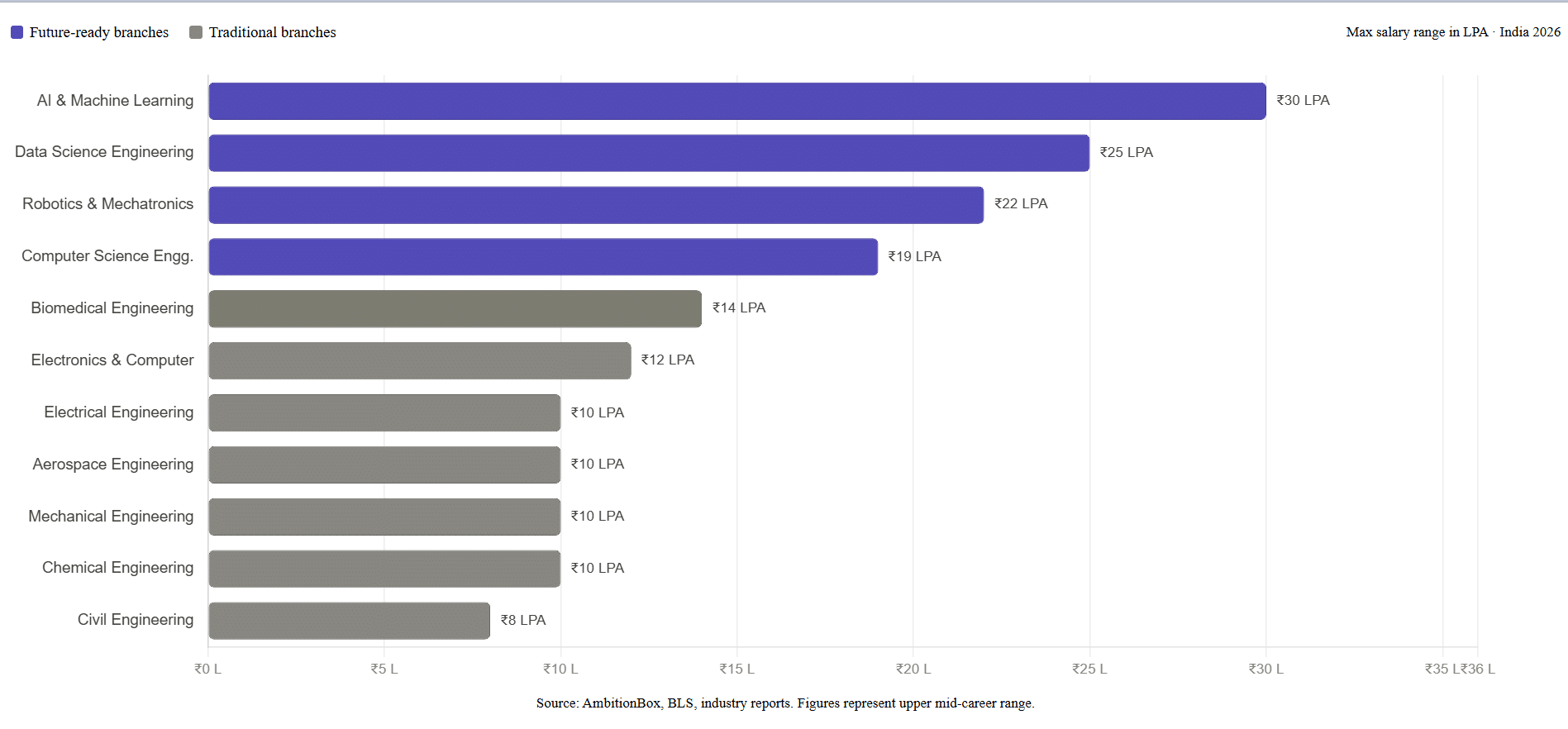
Engineering Salary in India - Traditional vs Future-ready Branches
Which Engineering Course is Best for You?
There is no single "best" engineering branch, but there is a best one for you, depending on what you actually want from your career.
Choose CSE or AI & Machine Learning if-
- You want a high starting salary and fast career growth
- You enjoy coding, logic or working with data
- You want the flexibility to work anywhere, in India or abroad
Choose Mechanical or Core Engineering if-
- You prefer hands-on, practical engineering over screen-based work
- You want a stable career with steady demand across industries
- You are open to adding tech skills like automation or EV systems on top of your core degree
Choose an Emerging Field (Robotics, Quantum, Renewable Energy, Biomedical) if-
- You want a career that is genuinely future-proof, not just currently trending
- You are comfortable with industries that are still evolving and being shaped
- You want to be early in a field rather than competing in an already crowded one
Quick Decision Framework
| Your Priority | Best Choice |
| High salary | AI / CSE |
| Low risk, strong placement | CSE |
| Passion for machines & building | Mechanical Engineering |
| Future innovation & research | Robotics, Quantum Engineering |
| Making an impact (health/environment) | Biomedical, Renewable Energy |
| Global career opportunities | IT, Software, CSE |
| Government jobs & infrastructure | Civil Engineering |
Mistakes to Avoid When Choosing an Engineering Branch
Most students do not make a bad choice because they are careless, but because nobody told them what to actually look for.
- Picking a branch just because it is trending is the most common one. CSE is a great choice, but not if you genuinely dislike sitting in front of a screen for hours.
- Ignoring skill requirements is the second trap. Every branch has a learning curve. AI and Data Science require strong math and programming.
- Not checking placement data before choosing a college is a mistake that hits students hardest at the end, not the beginning. Two colleges offering the same branch can have wildly different placement outcomes.
- Following peer pressure might be the quietest but most damaging one. Choosing Mechanical because your best friend did or avoiding Civil because someone called it "boring," rarely ends well.
What to Actually Look For Before You Decide
Before you finalise anything, run your choice through these four filters-
- Your interest- Not what sounds impressive, but what you can genuinely spend four years studying and still be curious about
- Industry demand- Is this branch growing, stable or shrinking? Look at hiring trends, not just college brochures
- College exposure- Does the college have labs, live projects and faculty who have actually worked in the industry?
- Internship opportunities- A branch with strong internship pipelines is often worth more than a "premium" branch with weak industry connect
Pro Tips Before You Lock In Your Decision
A few things that make a real difference, regardless of which branch you choose-
- Learn to code even if you are not in CSE. Python, data analysis and basic automation skills are now expected across engineering roles, not just software jobs
- Focus on skills, not just your degree. Certifications, projects and internships now carry as much weight as your marksheet in most hiring processes
- Choose colleges with strong industry tie-ups. A college that sends students for internships at real companies will prepare you better than one with a long list of theoretical courses
Final Thoughts
Choosing the right engineering course is not just about what interests you today, but also about where that choice takes you in the next five to ten years. If you want something that goes beyond classroom learning, built around industry exposure, real-world projects and outcomes that actually show up in placements, explore industry-ready engineering programmes designed to prepare you for what the industry looks like now, not what it looked like a decade ago.
FAQs
Computer Science, AI, as well as Data Science, offer a high engineering salary in india due to strong industry demand.
CSE, AI and Robotics are among the best due to future growth and job opportunities.
Yes, but only if combined with modern skills like coding, automation or analytics.
Electrical and Mechanical engineering offer stable, long-term career options.
Yes, many engineers move into management, data science or entrepreneurship.
All branches are equally suitable. CSE, AI and Biotechnology are highly preferred due to flexibility and growth.
The scope of engineering is vast and rapidly evolving, with high demand for professionals who can solve complex problems using technology, data and sustainable practices.
Related Blogs
Scope of IoT in India: Careers, Skills and What Comes Next
Key Takeaways The scope of IoT is wide: about 21.1 billion connected devices in 2025, heading to 39 billion by 2030. The IoT future scope in I...

Top B.Tech. Mechanical Engineering Specialisations in India for Working Professionals
If you are working in manufacturing, automotive, energy or any mechanical domain and your career has hit a ceiling, the missing piece is usually your ...
Automobile Engineering vs Mechanical Engineering – Which One Should You Choose After 12th?
The 12th class results are barely a memory and there's already a form to fill, a stream to lock in and a deadline closing in. For a lot of science stu...
10+ Best Engineering Colleges in India 2026: Top Government & Private Options with Rankings & Placements
Key Takeaways- Top government engineering colleges: IIT Madras, IIT Delhi, IIT Bombay, IIT Kanpur and IIT Kharagpur. Top private engineering c...

Top 10 Engineering Courses to Secure a High-Paying Job
Most students pick an engineering branch the way they pick a cricket team, i.e., based on loyalty, peer pressure or what someone's cousin is doing. Ve...

Top 10 Software Engineering Courses after 12th
Choosing the right software engineering course after 12th is the first and most important step toward a successful tech career. With software becoming...