
Entrance Exams After 12th: Stream-Wise List & How to Choose the Right One


Admissions Enquiry
Summary: Entrance exams after 12th are competitive tests that decide admission into undergraduate courses across engineering, medicine, law, commerce, design and government services in India. Depending on your stream, you may need to clear a national exam like JEE Main or NEET UG, a state-level CET or a university-specific test, each with its own eligibility, syllabus and exam calendar.

- JEE Main and NEET UG remain the two largest entrance exams after 12th, together drawing well over 35 lakh candidates a year across India.
- CUET UG has become the universal gateway for undergraduate admission at 49+ Central Universities and 200+ other participating institutes, cutting across Science, Commerce and Arts streams.
- Your stream (PCM, PCB, Commerce or Arts) decides your primary exam; your career goal decides which secondary or backup exams to add.
- Most counsellors recommend preparing for 2-3 exams at most; spreading preparation across too many exams tends to hurt performance in all of them.
- Design, law, defence and several niche fields (agriculture, biotechnology, pharmacy, aviation) each have their own dedicated entrance exams that are easy to miss if you only look at the ‘big four’.
Over 15.3 lakh candidates appeared for JEE Main 2026 across its two sessions and NEET UG continues to draw over 20 lakh applicants every year for roughly 1.36 lakh MBBS seats nationwide, as per official reports.
If you've just finished Class 12th and aren't sure which of these tests actually applies to you, you're not alone.
Every stream, from Science, Commerce, Arts to every goal, like engineering, medicine, law, design, government service or study abroad, comes with its own entrance exam ecosystem. This guide breaks down every major entrance exam after 12th by stream, gives you the tentative timeline for entrance exams and shows you how to shortlist the two or three exams actually worth your time.
Why Are Entrance Exams Held After 12th?
Entrance exams after 12th exist because board marks alone can't fairly compare lakhs of students from different boards, states and grading systems. They give colleges a common, standardised way to assess merit, readiness and aptitude before offering a seat.
- Fair Selection: A common test puts CBSE, ICSE and state board students on the same footing, rather than comparing incomparable marking scales.
- Quality Assurance: Entrance exams help institutions maintain a consistent academic bar across every admitted batch.
- Talent Identification: They surface students with strong aptitude in a subject even if their overall board percentage doesn't reflect it.
- Limited Seats: Top institutions like IITs, AIIMS and NLUs receive far more applications than seats available, making a competitive filter necessary.
Why Choosing the Right Entrance Exam Matters
The exam you pick decides which colleges you can apply to, so getting it wrong costs you time you won't get back.
- Different exams lead to different colleges; JEE Main and JEE Advanced don't open the same doors.
- Every extra exam adds a new syllabus and cutoff to track, stretching your prep thin.
- Most counsellors recommend sticking to two or three exams that actually match your stream and goal.
Tentative Timeline for Entrance Exams After Class 12th in India
Most entrance exams after 12th fall between January and July, with a second wave of state and university-specific tests through June. Use the following entrance exams timeline to plan overlapping prep and avoid clashing exam dates.
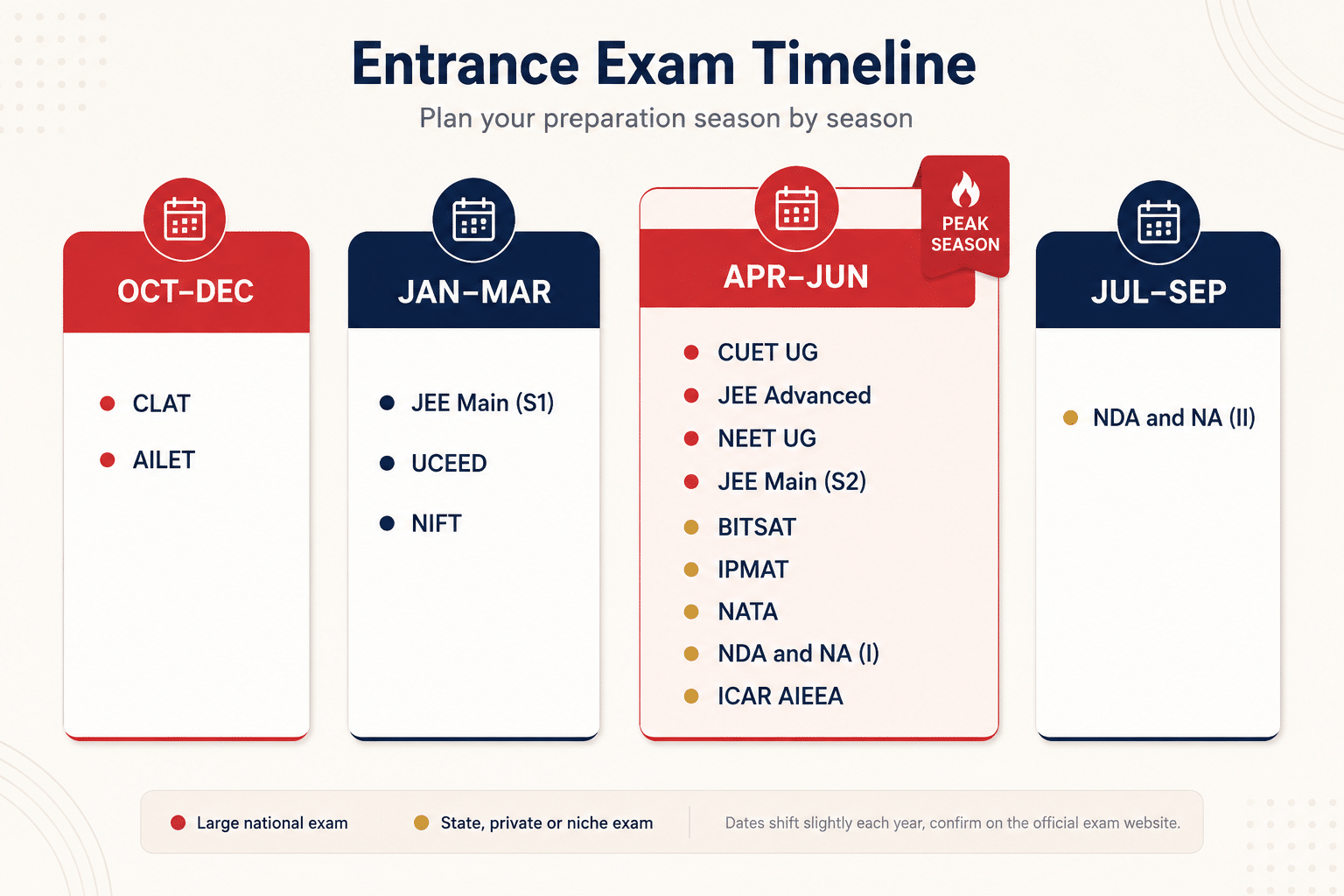
Dates shift by a few weeks each cycle, so always confirm the final schedule on the exam's official website closer to the date.
Stream-Wise List of Entrance Exams After 12th
Once you know your stream and target career, the list of relevant exams narrows quickly. Here's every major entrance exam after 12th, organised by stream.
1. Popular Entrance Exams After 12th Science
You will find a number of paths leading towards opportunities you can pursue after completing your 12th. Backing that statement, below is the list of entrance exams after 12th science (Medical + Non-medical):
A. Engineering (PCM) Entrance Exams
If you're from a PCM background aiming for a B.Tech or B.Arch., JEE Main is your starting point, with JEE Advanced, BITSAT and state CETs as the natural next tier. Here’s a brief list of engineering entrance exams in india after 12th:
| Exam | Conducting Body | Courses Offered | Eligibility |
| JEE Main | NTA | B.E./B.Tech./B.Arch. | 10+2 with PCM |
| JEE Advanced | IIT Joint Admission Board | B.Tech. at IITs | Top 2.5 lakh JEE Main qualifiers |
| BITSAT | BITS Pilani | B.E./B.Pharm. | 10+2 with PCM (75%+) |
| CUET UG | NTA | B.Sc./B.Tech. at central universities | 10+2 Science |
State-level options include
- MHT-CET (Maharashtra) for B.Tech./B.Pharm. in state colleges
- KCET (Karnataka), conducted by the Karnataka Examinations Authority for engineering and agriculture
- WBJEE (West Bengal) for state technical universities
Private/university-level tests include VITEEE (VIT), SRMJEEE (SRM) and LPUNEST (Lovely Professional University), along with Amity JEE and KIITEE.
Also Read: Top 10 Engineering Entrance Exams in India after 12th
B. Medical (PCB) Entrance Exams
For PCB students, NEET UG is not optional; it is the single mandatory gateway to MBBS, BDS and most other undergraduate medical courses in India. Below is a brief list of medical entrance exams after 12th in India:
| Exam | Conducting Body | Courses Offered | Exam Month |
| NEET UG | NTA | MBBS, BDS, BAMS, BHMS, B.Sc. Nursing | May |
| AIIMS MBBS (via NEET) | AIIMS | MBBS at AIIMS institutes | May |
| JIPMER (via NEET) | JIPMER | MBBS at JIPMER | May |
| IISER Aptitude Test (IAT) | IISER | 5-year BS-MS in pure sciences | June |
Both AIIMS and JIPMER stopped conducting separate entrance tests and now admit purely through NEET UG scores, so there is genuinely one exam to prepare for, not three.
2. Commerce & Management Entrance Exams
Commerce students have two real after-12th routes: integrated management programmes straight out of school or CUET-based admission into a BBA/B.Com course.
| Exam | Conducting Body | Focus / Courses |
| IPMAT | IIM Indore & IIM Rohtak | 5-year Integrated Programme in Management (BBA+MBA) |
| CUET UG | NTA | BBA/B.Com at central and participating universities |
| NPAT | NMIMS | BBA, B.Com and other management programmes at NMIMS |
| SET | Symbiosis International University | BBA and business programmes at Symbiosis |
| CA Foundation | ICAI | Entry-level exam for Chartered Accountancy |
CAT, XAT, MAT, CMAT and SNAP are worth knowing about too, but they're postgraduate MBA entrance exams, relevant only after you've completed a bachelor's degree, not directly after Class 12th.
3. Arts & Humanities Entrance Exams
Arts and humanities students have fewer standalone entrance exams, but CUET UG has effectively become mandatory for admission into BA programmes, including Psychology, Economics, Political Science, Sociology, History and Literature, at most central and several private universities.
CUET UG now covers 49+ Central Universities and over 160 additional participating institutions, making it the closest thing India has to a universal undergraduate entrance test.
Beyond CUET, some universities run their own aptitude-based entrance tests for BA (Hons) programmes, so it's worth checking each shortlisted university's own admission page for a university-specific test alongside CUET.
4. Entrance Exam for Law After 12th
If law is the goal, your options split between the consortium exam that most National Law Universities use and a handful of standalone tests run by individual institutions.
| Exam | Conducted By | Courses | Leads To |
| CLAT | Consortium of NLUs | BA LLB (Hons), BBA LLB (Hons) | 22 NLUs, NMIMS Law School |
| AILET | NLU Delhi | BA LLB (Hons) | NLU Delhi |
| LSAT-India | Pearson VUE for LSAC India | Law programmes | O.P. Jindal, Amity, ICFAI |
| SLAT | Symbiosis University | BA/BBA LLB | Symbiosis Law School, Pune & Noida |
5. Design & Architecture Entrance Exams
Design and architecture aspirants are tested on aptitude, spatial reasoning and creativity rather than a fixed PCM/PCB syllabus, so these exams look quite different from the science-stream tests above.
| Exam | Conducted By | Courses |
| NATA | Council of Architecture | B.Arch. |
| UCEED | IIT Bombay | B.Des. at IITs and partner institutes |
| NID DAT | National Institute of Design | B.Des. at NID campuses |
| NIFT Entrance Exam | National Institute of Fashion Technology | Fashion design, technology & management |
6. Government Exams After 12th
Several government and defence recruitment exams accept candidates straight after Class 12th, well before a bachelor's degree is required.
| Exam | Conducting Body |
| SSC CHSL | Staff Selection Commission |
| SSC MTS | Staff Selection Commission |
| SSC GD | Staff Selection Commission |
| RRB NTPC | Railway Recruitment Board |
| RRB Group D | Railway Recruitment Board |
| NDA & NA Exam | UPSC |
| Agniveer (Army / Navy / Air Force) | Indian Army / Navy / Air Force |
| Indian Coast Guard Navik (GD / DB) / Yantrik | Indian Coast Guard |
The NDA & NA Exam, conducted twice a year by UPSC, is the most direct route into the Indian Army, Navy or Air Force as a commissioned officer straight after 12th.
7. Other Notable Entrance Exams After 12th
A few career paths outside the mainstream streams have their own dedicated entrance exams that are easy to miss in a general search-
- Agriculture: ICAR AIEEA is the entrance exam for agriculture after 12th, which covers B.Sc. Agriculture, Horticulture, Forestry and allied sciences at agricultural universities.
- Biotechnology: Many universities admit B.Sc./B.Tech. Biotechnology through CUET UG or their own entrance test alongside a PCB/PCM background.
- Pharma: State-level pharmacy entrance tests and BITSAT (for BITS Pilani) are the two common routes into a B.Pharm. programme.
- Forensic Science:Sc. Forensic Science admissions typically run through CUET UG or a university's own science-stream entrance test.
- Pilot Training: Commercial Pilot Licence training doesn't have a single national entrance exam; admission depends on a DGCA-approved flying school's own selection process, a Class 1 medical and English/Maths eligibility.
- Psychology: Most universities offer a BA (Hons) in Psychology based on scores from the CUET UG. A few private institutions also use their own tests for admission.
Entrance Exams to Study Abroad After 12th
If your plan is to study outside India right after Class 12th, a different set of standardised tests applies, focused on English proficiency and general aptitude rather than a specific stream.
- IELTS (International English Language Testing System): tests English proficiency, required by most UK, Australian and Canadian universities.
- TOEFL (Test of English as a Foreign Language): the US-preferred alternative to IELTS for English proficiency.
- SAT/ACT: general aptitude tests used by many US universities for undergraduate admission, alongside board scores.
- GRE (Graduate Record Examinations): required for postgraduate study abroad, not an after-12th exam, but useful to know early if grad school abroad is the long-term plan.
- GMAT (Graduate Management Admission Test) and LSAT: postgraduate management and law-school tests abroad, relevant later in the journey.
Many top universities in the US, UK, Germany, Canada and Australia admit students directly after Class 12th on the strength of board marks and English proficiency scores alone, without requiring JEE or NEET, since those two exams are India-specific and not recognised internationally.
How to Choose the Right Entrance Exam After 12th
With dozens of options on the table, narrowing down to the right two or three exams comes down to five practical checks.
- Establish your career goal: Engineering, Medicine, Law, Design or Management first; exam second.
- Evaluate eligibility and subjects: Confirm the exam actually accepts your Class 12th stream and subject combination.
- Factor in the level of competition: National exams open more seats overall but draw far more applicants per seat.
- Reflect on exam costs & locations: Application fees, travel and coaching costs add up fast across multiple exams.
- Ensure the exam aligns with your preferred college or state: A state CET only helps if you're targeting colleges in that state.
A quick way to frame the trade-off between different types of entrance exams:
| Exam Type | Best For | Trade-off |
| National (JEE, NEET, CLAT, CUET) | Access to top-tier institutes across India | Highest competition, largest applicant pool |
| State-Level (MHT-CET, KCET, WBJEE) | Guaranteed-quota seats within your home state | Limited to colleges in that state |
| Private/University-Level (VITEEE, SRMJEEE, BITSAT) | A defined backup with a known syllabus overlap | Valid only for that university's own campuses |
How to Prepare for Entrance Exams After 12th
Preparing for entrance exams after Class 12th doesn’t have to be stressful if you follow a smart, consistent plan. The key is to start early, build strong conceptual understanding and practise under exam-like conditions. Below are the most effective steps to structure your preparation-
- Get started early: Begin in Class 11th itself so preparation doesn't feel overwhelming in the final months.
- Master concepts: Focus on understanding topics deeply rather than memorising formulas or facts.
- Create a timeline: Break the syllabus into digestible, trackable sections.
- Practise past papers: Understand recurring question patterns and difficulty trends.
- Take regular mock exams: Build timing discipline under real exam conditions.
- Track progress: Identify weak areas early enough to actually fix them before the exam.
Explore Future-Ready Undergraduate Programmes at BML Munjal University
Once your entrance exam results are in, choosing the right university is the next big decision. BML Munjal University focuses on experiential, interdisciplinary education backed by industry partnerships and global collaborations, preparing students for both professional success and social impact.
Popular UG programmes at BML Munjal University include:
- Tech. in Computer Science, Electronics & Computer Engineering and Mechanical Engineering
- BBA (Hons) & Integrated BBA-MBA
- Com (Hons)
- BA (Hons) Liberal Arts
- BA LLB (Hons) & BBA LLB (Hons)
Why Students Choose BML Munjal University:
- Hero Group legacy
- 45% experiential learning built into the curriculum
- Faculty with international experience
- Research and consultancy project opportunities
- Propel incubator and startup support
- 50+ industry and academic partnerships, including with Imperial College London
- Global immersion programmes
Explore all programmes at BML Munjal University or check specific programme pages for detailed eligibility and curriculum.
Conclusion
Choosing the right entrance exam after 12th shapes the next several years of your academic and career path. Whether your goal is a seat at a top engineering or medical college, a national law university, a design institute or a university abroad, the preparation has to start with knowing exactly which exam applies to you.
Start by shortlisting exams from the stream-wise list above, mark the relevant dates and build a realistic preparation timeline around two or three exams at most. If you're still unsure which path fits your goals, apply now to BML Munjal University and speak with the admissions team about which entrance route works best for you.
FAQs
The most common tests for studying abroad after 12th are IELTS and TOEFL for English proficiency and SAT or ACT for general aptitude, required by most undergraduate programmes in the US, UK, Canada and Australia.
Start early in Class 11th, focus on understanding concepts rather than memorising, build a study timeline, practise past year papers, take regular mock tests and track your weak areas consistently.
SSC CHSL, SSC MTS, SSC GD, RRB NTPC, RRB Group D, NDA & NA Exam, State PSC exams and Bank PO/Clerk exams are among the most popular government job entrance exams after 12th.
Commerce students aiming for an integrated management degree straight after 12th should target IPMAT (IIM Indore/Rohtak). For a standard BBA or B.Com, CUET UG, NPAT (NMIMS) or SET (Symbiosis) are the more common entrance routes.
There is no single national entrance exam for pilot training. Admission to a Commercial Pilot Licence course depends on the individual DGCA-approved flying school’s selection process, along with a Class 1 medical certificate and minimum Physics and Maths eligibility.
Most universities admit students into BA (Hons) Psychology through CUET UG scores, though a few private institutions also run their own aptitude-based entrance tests.
Most counsellors recommend preparing seriously for no more than two to three entrance exams. Spreading preparation too thin across many exams tends to lower performance across all of them rather than improving your overall odds.
CUET UG is mandatory for admission to 49+ Central Universities and required by over 160 additional participating institutions. However, many state, private and deemed universities still run their own entrance tests or admit directly on the basis of merit.
There is no separate AIIMS MBBS entrance exam anymore. AIIMS institutes now admit students purely through NEET UG scores, along with JIPMER, which also moved to NEET-based admission.
The best entrance exam depends on your career goal. JEE Main is ideal for engineering, NEET UG for medical courses, CUET UG for various undergraduate programmes, CLAT for law and IPMAT for integrated management.
Yes, students can appear for multiple entrance exams if they meet the eligibility criteria. However, focusing on two or three relevant exams is generally recommended.
CUET UG is the most common entrance exam for Arts and Humanities programmes. Some universities also conduct their own entrance tests for BA and BA (Hons) programmes.
There is no single easiest entrance exam after Class 12. The difficulty depends on the exam, competition and your preparation. Choose an exam that matches your stream and career goal.
Yes, you can appear for multiple entrance exams in the same year if you meet their eligibility requirements. However, preparing for too many exams can affect your performance.
There is no single national entrance exam for biotechnology after 12th. B.Sc. and B.Tech. Biotechnology admissions may be offered through CUET UG or university-specific entrance tests.
Related Blogs

Data Science vs Computer Science: Which Course Should You Choose After 12th?
Key Takeaways Computer Science builds software; Data Science turns data into AI-driven insights. Choose Computer Science if you enjoy coding a...
17 Best AI Tools for Students in 2026 (Free & Paid, Category-Wise)
Key Takeaways: 17 AI tools reviewed across 6 categories- concept clarity, research, writing, organisation, presentations and coding Most tools...

10 Best Universities in India for Commerce You Can’t Ignore in 2026
Commerce education in India is rapidly evolving by combining strong academic foundations with industry exposure, global learning as well as career-foc...

No Maths? No Problem. How to Become an Entrepreneur After 12th Commerce
A lot of students are under the impression that commerce without maths scope is extremely limited. However, this is far from true. In India, even if y...

Top Mini Project Ideas for College Students (Branch, Year & Technology Wise)
In Summary- Explore mini project ideas for college students, organised by branch, year and technology, helping UG learners build skills, score better ...

CAT Score vs Percentile 2025 – A Complete Analysis
The Common Admission Test (CAT) is one of the most important MBA entrance exams in India for admission to top business schools. Every year, lakhs of c...