
How to Become a Data Scientist: Different Pathways, Skills Required & Salary Insights


Summary: To become a data scientist in 2026, build core skills in Python, SQL, statistics and machine learning through a degree, bootcamp or self-taught path, then prove them with real projects. Entry-level salaries in India start around ₹11-12.5 LPA, rising sharply with experience and specialisation.
Key Takeaways
- There are three paths to become a data scientist: Degree (3-4 yrs), bootcamp (3-9 months) or self-taught (1-2 yrs).
- You can start right after Class 12- no prior coding needed, any stream.
- Core skills required: Python/R, SQL, statistics, machine learning, data visualisation, cloud/big data tools.
- Salary in India (2026): ₹11.3-12.5 LPA entry-level, up to ₹20.3-22.4 LPA senior (AmbitionBox).
- A strong project portfolio often outweighs certifications alone in hiring decisions.
- Certifications (Google, IBM, CAP) help most for career switchers and self-taught learners.
- Career changers just need to close their skill gap- not start over.
AI-driven demand is surging: AI-skill job postings grew 200x between 2021-2025.
One of the most searched career questions in 2026- How to become a data scientist?
As companies accelerate AI adoption, the demand for professionals who can collect, analyse and interpret data is growing faster than the talent pool. According to recent industry data, job postings requiring AI skills increased nearly 200-fold between 2021 and 2025, while experienced data scientists in Western Europe can now earn annual salaries exceeding $106,000, reflecting the premium employers place on data expertise.
But high salaries don't come from learning a single programming language or completing an online course. Today's employers want professionals who can combine statistics, programming, machine learning, cloud technologies and business understanding to solve real-world problems.
Whether you are a Class 12 student, a graduate or a working professional planning a career switch, following the right roadmap is essential. This guide explains how to become a data scientist in 2026, covering the skills you need, the best courses to pursue, eligibility, salary expectations and the career path.
Who Is a Data Scientist? What Do They Do?
A data scientist is a professional who collects, cleans and analyses large volumes of structured and unstructured data to uncover patterns and build predictive models for organisations to make better decisions. The role sits at the intersection of statistics, computer programming and business strategy- data scientists need deeper programming skills than a statistician and deeper statistical knowledge than a typical software engineer.
Core responsibilities include-
- Collecting, cleaning and processing raw data from databases, APIs and web sources
- Performing exploratory data analysis (EDA) to surface trends and anomalies
- Building, training and validating machine learning and predictive models
- Visualising and communicating findings to non-technical stakeholders
- Recommending data-driven strategy and process changes
How Long Does It Take to Become a Data Scientist?
It typically takes 3-4 years via a bachelor's degree, 3-9 months via a bootcamp or 1-2 years self-taught. This duration completely depends on your starting background and how consistently you study.
There's no fixed timeline because "becoming a data scientist" isn't one fixed journey. It depends heavily on where you are starting from and which path you take.
| Path | Typical Timeline | Best For |
| Bachelor's degree | 3-4 years | Starting right after school, no existing background |
| Master's degree (after a related bachelor's) | 1-2 years | Specialising or moving into research/leadership roles |
| Bootcamp | 3-9 months | Career switchers with some existing technical/quantitative base |
| Self-taught (MOOCs + projects) | 1-2 years | Highly disciplined learners, often alongside a full-time job |
How to Become a Data Scientist After 12th - Step-by-Step Roadmap
In India, you can begin your data science journey immediately after Class 12, regardless of stream (Science, Commerce or Arts), provided you are comfortable with math and logical reasoning. No prior coding experience is required; Python and SQL are taught as part of most undergraduate programmes. Some institutions may require an entrance test or interview, while others admit on merit.
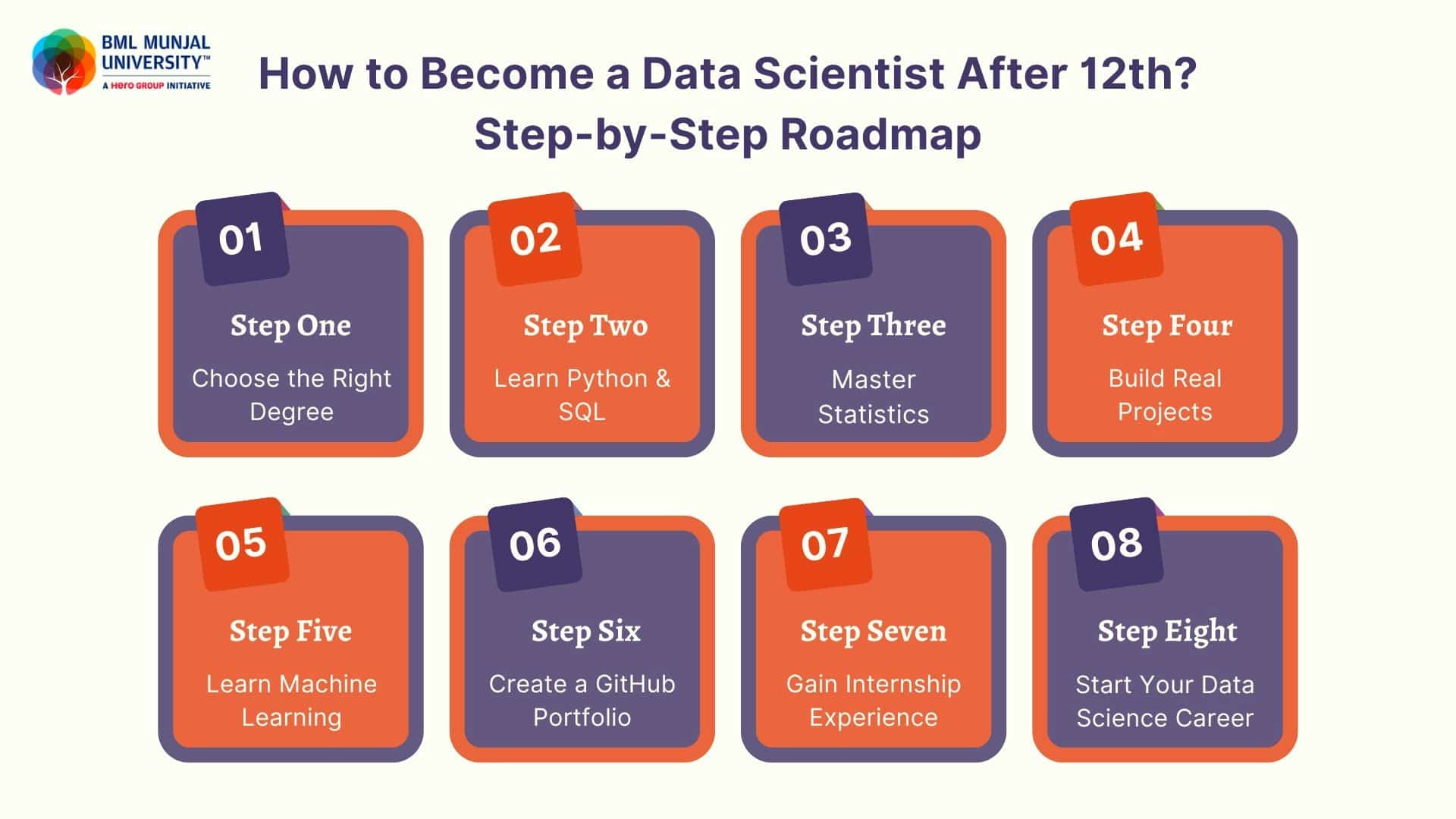
Below is your step-by-step roadmap for becoming a data scientist after 12th-
Step 1- Choose a relevant undergraduate degree (see course options below)
Step 2- Learn Python and SQL in your first year
Step 3- Study statistics and probability as your analytical foundation
Step 4- Build small projects using real, public datasets
Step 5- Learn a machine learning framework such as Scikit-learn or TensorFlow
Step 6- Create a GitHub portfolio showcasing your projects and analysis
Step 7- Take internships in your second or third year for industry exposure
Step 8- Apply for entry-level roles: Data Analyst, Junior Data Scientist or ML Engineer
Why Choose Data Science as a Career After 12th?
The answer is yes, especially if you enjoy solving problems, working with technology and making decisions using data. As businesses increasingly rely on artificial intelligence (AI), automation and analytics, data scientists have become one of the most sought-after professionals across industries.
Below are several reasons why pursuing a data science as a career after 12th is beneficial-
- High industry demand- Growing opportunities across healthcare, finance, IT, e-commerce and more.
- Attractive salaries- One of the highest-paying career options in technology.
- Diverse career roles- Become a Data Scientist, Data Analyst, ML Engineer, AI Engineer or Business Analyst.
- Global opportunities- In-demand skills that open doors to careers in India and abroad.
- Future-ready field- Driven by the rapid growth of AI, big data and emerging technologies.
Also, Data science is suitable for students from different academic backgrounds-
- Science students can leverage their mathematics and analytical skills.
- Commerce students can apply data science in finance, business analytics and marketing.
- Arts students with logical thinking and an interest in technology can also build successful careers by learning programming and analytics.
Different Pathways to Become a Data Scientist in India
There are three pathways- formal degree, bootcamps & certification courses, or self-taught via MOOCs to become a data scientist. You can choose any of the following three pathways as per your starting point, budget as well as timeline.
Below is the detailed breakdown of each pathway-
- Pathway 1- Formal Degree (Bachelor's or Master's)
The most common route. A bachelor's degree in data science, computer science, statistics or applied mathematics builds the theoretical foundation employers expect, plus access to internships and campus placements. Many professionals later add a master's for specialisation or a leadership track.
- Pathway 2- Bootcamps & Certification Programmes
A faster, more affordable option for career switchers who already hold a degree in an unrelated field. Bootcamps (typically 2-6 months) focus on Python, SQL and machine learning fundamentals and usually end with a portfolio project. Best suited to those with some existing quantitative or programming background. - Pathway 3- Self-Taught via MOOCs
Possible but demanding. Self-taught data scientists build skills through platforms like Coursera, edX and Kaggle, combined with independent projects and open-source contributions. This path requires strong self-discipline and is generally easier for those who already have a STEM background.
Which Course is Best After 12th for Data Science?
There's no single "best" course- it depends on your goal. For deep specialisation, choose B.Sc. in Data Science. For strong career growth and technical depth, choose B.Tech. in CSE/AI/Data Science. For a practical, industry-ready path, choose BCA with a Data Science specialisation. For flexibility across data-adjacent careers, choose B.Sc. in CS, Mathematics or Statistics.
Below is a comparison of the four most common entry routes after 12th, covering duration, focus areas, eligibility and who each course actually suits best-
| Course | Duration | Key Focus Areas | Eligibility | Best Suited For |
| B.Sc. in Data Science | 3 Years | Statistics, Python, ML, Data Analysis | 12th pass (Science/Commerce/Maths preferred) | Students certain they want to specialise in data science from day one |
| B.Tech. in CSE / AI / Data Science | 4 Years | Programming, AI, ML, Big Data | 12th with Physics, Chemistry, Maths (PCM) | Students wanting the strongest technical foundation and widest career options |
| BCA (Data Science Specialisation) | 3 Years | Programming, Databases, Analytics Tools | 12th pass, any stream (Maths often preferred) | Students who want a shorter, application-focused route into data roles |
| B.Sc. in CS / Mathematics / Statistics | 3 Years | Mathematics, Algorithms, Statistical Analysis | 12th pass with Mathematics | Students wanting a strong analytical base with flexibility to pivot into data science, analytics or research later |
How to Choose the Right Data Science Course After 12th
Discovering the right programme to become a data scientist after 12th depends on your interests, strengths as well as career goals. Below are some crucial factors that help you find an ideal course-
- Choose B.Tech in CSE / AI / Data Science if you enjoy programming and technical learning
- Opt for B.Sc. in Data Science / Statistics / Mathematics if you prefer numbers and analytics
- Consider BCA (Data Science Specialisation) for a balanced programming and analytics approach
- Check whether the course includes Python, statistics and machine learning
- Look for project-based learning and practical exposure
- Prefer programmes offering internships and industry collaboration
- Review curriculum, tools and specialisations before deciding
- Select a course that aligns with your career goals in data science
How Much Does a Data Scientist Earn in India in 2026?
As the global data science platform market continues to expand, the demand for skilled data professionals is rising across industries. According to Grand View Research, the global data science platform market is projected to grow at a 26.0% CAGR between 2024 and 2030, reflecting the increasing adoption of AI, analytics and big data technologies.
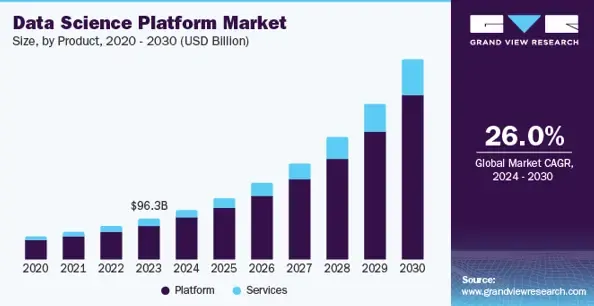
This strong market growth is one of the key factors driving competitive salaries for data science professionals. Here is the breakdown of the data scientist salary in India experience-wise:
| Level | Average Salary (India) | Experience |
| Fresher / Entry-Level | ₹11.3 - ₹12.5 LPA | 0-3 Year |
| Mid-Level | ₹14.8 - ₹16.4 LPA | 3-6 Years |
| Senior / Experienced | ₹20.3 - ₹22.4 LPA | 6-9 Years |
Source- Salary ranges are based on AmbitionBox salary insights.
Top Recruiters Hiring Data Scientists
Today, data scientists are hired by companies across technology, banking, healthcare, consulting, retail, telecommunications and manufacturing. While global technology companies remain major recruiters, many Indian startups and multinational organisations are also expanding their data science teams.
Some of the leading recruiters include:
| Company | Industry |
| Technology & AI | |
| Microsoft | Cloud Computing & AI |
| Amazon | E-commerce & Cloud |
| IBM | Technology & Consulting |
| Accenture | Consulting |
| Deloitte | Consulting & Analytics |
| TCS | IT Services |
| Infosys | IT Services |
| Wipro | Technology Services |
| Capgemini | Consulting & Digital Engineering |
| Cognizant | IT & Business Solutions |
| HCLTech | Technology Services |
| Flipkart | E-commerce |
| Reliance Jio | Telecommunications & Digital Services |
| Paytm | FinTech |
What Skills Do You Need as a Data Scientist?
If your goal is to become a data scientist, you have to build technical as well as non-technical skills. Below is the list of skills you should acquire-
Technical Skills
- Python / R- Core languages for data analysis and modelling
- SQL- For querying and managing relational databases
- Statistics & Probability- The mathematical core of data science
- Machine Learning- Regression, classification, clustering, deep learning
- Data Visualisation- Power BI, Tableau, Matplotlib
- Big Data & Cloud- Hadoop, Spark, AWS, GCP, Azure
Non-Technical Skills
- Critical thinking and structured problem-solving
- Clear written and verbal communication of complex findings
- Business acumen to connect analysis to commercial impact
- Curiosity and a habit of continuous learning
- Patience and attention to detail with messy, real-world data
Which Certifications Are Worth Pursuing for Data Science?
Firstly, certifications won't replace a degree, but they strengthen a resume and demonstrate applied expertise. This is particularly useful if you are a career switcher and self-taught learner-
- Certified Analytics Professional (CAP)- INFORMS' end-to-end analytics certification
- Google Data Analytics / Advanced Data Analytics Professional Certificate
- IBM Data Science Professional Certificate (Coursera)
- Microsoft Certified- Azure Data Scientist Associate
- SAS Certified Predictive Modeller
How to Build Real-World Data Science Skills Before Your First Job
Nowadays, employers weigh demonstrated ability heavily alongside credentials. A strong portfolio is often the deciding factor between two similarly qualified candidates. Below are some things you should do to gain real-world experience for becoming a data scientist-
- Publish 3-5 end-to-end projects on GitHub, including your process and findings
- Participate in Kaggle competitions to benchmark your skills against real datasets
- Take internships during your second or third year of study
- Contribute to open-source data or ML projects
- Prepare for technical interviews using LeetCode and HackerRank- most data scientist interviews include a coding or take-home assessment
What Projects Should I Include in a Data Science Portfolio?
Here is the curated list of 5 portfolio project ideas that actually get noticed-
- A customer churn prediction model using a public e-commerce or telecom dataset
- A sentiment analysis tool on real social media or product review data
- An interactive Power BI/Tableau dashboard analysing a public dataset (e.g., Indian census, stock market or sports data)
- A recommendation engine (movies, products or courses) built with collaborative filtering
- An end-to-end pipeline- scrape data via an API, clean it, model it and deploy a simple web app with Streamlit or Flask
How Data Science Bootcamps May Help You Become a Data Scientist
Data science bootcamps help you become job-ready in 3-9 months by focusing entirely on applied, in-demand skills like Python, SQL, machine learning and portfolio projects, without the general education requirements of a full degree.
Bootcamps exist to solve one specific problem- turning someone with little or no data background into a job-ready candidate, fast.
Below are some popular Data Scientist bootcamp free for beginners-
| Bootcamp | Format | Known For |
| Springboard | Online, mentor-led | Job guarantee model, 1:1 mentorship |
| Great Learning | Online + hybrid | University-partnered certifications, India-focused |
| Coding Temple | Online + in-person | Structured curriculum, strong career services support |
| FutureSkills Prime | Online | Government-backed (MeitY & NASSCOM), free/subsidised courses, India-focused |
Where to Study Data Science After 12th?
At BML Munjal University, students can pursue a B.Tech. Computer Science and Engineering with Data Science and Artificial Intelligence specialisation. The course is designed to build strong foundations in computing, analytics as well as emerging technologies. Its curriculum blends core engineering knowledge with hands-on exposure to real-world data science applications.
Key Highlights of the Course-
- Industry-aligned curriculum designed around current data science and AI trends
- State-of-the-art labs for hands-on learning and practical experimentation
- Global exposure through international collaborations and learning opportunities
- Faculty with real industry experience and research-driven teaching approach
- Multi-track flexibility to explore diverse tech domains and career paths
- Regular hackathons and guest lectures from industry experts
- Dedicated soft skills training for communication and professional development
- Strong placement support with career guidance and industry connections
This structured approach of BML Munjal University helps students build skills for careers in data science, AI as well as analytics. Apply now!
Conclusion
Becoming a data scientist in 2026 requires more than learning a programming language. It demands a strong foundation in statistics, coding, machine learning and practical problem-solving. Whether you choose a degree, a bootcamp or a self-taught path, consistent learning, real-world projects and industry experience will set you apart. So, it’s best to start with the right course, build a portfolio that showcases your skills and keep adapting as the field evolves. With growing demand across industries, data science remains one of the most rewarding career paths for students and professionals alike.
FAQs
If you have no experience, you should focus on building demonstrable skills before applying. Start by learning Python, SQL and statistics, complete 3-4 real projects for a portfolio and target entry-level titles like Data Analyst or Junior Data Scientist.
Choose a relevant undergraduate degree. Learn Python, SQL and statistics in your first year, build small projects with real datasets, complete an internship and apply for entry-level roles like Data Analyst or Junior Data Scientist once you graduate.
Yes, though it’s harder. Self-taught data scientists typically combine MOOCs (Coursera, edX), a strong GitHub portfolio and Kaggle competitions to demonstrate applied skill. This path works best if you already have a quantitative or programming background and it usually takes longer to reach the same job-readiness as a degree or bootcamp path.
Most employers expect a bachelor’s degree in computer science, data science, mathematics or a related field, plus demonstrated skills in Python, SQL, statistics and machine learning.
You don’t need prior coding experience to start. Python and SQL are taught progressively during most data science degrees and bootcamps. Consistent practice with real projects matters more than prior experience.
Yes. Many working data scientists hold degrees in mathematics, statistics, economics, physics or even commerce and business. What matters most to employers is demonstrated proficiency in Python, SQL, statistics and machine learning, backed by a portfolio of real projects, not the specific name of your degree.
Firstly, you have to identify which core skills your current field already gives you (coding, business context or analytical math). Then close the remaining gaps through a targeted online course or bootcamp, build 2-3 portfolio projects relevant to your target industry and pursue one recognised certification to signal credibility to recruiters.
Yes, but typically only with several years of experience and specialised expertise. For example, in senior leadership, AI research or applied ML roles at top tech companies or global firms.
After Class 10, choose the Science stream with Mathematics if possible, then pursue a relevant bachelor’s degree such as B.Tech. in Computer Science/Data Science, B.Sc. in Data Science or BCA with a Data Science specialisation after Class 12. Start learning Python, SQL and basic statistics early while building small coding projects.
Yes, PCB students can become data scientists. After Class 12, choose a degree that accepts PCB students, such as BCA or B.Sc. in Data Science, while strengthening your mathematics, Python, SQL and statistics skills through bridge courses.
Entry-level data scientists in India typically earn around ₹11.3-12.5 LPA, while experienced professionals in AI, machine learning or leadership roles can earn significantly more. Chartered Accountants also command high salaries, especially in consulting, finance and senior management positions.
No, JEE is not mandatory to become a data scientist. While some engineering colleges offering B.Tech. in Data Science or Computer Science require JEE Main or other entrance exams, many universities admit students through their own entrance tests or merit-based admissions.
No, AI is not replacing data scientists. Instead, AI is changing how data scientists work by automating repetitive tasks such as data cleaning and model building. Data scientists are still needed to solve business problems, interpret results, validate AI outputs and make strategic decisions using data.
To become a data scientist at Google, develop strong skills in Python, SQL, statistics and machine learning, earn a relevant degree, build a portfolio of real-world projects, gain internship experience and prepare for coding and data science interviews.
Related Blogs
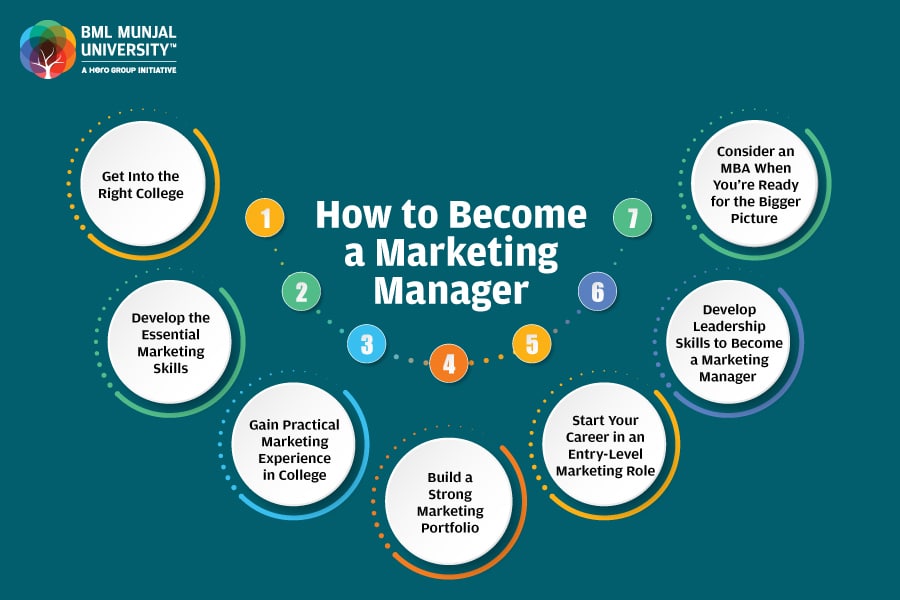
How to Become a Marketing Manager: Complete Step-by-Step Guide
Key Takeaways Becoming a marketing manager is a progression from execution to ownership and leadership. A relevant degree provides the foundat...
Difference Between Data Analyst and Business Analyst: Comparing Two In-Demand Career Paths
Key Takeaways Data analysts focus on what the data shows; business analysts focus on what the business should do about it, though both roles shar...

How to Become a Software Engineer: Your 2026 Career Roadmap
If you have PCM in your 12th and a vague sense that software engineering pays well, then you are already on the right path. The tricky part is not ...

Logistics & Supply Chain Management Courses: Scope, Salary & Career Opportunities in 2026
According to a recent report, the global logistics market size, which was valued at $5.9 Trillion in 2025, is projected to reach $8.2 Trillion by 2034...

Computer Science Courses After 12th: Best Options, Salary & Scope (2026 Guide)
If you’ve just completed your 12th and are interested in technology, one question naturally comes up- “Which computer science course should I c...

CUET College List 2026: Top Universities, UG & PG Courses & How to Choose the Right One
Planning to appear for CUET this year? Then you are not just preparing for one university- you are opening doors to hundreds. The CUET college list no...