

How to Become a Business Analyst: A Complete Career Guide


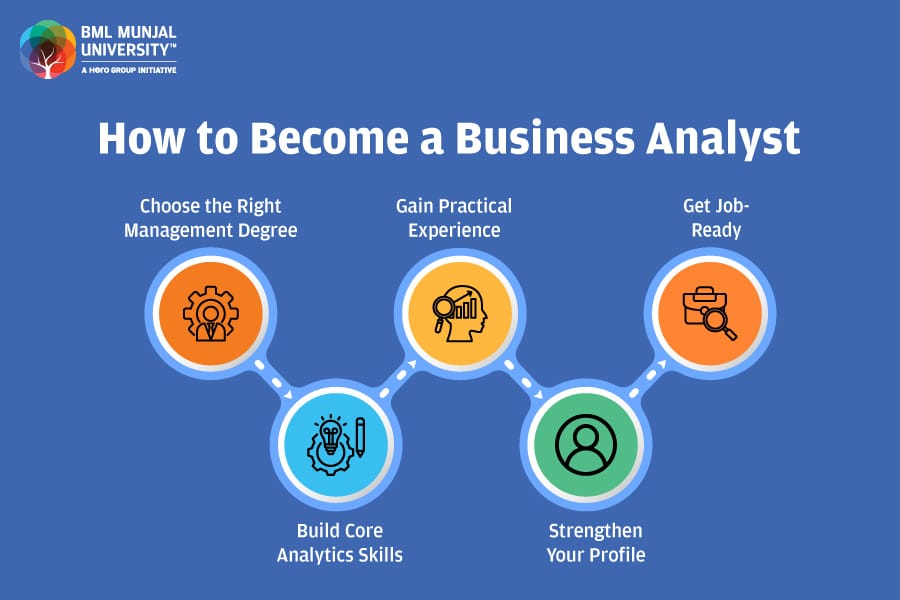
Summary: A business analyst studies how an organisation works, spots gaps between business goals and technology systems and recommends solutions that stakeholders can act on. Most BAs enter the field through a business or technology degree, build practical skills in requirements gathering and data tools, then strengthen their profile with a recognised certification, then move up from entry-level roles into senior and specialist positions over time.
Key Takeaways
- A bachelor's degree in business, IT or a related field is the usual starting point; no state licence is required.
- Students after 12th should choose a business analytics-focused undergraduate programme rather than expect a direct entry-level BA role.
- Engineering graduates often pivot into business analysis through an MBA or PG programme in business analytics, using their technical background as an advantage.
- Core skills split into technical (SQL, Excel, data visualisation) and soft skills (stakeholder communication, problem-solving).
- ECBA, CCBA, CBAP and PMI-PBA are the certifications employers recognise most.
- Career progression typically moves from entry-level BA to senior/specialist roles within 5–8 years, with an MBA often accelerating the mid-career jump.
- Entry-level business analysts in India typically earn between ₹4 LPA and ₹7 LPA, rising with experience and specialisation.
What if the difference between a stalled project and a successful one came down to one person asking the right questions at the right time? That is, in essence, what a business analyst does.
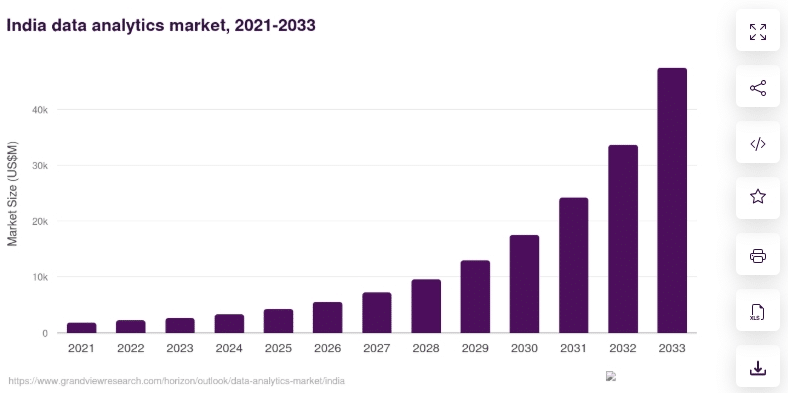
India's data analytics market is projected to grow from USD 5,482.6 million in 2026 to USD 47,505.0 million by 2033, a compound annual growth rate of 36.1%, according to Grand View Research. That scale of growth means one thing for students and career changers alike: organisations across banking, retail, healthcare and IT need people who can translate business problems into workable solutions faster than ever.
If you are wondering how to become a business analyst, whether straight after 12th or after an engineering degree, this guide walks you through the realistic path, the skills that matter and the certifications worth your time.
What Is a Business Analyst?
A business analyst is a professional who studies an organisation's processes, systems and data to identify gaps, then works with stakeholders to recommend and implement improvements. The role sits between business teams and technology teams, translating goals on one side into requirements the other side can build against.
No two business analyst roles look identical. Some sit closer to IT, working alongside developers on system requirements. Others sit closer to strategy, helping leadership teams decide where to invest next. What stays constant across every version of the role is the ability to gather scattered information from different stakeholders and turn it into a clear, actionable plan.
In practice, a business analyst's day-to-day work usually includes:
- Gathering and documenting business requirements from stakeholders
- Analysing existing workflows to identify inefficiencies
- Creating process maps, user stories and use cases
- Presenting findings and recommendations to decision-makers
- Supporting testing and implementation of new systems or processes
Why Are Business Analysts in Demand in India?
India’s growing adoption of AI and digital technologies is increasing the need for professionals who can connect business requirements with technology. 87% of Indian enterprises were actively using AI solutions, while the country’s data-centre capacity has reached about 1,575 MW in 2026, reflecting the expansion of its digital infrastructure.
Key factors driving demand for business analysts
| Demand Driver | How It Creates BA Opportunities |
| AI and automation | Organisations need analysts to identify suitable use cases, define requirements and evaluate how new tools can improve workflows. |
| Cloud and digital infrastructure | As businesses move applications and operations to cloud-based environments, analysts help map processes, gather requirements and coordinate business and technical teams. |
| Data-driven decision-making | Growing use of AI and analytics increases the need for professionals who can translate business problems into data requirements and actionable insights. |
| Digital transformation | Replacing legacy systems and redesigning processes requires analysts to identify gaps, document requirements and align stakeholders. |
| Cross-industry adoption | AI and digital technologies are being adopted across IT, manufacturing, finance, healthcare, retail and governance, expanding the range of industries where business analysts can contribute. |
As these technologies spread across sectors, businesses need professionals who can translate business goals into practical technology solutions, making business analysis increasingly relevant across industries.
How to Become a Business Analyst After 12th
A direct entry-level business analyst role straight after 12th is not realistic, since most employers expect at least a bachelor's degree. The practical path is to choose an undergraduate programme that builds business analytics skills from year one, rather than adding them on later.
Here is what that path typically looks like:
- Enrol in a business-focused undergraduate degree, ideally one with a specialisation in business analytics, data analysis or information systems
- Use your college years to build foundational technical skills in Excel, SQL and data visualisation alongside your coursework
- Take on internships or student projects that involve requirement gathering, market research or process analysis
- Begin an entry-level certification such as ECBA in your final year to strengthen your first job application
Choosing a specialised undergraduate programme over a generic degree matters here. A BBA with a specialisation in business analytics, for instance, integrates the technical and business foundation into the core curriculum instead of leaving students to piece it together through separate short courses.
How to Become a Business Analyst After Engineering
Engineering graduates are well represented among business analysts, since a technical background gives you a head start on the data, systems and logical-thinking side of the role. What most engineering graduates need to add is business context, stakeholder-facing communication and formal exposure to BA techniques and documentation.
A common and effective route after engineering is:
- Pursue an MBA or a postgraduate programme with a specialisation in business analytics, which builds strategic and stakeholder-management skills on top of your existing technical foundation
- Position your engineering background as an advantage in interviews, particularly for IT business analyst or business systems analyst roles that value both technical fluency and business thinking
- Round out your profile with a business-analysis-specific certification such as CCBA or PMI-PBA once you have some project exposure
- Look for placement or lateral roles in industries with strong tech-business overlap, such as banking, IT services or e-commerce
This is one of the more efficient transitions into business analysis. You are not starting from zero on the technical side, so a postgraduate business analytics programme mainly fills the business-strategy and communication gap rather than teaching you data fundamentals from scratch.
Certifications That Strengthen Your BA Profile
Certifications are not mandatory for your first BA role, but they signal credibility, especially if you are changing careers or lack direct BA work experience. The International Institute of Business Analysis (IIBA) and the Project Management Institute (PMI) offer the certifications employers recognise most.
| Certification | Best Suited For |
| ECBA (Entry Certificate in Business Analysis) | Students and recent graduates entering the field |
| CCBA (Certification of Capability in Business Analysis) | Professionals with 2-3 years of BA experience |
| CBAP (Certified Business Analysis Professional) | Senior analysts with 5+ years of experience |
| PMI-PBA (PMI Professional in Business Analysis) | Analysts working within project management environments |
You do not need to hold all four at once and most professionals never pursue CBAP unless they are aiming for a lead or managerial Business Analyst role. Choose the certification that matches your current experience level rather than the most advanced one available, since eligibility criteria for CCBA and CBAP are tied to verified years of BA work.
Skills You Need to Become a Business Analyst
Business analysis blends analytical and interpersonal ability. Neither side of that mix works well on its own. Strong technical skills without the ability to explain findings clearly lead to reports nobody acts on, while strong communication without technical grounding leaves an analyst unable to validate their own recommendations.
Employers generally look for a mix of the following:
| Technical Skills | Soft Skills |
| SQL and relational databases | Stakeholder communication |
| Microsoft Excel and data visualisation (Power BI, Tableau) | Problem-solving and critical thinking |
| Business process mapping (BPMN) | Active listening and requirement elicitation |
| Wireframing tools (Figma, draw.io) | Presentation and report writing |
| Basic understanding of Agile and Waterfall methodologies | Negotiation and conflict resolution |
You do not need every skill on this list before applying for your first role. Most employers expect a working knowledge of two or three technical tools and strong fundamentals in communication, with the rest developing on the job.
How to Become a Business Analyst: The LEARN Framework
There is no single mandatory route into business analysis, but a structured approach makes the transition faster. Use the LEARN framework below to plan your own path, whichever stage you are starting from.
- (L) ay the Foundation: Complete a relevant undergraduate or postgraduate degree in business, IT, commerce or a related field to build core business and analytical knowledge.
- (E) xperience the Tools: Practise hands-on with SQL, Excel, Jira, Confluence and a wireframing tool so you can speak the language of both business and technical teams.
- (A) pply Through Projects: Take on internships, live projects or a self-built portfolio case study that shows end-to-end requirement gathering and solution design.
- (R) ecognise with Certification: Pursue ECBA, CCBA or PMI-PBA depending on your experience level to validate your skills to employers.
- (N) etwork and Apply: Join BA communities, attend industry events and tailor your resume and LinkedIn profile to BA-specific keywords before applying.
Why AI Literacy Now Matters for Business Analysts
Generative AI tools have started changing how business analysts work and employers increasingly expect at least basic fluency with them. Rather than replacing the analyst, these tools speed up the repetitive parts of the job so analysts can spend more time on judgement and stakeholder work.
- Faster requirement elicitation through AI-assisted interview summarisation and clarification prompts
- Automated first drafts of documentation such as user stories and business requirement documents
- AI-generated test scenarios that analysts can refine rather than write from scratch
- Quick diagram and process-map generation to speed up early-stage workflow visualisation
Building comfort with these tools during your learning phase, rather than after you start your first job, gives you a genuine edge over candidates who only know the traditional BA toolkit.
Business Analyst Salary in India
Business analyst salaries in India vary by experience, industry and city, but the general progression follows a fairly consistent pattern across most sources tracking the role.
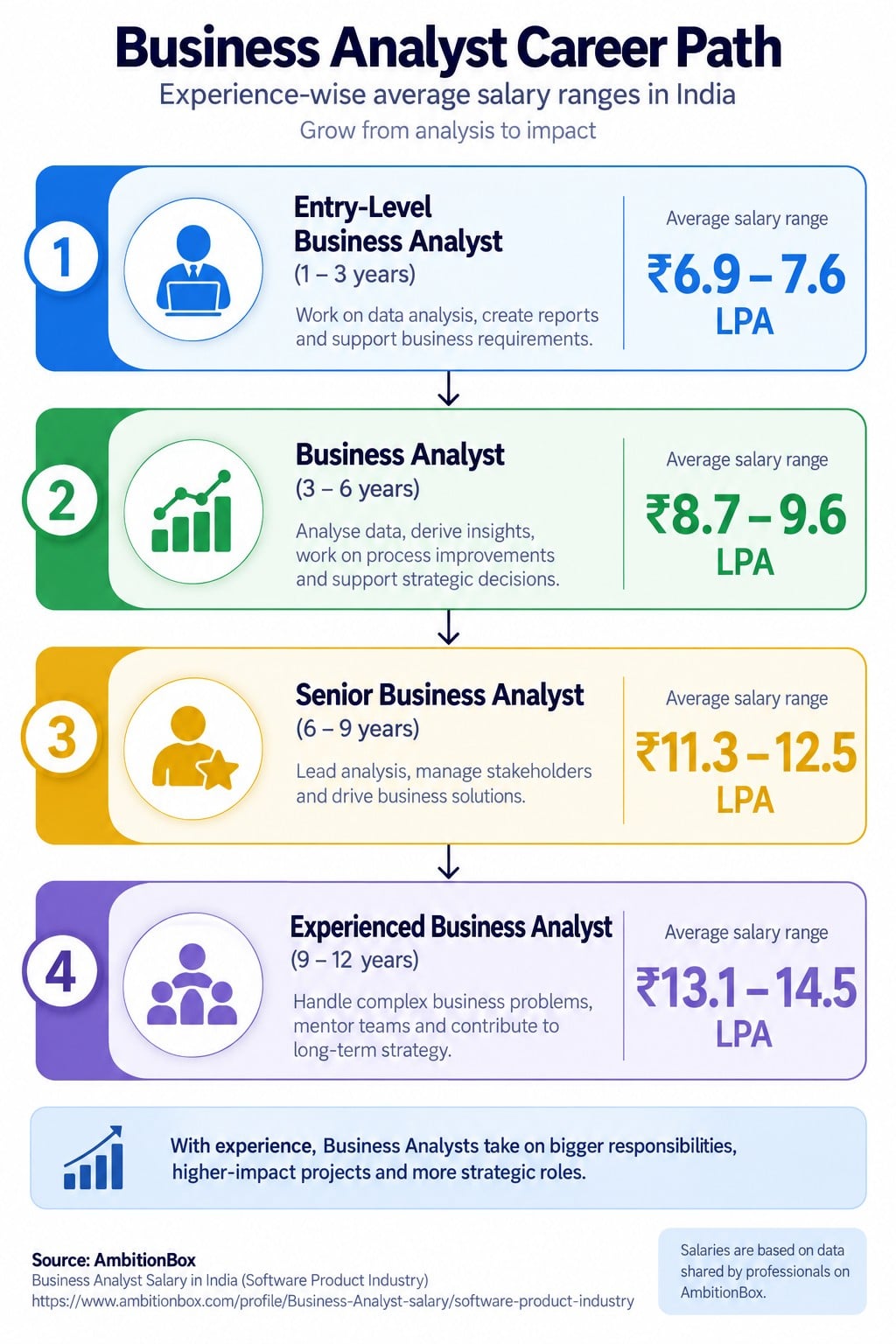
These figures are a rough estimate from AmbitionBox and shift depending on city, industry and specialisation. Business analysts working in banking, financial services and consulting tend to sit at the higher end of each band, while those in smaller companies or non-metro cities may start closer to the lower end. Certifications, an MBA and demonstrated project experience all help push starting offers toward the upper range.
Start Your Business Analyst Journey at BML Munjal University
BML Munjal University, set up by the Hero Group, offers two dedicated pathways into business analytics: the BBA with specialisation in Business Analytics for students starting after 12th and the MBA in Business Analytics for graduates and career switchers looking to specialise. Both are built around the same idea: analytics skills only matter when paired with the ability to apply them to real business problems.
BBA in Business Analytics
- Covers descriptive, predictive and prescriptive analytics, data visualisation, data mining and machine learning from the first year
- Includes live projects, internships and workshops for hands-on industry exposure
- Opens pathways into roles like business analyst, data analyst, marketing analyst and operations analyst
MBA in Business Analytics
- Builds on an existing degree with data visualisation tools (Tableau, Power BI), Python for analytics, NLP and business process automation
- Gives access to the Hero Group ecosystem for industry exposure and global immersion programmes
- Prepares graduates for roles across consulting, fintech and e-commerce, with recent placements reaching up to 17 LPA
Whether you are starting out after 12th or pivoting after your undergraduate degree, both programmes are designed to move you from learning analytics tools to applying them the way a working business analyst would.
Conclusion
Becoming a business analyst is less about following one fixed path and more about closing the specific gap you start with, whether that is business context after engineering or technical depth after 12th. Choosing the right undergraduate or postgraduate programme, building the right tools early and adding a recognised certification along the way puts you on a realistic timeline toward your first Business Analyst role. The career path progresses from entry-level to senior roles; a BBA builds this foundation from day one, while an MBA often accelerates the mid-career transition.
Discover admission requirements and application steps for BML Munjal University's MBA and BBA programmes in Business Analytics to prepare for your future career. Apply now!
FAQs
Start by completing a relevant degree in business, IT or a related field, build core skills in requirements gathering and data tools, gain practical experience through internships or projects and strengthen your profile with a certification such as ECBA or CCBA.
Yes. Many business analysts come from commerce, business administration or economics backgrounds. Employers value analytical thinking and communication as much as technical experience, especially at entry level.
Programmer-level coding is not required, but familiarity with SQL and data tools such as Excel, Power BI or Tableau significantly strengthens a business analyst’s profile.
For someone starting after 12th, it typically takes about four years, covering a bachelor’s degree along with certifications or internships. Career changers with an existing degree, such as engineering graduates pursuing an MBA, can transition sooner.
Yes. Freshers with a relevant degree, strong analytical skills and exposure to BA tools through internships or academic projects are regularly hired into entry-level business analyst roles.
A Business Requirement Document (BRD) captures high-level business goals and needs, while a Functional Requirement Document (FRD) details the specific functions and features required to meet those goals.
The ECBA (Entry Certificate in Business Analysis) from IIBA is designed specifically for students and professionals entering the field with little to no prior BA experience.
Engineering graduates typically pivot through a postgraduate programme like an MBA, building on existing technical skills. Students after 12th benefit more from a specialised undergraduate degree that builds business and analytics skills together from the start.
Yes. Digital transformation, cloud migration and AI adoption are all increasing demand for analysts who can bridge business goals with technical execution and India’s data analytics market is projected to grow at a 36.1% CAGR through 2033.
Start with Microsoft Excel and basic SQL, since these appear in almost every BA job description. Once comfortable, add a visualisation tool such as Power BI or Tableau and a collaboration tool such as Jira or Confluence.
Related Blogs

How to Become a Marketing Manager: Complete Step-by-Step Guide
Key Takeaways Becoming a marketing manager is a progression from execution to ownership and leadership. A relevant degree provides the foundat...

Difference Between Data Analyst and Business Analyst: Comparing Two In-Demand Career Paths
Key Takeaways Data analysts focus on what the data shows; business analysts focus on what the business should do about it, though both roles shar...

How to Become a Policy Analyst: The Career Path No One Explains Properly
Key Takeaways A bachelor's degree in Economics, Political Science, Public Policy, Sociology, International Relations or Law is the minimum qualif...

Business Analyst Salary in India 2026: How Much Can You Really Earn?
Key Takeaways The average business analyst salary in India is ₹7-10 LPA. Freshers in 2026 can earn ₹7-10 LPA, depending on skills and coll...

The Benefits of an Integrated BBA MBA: Career Growth & How It Compares to Traditional MBA
Integrated BBA MBA programmes are becoming increasingly popular among students who want to start building management careers right after Class 12. Wha...

Is BBA Worth It in 2026? Scope, Salary & Career Opportunities Explained
If you've just finished Class 12 and are weighing your options, the question "Is BBA worth it in 2026?" is a fair one to ask. The business landscap...