
How Women Professionals Build Authentic Leadership – Step-by-Step Guide


Summary: Authentic leadership for women professionals is not an innate trait but a trainable skill built through self-awareness, structured coaching and repeated practice in real decision-making situations. Rather than simply “being yourself,” it involves closing the gap between internalised self-doubt and consistent, values-driven leadership behaviour, something women in the workplace often have to build more deliberately due to fewer visible role models and higher scrutiny around assertiveness.
Key Takeaways
- Authentic leadership means leading with consistent values and self-awareness, not adopting a borrowed style
- Women professionals often face a structural gap here, not a personal one
- It is built through coaching, feedback and practice, not discovered through introspection alone
- Programmes with mentorship and simulation-based learning accelerate this development
“Be authentic” is among the most clichéd pieces of leadership advice and one of the least useful on its own. At present, women hold 29.6% of top-level management positions worldwide, up from 26.8% a decade ago, yet that share falls to just 24.6% in the C-suite and to 19.1% among CEOs specifically.
The higher up the ladder, the thinner the representation gets and the advice given to women along the way rarely explains why. That gap between who you are and how you are expected to lead is exactly where authentic leadership breaks down as generic advice and needs to become a trainable skill. This guide breaks down what authentic leadership actually requires and how women professionals build it in practice.
What Does Authentic Leadership Actually Mean?
Authentic leadership is the practice of leading with "self-awareness", a "consistent set of values" and "transparency"; it isn't something where you mimic a leadership style that isn't genuinely yours. It is not about oversharing, being unfiltered or simply following instinct, but rather leading with a disciplined, consistent form of leadership grounded in understanding your values well enough to act on them under pressure.
This distinction matters because authenticity is often seen as something you innately have or lack entirely. In reality, it is something you can develop by observing your own leadership, understanding how others experience it and learning to align your actions with your values. BML Munjal University's Women-in-Leadership programme frames this as addressing the self-perception, not just the pipeline, an approach that treats the internal barrier (how a woman sees her own leadership capability) as seriously as the external one (structural access to leadership roles).
Why Is This a Specific Challenge for Women Professionals?
Authentic leadership development is not gender-neutral in practice, even if the concept is. Women professionals encounter structural barriers that go well beyond personal confidence and recent research shows these barriers are cultural and domestic, not just corporate.
The Domestic Load
Women with partners are more than three times as likely as men to be responsible for all or most housework, a load that directly limits the time and energy available for the visibility-building work senior roles demand.
Personal Obligations as a Stated Barrier
Nearly 25% of entry-level and senior-level women who express reluctance about promotion cite personal obligations as a key barrier. This is not simply a preference gap: it reflects structural inequity that drains cognitive bandwidth and creates the burnout that makes senior roles feel unappealing in the first place.
The Flexibility-Visibility Trade-off
Entry-level women are far more likely than their peers to work remotely, often driven by caregiving needs, yet remote entry-level women are 1.5 times less likely to be promoted than their in-office counterparts. The flexibility that helps women manage domestic responsibilities simultaneously reduces their visibility and access to sponsorship, a tension men face far less acutely.
Progress Has Nearly Stalled at the Very Top
Women now hold 31.0% of leadership roles globally, despite making up 44.0% of the overall workforce. Progress has slowed sharply since 2022: leadership representation grew steadily at roughly 0.4 percentage points a year between 2015 and 2022, but gained just 0.3 percentage points total over the following three years, including only 0.1 point in the most recent year.
In 2025, 62% of the 74 countries studied saw the same or lower share of women in leadership than the year before. The steepest single drop remains the jump from Vice President to C-suite, where representation falls by 30% globally, a pattern that holds in 94% of countries studied.
The Cost of Barriers, Even When Invisible
A 2026 study of 401 employees in Colombia found that when women perceive barriers to leadership, such as unequal performance appraisal, exclusion from influential networks and difficulty balancing work and family, it doesn't measurably hurt their job performance.
What it does instead is quietly erode job satisfaction and significantly raise the likelihood of quitting. Women in the study reported feeling the impact of work-family imbalance far more acutely than men did and unequal HR practices were one of the few barriers where men actually perceived more inequity than women did, suggesting the barrier is visible enough that it isn't just a women's-issue blind spot.
Together, these findings shift the framing: authentic leadership isn't undermined by a lack of self-belief alone, but by a domestic and cultural load that competes directly with the time, visibility and sponsorship senior leadership requires.
How Do Women Professionals Actually Build Authentic Leadership?
If authentic leadership were purely innate, then coaching programmes, leadership retreats and mentorship circles would not have existed. These interventions in practice consistently move the needle, which is proof that it is a trainable skill and not some fixed trait.
1. Structured Self-awareness Work
This includes 360-degree feedback, personality & values assessments and guided reflection with a mentor. The goal is to identify the specific gap between “how you intend to lead” vs “how you are actually perceived”.
2. Individual and Group Coaching
One-on-one coaching actually helps translate self-awareness into behaviour change in real workplace situations. Group formats, like peer learning circles, help women share strategies for navigating the 'double bind', effectively reducing the isolation often felt in senior leadership roles.
3. Simulation and Practice-based Learning
Capstone simulations, role-play exercises and case-based discussions let leaders rehearse difficult moments like a hard negotiation, a conflict with a peer or a decision under scrutiny before they actually happen. This is where authentic leadership for women professionals becomes muscle memory rather than just an idea.
4. Building a Lasting Professional Network
A consistent finding across leadership research is that “sponsorship” and “visible networks” matter as much as individual skill-building. Women professionals who build a network of peers and mentors are better positioned to advocate for themselves and to be considered for stretch opportunities.
Here is how this trainable-skill approach compares with the generic advice most professionals encounter first:
| Aspect | Buzzword Version | Trainable Skill Version |
| Starting point | "Just be yourself" | Self-awareness built through feedback and coaching |
| How it's measured | A feeling of comfort | Consistency of values under pressure and conflict |
| How it's built | Introspection alone | Practice: simulations, role-play, structured coaching |
| Who it depends on | The individual, in isolation | A peer network and mentors who give real feedback |
How BML Munjal University's Women-in-Leadership Programme Builds This
BML Munjal University's Women-in-Leadership (WIL) programme is designed specifically around this skill-building model rather than a one-time workshop format. The programme is built to help women professionals overcome workplace barriers, build leadership skills and accelerate career growth.
How this programme is different from other WIL programmes:
- Faculty of 20+ eminent industry experts and academic leaders who teach from direct leadership experience
- A curriculum combining adaptive-leadership training, individual coaching and capstone simulations
- Learning circles, role-plays and action leadership learning project presentations built into the programme structure
- Multiple tracks for different career stages: WIL Signature (9-month PGP certificate for mid-to-senior leaders), WIL ASCENT (3-month track for school faculty leadership), WIL WISE (9-month track for women entrepreneurs) and WIL IGNITE (3-day intensive tracks, including a retreat format and a partnership with Nasscom for BPM sector leaders)
- A 100-hour programme delivered primarily online, designed for working professionals
Alumni of the programme report concrete outcomes, including corporate promotions and measurable productivity gains, alongside the qualitative shift in leadership confidence the programme is designed to build. Organisations including Axis Bank, TVS, Hero Enterprises and Nasscom have also partnered with BMU to sponsor high-potential women employees through these tracks.
Conclusion
Authentic leadership is not a personality trait some professionals happen to have and others don't. For women professionals in particular, it is a skill built against real structural headwinds, the broken rung, the double bind and declining representation at senior levels, through deliberate practice: coaching, feedback, simulation and a supportive peer network.
If you are looking to build this skill set with structured support rather than working it out alone, BML Munjal University's Women-in-Leadership programme offers a path suited to different career stages, from mid-career leaders to entrepreneurs and school faculty leaders. To learn more about BML Munjal University's Women-in-Leadership programme and connect with the faculty guiding it, explore the official Centre for Continuing Education page.
FAQs
Authentic leadership is a leadership style built on self-awareness, transparency and consistent values, rather than adopting a borrowed or performative leadership style. It is developed through practice and feedback, not simply discovered through introspection.
Women professionals often face structural barriers such as the broken rung at the first promotion to management, a double bind between conforming to masculine leadership norms and being penalised for lacking traditional warmth and fewer visible senior role models, all of which make authentic leadership development a more deliberate process.
It can be taught. Structured coaching, feedback, simulations and peer learning circles consistently improve leadership self-awareness and consistency, which is the core of authentic leadership. Leadership development programmes are built on this premise.
It is an executive education programme designed to help mid-to-senior-level women professionals, educators and entrepreneurs build leadership, business and behavioural skills through coaching, simulations and a curated peer network, with multiple tracks depending on career stage.
The core WIL programme is a 100-hour programme delivered primarily online. Track-specific durations vary: WIL IGNITE runs 3 days, WIL ASCENT runs 3 months and WIL Signature and WIL WISE run 9 months each.
These programmes are best suited to mid-career women professionals looking to step into larger roles, switch industries, lead academic institutions or scale their own ventures, as well as organisations building a pipeline of women leaders.
Reported benefits include increased leadership confidence, stronger business and decision-making skills, improved team effectiveness, career advancement including promotions and a lasting professional network of peers in similar roles.
Related Blogs
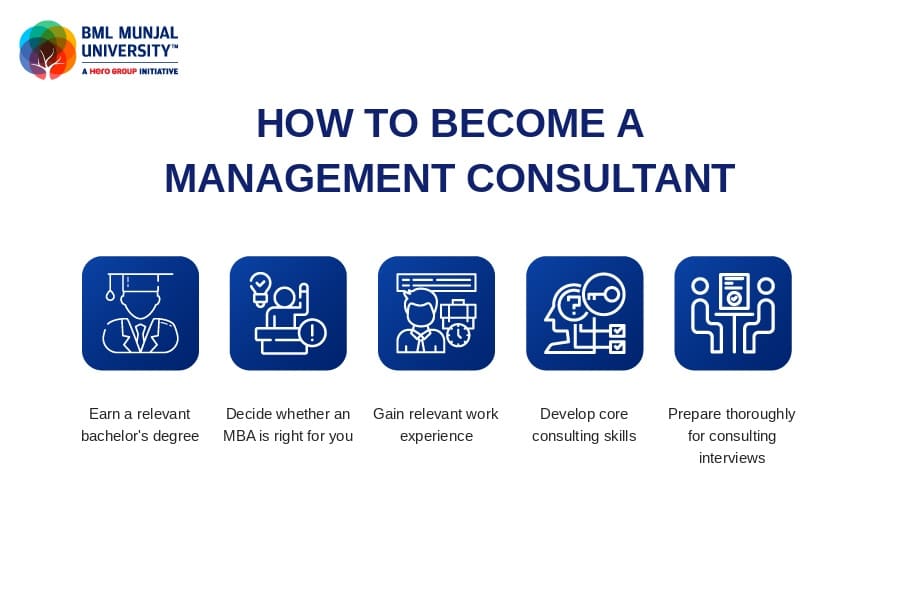
How to Become a Management Consultant in India: The Ultimate Career Guide
Key Takeaways A bachelor’s degree is the common starting point for a management consulting career. An MBA is valuable but not mandatory for ...
AI for Managers: Skills to Build, Tools to Master & Potential Risks
Key Takeaways AI supports managerial tasks like research, reporting, and decision-making, but managers retain judgment and accountability for out...
Leadership Development Programme for Senior Managers: Building Leaders for a Changing Business World
Key Takeaways Senior managers increasingly need to combine experience with AI, data and strategic thinking. Leadership development is shifting...

Executive MBA for Women: Why Is It the Right Move for Your Career?
Key Takeaways An EMBA is designed for professionals with 5+ years of experience who want to grow into leadership roles while continuing to work. ...