
Automobile Engineering vs Mechanical Engineering – Which One Should You Choose After 12th?


Admissions Enquiry
Summary: Confused between automobile engineering and mechanical engineering after 12th? This guide compares these specialisation pathways, including their curriculum, career opportunities and salary potential. Learn how automobile engineering fits within mechanical engineering, understand industry demand and discover which option best matches your interests, career goals and future opportunities in the evolving engineering landscape.
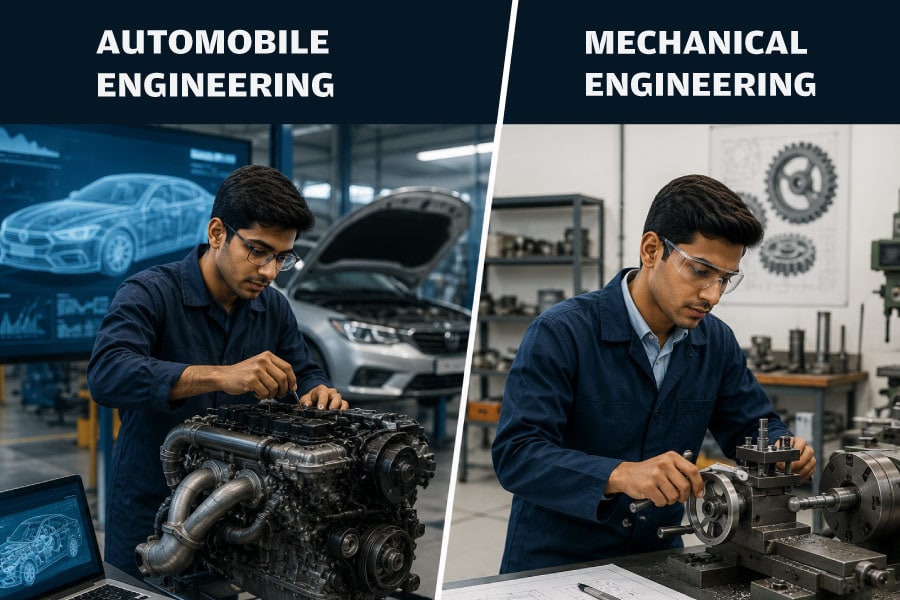
The 12th class results are barely a memory and there's already a form to fill, a stream to lock in and a deadline closing in. For a lot of science students, the hesitation isn't between engineering and something else, but among choosing two very similar-sounding names: automobile engineering vs mechanical engineering. Both involve machines and appear in nearly every JEE counselling list.
Here's the part most comparison guides tend to skip: In India, automobile engineering is rarely a degree you apply for on its own. At most universities, it's a specialisation you choose inside a B.Tech. in Mechanical Engineering and not a parallel, separate four-year programme. That single fact changes how you should think about this decision and it's where this guide starts.
Mechanical Engineering vs Automobile Engineering at a Glance
If you're uncertain about which course to select, exploring various criteria for both can clarify the distinctions and assist you in making an informed decision.
| Parameter | Mechanical Engineering | Automobile Engineering |
| What it trains you to do | Design, analyse and build mechanical systems across virtually any industry | Design, build and improve vehicles and their sub-systems specifically |
| Curriculum overlap | Full core: thermodynamics, mechanics, manufacturing, CAD/CAM, machine design | Same core in years 1–2, then IC engines, vehicle dynamics, automotive electronics, EV systems |
| Industries open to you | Automotive, aerospace, energy, robotics, manufacturing, consulting | Primarily automotive OEMs, EV makers, component suppliers, motorsport, testing agencies |
| How it's structured in India | B.Tech. in Mechanical Engineering | Usually, a specialisation chosen within the B.Tech. Mechanical Engineering programme, not a separate degree |
| Entrance route | JEE Main / state-level engineering entrance exams, same as any B.Tech. | Same entrance exam — specialisation is selected after admission, typically from year 2 or 3 onward |
This is also why mechanical engineering is often described as the foundation branch from which fields like automobile, robotics and aerospace engineering have grown. Each one applies core mechanical principles to a narrower, more specific problem. Automobile engineering simply narrows that lens to vehicles.
How the Curriculum Actually Differs
For the first two semesters, a mechanical engineering student and a student who will eventually specialise in automobile engineering are sitting in nearly identical classrooms. Engineering mechanics, thermodynamics, material science, mathematics and the basics of manufacturing form the shared foundation — this is true at almost every Indian engineering university, because these subjects are what make the rest of mechanical engineering possible.
The divergence shows up from the third year onward, once specialisation tracks open up. A student who continues on the general mechanical engineering path goes deeper into machine design, industrial engineering, CAD/CAM and heat and mass transfer — subjects that apply across industries rather than to one product category.
A student who picks the automobile engineering specialisation, on the other hand, starts working through IC engines, vehicle dynamics, transmission systems, automotive electronics and increasingly, EV and battery management systems, since electric mobility has become a standard part of how this specialisation is taught now.
Career Scope and Salary in India
Career outcomes are where the “specialisation, not separate degree” point actually matters in practice. A mechanical engineering graduate's job options stretch across manufacturing, energy, aerospace, robotics and consulting, while a graduate who specialised in automobile engineering carries that same foundation into roles that are vehicle-specific from day one.
Here's how the two paths typically compare on the ground in India-
| Parameter | Mechanical Engineering | Automobile Engineering |
| Typical job roles | Design engineer, manufacturing engineer, R&D analyst, quality assurance, project management | Powertrain engineer, vehicle design engineer, vehicle testing engineer, EV systems engineer |
| Starting salary (India) | Roughly ₹4-8 LPA, depending on the recruiter and the college placement record | Roughly ₹4-8 LPA, broadly comparable at the entry level |
| Mid-career trajectory | Easier to pivot across sectors if the first industry choice doesn't work out | Faster, steeper growth if you stay within the expanding automotive and EV space |
| Typical recruiters | Manufacturing firms, energy companies, robotics and automation firms, consulting | Automotive OEMs and EV makers (e.g. Hero MotoCorp, MG Motors), component suppliers |
Note: Salary figures vary year to year and by recruiter, college and location — treat these as indicative bands rather than guarantees.
Which One Should You Choose? A Self-Check
Before locking in a specialisation, it helps to be honest with yourself about a few things-
- Are you drawn to one specific product category or to the idea of machines and systems in general?
If you already know you want to spend your career around vehicles — cars, two-wheelers, EVs — that's a meaningful signal toward automobile engineering. If your interest is closer to “how do things work and get built,” general mechanical engineering keeps more doors open.
- How much certainty do you actually have right now?
It's completely normal to not be sure at 17 or 18. Choosing general mechanical engineering and deciding on a specialisation once you've had a year or two of exposure to different subjects is a legitimate strategy, not a lesser one.
- Does the auto industry's current direction excite you?
Electric vehicles, battery systems and connected mobility are reshaping what automobile engineering even means right now and that energy is part of why this specialisation has picked up momentum in the last few years.
And if you're someone who finds yourself equally pulled toward circuits and power systems as toward engines and chassis, it's worth spending a bit more time figuring out whether mechanical or electrical engineering fits you better before deciding on a mechanical specialisation at all.
Why Choose Mechanical Engineering with an Automobile Engineering Specialisation at BML Munjal University
The B.Tech. Mechanical Engineering programme at BML Munjal University is built so that choosing automobile engineering doesn't mean narrowing your options too early. Here, you get the full mechanical engineering core first, then specialise with hands-on exposure designed around real industry needs.
Have a look at what that looks like in practice-
- Dedicated labs and Centres of Excellence in advanced manufacturing, automotive design and validation, industrial hydraulics and pneumatics and mechatronics, so the automobile specialisation isn't confined to theory.
- A Practice School model that builds structured internships and real industry projects into all the phases of the programme, rather than treating industry exposure as a one-off final-year activity.
- An outstanding placement track record with recruiters like Hero MotoCorp and MG Motors hiring directly out of the Mechanical Engineering programme, which signals that the automobile specialisation here connects to real, ongoing industry demand.
- Specialisation flexibility - automobile engineering sits alongside other tracks such as robotics and automation, IoT and VLSI design, which you can explore on the programme's specialisations page.
Conclusion
The automobile-versus-mechanical debate often gets treated as an either-or choice, but for most students in India, it isn't one. Automobile engineering is the specialised lane inside the much wider mechanical engineering road — you get the same core foundation either way and the real decision is how early and how narrowly you want to specialise within it. If you already know vehicles, EVs or mobility tech are where your interest lies, leaning into the automobile specialisation makes sense. If you're still figuring that out, staying on the general mechanical engineering track keeps your options open without costing you anything.
FAQs
At most Indian universities, including BML Munjal University, automobile engineering isn’t a standalone four-year degree; it’s offered as a specialisation within the B.Tech. Mechanical Engineering programme. A few specialised institutes do offer it as an independent degree, but this is the exception rather than the norm.
Starting salaries are usually comparable. General mechanical engineers often have more flexibility to move across industries, while automobile-specialised engineers can see faster growth if they stay in the fast-expanding automotive and EV sector.
Yes. The automotive industry hires mechanical engineers broadly, not just those who specialised in automobile engineering, since core mechanical skills like design, thermodynamics and manufacturing apply directly to vehicle production and R&D roles.
Yes. BMU’s B.Tech. Mechanical Engineering programme offers automobile engineering as a major specialisation, alongside other options including robotics and automation, IoT, data science and AI, cybersecurity and VLSI design.
Related Blogs
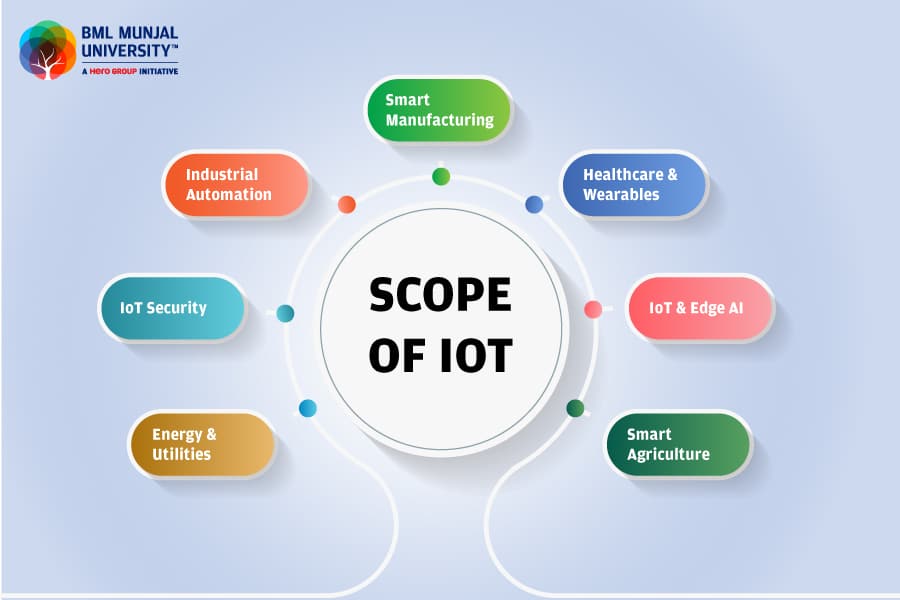
Scope of IoT in India: Careers, Skills and What Comes Next
Key Takeaways The scope of IoT is wide: about 21.1 billion connected devices in 2025, heading to 39 billion by 2030. The IoT future scope in I...
Top B.Tech. Mechanical Engineering Specialisations in India for Working Professionals
If you are working in manufacturing, automotive, energy or any mechanical domain and your career has hit a ceiling, the missing piece is usually your ...

10+ Best Engineering Colleges in India 2026: Top Government & Private Options with Rankings & Placements
Key Takeaways- Top government engineering colleges: IIT Madras, IIT Delhi, IIT Bombay, IIT Kanpur and IIT Kharagpur. Top private engineering c...

Top 10 Engineering Courses to Secure a High-Paying Job
Most students pick an engineering branch the way they pick a cricket team, i.e., based on loyalty, peer pressure or what someone's cousin is doing. Ve...

Top 10 Software Engineering Courses after 12th
Choosing the right software engineering course after 12th is the first and most important step toward a successful tech career. With software becoming...

JEE Main 2026 Latest Update: Check Session 1 Result, April Exam Dates, Syllabus, Pattern & More
If you are an engineering aspirant, preparing for JEE Main 2026 marks as a significant phase. As we know, the National Testing Agency has already clos...