
10+ Best Engineering Colleges in India 2026: Top Government & Private Options with Rankings & Placements


Admissions Enquiry
Summary: Discover the best engineering colleges in India in 2026, including top government and private institutions, rankings, fees, placements, entrance exams and cutoffs. Compare leading colleges, explore best private engineering colleges in India and identify the right engineering college based on your career goals.

Key Takeaways-
- Top government engineering colleges: IIT Madras, IIT Delhi, IIT Bombay, IIT Kanpur and IIT Kharagpur.
- Top private engineering colleges: BITS Pilani, VIT, SRM, Manipal, BML Munjal University and Thapar.
- Compare colleges on the basis of rankings, placements, fees, faculty and infrastructure.
- JEE Main and JEE Advanced are key admission routes.
- Cutoffs vary by college, branch, category and exam.
- Compare median/average CTC, not just highest packages.
- Government colleges generally have lower fees; private colleges may offer greater flexibility.
- For Mechanical Engineering, check labs, robotics, automation and industry exposure.
- BMU B.Tech. offers CSE, Electronics & Computer Engineering and Mechanical Engineering.
India has 8,876 engineering colleges. So, how do you decide which one is actually worth choosing?
With around 6,611 private and 2,265 government engineering institutions, plus 4,359 colleges offering B.Tech. programmes, students have no shortage of options.
The real challenge is separating a good college from the right college for you.
Rankings matter, but so do fees, placements, entrance requirements, industry exposure, infrastructure and the strength of your chosen engineering branch. Here’s a closer look at the best engineering colleges in India in 2026 and what you should consider before making your choice.
Best Engineering Colleges in India 2026- Ranking Snapshot
Looking for the best engineering colleges in India in 2026? Start with recognised rankings, but don't stop there. The following snapshot brings together leading government and private engineering institutions, giving you a quick view of their latest ranking or recognition before comparing factors such as fees, placements and career opportunities.
| S.No. | Engineering College | Category | Location | Ranking / Recognition |
| 1 | IIT Madras | Government | Chennai, Tamil Nadu | #1- NIRF Engineering 2025 |
| 2 | IIT Delhi | Government | New Delhi | #2- NIRF Engineering 2025 |
| 3 | IIT Bombay | Government | Mumbai, Maharashtra | #3- NIRF Engineering 2025 |
| 4 | IIT Kanpur | Government | Kanpur, Uttar Pradesh | #4- NIRF Engineering 2025 |
| 5 | IIT Kharagpur | Government | Kharagpur, West Bengal | #5- NIRF Engineering 2025 |
| 6 | BML Munjal University | Private | Gurugram, Haryana | #5 in India & #1 in Haryana — Education World 2025-26, Private Engineering & Technology Universities |
| 7 | BITS Pilani | Private | Pilani, Rajasthan | #1- IIRF Private University Engineering 2026 |
| 8 | SRM Institute of Science & Technology | Private | Chennai, Tamil Nadu | #2- IIRF Private University Engineering 2026 |
| 9 | VIT | Private | Vellore, Tamil Nadu | #3- IIRF Private University Engineering 2026 |
| 10 | Manipal Academy of Higher Education | Private | Manipal, Karnataka | #4- IIRF Private University Engineering 2026 |
| 11 | Thapar Institute of Engineering & Technology | Private | Patiala, Punjab | #5- IIRF Private University Engineering 2026 |
What Makes an Engineering College One of the Best?
The best engineering colleges in India combine strong placement outcomes, industry exposure, experienced faculty, credible accreditation and quality infrastructure. Rankings can help you create a shortlist, but students should also evaluate these factors to determine whether an engineering college is the right fit for their career goals.
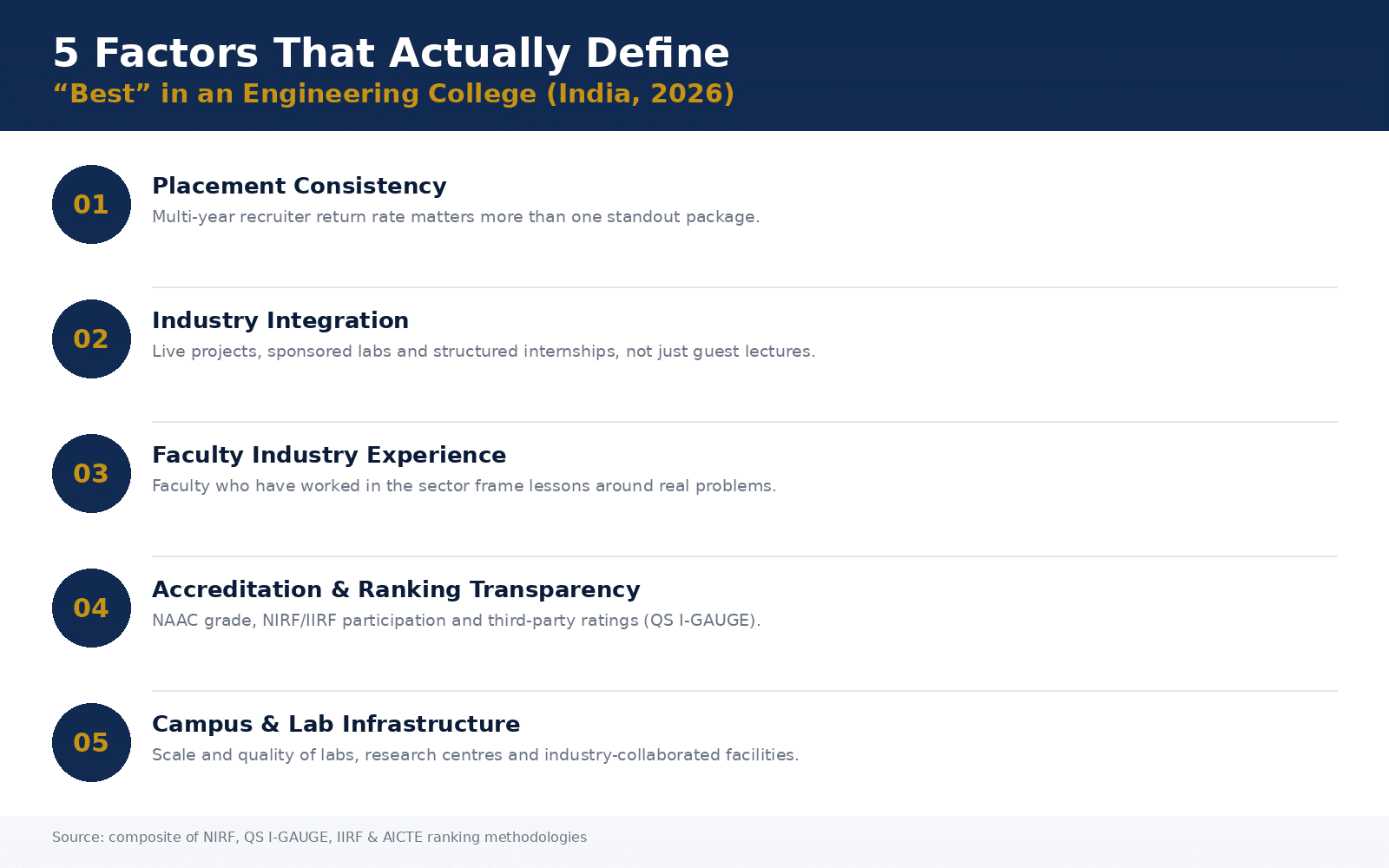
Here is the list of core factors that you should keep in mind when finding the best engineering college in India-
- Compare placement rates, median/average CTC, recruiters and year-on-year performance.
- Look for internships, live projects, practice-school programmes, industry labs and corporate collaborations.
- Consider faculty qualifications, research experience, industry exposure and expertise in emerging technologies.
- Check accreditation and verify the ranking body, year, category and methodology before comparing colleges.
- Evaluate labs, research centres, workshops and industry-linked facilities relevant to your chosen engineering branch.
How Indian Engineering Rankings Actually Work?
There is no single official ranking for the best engineering colleges in India. NIRF, IIRF, QS I-GAUGE and AICTE/IIC use different parameters to evaluate institutions, from academic and research performance to placements, industry integration and innovation.
Below are the frameworks that help you make a more informed decision-
| Framework | Run by | What it primarily measures |
| NIRF | Ministry of Education, Govt. of India | Teaching resources, research output, graduation outcomes, outreach & inclusivity, peer perception |
| IIRF | International Institutional Ranking Framework | Placement performance, pedagogy, research income, industry integration, future orientation |
| QS I-GAUGE | QS (in partnership with I-GAUGE, India) | Subject-level quality ratings (e.g., Engineering) on a Bronze-Platinum scale, assessed independently of overall university rank |
| AICTE / IIC | All India Council for Technical Education | Innovation ecosystem maturity - incubation, IP, entrepreneurship support (1–5 star rating) |
Which Engineering Colleges in India Have the Best Research Facilities?
Research infrastructure differs across engineering colleges, with some institutions focusing on broad multidisciplinary research and others developing specialised facilities for areas such as AI, advanced materials, robotics, semiconductor technology, manufacturing and sustainable engineering.
The table below highlights the range of research environments you can explore at leading government and private engineering institutions.
| Engineering College | Research Facilities / Infrastructure |
| IIT Madras | Advanced research centres, specialised laboratories and interdisciplinary research facilities |
| IIT Delhi | Central research facilities and specialised laboratories |
| IIT Bombay | Central research facilities and specialised departmental laboratories |
| BML Munjal University | Centre for Advanced Materials & Devices, Siemens Centre of Excellence in Automation, Robotics & Mechatronics, KUKA Robotics Laboratory, Shell Learning Centre and specialised automation, CNC and mechatronics facilities |
| BITS Pilani | Research centres, specialised laboratories and interdisciplinary facilities |
| VIT Vellore | Dedicated research centres and specialised laboratories across engineering disciplines |
| SRM Institute of Science & Technology | Research centres, advanced laboratories and specialised technology facilities |
| Manipal Institute of Technology | Departmental research laboratories and specialised research centres |
| Thapar Institute of Engineering & Technology | Advanced laboratories, research centres and specialised facilities |
| Shiv Nadar University | IoT & Wireless Lab, Cybersecurity Lab, AI & ML Lab, Nanomaterials Synthesis/Characterisation Labs and Environmental Engineering Lab |
What Entrance Exams Do I Need to Get into the Best Engineering Colleges in India?
The entrance exam required for admission to an engineering college depends on the institute, programme and admission route. JEE Main is one of the most widely accepted engineering entrance exams in India, while some state-level and private institutions have their own admission tests or accept other national-level examinations.
Common engineering admission routes include-
- JEE Main- Accepted by NITs, IIITs and several other government and private engineering institutions.
- JEE Advanced- Required for undergraduate admission to IITs, subject to the applicable eligibility criteria.
- State-level Entrance Exams- Exams such as MHT-CET and WBJEE are used for admission to participating engineering institutions in their respective states.
- University-specific Entrance Tests- Some private universities conduct their own entrance examinations alongside other accepted scores. For example, BML Munjal University conducts BMU-SAT for eligible B.Tech. applicants.
- Other National-level Examinations- Depending on the institution, exams such as SAT or CUET may also be accepted for engineering admissions.
Before applying, you should check the latest eligibility criteria, accepted entrance exams, cutoff requirements and admission process on the official website of your shortlisted engineering college.
What are the Typical Cutoff Ranks for the Best Engineering Colleges in India?
There is no single cutoff rank for the best engineering colleges in India. Cutoffs vary by college, engineering branch, entrance exam, category, domicile and counselling round. As a general benchmark, the most competitive IIT programmes can require JEE Advanced ranks within the top few hundred, while CSE at leading NITs can typically require JEE Main ranks in the low thousands to tens of thousands.
Private engineering colleges follow different admission patterns. Some accept JEE Main scores, while others use their own entrance examinations such as VITEEE or accept multiple admission routes. Therefore, their cutoff ranks should not be directly compared with IIT or NIT JEE ranks.
| College Type / Programme | Entrance Exam | Indicative Cutoff / Admission Benchmark |
| Top IITs- CSE | JEE Advanced | Under 500 rank |
| Top IITs- Electrical Engineering | JEE Advanced | Around 500-1,500 rank |
| Top IITs- Mechanical Engineering | JEE Advanced | Around 1,500-4,000 rank |
| Leading NITs- CSE | JEE Main | Around 3,000-20,000 rank |
| Other NITs- CSE & allied branches | JEE Main | Around 10,000-30,000+ rank |
| BITS Pilani- B.E. programmes | BITSAT | Programme-specific BITSAT cutoff |
| VIT Vellore- CSE | VITEEE | Around 600-6,000+ rank, depending on fee category |
| SRM Institute of Science & Technology- CSE | SRMJEEE | Programme and campus-specific cutoff |
| Thapar Institute- CSE | JEE Main | Programme and category-specific cutoff |
| BML Munjal University- B.Tech. | JEE Main / SAT / CUET / BMU-SAT | JEE Main: 55 percentile minimum; other routes have separate criteria |
What Are the Placement Outcomes at the Best Engineering Colleges in India?
Placement outcomes vary by college, branch and graduating batch. When comparing the best engineering colleges in India, look beyond the highest package and check placement rate, median/average CTC, recruiters and branch-wise outcomes.
Here is the curated list of the best engineering colleges in India placement-wise:
| Engineering College | Category | Key Placement Outcome |
| IIT Madras | Government | Average CTC: ₹21.48 LPA |
| IIT Delhi | Government | Average CTC: ₹25.82 LPA |
| IIT Bombay | Government | Average CTC: ₹23.50 LPA |
| IIT Kanpur | Government | Median CTC: ₹21.70 LPA |
| NIT Trichy | Government | Median CTC: ₹14 LPA |
| BITS Pilani | Private | Median CTC: ₹20 LPA |
| VIT Vellore | Private | Median CTC: ₹8.99 LPA |
| BML Munjal University | Private | Average CTC: ₹19.38 LPA |
*Placement metrics and reporting years may differ by institution. Check the latest official placement report before comparing colleges.
What Are the Fees for the Best Engineering Colleges in India?
B.Tech. fees vary significantly between government and private engineering colleges. Government institutes generally have lower tuition costs, while private universities can have higher fees depending on the programme and facilities.
| College Type | Indicative B.Tech. Fee |
| Government engineering colleges | ₹6-13 lakh |
| Private engineering colleges | ₹5-30 lakh+ |
Fees can also include hostel, examination, laboratory and other institutional charges, so compare the total cost of the degree rather than tuition alone.
Engineering College Admission Process in India 2026
The engineering college admission process in India typically includes checking eligibility, appearing for an accepted entrance exam, applying to colleges, meeting cutoffs, participating in counselling or university-level selection, completing document verification and paying the admission fee. The exact process varies by college, programme and admission route.
Below are the general steps you can follow for engineering college admission in 2026-
Step 1: Check Eligibility
Check the college's Class 12 subject and minimum marks requirements for your preferred B.Tech. programme.
Step 2: Appear for the Required Entrance Exam
Depending on the college, admission may be based on JEE Main, JEE Advanced, state-level exams, CUET or a university-specific entrance test.
Step 3: Apply to Colleges
Submit the college application form along with the required documents and application fee.
Step 4: Check Cutoffs
Compare your entrance exam rank or score with the college and branch-wise cutoff for your preferred B.Tech. programme.
Step 5: Participate in Counselling or Selection
Government colleges generally follow centralised or state counselling, while private universities may conduct their own admission and selection process.
Step 6: Complete Document Verification
Submit and verify the required academic, identity and eligibility documents.
Step 7: Pay the Admission Fee
Pay the required fee within the given deadline to confirm your B.Tech. seat and complete the admission process.
Government vs Private Engineering Colleges- Which Is Better
Neither is universally better. Government colleges may offer lower fees and established academic ecosystems, while private universities can provide curriculum flexibility, newer specialisations and industry-focused learning.
| Factor | Government | Private |
| Fees | Generally lower | Generally higher |
| Admission | JEE/state-level exams | JEE, state or university-specific exams |
| Curriculum | Established | Often more flexible |
| Industry exposure | Varies by institute | Often a key focus |
| Specialisations | Strong core branches | Core + emerging areas |
| Infrastructure | Varies | Can be a key differentiator |
The best choice depends on your branch, budget, admission score, placement goals and preferred learning environment.
Choosing a Private Engineering College? See What BML Munjal University Brings
BML Munjal University (BMU) is a private university in Gurugram offering four-year B.Tech. programmes designed around experiential learning, industry exposure and emerging technologies. Its School of Engineering & Technology currently offers B.Tech. in Computer Science & Engineering, Electronics & Computer Engineering and Mechanical Engineering, with specialisations including AI & Data Science, Robotics & Automation, Cyber Security, VLSI Design, Internet of Things and Automobile Engineering.
Why Consider BML Munjal University for Engineering?
- Industry-focused Learning: BMU's B.Tech. curriculum combines classroom learning with real-world projects, internships and research-driven innovation.
- Hands-on Engineering: The university provides specialised facilities including robotics, CNC, mechatronics, automation, electrical, pneumatics and hydraulics laboratories.
- Industry Immersion: BMU's Practice School model introduces students to practical and industry-oriented learning through projects and internships during the programme.
- Placement Outcomes: BMU reports a ₹59.35 LPA highest CTC, ₹19.38 LPA top-10% average CTC and ₹14.09 LPA top-25% average CTC.
- Multiple Admission Routes: Eligible B.Tech. applicants can apply through JEE, SAT, CUET or BMU-SAT.
Build your engineering career with industry exposure, hands-on learning and future-ready specialisations at BML Munjal University. Apply now!
Conclusion
Choosing among the best engineering colleges in India is about more than rankings. Compare placements, fees, entrance requirements, industry exposure, infrastructure and your preferred engineering branch before making a decision.
Whether you choose a leading government institute or one of the best private engineering colleges in India, focus on the college that aligns with your career goals, budget and learning preferences. For students considering private engineering education, BML Munjal University offers B.Tech. programmes with industry exposure, hands-on learning and future-ready specialisations.
FAQs
Admission requirements vary by college and programme. JEE Main is accepted by NITs, IIITs and several other engineering colleges, while JEE Advanced is required for IIT admissions. State-level exams such as MHT-CET and WBJEE and university-specific tests such as BMU-SAT are also used for engineering admissions.
Placement outcomes vary by institution, engineering branch and graduating batch. Students should compare placement rates, median or average CTC, highest packages, recruiters and branch-wise outcomes rather than relying only on the highest salary offered. Internship opportunities and industry exposure are also important indicators of career readiness.
B.Tech. fees vary significantly between government and private institutions. Government engineering colleges generally have lower tuition fees, while private engineering colleges can cost more depending on the programme and facilities. Students should also factor in hostel, examination, laboratory and other institutional charges when calculating the total cost.
The best private engineering colleges in India can vary depending on the ranking framework used. BITS Pilani, VIT, SRM Institute of Science & Technology, Manipal Academy of Higher Education and Thapar Institute of Engineering & Technology feature among leading private institutions in current rankings. Students should also compare fees, placements, infrastructure and specialisations.
When comparing the best mechanical engineering colleges in India, consider curriculum quality, faculty expertise, laboratories, industry exposure, internships and placement outcomes. Facilities for areas such as CAD/CAM, robotics, automation, manufacturing, mechatronics and automotive engineering can also indicate the practical strength of a Mechanical Engineering programme.
The best engineering institutes for undergraduate study include leading IITs, NITs and prominent private universities. However, the right choice depends on your preferred branch, entrance score, budget, placement goals and career interests. Compare rankings, fees, curriculum, infrastructure, industry exposure and placements before selecting a B.Tech. college.
Leading IITs, NITs and private universities such as BITS Pilani, VIT, Manipal and BMU offer strong placement opportunities. Compare average/median CTC, placement rates, recruiters and branch-wise outcomes.
Many top engineering colleges offer international exposure through student exchanges, global collaborations, international internships and overseas projects. Check the college’s partnerships and international opportunities before applying.
Consider rankings, fees, placements, faculty, curriculum, infrastructure, industry exposure, internships, research opportunities and your preferred engineering branch before choosing a college.
IIT Madras is ranked No. 1 in the NIRF Engineering 2025 rankings. However, students should also consider placements, fees, faculty, infrastructure and programme-specific strengths.
Government engineering colleges generally have lower fees than private institutions. Compare tuition, hostel and other charges to understand the total cost of a B.Tech. degree.
Neither is universally better. Government colleges may offer lower fees, while leading private universities can provide flexible curricula, modern infrastructure and strong industry exposure.
Related Blogs

Scope of IoT in India: Careers, Skills and What Comes Next
Key Takeaways The scope of IoT is wide: about 21.1 billion connected devices in 2025, heading to 39 billion by 2030. The IoT future scope in I...

Top B.Tech. Mechanical Engineering Specialisations in India for Working Professionals
If you are working in manufacturing, automotive, energy or any mechanical domain and your career has hit a ceiling, the missing piece is usually your ...
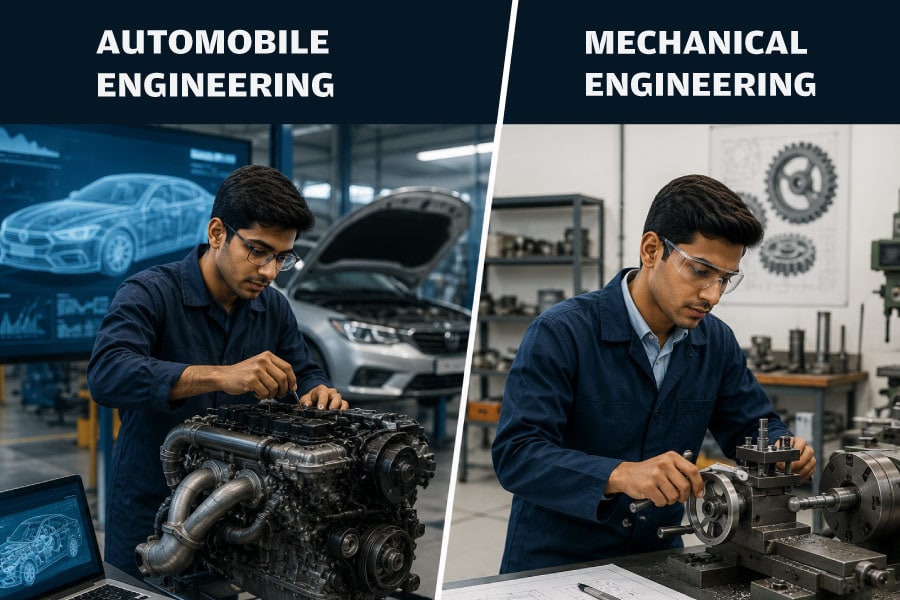
Automobile Engineering vs Mechanical Engineering – Which One Should You Choose After 12th?
The 12th class results are barely a memory and there's already a form to fill, a stream to lock in and a deadline closing in. For a lot of science stu...

Top 10 Engineering Courses to Secure a High-Paying Job
Most students pick an engineering branch the way they pick a cricket team, i.e., based on loyalty, peer pressure or what someone's cousin is doing. Ve...

Top 10 Software Engineering Courses after 12th
Choosing the right software engineering course after 12th is the first and most important step toward a successful tech career. With software becoming...

JEE Main 2026 Latest Update: Check Session 1 Result, April Exam Dates, Syllabus, Pattern & More
If you are an engineering aspirant, preparing for JEE Main 2026 marks as a significant phase. As we know, the National Testing Agency has already clos...