
How to Become a Judge in India: Eligibility, Salary, & the New 3-Year Practice Rule


Summary: To become a judge in India, complete a 3-year or 5-year LLB from a BCI-recognised university, enrol as an advocate with a State Bar Council and complete a minimum of three years of legal practice – mandatory since the Supreme Court’s May 2025 ruling. Clear the State Judicial Services Exam (Prelims, Mains, Interview) to be appointed as a Civil Judge (Junior Division), the entry point into India’s judiciary.
A judge's black robe is one of the most respected sights in an Indian courtroom and one of the most misunderstood career paths in law. Every year, lakhs of LLB graduates ask the same question- how do you actually get there?
The honest answer changed in a fundamental way in May 2025, when the Supreme Court revived a rule that had been dropped back in 2002- a mandatory three years of courtroom practice before a law graduate can even sit for the judicial services exam. That single ruling has reshaped preparation timelines for an entire generation of judiciary aspirants and the rule itself is still being actively reviewed by the Court through 2026.
This guide provides you with insights into how the Indian judiciary actually works. You will know about the eligibility rules, exam stages, new practice requirements, judges’ salaries and a realistic timeline from law school to the bench.
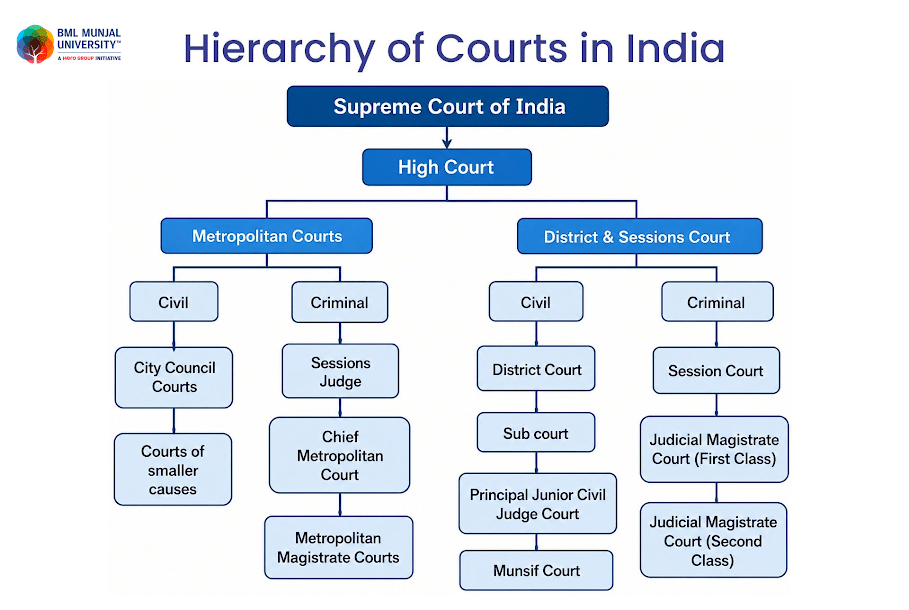
Understanding the Structure of the Indian Judiciary
Before mapping out how to become a judge, you should know where judges actually sit. The Indian judiciary is organised into three tiers and almost every aspiring judge enters at the bottom and works upward, either through promotion or through a separate competitive exam at each stage.
| Level | Court(s) | Who Appoints | Typical Entry Route |
| Apex | Supreme Court of India | President of India, on the recommendation of the Collegium | Elevation from High Courts or the Bar (Article 124) |
| State | High Courts (25 across India) | President of India, in consultation with the CJI and Governor | Elevation from District Judiciary or the Bar (Article 217) |
| District / Subordinate | District Courts, Sessions Courts, Civil & Magistrate Courts | State Governor, on High Court recommendation | Judicial Services Exam (PCS-J) or promotion |
Most LLB graduates asking how to become a judge in India are referring to the Civil Judge (Junior Division) role, which is the entry-level position in the subordinate judiciary. Candidates are selected through the State Judicial Services Examination conducted by the respective High Courts or State Public Service Commissions.
Eligibility Criteria to Become a Judge in India
Eligibility for judicial service is set independently by each state's High Court or Public Service Commission, so exact numbers vary. That said, the core criteria are consistent nationwide.
Core Requirements
- Citizenship- You must be a citizen of India.
- Education- A Bachelor of Laws (LLB), either the 3-year course after graduation or the 5-year integrated course after Class 12 from a university recognised by the Bar Council of India. An LLM degree is optional.
- Bar Enrolment- Registration as an advocate with a State Bar Council, along with the All India Bar Examination (AIBE) certificate of practice.
- Legal Practice- A minimum of three years as a practising advocate, mandatory since May 2025 for entry-level posts.
- Age Limit- Generally 21-35 years for entry-level posts, with relaxation for reserved categories; this varies by state.
- Language- Working knowledge of the state's official/regional language, required in several states for both the Mains exam and courtroom functioning.
| Criteria | Lower Judiciary (Civil Judge Jr. Division/Judicial Magistrate) | Higher Judiciary (District Judge, High Court Judge, Supreme Court Judge) |
| Education | 3-year or 5-year LLB, BCI-recognised | LLB + enrolment as advocate |
| Legal Practice | Minimum 3 years (mandatory since May 2025) | Minimum 7 years of active practice |
| Age Limit | 21–35 years (state-specific, relaxation for reserved categories) | 35–45 years (state-specific) |
| Constitutional Basis | State Judicial Service Rules | Article 233 of the Constitution |
| Selection Mode | Judicial Services Exam (Prelims, Mains, Interview) | Higher Judicial Services Exam or promotion by seniority-cum-merit |
The 2025 Supreme Court Ruling on the 3-Year Practice Rule
This is the single most important update for anyone researching how to become a judge in India after LLB and it is the part most guides on this topic have not kept pace with.
The key details
- The three-year period is counted from the date of provisional enrolment with the Bar Council, not from the date of clearing the AIBE.
- Experience as a law clerk to a judge counts toward the three years.
- Candidates need a certificate from an advocate of at least 10 years' standing, countersigned by the Principal District Judge (or an equivalent officer for High Court practitioners).
- Selected candidates must undergo one year of mandatory judicial training before taking charge.
- The rule applies prospectively- it does not affect recruitment processes that were already underway when the judgment was delivered.
What This Means If You're Planning Your Career Right Now
Plan on needing three years of practice after your LLB before you can sit for the judicial exam- this is the standing rule. Do not defer your practice plans on the assumption the rule will be struck down; the Court has signalled the core requirement is likely to remain even as it fine-tunes exemptions. Always check your target state's latest official notification before applying, since implementation details are still being clarified.
How to Become a Judge in India After LLB?
Below is the step-by-step process for how you can become a judge in India after completing your LLB-
Step 1- Complete your LLB. Choose the 3-year course after a bachelor's degree or the 5-year integrated course after Class 12, from a BCI-recognised university.
Step 2- Enrol with your State Bar Council and clear the All India Bar Examination (AIBE) to receive your Certificate of Practice.
Step 3- Complete a minimum of three years of active legal practice- litigation, law clerkship with a judge or legal aid work all count, per the 2025 ruling.
Step 4- Obtain your practice certificate, endorsed by a senior advocate (10+ years' standing) and the Principal District Judge.
Step 5- Track notifications for your target state's Judicial Services Exam (commonly called PCS-J). Basically, these are issued periodically, not on a fixed annual calendar in every state.
Step 6- Clear the Preliminary Examination, which is known as an objective-type screening test.
Step 7- Clear the Main Examination- a descriptive, written paper covering substantive and procedural law.
Step 8- Clear the Interview / Viva Voce- the final assessment of temperament, communication and judicial aptitude.
Step 9- Complete one year of mandatory judicial training at your state's Judicial Academy.
Step 10- Take charge as a Civil Judge (Junior Division) or Judicial Magistrate. This becomes your starting point of a judicial career.
Judicial Services Examination- Pattern and Syllabus
Every state conducts its own Judicial Services Exam (often called PCS-J), but nearly all of them follow the same three-stage structure pattern.
| Stage | Type | What It Tests |
| Preliminary Exam | Objective (MCQ) | General legal knowledge, current affairs, reasoning- used purely for screening |
| Main Examination | Descriptive, written | In-depth knowledge of substantive and procedural law, legal drafting, language proficiency |
| Interview / Viva Voce | Personal interview | Judicial temperament, communication, ethics and overall suitability for the bench |
Core Subjects Across Most Judicial Exams
- Constitutional Law
- Indian Penal Code (IPC)- now the Bharatiya Nyaya Sanhita (BNS)
- Code of Criminal Procedure (CrPC)- now the Bharatiya Nagarik Suraksha Sanhita (BNSS)
- Code of Civil Procedure (CPC)
- Indian Evidence Act- now the Bharatiya Sakshya Adhiniyam (BSA)
- Contract Act, Transfer of Property Act and Limitation Act
- Personal laws (Hindu and Muslim law)
- The state's local/regional language and laws
State-Wise Judicial Service Exams
Recruitment is state-specific, so aspirants typically target one or two states based on language comfort as well as vacancy trends. Below is the list of some popular ones-
| State | Exam Commonly Known As | Conducted By |
| Uttar Pradesh | UPPCS-J / UPHJS | Uttar Pradesh Public Service Commission |
| Bihar | BJS (Bihar Judicial Service) | Bihar Public Service Commission |
| Madhya Pradesh | MPCJ / MPJS | Madhya Pradesh Public Service Commission |
| Rajasthan | RJS (Rajasthan Judicial Service) | Rajasthan High Court |
| Delhi | DJS (Delhi Judicial Service) | Delhi High Court |
| Haryana | HJS (Haryana Judicial Service) | Punjab & Haryana High Court |
| Maharashtra | MCJ (Maharashtra Civil Judge) | Maharashtra Public Service Commission |
| Karnataka | KJS (Karnataka Judicial Service) | Karnataka High Court / KPSC |
How to Become a High Court Judge
There is no direct entrance exam for the High Court. Under Article 217 of the Constitution, candidates are selected from two pools-
- District Judges who have held judicial office for at least 10 years or
- Advocates who have practised in a High Court (or two or more such courts in succession) for at least 10 years
Recommendations are made by the Collegium, a panel of senior judges led by the Chief Justice of India. Also, the appointments are formally made by the President of India in consultation with the CJI and the Governor of the concerned state.
How to Become a Supreme Court Judge
Appointment to the Supreme Court, under Article 124 of the Constitution, similarly has no direct exam. Eligible candidates are-
- A High Court judge with at least 5 years of service or
- An advocate with at least 10 years of practice in a High Court (in practice, appointees typically have significantly more experience) or
- In the President's opinion, a distinguished jurist
As with High Court appointments, the Collegium recommends names and the President makes the final appointment.
What is the Monthly Salary of a Judge in India?
Judicial pay is fixed through periodic Judicial Pay Commission recommendations and varies slightly by state. Here is the salary breakdown of judges by their position-
| Judicial Position | Approximate Monthly Pay Scale (₹) |
| Civil Judge (Junior Division) / entry-level Magistrate | ₹28,000 - ₹2,00,000 |
| Civil Judge (Senior Division) | ₹1,75,000 |
| District Judge (entry) | ₹2,00,000 |
| District Judge (Selection Grade) | ₹1,63,030 - ₹2,19,090 |
| High Court Judge | ₹99,167 - ₹1,09,167 |
| Supreme Court Judge | ₹2,50,000 |
Note- Judicial officers also receive House Rent Allowance, Dearness Allowance, official accommodation or housing allowance, medical benefits and a pension after retirement.
Career Progression- From Civil Judge to Chief Justice of India
A judicial career is a climb, not a single appointment. Below is the breakdown of a career progression of judges in India-
| Stage | Position | Typical Route Up |
| 1 (Entry) | Civil Judge (Junior Division) / Judicial Magistrate | Judicial Services Exam |
| 2 | Civil Judge (Senior Division) | Seniority-cum-merit promotion |
| 3 | Additional District Judge | Promotion or Higher Judicial Services Exam |
| 4 | District Judge / Sessions Judge | Promotion or direct HJS recruitment (7+ yrs practice) |
| 5 | High Court Judge | Collegium recommendation (Article 217) |
| 6 (Apex) | Supreme Court Judge / Chief Justice of India | Collegium recommendation (Article 124) |
How to Start Preparing for Judicial Services?
To clear judicial services exams, follow the preparation tips below to succeed.
- Master the Bare Acts, including the CPC, BNSS, BNS, Bharatiya Sakshya Adhiniyam (BSA) and the Constitution. These form the foundation for your judiciary exams.
- Stay updated on recent Supreme Court and High Court judgments, as current legal developments are frequently tested.
- Prepare for the regional language paper early if it is part of your state's Judicial Services Examination.
- Practise previous years' question papers under timed conditions to improve speed, accuracy and exam readiness.
Make the most of your three years of legal practice by gaining courtroom experience, improving legal drafting and interacting with clients. These skills are valuable for both the written exam and the interview.
Building a Foundation for the Judiciary- LLB at BML Munjal University
A judicial career starts long before the courtroom- it starts with how rigorously your law degree trains you to think, argue and hold up under scrutiny. The 3-Year LLB programme at BML Munjal University is built around that idea, combining a Bar Council of India and UGC-recognised curriculum with hands-on courtroom exposure most law schools only offer on paper.
What sets the programme apart-
- A simulated on-campus courtroom for practising litigation and advocacy skills before students ever step into a real one.
- Case-based learning, moot courts and student-run legal aid clinics that build the same analytical and drafting skills judicial exams test for.
- Mentorship and guest sessions with practising judges and in-house counsels, alongside a 1:7 faculty-to-student ratio.
- Elective courses in emerging areas- AI and Law, Data Privacy Law, EU Competition Law and Sports Law.
- Graduates of BMU's law programmes have gone on to firms including JSA Advocates & Solicitors, Cyril Amarchand Mangaldas, AZB & Partners, etc.
If your goal is to build a career in the judiciary, choosing the right law school is the first step. Explore BML Munjal University's 3-Year LLB programme to gain a strong legal foundation, practical courtroom experience as well as the skills needed for the Judicial Services Examination.
Conclusion
In India, becoming a judge requires the right qualifications, practical legal experience and consistent preparation. After completing an LLB course, aspiring judges must now fulfil the mandatory three years of legal practice, clear the State Judicial Services Examination and complete judicial training before joining the subordinate judiciary.
Whether you are exploring how to become a judge in India after LLB, understanding the latest eligibility rules and preparing strategically can help you build a successful judicial career.
FAQs
Not anymore for entry-level posts. Since the Supreme Court’s May 2025 ruling, a minimum of three years of legal practice is mandatory before you can sit for the Civil Judge (Junior Division) exam.
For entry-level judicial posts, the minimum age is typically 21 years, with an upper limit of around 35 years (varying by state, with relaxations for reserved categories). There is no fixed minimum age for High Court or Supreme Court judges under the Constitution; eligibility is instead based on years of experience.
For entry-level posts, you need to clear your state’s Judicial Services Examination (commonly called PCS-J), conducted in three stages- Preliminary, Main and Interview.
Entry-level Civil Judges earn roughly ₹28,000-2,00,000 per month under current pay scales, rising through the ranks to approximately ₹1,00,000 for High Court judges and ₹2,50,000 for Supreme Court judges, plus allowances and post-retirement pension.
It will take roughly 9-11 years. 5 years for an integrated LLB (or 3 years after a separate bachelor’s degree), followed by the mandatory 3 years of legal practice, plus the time needed to clear the judicial exam and complete 1 year of training.
Related Blogs
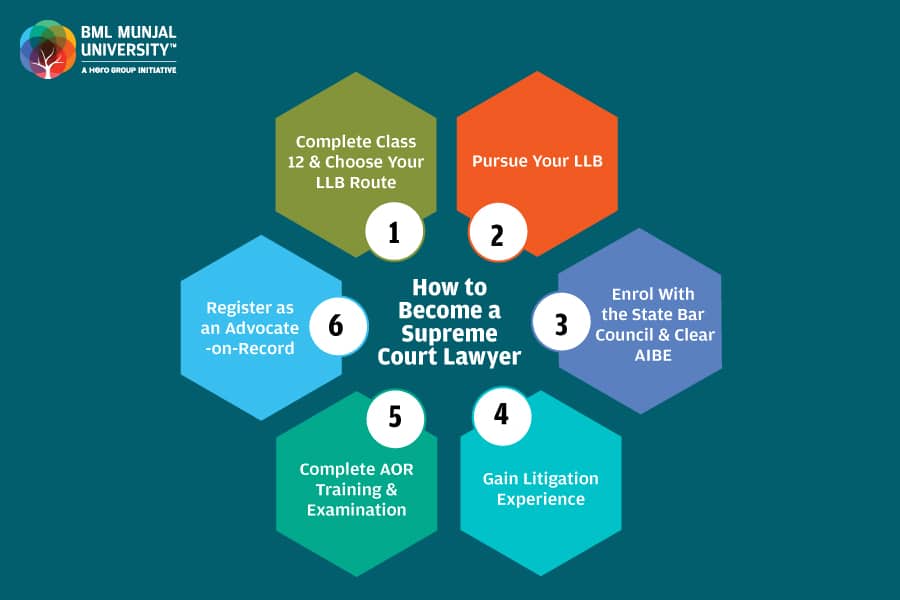
The Road to India’s Highest Court: How to Become a Supreme Court Lawyer
Key Takeaways A recognised LL.B. is the first step toward a career in Supreme Court litigation. After graduation, State Bar Council enrolment ...

What is Legal Drafting? Types, Skills & Why It’s a Core Skill for Every Law Student in India
A few years ago, a Maine dairy company agreed to pay $5 million to settle a lawsuit that turned on a single missing comma in one sentence of a state l...

Types of Lawyers in India- 20 Law Specialisations, Salaries and Career Scope (2026 Guide)
Today, the law field extends far beyond traditional courtroom practice. Many professionals work with companies, startups, government bodies and intern...

How to Become a Corporate Lawyer in India: Step-by-Step Guide (2026)
Key Takeaways Complete a 5-year integrated BA LLB/BBA LLB after Class 12 or a 3-year LLB after graduation to become a corporate lawyer. Clear ...

LLB vs BA LLB: Which Law Degree Should You Choose?
Why do thousands of students search "LLB vs BA LLB" every admission cycle? The answer lies not just in understanding the difference, but in figuring o...

Top Career Options After Law in India: Best Jobs & Career Paths After LLB
[In Summary: Explore career options after law in India, including traditional, corporate, government and future-ready roles, salary insights, top recr...