

Law Courses After 12th: BA LLB vs BBA LLB, CLAT Cutoffs & Admission Guide 2026


Admissions Enquiry
In Summary: Law courses after 12th include BA LLB (Hons), BBA LLB (Hons), B.Com LLB, B.Sc. LLB and other integrated programmes. BA LLB is suitable for careers in litigation, judiciary and public policy, while BBA LLB is ideal for corporate law and compliance roles. This guide compares law courses, CLAT 2026 admission options, eligibility criteria, career opportunities and law school selection factors to help you choose the right legal education pathway.

CLAT 2026 registered 92,344 students, which is a 17% jump from the year before and it's also the highest application count in the exam’s 17-year history. Around 72,631 candidates appeared for the UG law seats.
Let’s keep it simple- one of the most competitive admission races in India.
Also, India’s legal services market was valued at USD 2.64 billion in 2026 and is projected to reach 3.52 billion by 2031, at a CAGR of 5.92%. This alone tells you that the law is no longer a niche or backup choice.
But getting the course choice right matters as much as clearing the exam. When you start discovering the top law courses after 12th, you have a number of options which might confuse you. But no worry, this guide lays out the full picture for you so that you can make an informed choice for your career.
CLAT 2026 Rank- What Are Your Realistic Options?
CLAT 2026 saw 72,631 UG candidates appear. NLUs have roughly 4,000 UG seats across all 25 participating universities. That ratio, about 18 applicants per NLU seat, explains why even a rank of 2,000 closes out several top-tier options.
Below is the table you can use as a planning framework. Cutoffs shift each year based on paper difficulty, category composition and domicile quotas.
| CLAT 2026 Rank (General) | Realistic NLU Options | Strong Private University Options |
| 1 - 350 | Top 3- NLSIU Bangalore, NALSAR Hyderabad, NUJS Kolkata | Full choice across all private universities |
| 351- 1,500 | NLU Jodhpur, GNLU Gandhinagar, NLU Bhopal, HNLU Raipur | BML Munjal University, Jindal, Symbiosis, NMIMS |
| 1,501- 4,000 | Mid-tier NLUs; domicile category may help | BML Munjal University, Symbiosis, NMIMS, UPES, Amity |
| 4,001 - 9,000 | Newer NLUs in rounds 3-5 of counselling | BML Munjal University, UPES, Bennett, Christ Bangalore |
| 9,001+ | State NLUs via domicile; limited general-category seats | BML Munjal University and BCI-approved private universities |
Top 3 Law Courses After 12th You Can Pursue
Choosing a law programme is a five-year (or more) commitment. The table below compares the three most common law programmes for students who have just cleared 12th.
| Parameter | BA LLB (Hons) | BBA LLB (Hons) | 3-Year LLB |
| Duration | 5 years (after 12th) | 5 years (after 12th) | 3 years (after graduation) |
| Eligibility | 10+2, any stream; min 45% (varies) | 10+2, any stream; min 45% (varies) | Graduation in any discipline; min 45-50% |
| Entrance Exam | CLAT / AILET / LSAT India / BMU-SAT | CLAT / AILET / LSAT India / BMU-SAT | CLAT / state-level / direct (varies by university) |
| Core Subjects | Political Science, History, Sociology, Economics + Law | Business Admin, Finance, Management + Law | Core law subjects; no dual-degree component |
| Degrees Awarded | Two degrees- BA + LLB | Two degrees- BBA + LLB | Single degree- LLB |
| Best-fit Career | Litigation, Civil Services (UPSC), Policy, Human Rights, Judiciary | Corporate Law, M&A, Finance Law, In-house Counsel, Legal Consulting | Litigation, Govt Legal Services; ideal for career-changers |
| Fee Range (India) | ₹2.5L-₹7L total (govt NLU);
₹8L-₹20L+ (private) |
₹3L-₹9L total (govt); ₹10L-₹22L+ (private) | ₹50K-₹3L/yr (govt); ₹1.5L-₹5L/yr (private) |
Decision Framework- Which Should You Pick?
- Pick BA LLB if your interests are in public law, constitutional matters, civil services, human rights or litigation.
- Pick BBA LLB if you see yourself in a corporate law firm, as in-house legal counsel at a company or at the intersection of business and law.
- Pick a 3-Year LLB if you already hold a degree and want to pivot into law or if you want to finish a non-law undergraduate course before committing.
Types of Integrated Law Courses After 12th- Full Overview
The 5-year integrated LLB is the standard route for students who decide on law directly after Class 12. Beyond BA LLB and BBA LLB, several other combinations exist- though most are offered by only a handful of universities in India.
| Programme | Duration | Typical Fee (Total) | Best For |
| BA LLB (Hons) | 5 years | ₹2.5L - ₹20L | Litigation, Judiciary, Civil Services, Policy |
| BBA LLB (Hons) | 5 years | ₹3L - ₹22L | Corporate Law, M&A, Finance Law, In-house Counsel |
| B.Com LLB (Hons) | 5 years | ₹2.5L - ₹8L | Taxation, Commercial Litigation, Accounting Law |
| B.Sc. LLB | 5 years | ₹3L - ₹8L | Forensic Law, Environmental Law, IP / Biotech Law |
| B.Tech. LLB | 6 years | ₹4L - ₹10L | Cyber Law, Patent Law, Tech Law, IT Regulation |
| B.Arch. LLB | 6 years | ₹4.5L - ₹12L | Construction Law, Real Estate, Environmental Compliance |
Law After 12th by Stream- Arts, Commerce and Science
Law Courses After 12th Arts
Arts stream students are the natural fit for BA LLB, given the overlap between political science, history, sociology, economics and core law subjects. Civil services aspirants especially benefit from the BA LLB route because the humanities foundation also prepares them for UPSC.
Law Courses After 12th Commerce
Commerce students are well-positioned for BBA LLB and B.Com LLB, both of which build directly on the economics, business studies and accounting background from Class 12. Corporate law and taxation law are natural specialisation paths.
Law Courses After 12th Science
Science stream students often assume law is not for them, but it is. BA LLB and BBA LLB are open to all streams. Beyond these, niche programmes like B.Sc. LLB (environmental/forensic law) and B.Tech. LLB (cyber law, patent law) specifically leverages the science background.
Eligibility Criteria for Law Courses After 12th
| Programme | Stream Required | Min Marks (General) | Entrance Exam |
| BA LLB (Hons) | Any stream | 45-50% in 10+2 | CLAT / AILET / LSAT India / BMU-SAT |
| BBA LLB (Hons) | Any stream | 45-50% in 10+2 | CLAT / AILET / LSAT India / BMU-SAT |
| B.Com LLB (Hons) | Commerce preferred (any at many unis) | 45-50% in 10+2 | CLAT / LSAT India / state law entrance |
| B.Sc. LLB | Science required | 45-50% in 10+2 (science subjects) | CLAT / university entrance |
| B.Tech. LLB | Science / Engineering | 50-55% in 10+2 | Combined engineering + law entrance (varies by university) |
| 3 Year LLB | Any (post-graduation) | 45-50% in graduation | CLAT / state-level / direct at some universities |
What Can I Do After a Law Degree?
A law degree opens more doors than most students anticipate. The careers below range from traditional practice to corporate, government and emerging roles.
After BA LLB (Hons)
- Litigation and Advocacy- District courts, High Courts, Supreme Court practice as an advocate
- Judiciary- Civil Judge / Judicial Magistrate (state PCS-J exams); High Court and Supreme Court judges (through elevation)
- Civil Services- UPSC IAS/IPS/IFS with Law as optional; many toppers come from law backgrounds
- Public Prosecutor / Government Advocate- Representing the state in criminal and civil matters
- Legal Aid and Human Rights- Work with NGOs, Legal Services Authorities and international organisations
- Legal Academia- Teaching and research at law schools
After BBA LLB (Hons)
- Corporate Law Firm Associate- M&A, private equity, banking and finance, capital markets practice
- In-House Legal Counsel- Legal department at companies across sectors- FMCG, tech, manufacturing, banking
- Company Secretary / Compliance Officer- Cross-qualified role combining law and governance
- Investment Banking / PE (Legal Track)- Due diligence, transaction structuring, regulatory compliance
- Legal Consulting- Big-4 firms (Deloitte, KPMG, EY, PwC) run legal and tax consulting practices
- Entrepreneurship- Build a legal-tech startup, alternative dispute resolution firm or compliance platform
After LLB (3-Year)
- All the same career paths as above - the route is different, the destination is the same
- Particularly suited for domain experts (engineers, doctors, CAs) adding legal expertise to an existing career
Choosing Your Law School Matters- Explore BML Munjal University's Programmes
Choosing the right law school is about more than securing admission- it is about finding a programme that combines academic rigour with practical legal training. At BML Munjal University, BA LLB (Hons), BBA LLB (Hons) and 3-year LLB courses are offered, accredited by the Bar Council of India to train students to be holistic legal professionals.
Programme Highlights
- 45% experiential learning component, among the highest in Indian legal education
- Bar Council of India (BCI) approved School of Law- graduates are eligible to enrol with any State Bar Council
- Structured internships at leading law firms, non-profit legal organisations and government agencies via practice school model
- Students work on real cases under the supervision of practising lawyers and faculty
- Dedicated moot court facility in which regular intra- and inter-university moot court competitions are held
- Centre on Law, Regulation and Technology (CLRT) focused on emerging areas including cyber law, data privacy and tech regulation
- Access to the Hero Group network, creating opportunities for industry interaction and professional growth
- Explore emerging legal domains such as AI & Law, Data Privacy, Sports Law and Mergers & Acquisitions through specialised electives.
BMU Law Programmes at a Glance
| Programme | Duration | Tuition Fee
(Total, approx.) |
Entrance Accepted |
| BA LLB (Hons) | 5 years | ₹3,90,000 per year | CLAT / LSAT India / BMU-SAT |
| BBA LLB (Hons) | 5 years | ₹3,90,000 per year | CLAT / LSAT India / BMU-SAT |
| LLB (3-Year) | 3 years | ₹2,50,000 per year | Graduation + CLAT / BMU-SAT |
Note- Scholarships of up to 100% tuition fee waiver are available based on CLAT/LSAT scores, academic merit, financial need and sports achievement. Check the BMU Scholarships page for current slabs.
Conclusion
Selecting the right law course after 12th depends on your career goals, interests as well as preferred learning pathway. Whether you opt for BA LLB (Hons), BBA LLB (Hons) or pursue law after graduation through a 3-year LLB, the key is to select a programme that aligns with your long-term aspirations.
As legal careers continue to expand across litigation, corporate law, public policy, compliance and emerging technology-driven fields, a strong legal education can open diverse professional opportunities. So it’s important to take time to compare courses, understand admission requirements and evaluate institutions carefully before making your decision.
FAQs
The best law course after 12th depends on your career goals. BA LLB (Hons) is suitable for students interested in litigation, judiciary, civil services and public policy, while BBA LLB (Hons) is ideal for those aiming for corporate law, compliance, mergers and acquisitions or in-house legal roles. Students who decide on law after graduation can pursue a 3-year LLB.
Yes. CLAT is mandatory for NLU admission, but private universities accept LSAT India or their own entrance tests. Some state universities accept state-level law entrance exams.
The most common entrance exams for law courses after 12th are CLAT, AILET, LSAT India and university-specific entrance tests. Admission requirements vary by institution, so students should check the latest eligibility and entrance criteria of their preferred law schools.
Yes. BA LLB and BBA LLB are open to students from all streams. A Physics or Biology background is not a disqualifier; some of the strongest law students come from science backgrounds.
A Class 12 student starts preparing at least 6-12 months before CLAT. They should focus on legal reasoning, logical reasoning, English language, current affairs and quantitative techniques. Regular mock tests, newspaper reading, time management practice and analysis of previous years’ papers can significantly improve performance. Starting preparation at least 6-12 months before the exam is generally recommended.
Related Blogs

How to Become a Criminal Lawyer After 12th: A Step-by-Step Guide for 2026
Key Takeaways Choose a 5-year BA LLB or BBA LLB after Class 12. Gain experience through internships, moot courts and legal-aid work. Learn ...
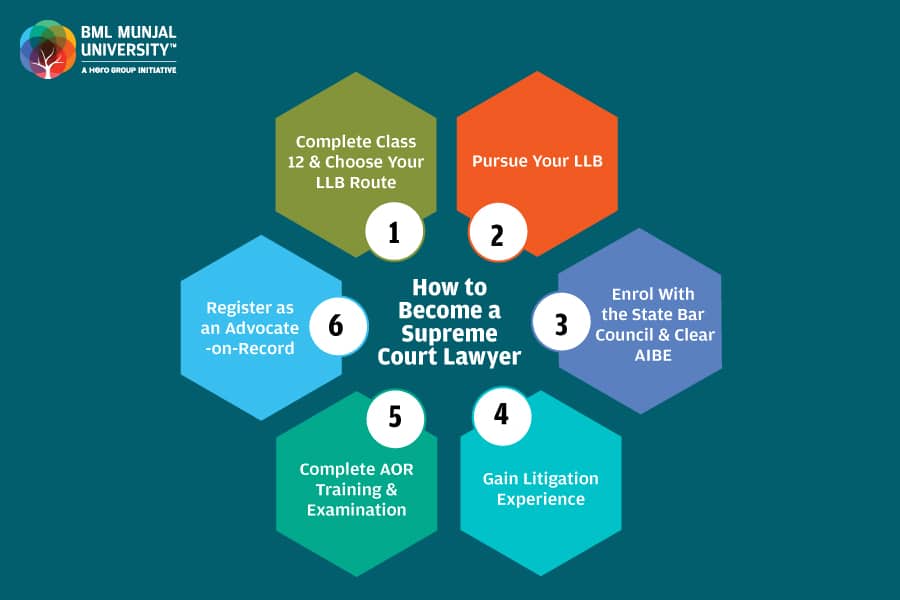
The Road to India’s Highest Court: How to Become a Supreme Court Lawyer
Key Takeaways A recognised LL.B. is the first step toward a career in Supreme Court litigation. After graduation, State Bar Council enrolment ...

How to Become a Judge in India: Eligibility, Salary, & the New 3-Year Practice Rule
A judge's black robe is one of the most respected sights in an Indian courtroom and one of the most misunderstood career paths in law. Every year, lak...

What is Legal Drafting? Types, Skills & Why It’s a Core Skill for Every Law Student in India
A few years ago, a Maine dairy company agreed to pay $5 million to settle a lawsuit that turned on a single missing comma in one sentence of a state l...

Types of Lawyers in India- 20 Law Specialisations, Salaries and Career Scope (2026 Guide)
Today, the law field extends far beyond traditional courtroom practice. Many professionals work with companies, startups, government bodies and intern...

How to Become a Corporate Lawyer in India: Step-by-Step Guide (2026)
Key Takeaways Complete a 5-year integrated BA LLB/BBA LLB after Class 12 or a 3-year LLB after graduation to become a corporate lawyer. Clear ...